(Part 3) One Freezing Night, She Dug a Room Beneath Her Cabin—It Saved Her Family Through a -40°F Blizzard
(Part 3) One Freezing Night, She Dug a Room Beneath Her Cabin—It Saved Her Family Through a -40°F Blizzard
.
.
Bram Talins arrived later with the thermometer from his store. He checked the lower room. He examined the tin cup. Then he asked for Corbin’s notebook. Page after page showed the same pattern: less than half the firewood, no frozen cup, a dry northern wall, steady temperatures. Bram closed the notebook without argument, as if the proof had finally become too heavy to deny. Enoch arrived last. He inspected the clearance around the stone peers.
He found the charcoal marks beside the old floor crack and traced them with a careful glance. He checked the insulation gap behind the sandstone. He followed the intake pipe outside and studied the hatch frame inside. Finally, he pressed his bare hand against the northern wall. Dry.
Enoch looked at his palm before removing his hat. “You left how much space behind these stones?” he asked. Dell answered without hesitation, “Just under two inches.” And she added what she believed was the smallest difference that mattered: “And the elbow on the intake it slows the wind before it reaches the room.”
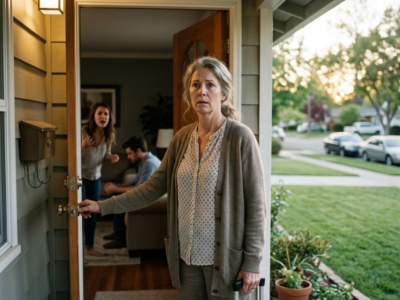
Enoch gave a slow nod. He asked nothing else. At the doorway, Harland Creed stood with Tomas beside him. He never interrupted. He never criticized. He only stood there as a man standing at the edge of a truth too late to fight.
When he left, he placed a bundle of dry firewood against the porch. No apology followed. None was needed. Dell poured half of Agnes’s broth back into the kettle and handed it to her neighbor. “Take this home,” she said. “Your children need it more than mine.” Agnes lowered her eyes before accepting it, the gesture of someone humbled by survival that wasn’t bought with miracles, but with work.
Weeks later, after the blizzard sounded different in the valley’s memory—no longer present, but carved into the mind—Rookpine Hollow changed. Not because the wind changed, but because the people did. Enoch never copied Dell’s room exactly. He copied its principles instead. Agnes’s cabin stood on shallow footings, so he designed a half-buried shelter against the northern wall with a drainage trench and sloped timber roof. Behind Bram’s store, a small underground room protected flour, beans, and lamp oil from freezing.
In return for seeing how Dell had arranged the intake and exhaust, Bram quietly erased part of her debt. Another family connected a low sleeping space to an old root cellar. Harlon rebuilt the ground around his chimney and moved his firewood into a sheltered corner where drifting snow couldn’t bury it again. He never called Dell’s room foolish another time.
One Sunday, Reverend Alden Pike stood before the congregation and did not call Dell’s survival a miracle. He said a prayer could never replace closing a gap that people had already found, measured, and understood. By the end of winter, shovels rang beneath and beside seven different cabins. People began calling them low rooms.
No two looked alike, but each depended on different soil, water, and foundations. Each followed the same lessons: stay out of the wind; let the earth change temperature slowly; keep stone dry; move fresh air gently; measure first, believe afterward.
And when the next winter rolled around, Corbin would stand outside the cabin, listen, and hear the echo of shovels across the valley from every direction. Then he would open Everett’s old firewood notebook one last time. He would look at the first page—at the early marks made when their wood pile was already failing and Dell’s hands were still learning how to trust certainty—and he would quietly close it.
Years passed, but the room beneath Dell’s cabin remained. It was never hidden again. The blanket chest still rested above the hatch, just as it always had. But everyone in the family knew what waited below. Not a cellar, not a secret, a place where the house had learned how to live with winter instead of arguing against it.
Corbin grew into a surveyor for wagon roads pushing farther west. Before marking sites for a way station or a small cabin, he studied the wind first, then drainage, then the temperature of the ground beneath his boots. Only after that did he reach for stakes. Milo became known for repairing stoves and chimneys throughout the valley.
Whenever a family complained their cabin wouldn’t stay warm, he never told them to burn more wood. He knelt beside the floorboards first. He searched for hidden drafts, empty spaces beneath cabins, and the path air was taking before touching the stove. Years later, Milo hung his father’s wooden whistle beside the hatch. He still never blew it. But now the silence surrounding it no longer meant loss. It meant safety. It meant home. Dell never called the room an invention. Neither did Enoch.
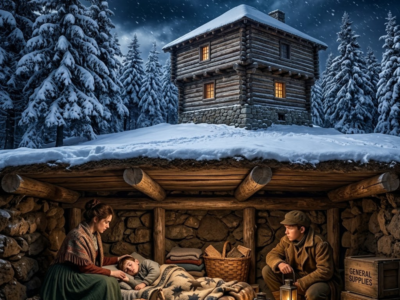
People had dug earth shelters, root cellars, and covered sleeping pits long before anyone settled Rookpine Hollow. Dell had simply remembered an old truth on the one freezing night her family could no longer afford another wrong answer. During the minus forty blizzard, they hadn’t created summer beneath the ground. They lived between forty-three and forty-eight degrees. They ate cold cornbread. They slept beneath a low ceiling. They burned far less firewood than their neighbors. That was never comfort. It was the narrow distance between exhaustion and survival.
And when the wind returned, as it always does, the family didn’t argue with it anymore. They didn’t pretend the storm was a villain to defeat or a lesson to learn only once. They had measured it. They had respected it.
They had made room for the wind to pass somewhere else, somewhere that didn’t steal their children’s heat. In that sense, the most shocking part of their story wasn’t that Dell’s family survived minus forty. It was that survival changed the valley’s hands, its minds, its architecture, its pride—and in the end, it turned a cabin into a lesson everyone could live inside.