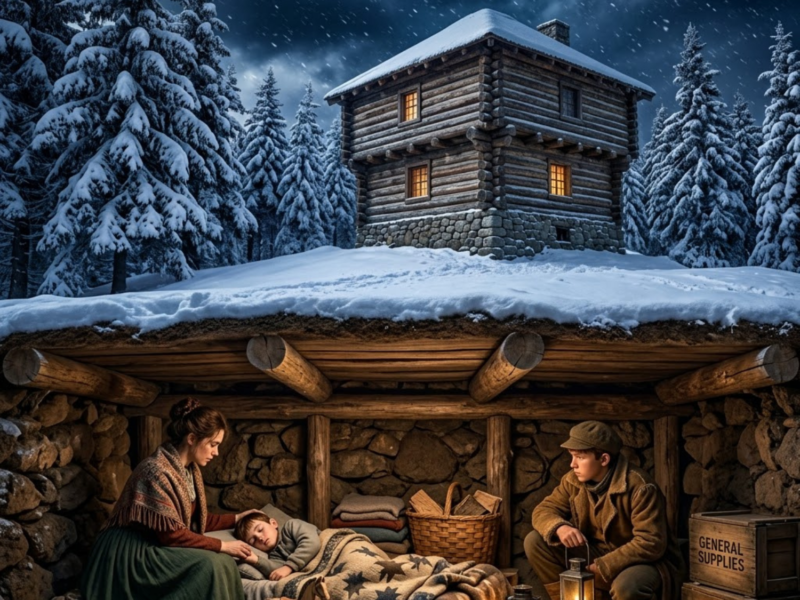
(Part 2) One Freezing Night, She Dug a Room Beneath Her Cabin—It Saved Her Family Through a -40°F Blizzard
(Part 2) One Freezing Night, She Dug a Room Beneath Her Cabin—It Saved Her Family Through a -40°F Blizzard
.
.
Then a hard west wind arrived before the worst of winter. Dell climbed into the lower room to make another inspection and stopped beside the intake pipe. The wool strand by the intake no longer leaned inward. It pointed the wrong way. Cold air rushed through the pipe, skimmed across the floor, and made the lower candle dance violently. Milo tucked both hands inside his sleeves without a word, watching like a patient animal sensing the shift before it pounces.
Corbin looked toward the hatch. Dell slid the intake shutter partly closed but refused to seal it completely. “Stale air could become as dangerous as cold air,” she said. She pulled on her coat and crawled outside into the wind. Enoch had been right. Wind changes direction. The room had been tuned for one storm, not all of them.
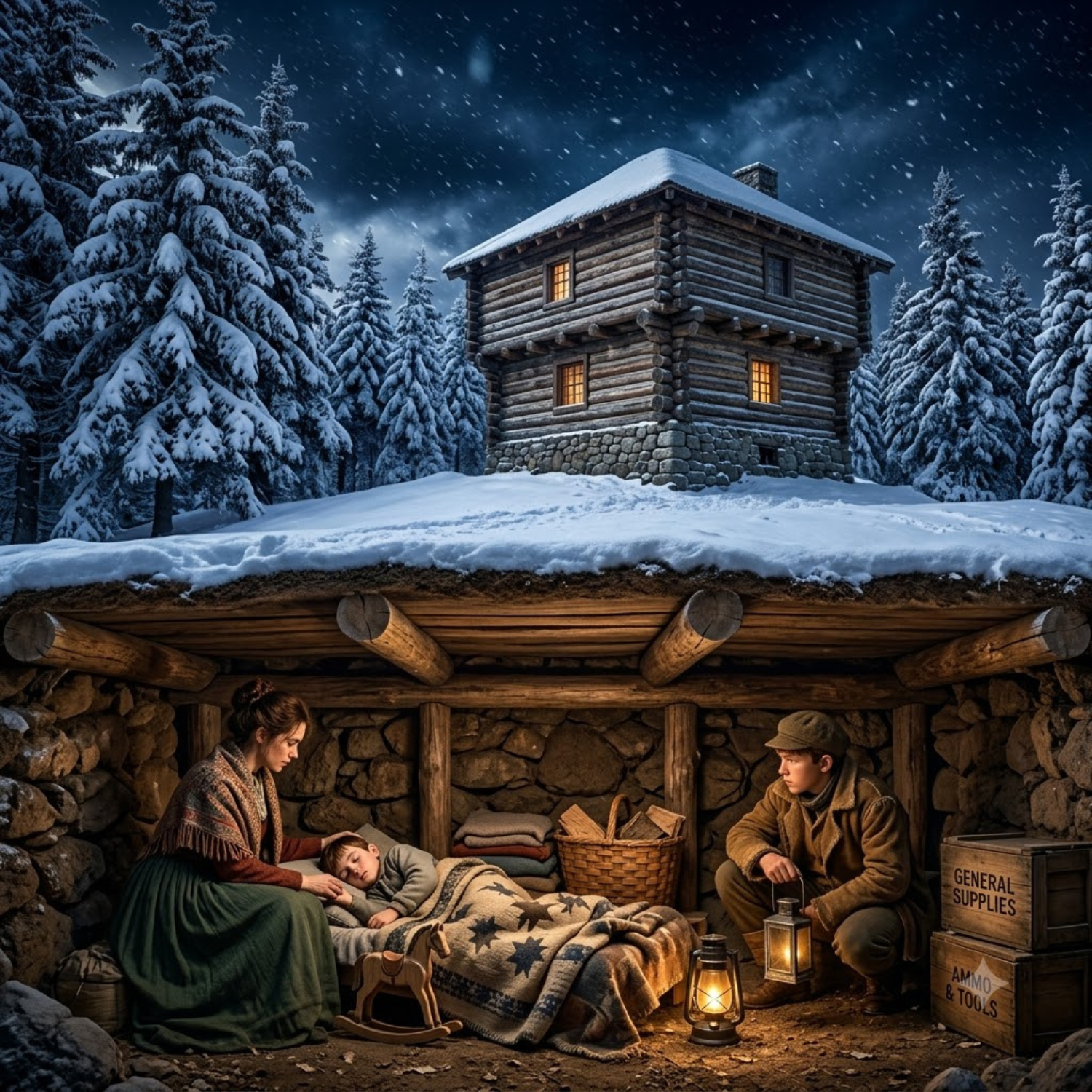
She gathered flat sandstone and woven willow branches. She built a low windbreak a short distance from the intake, leaving a sheltered pocket behind it. Then she added a short L-shaped elbow to the pipe so incoming air had to change direction before entering the room. Corbin held the lantern while she adjusted the stones a few inches at a time. They tested again. At first, the wool strand hung still. Dell shifted the windbreak farther west. The strand leaned inward, only slightly. That was enough. Fresh air entered slowly instead of pouring across the floor as a freezing draft.
Milo retrieved his father’s wooden whistle from the sleeping platform. His hands had stayed hidden inside his sleeves until now. He turned the whistle over once, then slipped it into his pocket. He still never blew it. Enoch returned the next morning. He watched the wool strand for nearly a minute before speaking. “It works today.” Then he looked toward Corbin, and his words became a new task. “Start writing down the wind.” Corbin frowned. “A room that works with a south wind may fail in a west wind.” Enoch nodded. “The weather changes before people do.”
Corbin opened the notebook and added a page. Dell watched as if the act of writing could keep danger from slipping between lines. By the last week of December, Dell trusted the room enough to spend another night below. Upstairs, a small fire burned, keeping the chimney warm and preventing ice from forming inside the flu.
Near midnight, one log collapsed into glowing coals. Dell opened the stove door to feed another stick of wood. A thin ribbon of smoke drifted across the cabin. At almost the same moment, pressure between warm cabin and cooler room below changed. Corbin smelled the smoke first. Dell opened the hatch immediately and hurried both boys upstairs. No one struggled to breathe, but the blankets below carried the unmistakable smell of wood smoke. The room had kept warmth but failed another test: the hatch sealed against cold air, but it did not seal against changing pressure.
Dell removed the hatch frame and added a stepped wooden overlap, packed the edges with clay mixed with ash, and pressed a strip of tightly felted sheep’s wool around the opening to form a gasket. She also changed how she tended the stove. Instead of letting the fire burn low before adding fresh wood, she kept a steady bed of glowing coals throughout the night. When the repairs were finished, Corbin carried a candle around every edge of the hatch. The flame never leaned toward a crack. From that night forward, a small candle always burned beside the hatch whenever the family slept below. If the flame bent strangely or went out, everyone climbed upstairs immediately.
During the first week of January, Dell’s proving ground began. There was no blizzard yet—only temperatures that still dropped below zero, cold enough to test without risking the boys’ lives. Corbin devoted pages of the notebook not to stories but to measurements. Each morning he recorded how many firewood sticks burned during the night. He checked the thin sheet of ice inside the tin cup. He marked where frost reached across the cabin floorboards. He compared warmth above with warmth below. He ran his fingers across the northern sandstone wall to ensure it stayed dry. Finally, he counted how many times Milo coughed before falling asleep.
Three nights. Three pages. The pattern stayed constant. The cabin above remained coldest along the floor. The room below stayed between forty-five and forty-eight degrees. The tin cup never froze. The northern wall stayed dry. Milo coughed only a few times before sleeping through the rest of the night. Upstairs, Dell could sleep too, not long, not deeply, but enough to keep fear from eating her alive.
At Bram Talins’s store, Corbin mentioned they used less firewood. Bram smiled politely. “A twelve-year-old can count wrong,” Bram said. Corbin returned home, quietly opened the notebook, and showed him the pages. One mark after another. Every number matched the next. Bram stopped talking. Later, Enoch studied the same pages and only then offered his own caution. “Three cold nights aren’t the same as one hard blizzard.” For the first time, he asked Dell a question instead of giving one. “How much higher is your exhaust than your intake?” he asked. Dell answered without looking up from her work. Enoch nodded thoughtfully.
Far beyond the rooftops of Rookpine Hollow, leaded clouds settled across the northwestern peaks. Dell closed the notebook. “Three nights don’t make a winter,” she told Corbin. Outside, the wind shifted as if testing the room’s tuning. Then the storm arrived on January 14th. Snow drifted down gently that morning, like the world was trying to pretend it hadn’t come to kill. By afternoon, the northwest wind drove it sideways across Rookpine Hollow. Before sunset, every trail disappeared. The second day brought eighteen below. The third brought stronger wind and more snow until fences vanished, barns groaned under ice, and wood piles froze into buried blocks beneath hard white drifts. On the fourth night, Bram’s thermometer fell to thirty-two below. The valley began to fail one cabin at a time.
The roof tore loose on one woodshed. Agnes Weller’s storehouse door froze shut. Snow blocked part of Harland Creed’s chimney until smoke backed into his cabin. One family burned broken chairs because dry firewood lay trapped beneath frozen drifts that wouldn’t melt even when the stove glowed bright.
Dell changed nothing. She cooked upstairs during the daylight when the danger felt manageable, and every evening the family moved below. On the sixth day, the wind struck directly toward the intake. The wool strand still leaned inward. The stone windbreak and elbow pipe held. The northern wall stayed dry. Then Corbin noticed something else. The warning candle burned shorter than usual. Dell looked up. Snow had begun choking the upper exhaust.
Corbin grabbed a rope while Dell tied it around her waist. “Hold tight,” she said. She disappeared into the storm. The rope sagged with her first steps through drifts and then snapped tight as the wind caught her body like a hand. Corbin wrapped the line around his forearm and leaned backward with all his weight. Milo cried “Mama!” as his voice tried to become bigger than fear. Dell crawled through waist-deep snow, found the buried vent, and drove the shovel handle through packed drift until the opening cleared. When she returned, the candle stood taller almost immediately. That night, the outside air reached minus forty.
The cabin floor far from the stove nearly froze solid. The room below remained close to forty-four degrees. The storm found every weakness it could reach, and this time it couldn’t find one that survived their repairs. Dampness was gone. Reverse draft was gone. The leaking hatch was gone. Nature tested each correction the way a smith tests hammered metal. And each time, it failed to break them.
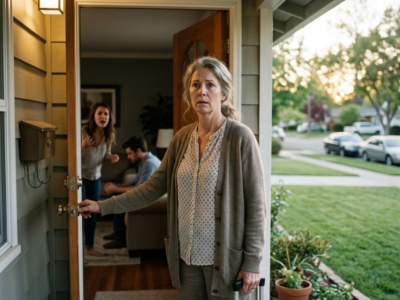
In the dead of that night—when the air itself seemed sharpened into a blade—there came a knock at the door. Not loudly. Just three weak blows. Dell opened it and found Harland Creed standing in blowing snow. Frost covered his beard and shoulders. In his arms was seven-year-old Tomas. The boy shook so violently his boots rattled against his father’s leg. His lips had lost their color. He could barely stay upright. Smoke had been backing into Harland’s cabin for hours, a slow poison that promised to take them without needing to freeze them. Harland Creed didn’t defend himself. He didn’t repeat a single word he’d once used against Dell. He asked only one question, voice wrecked and small. “Is there room?”
Dell looked toward the hatch. The room below had been built for three people. Four would crowd. Five would mean more moisture, less fresh air, and fewer margins for mistakes. Corbin stared at the newcomers as if the storm itself had just changed the rules. Dell’s mind ran ahead—air passages, exhaust clearance, hatch sealing, candle behavior. She looked at Milo, sitting quietly on the warmest platform against the eastern wall. Milo didn’t cry. He didn’t plead. He just shifted a blanket edge with careful hands, making space in a way only someone who had been cold long enough could understand. Dell nodded once. “Tomas comes down,” she said.
Harland started to follow. Dell stopped him. “You stay up here,” she said quickly. “Keep the stove burning low. Watch the chimney. If snow covers the exhaust, clear it. If the warning candle changes, call me.” Harland answered immediately as if he’d been waiting his whole life to be told what to do without insulting someone. Then he climbed back into his cabin while the wind swallowed his figure.
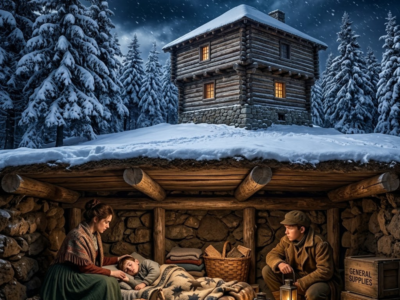
Below, Corbin slid the storage box against the wall to create another sleeping space. Without anyone asking, Milo pulled his own blanket away from the warm corner and spread it across to them. The room felt different at once—warmer, yes, but also damp with extra breath. Dell opened the upper exhaust another notch and watched the wool strand beside the intake. It still leaned gently inward. She watched the warning candle. The flame remained steady. The room was breathing.
Nearly an hour passed before Tomas stopped shivering. His breathing slowed. His hands relaxed beneath Milo’s blanket. Just before dawn, he finally fell asleep. Harland climbed down to check on his son. The ceiling forced him to bow his head. He removed his hat without thinking. His hand rested against the northern sandstone wall. Dry. He didn’t speak. He left as quietly as someone leaving a sacred place, the kind where a person’s pride is forced to kneel.
After he went, Milo shifted in his sleep. The blanket no longer covered his own shoulders. Dell reached to pull it back. Half asleep, Milo caught the blanket’s edge before she could and tugged it over Tomas once more. Then he rolled quietly toward the wall. The blizzard refused to leave. It stayed another three days. Twice each day, Dell climbed into the cabin above to stir cornmeal porridge, tend the stove, and knock snow from the roof before the weight became dangerous.
Late on the eighth day, the room delivered another threat. While Dell was upstairs cooking, the bitter cold swelled and tightened the hatch frame until the wood locked shut. She realized too late she couldn’t open the hatch from her side. Panic surged through her, not loud, not dramatic—just fast and sharp like a needle. She grabbed Everett’s old framing chisel and carefully worked the blade beneath the edge from above. Scraping wood echoed down into the chamber, a sound Corbin could not interpret as anything but rescue or failure. He lit the lantern and sat beside the hatch, gripping the spare chisel across his knees. He didn’t wake Milo. He didn’t wake Tomas. He only gripped the tool and waited for Dell’s cold hands to find a way through the frozen seal.
Dell’s hands trembled from cold. Corbin couldn’t see her, but he heard wood give, the slow shift of trapped timber under pressure. When the hatch finally lifted, Dell climbed down with eyes bright and dangerous with fatigue. Without a word, Corbin handed her the larger piece of cornbread he had saved. She understood why he’d been waiting. He had counted hunger the way he had counted firewood, measured survival not by comfort but by what the body needed when the world was trying to steal it.
That night, Milo never coughed. Silence fell into the room like snow. The sound didn’t alarm Corbin. It alarmed Dell. The silence woke her. For one terrible heartbeat she thought it meant loss. She leaned close and placed her hand beneath Milo’s nose. Warm breath touched her fingers, slow and steady, as if the boy had decided the cough was a story he no longer needed. Outside, wind still struck the cabin with strength enough to tear hair from a person’s skull. Inside, the room settled near forty-three degrees and held there. The wool strand beside the intake barely moved. The warning candle burned steadily as if it had never been threatened.
The storm finally ran out of questions. Nature never announced a winner. It simply stopped testing them. The wind left as quietly as it had arrived. One cabin at a time, Rookpine Hollow dug itself back out of the snow. Agnes Weller was among the first to reach Dell’s door. She carried a kettle of broth, expecting to find an exhausted family barely holding together, the kind of ending grief loves to write. Instead, Milo sat cross-legged on the eastern sleeping platform, patiently tying a fresh cord onto Everett’s wooden whistle as if his fingers were learning to do gentle things again. Corbin stood outside counting the remaining firewood. Agnes looked from the wood pile to her own cracked hands, and the memory of her own storehouse door freezing shut made her throat tighten. Her family had burned almost everything they owned. They had even pulled two rails from the pasture fence for fuel.
Continue with Part 3 at the link below 👇