(Part 2) They Abandoned My Father-in-Law at the Hospital… Then He Whispered, “Drive to My Lawyer.”
(Part 2) They Abandoned My Father-in-Law at the Hospital… Then He Whispered, “Drive to My Lawyer.”
.
.
Part 2 — The Envelope That Couldn’t Stay Closed
The envelope felt heavier in my jacket than it should have.
I kept it close, like the sealed paper carried heat from the field, heat from Harold’s porch, heat from the truth I wasn’t allowed to touch yet.
That night, we sat on the back porch until the crickets sounded like they were repeating the same comforting note over and over.
Harold’s hand occasionally tightened on his cane as if reminding himself he still existed. He didn’t speak much after the envelope appeared. The silence between us wasn’t empty—it was full of the kind of choices that only show up after the damage is already done.
When I finally helped him back into the house and stood to leave, Harold called my name once more.
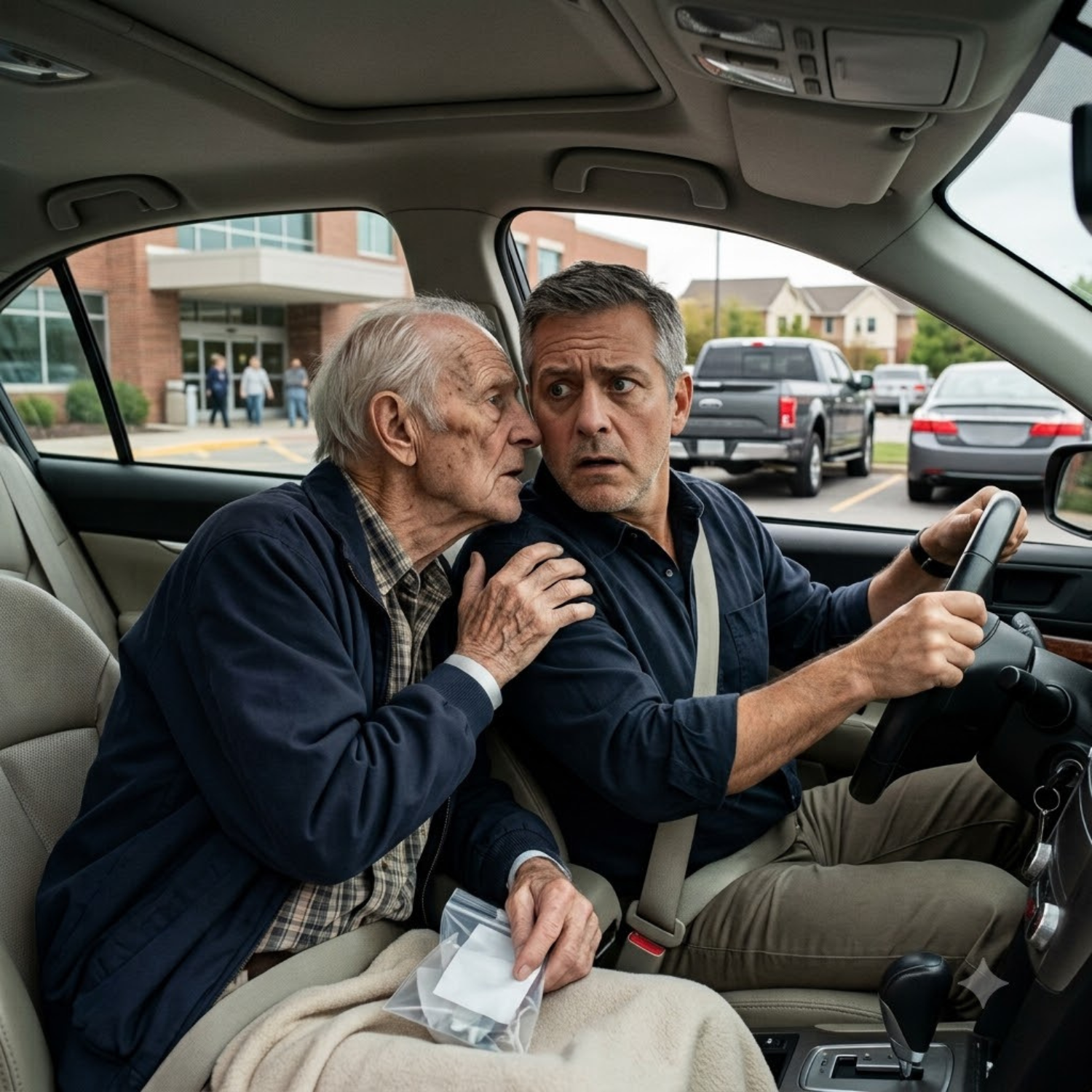
“Michael,” he said, and his voice was barely audible, like the sound had to fight to cross the distance between us.
“Uh, thank you for showing up.”
I wanted to argue—wanted to say I didn’t deserve thanks, that I hadn’t done anything brave.
But he had already seen me better than I’d seen myself. So I only nodded.
When I drove back to the motel, I realized something I hadn’t wanted to admit.
This wasn’t only about land.
Not only about money.
It had become a promise—the kind Harold built out of fear, guilt, and love so complicated it could only survive by hiding.
And keeping it might cost me everything.
Three weeks after that night, Harold Bennett died on a cold December morning.
No dramatic miracle. No last-minute speech. Just a quiet passing before sunrise with a Bible resting on his nightstand and an old photograph of his late wife beside the bed.
A hospice nurse told me he passed peacefully.
I stood at the funeral wearing the same dark suit I’d worn to my daughter’s wedding years earlier.
The suit fit tighter now. Funny how grief and age change a man—how they steal dignity while pretending they only offer wisdom.
The church was full.
Neighbors. Farmers. People Harold had helped over the years without ever talking about it. If you listened long enough, you could hear the real Harold Bennett in their stories—not the man Rick and Dennis described, not the villain the rumors invented.
Rick and Dennis stood together near the front.
They greeted people with practice smiles.
“Dad left quite a responsibility,” they told strangers, like they were reading from talking points.
They talked about the farm.
They talked about the future.
They made Harold’s death sound like a meeting agenda.
And the absence of their grief wasn’t just sad—it was suspicious. It felt too controlled, like mourning had been scheduled.
I stayed toward the back because it seemed easier for everyone.
Then Linda approached me near the beginning of the service.
“You’re still staying at the motel,” she said.
“I am,” I answered.
“I never wanted it to come to this,” she whispered, eyes red.
“Neither did I,” I admitted.
She hesitated as if trying to decide whether honesty would help or poison.
“I don’t know how to fix it.”
I wanted to tell her the truth: that I’d been trying to fix it the whole time—by keeping my promise, by trusting Harold, by believing law and love could still align.
But instead I said, “I don’t either.”
The pastor began speaking.
And I felt my life become something I had to defend, not live.
Rick filed a petition in probate court three weeks later.
He claimed Harold lacked mental capacity after his stroke and accused Susan Miller of allowing undue influence by me.
Undue influence.
That phrase became the center of everything.
According to Rick’s attorney, I had manipulated an elderly man into changing legal documents for my own benefit.
The irony almost made me laugh if laughter didn’t feel like betrayal.
I hadn’t asked Harold for a single thing.
I’d driven him. I’d kept my mouth shut. I’d carried an envelope without opening it.
But the courtroom didn’t care about my intentions.
It cared about stories—and Rick’s story was polished enough to smell like truth.
The hearing happened in the Fairfield County Courthouse on a gray morning in January. Snow covered the sidewalks outside. Inside, people filled nearly every bench.
In a small town, courtrooms weren’t places of justice.
They were places of entertainment disguised as procedure.
Susan leaned toward me before proceedings began.
“Remember,” she murmured. “I’m listening. Don’t argue. I won’t answer only what’s asked.”
I nodded.
I understood.
Then the bailiff called the room to order.
The judge entered.
Everything grew quiet in the way only a judge’s presence can command. People stopped fidgeting. Attorneys stopped shifting in their chairs like predators adjusting their posture.
Rick’s attorney spoke first.
He painted a simple story—simple enough to be believable if you didn’t know Harold personally.
“An elderly man suffered a stroke. His son-in-law isolated him. A new trust appeared. The family lost control of property that had belonged to them for generations.”
Then he pointed.
“Mr. Carter benefited enormously.”
The courtroom held its breath.
It wasn’t even true, but saying it confidently made it sound like a fact.
When Susan Miller stood, she didn’t rush.
She carried one thin folder to the podium—almost insultingly small compared to the size of the accusations.
“Your honor,” she said calmly, “the evidence tells a very different story.”
She called Harold’s neurologist first.
The doctor explained Harold’s stroke affected movement, not judgment. He reviewed cognitive evaluations performed the day before Harold signed the trust.
Harold answered questions correctly. No dementia. No confusion. No impaired decision-making.
Rick’s attorney tried to challenge him. But the doctor never wavered.
For the first time that morning, I saw Rick shift in his chair—just a small move, a subtle crack in the confidence.
Then Susan called herself as witness.
Her standard procedures, her meetings.
She explained she’d met privately with Harold, asked the same questions twice on different days, and insisted on independent witnesses.
Two legal assistants from her office watched every signature. Not me. Not Rick. Not Dennis.
The judge listened.
And then Susan did something I didn’t expect.
She lifted a small recorder—the digital one Harold had taken from his flannel pocket in my truck.
“This,” Susan said, “is exhibit 12.”
The room filled with static again.
Then Rick’s voice.
“If we split the Southfield…”
Dennis laughing.
“Dad probably won’t make another Christmas anyway.”
And suddenly the courtroom didn’t feel like a room.
It felt like the inside of someone’s mind after a lie has finally been exposed.
When the audio ended, silence filled the space so deeply the court reporter looked up as if she might have heard wrong.
Rick’s attorney jumped up immediately.
“Private recordings can be misleading.”
Susan nodded, not angry, just prepared. “They can.”
Then she reminded the judge that this wasn’t their strongest piece of evidence—meaning they had more.
And she wasn’t bluffing.
Susan projected printed emails and text messages onto the courtroom screen.
“Letter of intent subject to probate,” one read.
The date was three months before Harold entered the hospital.
Property maps. Estimated lot prices. Utility access discussions.
A message from Rick: “Once dad passes, we’ll move quickly before neighbors complain.”
In the gallery, someone whispered, “Oh my god.”
The judge removed his glasses and spent several minutes reading every page himself.
Rick refused to give in.
Even then.
Even with evidence that didn’t need belief.
Susan’s voice remained steady. “Which is why I’d like to call Mr. Thomas Avery.”
An older man with silver hair walked to the witness stand.
I recognized him immediately.
Rick’s former accountant.
After he took the oath, Susan asked, “Mr. Avery, what changed your mind?”
He looked at the judge, then at the courtroom like he had been carrying guilt for a long time and finally decided it mattered.
“Harold deserved better.”
Susan asked more questions. And he explained he’d been asked to prepare tax projections months earlier, based on proceeds from selling the farm.
Then he said a sentence that made my lungs stop.
“I was also asked to review paperwork involving a refundable deposit from a development company.”
Rick’s attorney rose. “Objection.”
Susan didn’t flinch. “Hearsay?”
The judge reviewed certified financial records.
Overruled.
Mr. Avery continued.
The deposit had been placed in escrow pending probate—not an illegal sale, but proof Rick fully expected to sell land that wasn’t even his yet.
It wasn’t a rumor.
It was planning.
Rick looked pale. Dennis wouldn’t meet anyone’s eyes.
For a moment, I believed it was over.
Then Susan turned toward me, and her voice softened just enough to feel human.
“Mr. Carter.”
She held up an envelope I recognized before I even saw the handwriting.
“My understanding,” she said, “is that Mr. Bennett left this in your care.”
My heart pounded.
For weeks I’d carried that envelope everywhere, never opening it, never even holding it longer than necessary.
Because Harold had told me not to—unless I was forced.
Now the judge nodded. “May he read it?”
Susan stepped aside.
I walked slowly to the witness stand.
My hands shook, not because I was nervous, but because I was already grieving the man who had written those words.
I broke the seal carefully.
Inside were several handwritten pages.
I looked toward the judge. “May I read this?”
“Yes.”
Then I inhaled.
And I began.
“If you’re hearing these words,” I read aloud, “I’m gone. I loved each of you more than you will ever know. But love cannot survive without honesty.”
My voice caught on that last word.
I turned the page.
“I turned the page carefully because I had to. Because Harold Bennett had asked me to carry this without opening it, and that promise wasn’t symbolic. It was a test of character.”
The courtroom watched my face like it was waiting for a performance.
But I wasn’t performing.
I was delivering truth.
I read about Rick measuring the farm in dollars while Harold measured his remaining days.
I read about Dennis missing moments that couldn’t be rescheduled.
And then I reached the part addressed to me.
When I read the words, the courtroom grew so quiet I could hear the heating system humming above us.
“The only man who never asked me for anything is the one person I trusted with everything that truly mattered,” I read.
Then I looked up, because my eyes blurred.
Not because he married into this family—but because he showed up when everyone else found an excuse.
I lowered the letter.
No one spoke.
And then something happened I never expected.
Linda stood.
She didn’t look at me first—she looked at the judge, like she was bracing for punishment.
Her attorney looked surprised.
Rick turned around slightly.
Dennis stared at the floor as if the boards were more honest than their own faces.
Linda stepped forward.
“Your honor,” she said, voice trembling. “I need to say something.”
The judge nodded. “Go ahead.”
Linda looked at her brothers and then at me.
“For 30 years,” she whispered, “I let other people tell me what kind of husband Michael was.”
Tears rolled down her face.
“I never stopped long enough to see him for myself.”
Rick snapped, voice sharp. “Linda—sit down.”
She didn’t.
“I was wrong,” she said, slow and steady now. “He never asked my father for money. He never asked for the farm. He never asked for anything.”
Her breath hitched. Then she corrected herself.
“He never asked… and he still showed up.”
The courtroom held the truth in its mouth like it was afraid to swallow too quickly.
Then the judge spoke.
“The evidence clearly demonstrates that Harold Bennett acted knowingly, voluntarily, and with full mental capacity.”
The judge looked toward Rick.
“The trust shall remain in full force.”
The gavvel struck once.
Not loud.
But after months of lies, it sounded like truth.
When the hearing ended, people asked me the same question they always asked in stories like this:
“Did you inherit the farm?”
The answer surprised them every time.
No.
Not in the way they imagined.
Two weeks later, Susan Miller invited me back to her office.
Winter snow melted in muddy fields and patches of brown grass across Fairfield County. The roads looked like they’d been bruised by cold.
Susan slid a thick binder across the conference table.
“The judge signed the final order this morning,” she said.
“So, what happens now?” I asked.
She smiled like she’d been waiting for me to ask.
“Exactly what Harold wanted.”
She opened the binder to the trust documents.
“The farm belongs to the Bennett family trust. Ownership remains with the trust itself.”
“No individual family member can force a sale.”
“No one can borrow against it.”
“No one can divide it into housing lots without meeting conditions so strict they’re practically impossible.”
I flipped through pages slowly, like each line might change what I thought I knew.
Then I reached the successor trustee page.
My name was printed there.
Michael Carter.
I looked up. “I don’t own any of this.”
“No,” Susan agreed. “But you’re responsible for protecting it.”
Until when? for as long as you’re willing, her eyes seemed to say.
I leaned back.
Harold hadn’t given me land.
He’d given me responsibility.
Some people would have considered that a burden.
To me, it felt like the greatest compliment I’d ever received.
Rick and Dennis weren’t completely disinherited. Harold didn’t choose revenge through money.
Each son received a modest inheritance—enough to acknowledge they were his children.
But because they challenged the trust in bad faith and violated the no contest provisions, they lost the opportunity to control the property.
That hurt far more than losing dollars.
Rick appealed once.
Then his attorney advised him quietly to stop.
After that, I heard his landscaping company lost two commercial contracts.
Not because of anything I’d done.
Because word spread: business owners didn’t like shaking hands with someone they didn’t trust.
Dennis stayed in real estate, but several local farmers stopped returning his calls.
Small towns have long memories.
Eventually people decide for themselves who deserves confidence.
I didn’t celebrate any of it.
I had one priority now: protect the farm.
I wasn’t a farmer. I knew enough to admit what I didn’t know.
So I met with Harold’s longtime neighbor, Ben Walker.
One windy afternoon we sat in his pickup and looked across Harold’s land.
“You interested in leasing it?” Ben asked—already knowing the answer before I said a word.
We worked out an agreement over coffee at my kitchen table.
No complicated schemes. No hidden clauses. Just honest numbers and a handshake before Susan drew up the paperwork.
The field stayed green.
The fences stayed repaired.
The old red barn received a fresh coat of paint for the first time in nearly fifteen years.
Every time I drove past, I thought Harold would have approved.
Spring turned into summer.
Then, one Saturday in September, I decided to do something Harold had talked about for years but never quite managed.
We organized a community harvest festival on the farm.
Nothing fancy.
A local church youth group ran a bake sale. The volunteer fire department grilled hamburgers and hot dogs. Kids rode hay rides through the back fields. An old bluegrass band played under a white tent. Neighbors brought homemade pies.
We even set up a table where veterans could share old photographs and stories.
I spent most of the afternoon helping children feed stubborn goats that seemed determined to eat everyone’s shirt sleeves.
For the first time in a long while, the farm sounded alive—not because it was making money, but because it was making memories.
That evening, just before sunset, I noticed a black SUV slow down on the county road.
Rick.
He didn’t turn into the driveway.
He just sat there for a few seconds, then drove away.
No one waved. No one yelled. Most people didn’t even notice he’d been there.
Sometimes being forgotten hurts more than being hated.
Then Linda came to the festival too.
She arrived alone.
I found her near the apple cider stand, looking uncertain—almost like a guest in a place that used to feel familiar.
I walked over.
“I’m glad you came.”
“So am I,” she said quietly.
For a moment neither of us knew what to say.
Finally she smiled, small and real. “I heard the goats escape twice this morning.”
“They did,” I confirmed.
“They’re smarter than they look,” she added, and this time the laugh sounded genuine.
It was the first real laugh I’d heard from her in months.
Later that afternoon, we sat together on the old porch where Harold and I had shared so many cups of coffee.
“I’ve been going to counseling,” Linda said quietly.
“I know,” I answered.
“The pastor mentioned he saw you there too.”
Linda nodded. “I’ve got plenty to work on.”
“So do I,” I admitted.
No dramatic apology. No speech that rewrote the past.
Real life rarely works that way.
Healing isn’t one decision; it’s hundreds of small ones.
A phone call. Dinner together. Learning to listen instead of assuming.
By Thanksgiving, we spent weekends together again—not because the pain had disappeared, but because we stopped pretending it never existed.
We moved slowly, like something fragile being brought back to life.
A few weeks before Christmas, I visited Harold’s grave.
The cemetery overlooked rolling farmland dusted with early snow. Pine and wood smoke drifted from nearby houses, and the wind moved over the ground like it was turning pages.
I carried something simple.
An old pair of worn leather work gloves Harold had forgotten in my truck years earlier after we repaired a broken fence.
I laid them gently against his headstone.
“Still showing up,” I said quietly.
The wind answered with nothing more than rustling dry grass.
Somehow that was enough.
People sometimes think revenge is about watching someone suffer.
Harold taught me something different.
Real justice isn’t taking away what someone owns.
It’s revealing who they are when everyone is finally paying attention.
Rick and Dennis weren’t defeated because they lost control of a farm.
They defeated themselves long before that—through every selfish choice, every excuse, every opportunity they ignored to simply sit beside their father while he was still alive.
That was the real loss.
As for me, I drove over 200 km that morning because everyone else claimed they were too busy.
It wasn’t the longest drive I’d ever made.
It was simply the most important.
If this story reminds you of someone who quietly stood beside you when life became difficult, take a moment to let them know they mattered.
And if you enjoy stories about family, second chances, and justice that feels earned—stay with me.
There are always more promises to keep.