(Part 2) I Woke From a Coma and Heard My Wife Say, “Don’t Revive Him.” Then My Son Asked About My Money
(Part 2) I Woke From a Coma and Heard My Wife Say, “Don’t Revive Him.” Then My Son Asked About My Money
.
.
The first thing Sandra Harris did after Adrien was arrested was cry.
Not the sobbing kind that sounded like grief.
It was the kind that sounded like damage control—an attempt to make the world soften around her before the law could harden.
Matt watched her from a distance he didn’t recognize. For seven days in the ICU, distance had been physical—his inability to move. But now it was emotional.
He wasn’t looking at a wife.

He was looking at the person who had asked the medical staff not to revive him if his heart stopped.
He was looking at the signature that appeared on approvals connected to Cooper Logistics—again and again—after he’d asked himself for weeks if greed was the only disease in his family.
It wasn’t.
It was betrayal with a system.
It was marriage turned into strategy.
Carl stood rigid, staring at Matt as if Matt had become someone else. He didn’t argue at first. He didn’t accuse.
He looked like a man who had built a future out of uncertainty and then discovered the foundation had been lying the whole time.
Eva, eyes wide, pressed her hand against her mouth as if she could hold the shock in place. She stared at the officers leaving with Adrien, then turned toward Matt with a frantic expression that didn’t match the calm confidence she had once displayed when discussing inheritance.
Pastor Reynolds had left quietly.
Friends had left in smaller groups, not speaking to each other like people who had heard good news at an anniversary celebration.
This wasn’t a scandal people could shrug away.
This was evidence.
The kind you can’t talk yourself out of.
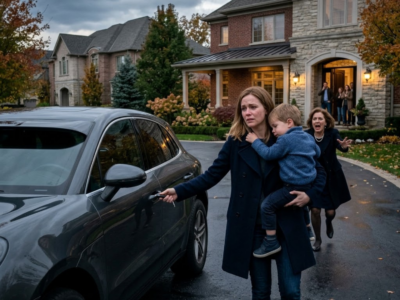
Ray Bennett reappeared briefly at the threshold, exchanging a few quiet words with the police. Then the house was left with the family members who remained—three children and a woman who had spent thirty years wearing the role of “wife” like a costume she never questioned.
Sandra wiped her face with the heel of her hand, then stepped toward Matt.
“Matt,” she said softly, as if softness could undo everything. “I didn’t think it would… I was terrified. Scott didn’t matter like that. It was just—”
“Stop,” Matt said.
The word didn’t sound cruel.
It sounded final.
He had spent the last month acting weak, because it was the only way to keep the evidence from disappearing. Now he no longer needed to perform weakness. Now he no longer needed their belief that he was confused.
Now he only needed them to understand that his memory had returned intact.
That his listening in the ICU hadn’t been a hallucination.
It had been testimony.
The house fell silent again.
Sandra took a shaky breath and asked, “Is there still any chance to save our marriage?”
Matt felt something tighten in his chest, not anger—something steadier. Something like grief that had been delayed until the truth arrived.
He looked at her and realized the answer had been decided long before that evening.
“The divorce papers are real,” he said.
Sandra’s eyes flickered. She turned toward the living room coffee table as if she might find a missing page, a loophole, a way to argue the legal language into mercy.
“I never meant for it to go this far,” she whispered.
Matt didn’t correct her. He didn’t need to.
He walked to the staircase and stopped, not yet leaving the room, just standing with his hand on the railing.
Carl finally found his voice.
“$1,000,” he said, as if the number physically offended him. “You’re really doing this? For what? For being worried about you?”
Matt looked at Carl.
Carl’s question contained a flaw: he wanted Matt to treat his fear like moral intent.
In the ICU, Carl had asked about liquidity.
He had used business language beside a man’s sleeping body because he believed the nurses wouldn’t hear.
Carl had also lied about Matt’s wishes.
Matt didn’t shout.
He simply answered with truth—because truth, unlike yelling, didn’t get tired.
“You were worried,” Matt said. “You were also prepared.”
Eva stepped forward abruptly, her voice trembling.
“Ray Bennett—he’s turning you against us,” she said, as if blame could reverse paperwork. “He got in your head. The whole thing is—”
“It’s records,” Matt corrected.
Eva’s throat bobbed. “So what, you’re going to destroy us?”
Matt stared at her.
He thought about Eva discovering Cooper Logistics nearly a year earlier and choosing silence.
He thought about Glenn Ferris—an accounting employee who kept copies of invoices because the billing “bothered him,” and because fear had prevented him from reporting it directly.
He thought about Eva’s argument with Adrien behind closed doors.
He thought about payments starting afterward—smaller sums disguised as reimbursements and personal loans, as if money could become less dangerous if it arrived in a more polite envelope.
Then Matt looked back at Eva and realized a terrifying detail:
Eva had believed she could stay a daughter while becoming an accomplice.
She had believed she could live with the secret because it bought her comfort.
Now comfort had been traded for consequences.
Matt spoke carefully, like he was choosing each word to prevent her from hiding behind misunderstanding.
“No negotiation,” he said. “My finances are no longer part of bargaining.”
Sandra flinched as if he’d slapped her with a sentence.
Carl turned pale. “Then what do you want?”
Matt didn’t look at them like suspects.
He looked at them like people who had mistaken his silence for permanent helplessness.
“I want you to stop pretending you didn’t understand what you were doing,” he said. “I want the truth to matter.”
The next question came from Sandra, quieter.
“You didn’t even confront us before you—before you did all this,” she accused. “You waited. You planned.”
Matt nodded once.
“Yes,” he said. “Because you would have found a way to destroy evidence if I’d moved early.”
Carl swallowed hard.
He opened his mouth, then closed it.
Eva’s hands trembled.
For a moment, none of them moved.
Then Sandra took a step back as if the room had narrowed.
“Scott,” she said suddenly. “You’re using Scott as a weapon.”
Matt’s jaw tightened.
He didn’t deny it.
He had used everything—photos, timelines, communications—because he had learned in the ICU that pretending wouldn’t save him. It only saved the people who had decided he wouldn’t be around to object.
“What you did with Scott mattered,” Matt said. “But not the way you think.”
Sandra stared at him, confused.
“It’s not only about the affair,” Matt continued. “It’s about the double life you built while you helped—while you approved.”
Sandra started crying again, but this time the tears looked more like fear than performance.
She reached for his arm.
Matt moved away.
He couldn’t allow himself to be touched.
Not now.
Not when he remembered the thumb rubbing his knuckles in the ICU, the whisper—Just rest, Matt. We’ll take care of everything.
“We” hadn’t meant family.
“We” had meant theft continuing, paperwork shifting, money routed.
And now the legal system had entered their anniversary like an unwelcome guest that couldn’t be persuaded to leave.
Ray Bennett returned briefly to the living room.
He spoke in a calm, measured voice. “Officers have to process Adrien’s statement and collect documentation. You should expect follow-up.”
Carl snapped, “We didn’t do anything illegal.”
Ray’s expression didn’t change. “Your family members did what their choices show on paper. That’s what law enforcement cares about.”
Carl’s face reddened. “Ray Bennett, you don’t know—”
Ray cut him off gently. “I do know. I’m here for the next step.”
Matt felt a strange clarity.
The evidence had moved from Ray’s office to a courtroom path—paperwork now traveling farther than human anger.
But Matt had one more task before he could stop thinking about what had happened in his coma.
He turned to Sandra, then to Carl, then to Eva.
“I’m not staying in Kraton Road,” he said.
Sandra’s eyes widened. “What? After everything you did tonight—after you—why would you—this is our home.”
Matt looked at the staircase again.
It wasn’t their home anymore.
It had become the place where he had been staged as unconscious while they negotiated what came next.
“Rey already arranged somewhere else for me,” Matt said.
Carl’s voice rose. “So you’re just… leaving? You don’t even want to talk? You don’t—”
Matt interrupted, calm. “No more negotiation about money. If you want to talk, talk about truth.”
Eva’s voice cracked. “Truth about what?”
Matt answered her directly.
“About Cooper Logistics,” he said. “About the forged power of attorney. About the property filings. About who approved what.”
Sandra shook her head quickly, as if speed could prevent guilt from landing.
“I didn’t forge anything,” she insisted. “Adrien told me it was legitimate. I thought—”
“You thought he was taking care of you,” Matt said. “And you were right. He was taking care of you.”
Carl frowned. “Taking care of us?”
Matt looked at him, and his voice remained controlled.
“Taking care of your inheritance,” Matt replied. “Taking care of the liquidity question you asked in the ICU. Taking care of the plan you had for when he didn’t wake up.”
Carl’s face collapsed with understanding, or the closest thing to it he could manage.
“Dad,” Adrien had said earlier—After everything I’ve done… Dad. Tonight, Carl never said dad. He couldn’t.
Matt turned away from them and began moving toward the staircase.
Sandra followed, still pleading.
“Matt, please. We can fix this. We can sit down with lawyers privately. We can—”
“You can do that,” Matt said. “But you won’t rewrite the outcome.”
Sandra’s eyes went wide. “You don’t even care if we lose everything?”
Matt paused.
He looked at her as if she’d just asked the wrong question at the right time.
“I do care,” he said quietly. “But caring is not the same thing as letting you control it.”
He walked upstairs.
In the upstairs bedroom he had packed days ago—before he hosted the anniversary, before he let them believe he was slow to recover, before he delivered the final evidence.
He picked up the suitcase and brought it back downstairs.
Carl watched him like a man witnessing something he couldn’t reverse.
Eva looked at the suitcase like it was a verdict made visible.
Sandra—still crying, still trying to be the woman who could explain herself—reached for him one last time.
“Don’t leave,” she whispered. “Please.”
Matt stopped.
He didn’t give her a dramatic speech. He didn’t raise his voice.
He just said, “I’m not leaving you because I hate you.”
Sandra’s eyes flickered.
“I’m leaving because you chose silence while I was unconscious,” Matt continued. “You helped create a future where my body could be written off and my assets could be rerouted.”
He held her gaze long enough for her to feel the weight of it.
“And you don’t get to ask me to stay after that.”
Then he carried the suitcase out.
No one stopped him.
No one begged hard enough to challenge what they’d already done.
That silence from his family—after the envelopes, after the police, after the collapse—told him everything.
They weren’t only afraid of losing money.
They were afraid of losing the version of themselves that didn’t require guilt.
Outside, Matt got into the car Rey had arranged.
He didn’t pretend to be weak anymore.
He drove away with steady hands and a mind that didn’t drift back to ICU darkness.
Instead, his thoughts moved forward, into the next legal steps—divorce filing after the appropriate window, handwriting expert analysis for the power of attorney, document challenges for property changes, and evidence submission for Cooper Logistics and internal approvals.
Ray and Frank would keep working.
But Matt’s role was no longer to stay helpless.
He became the man who could decide.
Over the next few weeks, legal work consumed his time. Rey challenged forged documents through proper channels. Glenn’s preserved accounting records helped reconstruct missing transactions. The divorce moved forward.
Matt returned to Harris Supply gradually—not because he needed to prove anything, but because employees deserved stability.
Adrien’s case would belong to the courts.
Matt understood something important now: he wasn’t judge and jury.
He wasn’t a man who needed vengeance.
He was a man who needed the truth to survive the damage done to him.
Yet the most haunting part wasn’t the paperwork.
It was the silence in his own bed, when he had listened and listened until he could map his family’s plan like a blueprint.
He thought about the question he’d asked himself when he finally gained finger control.
If I confront them now, will they only tell me what they’re prepared to admit?
In the end, Matt’s waiting had been the only thing that made justice possible.
He couldn’t stop time.
He couldn’t stop the betrayal.
But he could stop it from being rewritten.
One evening, his phone buzzed.
A message from Sandra.
I can’t understand how 30 years could end like this. Did anything we shared matter to you?
Matt stared at the screen until the words blurred.
He could have answered with anger.
He could have answered with a list of offenses.
But he didn’t.
He typed four words.
I heard every word.
He sent it and put the phone down.
He didn’t know if Sandra would understand the full implication.
But Matt did.
Everything that had ended their marriage wasn’t only the money.
It was the way Sandra had looked at his helpless body and chosen—again and again—what would happen next.
Months earlier, Matt might have measured his life by what he would leave behind.
Now he measured it by what remained inside him after survival.
He hadn’t just survived a crash.
He had survived his own family’s expectations.
And what none of them expected—what they certainly couldn’t have predicted when they spoke quietly beside his unconscious bed—was that Matt would wake up, remember every sentence, and turn helplessness into control.
Harris Supply had stood because the man who built it had returned to reclaim it.
The family structure, the marriage, the trust—those had been broken.
But the future was still his to decide.
And as Matt walked through the company offices days later, hearing employees greet him as if nothing had happened, he realized something else:
The accident had changed what mattered.
Not legacy.
Not inheritance.
Not the life he thought he was entitled to protect.
What mattered now was choice.
And he had made his choice long before the police ever stepped into the anniversary party.
He had made it in darkness, lying 6 feet away from the woman who told the nurse not to revive him.
He had made it in the ICU when Sandra whispered, We’ll take care of everything.
Now it was time for the world to see what “everything” really meant.
And the final truth, the one Matt finally accepted, was simple:
They hadn’t planned for his death.
They had planned for his silence.
But silence was gone.
The truth was awake.