(Part 2) My Husband Ordered Me to Apologize or Get Out—Then His Mother Screamed, “Leave the Porsche!”
(Part 2) My Husband Ordered Me to Apologize or Get Out—Then His Mother Screamed, “Leave the Porsche!”
.
.
The first thing I noticed wasn’t Patricia’s words.
It was the way her anger didn’t carry the messy urgency of humiliation anymore. It had matured. It had strategy.
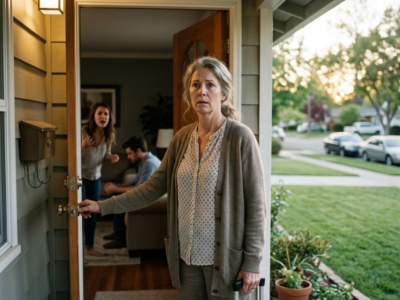
She stood at our front door, not calling for attention, not even raising her voice. Her tone was controlled—almost polite.
But controlled anger is more terrifying than loud anger, because it pretends to be reasonable.
“This has gone far enough,” Patricia repeated.
Daniel’s hand hovered at his side, like he was restraining more than his temper. He wasn’t chasing her away. He wasn’t dramatizing the conflict.
He was drawing a line.
But the line mattered because Patricia had never truly accepted that some boundaries aren’t negotiable.
I watched her eyes flick to Noah—measuring whether the child could be used to soften the rules.
Noah, bless him, didn’t understand the stakes. He only knew Patricia meant attention and stories and that the grown-ups were being quiet.
I stepped forward just enough to be heard without making this a battle.

“Patricia,” I said, keeping my voice calm, “you will see Noah at a scheduled visit. By invitation only. The way we agreed.”
Patricia’s jaw tightened.
“Daniel is choosing you again,” she snapped, like my safety was an act of betrayal.
“No,” Daniel answered. “I’m finally taking responsibility for what I helped you do.”
That sentence—taking responsibility—landed differently than everything else Patricia had demanded. It didn’t offer comfort. It didn’t apologize for Daniel. It didn’t ask her to accept uncertainty.
It simply named reality.
Patricia left angrily.
But she left without crossing the threshold.
And in the past, that small victory would have felt like enough.
This time, I didn’t celebrate.
Because the past had already shown me that Patricia’s apologies could change her behavior for a moment, but they didn’t always change the story living behind her eyes.
That night, after Noah was asleep, my phone buzzed with a voicemail.
For the first time, Patricia’s message didn’t start with if.
Her voice shook as if she was forcing herself to speak without armor.
“Claire,” she began, “I humiliated you in front of Noah. I treated you as though you were living on Daniel’s generosity. I screamed at you about a car that was never his and I helped make your little boy feel unsafe in his own home.”
She paused, breathing hard.
“I was wrong.”
Then she added the part that mattered most.
“You do not owe me forgiveness. I only wanted to say that clearly.”
I listened twice, sitting alone in the kitchen with the quiet pressing in around me.
The apology didn’t erase what had happened.
But it marked a shift I hadn’t seen before: Patricia had started speaking about her behavior without reaching for an excuse.
And once you notice someone can change the way they speak, you begin to believe—carefully—that they might change the way they act.
Evidence, Not Promises
Daniel and I kept counseling.
We didn’t rush into forgiveness.
We didn’t treat apologies as cures.
We built rules.
Elena had warned me during our early separation: joint money must be managed carefully, schedules must be documented, and trust isn’t a feeling—it’s evidence over time.
My counselor, Dr. Evelyn Carter, later gave me a distinction that stayed with me long after the sessions ended.
“Forgiveness is personal,” she said. “Access is earned. Trust is evidence gathered over time.”
So I watched for evidence.
Not dramatics.
Not grand gestures.
Just daily choices.
Daniel continued following the parenting schedule.
He arrived on time.
He paid his share of Noah’s expenses.
He attended counseling.
He made every repayment to our joint savings, tracked and documented.
He never used Noah to ask when he could come home.
And when Patricia didn’t call again for a while, I let myself believe—only slightly—that her changes were real enough to keep moving.
But I also knew the truth: change could be temporary if it was only fueled by Daniel’s absence, not by Patricia’s own accountability.
So I kept boundaries firm.
My boundaries were not punishments. They were the conditions that made a relationship safe.
And Patricia learned to accept them without turning everything into a courtroom.
When she finally contacted me to meet George, she asked for a public place.
I agreed to thirty minutes at a quiet park near the library.
She looked smaller with less audience around her, like the theater had been removed from her anger.
George sat beside her on the bench, letting her speak for herself.
Patricia told me George’s retirement had frightened her more than she admitted.
Their savings were thinner than she believed.
She feared becoming dependent on their children.
And she was afraid—in a way she’d been too ashamed to name—that Daniel’s marriage had reduced her influence over him.
His stories about the house, the Porsche, and his success reassured her that she had raised a son who could protect everyone.
So when I challenged the picture she clung to, she treated me like the threat.
It was an honest explanation.
It wasn’t an excuse.
I told her the same thing I’d learned to tell Daniel years ago: fear may explain why someone behaves that way. It does not excuse what Noah heard.
Patricia listened.
She agreed to the boundaries.
“Those aren’t punishments,” I said, and made sure she understood the purpose. “They’re the conditions that keep Noah safe.”
Then I offered her a gradual path back into Noah’s life—brief planned visits, no pressure on him, no expectation that I would pretend everything was normal.
She didn’t argue.
That mattered.
Can a Marriage Survive When the Truth Hurts?
At night, Daniel started calling more regularly.
Some calls were practical—dates, schedules, preschool logistics.
Others carried something new: reflection without defensiveness.
Once, Daniel said quietly, “My counselor thinks we should meet together.”
Not to bargain.
Not to beg.
To understand whether we had destroyed something we couldn’t rebuild.
I agreed.
But I didn’t agree to a promise.
Counseling wasn’t a guarantee that Daniel would be welcomed home.
It was a process to assess whether trust could exist between us again.
So we agreed to ninety days of marriage counseling with one condition: we weren’t there to measure how fast Daniel could return.
We were there to measure whether trust could be rebuilt at all.
Daniel nodded like he understood this time the difference between wanting and earning.
During one of our sessions, Dr. Carter asked him a question so simple it felt like a blade.
“Whose approval were you protecting at the cookout?”
Daniel looked down at his hands.
“My mother’s,” he said.
Then, without arguing, he added the part that hurt but also explained everything.
“And I protected it at the expense of my wife and my son.”
Hearing him say it didn’t make the past disappear.
But it made it real in a way I could finally stop living around.
Then Dr. Carter asked me, “What did silence protect for you?”
I wanted to say it protected our marriage.
I wanted to claim it was noble, that I was choosing peace.
But after a long pause, I answered more honestly.
“It protected me from conflict,” I said.
The word conflict sounded small compared to what I’d endured, but it was true.
I had taught Daniel that I would absorb disrespect so everyone else could feel comfortable.
I realized it didn’t make me responsible for his lies—but it did show my own pattern.
I couldn’t build a healthier marriage by returning to the same silence.
Dr. Carter also reminded us that reconciliation wasn’t just emotion.
It was structure.
It was communication.
It was accountability.
So we did it with a plan—not a fantasy.
A Test Disguised as a Birthday
Six months after the cookout, Noah’s fourth birthday approached.
We didn’t celebrate at the house.
We chose a local park so the day belonged to Noah—not to property, not to power struggles, not to adults trying to prove ownership.
We invited both sides of the family.
Then Megan—Daniel’s sister—sent him a joke about Claire’s property war.
Daniel showed me the message before answering with surprising honesty.
“I know this is another test,” he said.
And he was right.
Soon we’d all stand together again, and I would learn whether his changes could survive an audience.
The morning of Noah’s birthday, I almost canceled.
I feared that another family gathering could undo progress we had worked to create.
But Noah had been talking about cupcakes, balloons, and the playground’s really fast slide for weeks.
He deserved a day touched only by childhood excitement, not adult shame.
So we went.
Daniel arrived early with folding tables.
He didn’t act like setting them up earned praise.
Patricia waited until she was invited before hugging Noah.
For the first hour, everything felt cautiously ordinary.
Then Megan stood beside the picnic table watching Daniel cut Noah’s cake.
“So, Claire,” Megan said loudly, “did you ever imagine you’d win the whole family property war?”
Some relatives gave uncertain laughs.
The old story could have flowed again—mature into conflict, turn into another humiliation I would have absorbed silently.
I felt my throat tighten.
Daniel set down the knife before I could answer.
“There was no property war,” he said.
His voice was calm.
But it held steel.
“I lied. The house and car were always Claire’s, and she paid the price for the story I told.”
Megan’s smile faded.
Daniel didn’t look at me for approval.
He didn’t wait until we were alone.
He didn’t demand that I rescue him from the discomfort of being honest.
He corrected reality in front of the people who had once rewarded his lie.
And Patricia—Patricia surprised me.
She added, “That subject is finished, Megan.”
The moment lasted less than a minute.
But that minute was evidence.
It meant Daniel could defend truth even when it cost him comfort.
It meant Patricia could stop using Noah’s presence to resume the conflict.
After the party, Daniel and I sat on a bench while Noah chased bubbles with George.
I told Daniel what I had to tell him—that his response mattered because he hadn’t left me alone to defend reality again.
But I still wasn’t ready for him to assume his suitcase would be welcomed into my home as if one good afternoon repaired everything.
So we agreed on a gradual trial reconciliation.
He would join us for dinner twice a week.
He would attend counseling.
He would spend occasional family days while keeping his apartment.
We agreed to review after two months—not based on how badly either of us wanted the old life back, but based on how safe our home felt.
Daniel looked across the park at Noah and then back at me.
“If I come home someday,” he asked carefully, “can we build something that belongs to both of us even if the house never does?”
It was the first time his question sounded less like ownership and more like possibility.
Maybe, I said, but we build it slowly and we build it truthfully.
When the Past Finally Stops Being a Weapon
One year after George’s retirement cookout, we gathered again in my backyard.
No speeches about who provided the house.
No quiet struggle over authority.
No adults testing the boundaries by baiting Noah with jokes.
Just grilled chicken, Noah’s laughter, and a folding table filled with dishes everyone helped prepare.
Daniel had moved home three months earlier after our trial reconciliation grew into a steady routine.
He kept his apartment until Dr. Carter and I believed the change was durable.
Trust didn’t reappear like magic.
It returned in small repeated choices.
He asked before making large purchases.
He shared financial statements without being reminded.
When Patricia disagreed with a boundary, he spoke to her directly instead of asking me to endure her displeasure.
He stopped using his family’s feelings as a justification for his dishonesty.
Even when conflict remained possible, he didn’t hide behind it.
Patricia waited at the gate until I invited her in.
She asked before making plans with Noah.
She never again suggested that Daniel was the only person supporting our family.
Our relationship still wasn’t intimate in the way people imagine romance.
The hurt didn’t vanish.
But it had become respectful, honest, and safe.
At one point, Noah climbed onto my lap and asked about Grandma.
“Does Grandma know whose house it is now?” he asked, voice serious like he wanted the answer to be correct.
“She knows,” I told him. “But more importantly… she knows this is your home. And everyone here has to treat each other kindly.”
The house and Porsche were still mine.
That wasn’t my victory.
My victory was refusing to teach Noah that keeping a family together requires one person to accept humiliation.
Daniel’s victory was learning that love doesn’t grant permission to hide behind a lie.
Patricia’s victory was discovering that an apology only matters when changed behavior follows.
I also understood something else.
Reconciliation wasn’t the same as returning to the marriage we had before.
Before, that marriage had been built around avoidance.
Now we needed harder conversations.
Clearer boundaries.
Humility strong enough to admit when either of us was wrong.
The legal protections mattered—separate property records, independent lawyers, documented repayments, transparent accounts, written parenting schedules—because fear could easily turn chaos if left unchecked.
But no deed, no contract, no bank statement repaired our family.
Only truth, accountability, and consistent action could.
The Ending That Doesn’t Pretend Everything Was Easy
Before dessert, Daniel stood beside me while Noah carried napkins to the table.
He didn’t call the house his.
He didn’t call it mine.
He didn’t call it ours like a claim.
He simply said, “I’m grateful to be home.”
This time, home sounded like responsibility—not ownership.
Noah didn’t learn that the loudest person owns the house.
He learned something more important and harder to teach:
Love means telling the truth.
Love means respecting boundaries.
Love means earning your way back after you have broken someone’s trust.
And if this story made you think about the difference between forgiveness and restored trust, I hope you’ll share your thoughts.
Because families can heal without pretending the hurt never happened.
And that kind of healing—real healing—starts with truth, not silence.