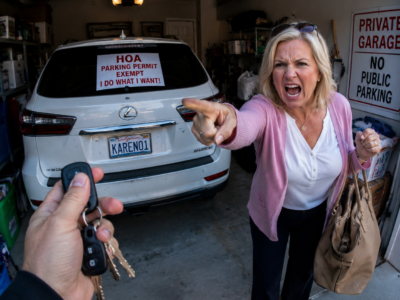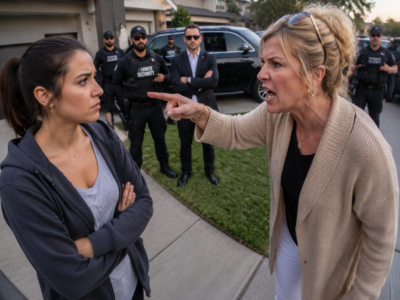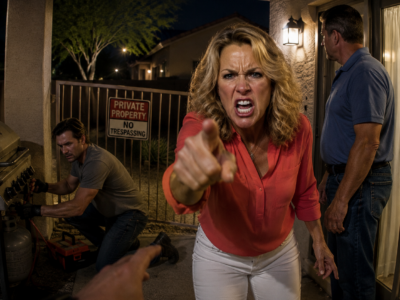
Part 2 – HOA Karen Stored Her Junk in My Garage — I Posted “Free Pickup” and It Was Gone Overnight
HOA Karen Stored Her Junk in My Garage — I Posted “Free Pickup” and It Was Gone Overnight
Let me briefly recap part 1
By sunrise, every last box was gone.
The treadmill, the rolled-up rugs, the cracked mirror in the gold frame, the dining chairs with clawed feet, the plastic bins full of “seasonal décor,” the broken patio umbrella, the six bags of clothes, the fake Christmas trees, the old elliptical machine, even the ugly ceramic rooster that had been staring at me from the corner of my garage for three weeks — gone.
All that remained was an empty concrete floor, a few scraps of packing tape, and the big cardboard sign I had leaned against my driveway the night before.
FREE PICKUP. TAKE WHAT YOU CAN USE.
I was standing there with a cup of black coffee in my hand, finally breathing like a man who had gotten his house back, when Deborah Whitaker came flying around the corner in her white Lexus like the devil had grabbed the steering wheel.
She slammed the brakes so hard the front bumper dipped.
Then she jumped out wearing a hot-pink blazer, black slacks, heels too sharp for a suburban driveway, and a face that looked like she had just witnessed a bank robbery.
“My things!” she screamed.
Her voice cracked across the quiet street. Porch lights flicked on. Curtains shifted. Somewhere, a dog started barking.
Deborah ran toward my open garage, stopped at the threshold, and stared into the empty space where her mountain of junk had been. For three seconds, she could not speak. That silence was almost beautiful.
Then she turned on me.
“What did you do?”
I took one slow sip of coffee.
“I cleared my garage.”
“You gave away my property!”
“No,” I said. “I gave away abandoned property that you illegally stored in my garage after three written notices, two certified letters, one sheriff’s report, and twenty-one days of you pretending my house belonged to your HOA.”
Her eyes bulged.
“You are going to prison.”
I almost laughed, but I didn’t. Not because she scared me. Because people like Deborah are dangerous when they feel embarrassed, and she had just been embarrassed in front of the entire neighborhood.
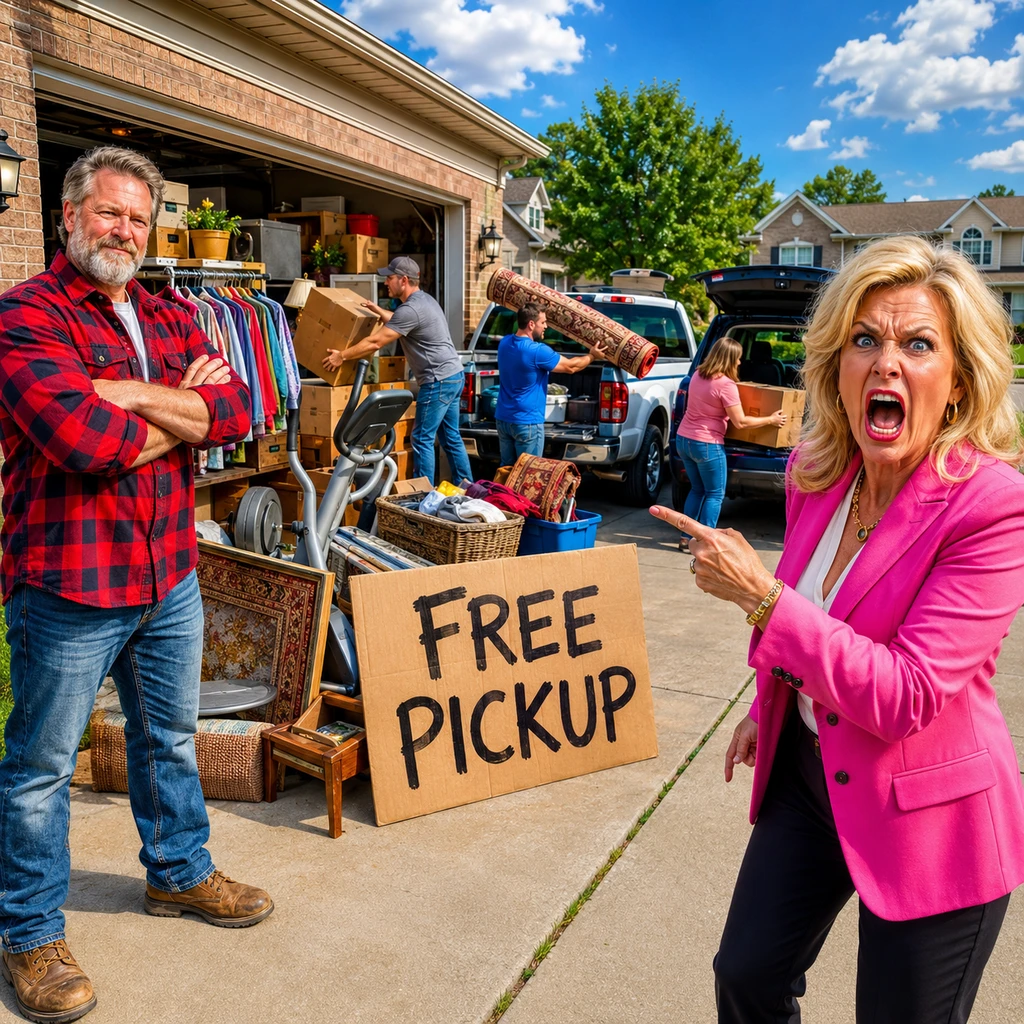
Across the street, Mr. Alvarez stood on his porch with his arms crossed, smiling like he had been waiting for this episode all season. Two houses down, a young couple pretended to check their mailbox even though it was 6:48 in the morning. My teenage daughter, Emma, watched from the front window with a bowl of cereal in her hands.
Deborah pointed at the garage.
“That was HOA inventory!”
“It was in my private garage.”
“It was for a community charity sale!”
“It was labeled with your name, your sister’s consignment tags, and your storage-unit stickers.”
Her mouth opened, then snapped shut.
That was the first crack.
The first tiny moment when the truth peeked through the performance.
She jabbed a finger at me.
“You had no right.”
I set my coffee on the workbench just inside the garage and picked up the folder I had left there for exactly this moment.
The folder was thick.
Photos. Emails. Certified mail receipts. Screenshots. A copy of my deed. A copy of the HOA bylaws. A sheriff’s incident report. A letter from my attorney. An inventory list with timestamps and video stills from the day her people used an old contractor code to open my garage and turn it into her personal warehouse.
“I had every right,” I said. “And unlike you, I kept receipts.”
Her face went from red to white.
Then, because Deborah Whitaker had never met a disaster she couldn’t make worse, she pulled out her phone and called 911.
“Yes,” she said, breathless and shaking with fake fear, “I need officers at 418 Maple Hollow Drive. A man has stolen thousands of dollars of my belongings and is threatening me.”
I looked at her.
“Deborah.”
She turned away and raised her voice.
“He’s hostile. He’s standing in the driveway. I don’t feel safe.”
That sentence changed the air.
I had been angry before. Annoyed. Tired. Even amused in a dark sort of way. But when she said she didn’t feel safe, while standing in my driveway after trespassing onto my property and screaming about junk she had no permission to store, something in me went cold.
Because those words are not small.
They bring patrol cars. They bring body cameras. They bring officers arriving with their nerves already tight. People like Deborah know that. They understand exactly which words make authority move faster.
So I stepped back.
I kept my hands visible.
And I waited for the sheriff’s deputies to arrive at the garage she had tried to steal one cardboard box at a time.
My name is Jack Mercer. I’m forty-four years old, a divorced father, a former home remodeler, and the kind of man who used to believe that if you were polite, paid your bills, followed the rules, and minded your own business, most people would leave you alone.
That was before I met Deborah Whitaker.
I moved into Maple Hollow Estates after my divorce because I needed a clean break and a stable place for my daughter. Emma was sixteen then, old enough to understand more than I wanted her to, young enough that I still wanted to protect her from the ugliest parts of adult life. Her mother and I had not ended in some dramatic explosion. No scandal. No betrayal. Just years of drifting, then one quiet kitchen-table conversation where both of us admitted we were tired of pretending tiredness was love.
So I bought the brick ranch on Maple Hollow Drive.
It wasn’t fancy, but it had good bones. Three bedrooms. A deep front porch. A maple tree in the yard. And, most important to me, a two-car garage with enough space for my tools, my workbench, and the old furniture restoration business I was trying to restart.
That garage was supposed to be my second chance.
For years, I had worked construction and remodeling jobs all over central Ohio. Kitchens. Decks. Basement finishes. Emergency repairs after storms. I was good with my hands, but after the divorce I wanted something quieter. Less hauling drywall up stairs. More fixing old things. I liked taking a scratched table, sanding it down, finding the grain underneath, and making it useful again.
Maybe because I was trying to do the same thing with myself.
Emma liked the house. That mattered more than anything. She chose the bedroom with the east window, painted one wall sage green, and hung little fairy lights around her desk. The first night we slept there, she came into the kitchen in socks and said, “It feels weird, but not bad.”
I took that as a victory.
Maple Hollow Estates looked like the kind of neighborhood people fight to get into. Clean sidewalks. Fresh lawns. Basketball hoops tucked away before sunset. Flags on porches. Dogs behind white fences. On Saturday mornings, you could smell coffee, lawn clippings, and somebody grilling too early.
It had an HOA, of course.
I knew that going in. I had read the packet. No junk cars. No broken fences. Trash cans hidden after pickup. Reasonable stuff, or so I thought.
Then Deborah Whitaker arrived at my door with a welcome basket.
That basket should have warned me.
It had two blueberry muffins, a refrigerator magnet with trash dates, a tiny candle, and a printed copy of the HOA rules with several pages already highlighted in pink.
Deborah stood on my porch smiling like a woman posing for a campaign photo. She was in her late fifties, blonde hair shaped into perfect waves, bright lipstick, gold earrings, and a hot-pink blazer that looked expensive enough to have its own insurance policy.
“Mr. Mercer,” she said, holding out her hand. “I’m Deborah Whitaker, president of the Maple Hollow Homeowners Association.”
Not “your neighbor.”
Not “welcome.”
President first.
Human being later.
I shook her hand.
“Nice to meet you.”
“We’re very glad to have you,” she said. “Maple Hollow is a standards community.”
That phrase sounded odd, but I let it pass.
“I like a clean neighborhood.”
Her smile sharpened.
“Wonderful. Then I’m sure you’ll fit right in.”
She glanced past me into the foyer, then toward the driveway where my pickup truck sat. It was a black F-150 with a ladder rack and a few scratches from years of honest work. Nothing leaking. Nothing ugly. Just a truck that looked like it had carried lumber instead of golf clubs.
Her eyes lingered on it.
I noticed.
After she left, Emma came out of her room and looked in the basket.
“Did she bring muffins or a lawsuit?”
“Both,” I said.
We laughed.
I wish I had taken that joke more seriously.
The first notice came nine days later.
Commercial vehicle visible from street.
I stood in the driveway holding the letter, staring at my truck like it had betrayed me.
The truck was registered as personal. It was clean. It was parked in my driveway. The HOA rules said no commercial vehicles with visible logos or heavy equipment. My truck had no logo. The ladder rack was empty.
I called the number on the notice.
Deborah answered.
“Maple Hollow HOA, this is President Whitaker.”
Again with the title.
“This is Jack Mercer. I got a notice about my truck.”
“Yes,” she said, already satisfied. “We like to address issues quickly before they become habits.”
“It’s not a commercial vehicle.”
“It has a work rack.”
“I use it for work sometimes. I also use it for groceries.”
“Mr. Mercer, appearances matter here.”
There it was.
Appearances.
That soft word people use when they want control to sound like responsibility.
I appealed the notice, attached registration proof, and included photos of three other trucks with racks in the neighborhood. The fine disappeared, but the tone changed. Deborah began watching me.
I could feel it.
Some people watch in obvious ways. Deborah watched with paperwork. A reminder about trash cans after mine sat at the curb for two extra hours because I was picking Emma up from school. A note about lawn height two days after rain. A warning that my garage door had been open “for extended periods,” which apparently threatened neighborhood harmony.
I tried to ignore her.
That was my first mistake.
People like Deborah treat patience like permission.
The garage issue began with the Maple Hollow Spring Charity Sale.
Every year, according to the HOA newsletter, residents donated furniture, clothes, tools, toys, and household items. The HOA sold them at the clubhouse parking lot and donated the money to a local children’s hospital. On paper, it sounded good. I have no problem with charity. I have no problem with garage sales. I even thought about donating a few things.
Then, at the March HOA meeting, Deborah announced that “temporary staging sites” would be used for donation sorting.
She stood in front of the clubhouse with a microphone, pink blazer glowing under fluorescent lights, speaking like a governor declaring disaster relief.
“To preserve the beauty of our common areas,” she said, “the board has identified several suitable homeowner-adjacent storage locations for short-term staging.”
Homeowner-adjacent.
That phrase made my skin itch.
A man in the back asked, “What does that mean?”
Deborah smiled.
“It means certain garages, side yards, and utility-adjacent spaces may be used temporarily with proper coordination.”
“With permission?” I asked.
Her eyes found me.
“Of course, Mr. Mercer. Maple Hollow is a cooperative community.”
That was not a yes.
After the meeting, I approached her.
“My garage is not available.”
She tilted her head.
“I didn’t say it was.”
“I’m saying it now.”
Her smile stayed in place, but her eyes cooled.
“Your home has one of the larger garage footprints on the street.”
“Because I bought it.”
“And your rear garage wall faces a service lane.”
“A service lane for utilities. Not storage.”
She sighed like I was being difficult.
“Mr. Mercer, sometimes community living requires flexibility.”
“Flexibility is when I let a neighbor borrow a ladder. Not when the HOA uses my garage.”
Her smile disappeared.
“We’ll note your position.”
That sounded less like a note and more like a threat.
I went home and changed my garage keypad code.
At least, I thought I did.
The previous owner had left me a folder with manuals, paint colors, appliance warranties, and a little card with the old garage keypad code. I changed it the week I moved in. What I didn’t know was that the side door had a separate smart lock installed years earlier for contractors, and the old owner had once given the HOA a temporary access code during a roof repair project.
Temporary, in an HOA, is a word that lives forever if nobody kills it properly.
Two weeks after the meeting, Emma and I drove to Cincinnati for my sister’s birthday. We left Friday afternoon and came back Sunday evening. It was one of those rare weekends where things felt almost normal. Emma laughed with her cousins. My sister made too much pasta. I slept on a pullout couch that tried to fold me into a question mark.
When we turned onto Maple Hollow Drive Sunday night, I noticed the garage light was on.
My stomach tightened.
The garage door was closed. The front of the house looked fine. But the garage light glowed through the small side window, and I knew I had turned it off.
I parked in the driveway.
Emma looked at me.
“Dad?”
“Stay in the truck.”
That was not a dramatic father line. It was instinct.
I walked to the garage side door and tried the handle. Locked. No damage. I opened it with my key.
The smell hit me first.
Dust. Old fabric. Cardboard. Mildew. Perfume. Plastic. Something sour underneath.
Then I turned on the main light.
My garage was full.
Not “a few boxes” full.
Not “temporary staging” full.
Full full.
There were cardboard boxes stacked against my workbench. Clothing racks along the wall. A treadmill blocking the freezer. Rugs rolled like dead bodies near the garage door. Dining chairs piled on top of one another. Plastic tubs labeled D.W. HOLIDAY, D.W. ESTATE, and CONSIGNMENT — DO NOT DISCOUNT. A fake ficus tree leaned against my tool cabinet. The elliptical machine stood in the middle like a monument to bad decisions.
My workbench was buried.
My tools had been moved.
A dresser I had been restoring for a client had a box of ceramic pumpkins sitting on top of it.
For a second, I simply stood there.
People think anger arrives loud. Sometimes it doesn’t. Sometimes it arrives as silence so complete you can hear your own pulse.
Emma came up behind me despite my instruction.
“Oh my God,” she whispered.
That broke something in me.
This was supposed to be our home. Our reset. Our safe place after a year of lawyers, moving boxes, custody schedules, and pretending we were all handling things better than we were. And now some woman with a title had decided my garage was hers because she liked the square footage.
I took out my phone and started recording.
Every corner.
Every label.
Every item.
Every scratch on my dresser.
Every tool moved from its place.
Then I checked the camera above the driveway.
I had installed it after the truck notice because I didn’t trust Deborah. That camera saved me.
The video showed two HOA volunteers arriving Saturday morning in a white pickup. Then another truck. Then Deborah herself in her Lexus. One man entered the side door using a code. They opened the garage. They spent four hours unloading.
At one point, Deborah stood in my driveway holding a clipboard while a man carried in the treadmill.
At another point, she pointed toward my workbench like she was arranging a warehouse.
I saved the footage to three places.
Then I called Deborah.
She answered on the third ring.
“Mr. Mercer,” she said, cheerful as poison. “I assume you’re calling about the charity staging.”
“You put junk in my garage.”
Her voice cooled.
“That is an unkind way to describe community donations.”
“Some of these boxes have your initials on them.”
“I am coordinating inventory.”
“You entered my garage without permission.”
“The board approved temporary staging.”
“The board does not own my garage.”
“Mr. Mercer, your garage was selected because of its location and capacity. This is temporary.”
“No. It ends tonight.”
“That isn’t possible.”
“It became possible when you broke into my garage.”
She gasped.
“Do not use that word.”
“Broke?”
“Your inflammatory language is not helpful.”
“Neither is storing mildew rugs beside my daughter’s bike.”
There was a pause.
Then she said, “If you interfere with HOA property, you may be fined.”
I almost said something I would regret.
Instead, I hung up.
That was one of the smartest things I did.
The next morning, I called an attorney named Sam DeLuca.
Sam and I had done some remodeling work on his office years earlier. He was blunt, practical, and looked like a man who had been born holding a coffee cup.
I sent him the video, photos, HOA rules, and Deborah’s notices.
He called me back after lunch.
“First,” he said, “don’t throw anything out today.”
“I wasn’t planning to throw it out.”
“You were thinking about it.”
“I was thinking about a wood chipper.”
“Don’t do that either.”
He explained the boring but important part. Even if someone wrongfully stored property in your space, you had to handle it carefully. Notice. Documentation. Opportunity to remove. No damaging items. No selling before the process was clean.
“I want my garage back,” I said.
“Then we do this right.”
Sam drafted a letter that afternoon.
It stated that Deborah Whitaker and/or the Maple Hollow HOA had entered my private garage without permission and stored property there unlawfully. It demanded removal within seven days. It stated that storage fees would accrue after that deadline. It warned that if items were not removed after proper notice, they would be treated as abandoned according to available civil remedies.
I sent it by email, certified mail, and hand delivery to the HOA office.
Deborah replied within eleven minutes.
Your letter is rejected. The HOA maintains authority under community operations provisions. Any attempt to remove, dispose of, conceal, damage, or interfere with staged property will result in enforcement action.
Sam read it and laughed.
Not a happy laugh.
A lawyer laugh.
“She just put the rope around her own neck,” he said.
The next week became ridiculous.
My garage was unusable. I had to cancel two furniture restoration jobs because my workbench was blocked. Emma couldn’t get her bike out. The freezer door barely opened. The place smelled worse every day, especially after rain made the rugs damp.
I sent another notice.
Deborah ignored it.
Then I got an HOA fine.
Violation: Interference With Community Charity Operations — $1,000.
I stood in the kitchen reading it while Emma made toast.
She looked at me.
“Can they do that?”
“No.”
“Then why does it feel like they can?”
That question hurt because it was exactly how these people operate.
A letter with a logo can make nonsense feel official. A deadline can make you doubt yourself. A fine can turn your own home into a place where you feel like a guest.
I told her, “Because they’re counting on us being scared.”
“Are we?”
I thought about lying.
“No,” I said. “But I’m angry.”
She nodded.
“Good.”
By the second week, neighbors started whispering.
Mr. Alvarez came over first. He was seventy-two, retired from the post office, with thick glasses and a tomato garden he treated like a military assignment.
“I saw them loading your garage,” he said.
“Why didn’t you call me?”
He looked embarrassed.
“I thought you agreed. Deborah said you volunteered.”
There it was.
Volunteered.
That word made everything worse.
Then a younger couple, Jasmine and Aaron, stopped me by the mailbox. They said Deborah had asked to use their driveway for donation overflow, and when they refused, they got a warning about their fence stain.
A widow named Mrs. Callahan told me the HOA had stored folding tables in her shed the year before “just for a weekend.” They stayed four months.
A man named Blake admitted Deborah had used his side yard for mulch pallets after telling him the landscaping committee had authority because his lot bordered a common drainage strip.
Different homes.
Same pattern.
Deborah didn’t ask. She applied pressure until people surrendered.
And when they surrendered, she called it community spirit.
That is something I believe now more than ever: real community does not begin with coercion. It begins with respect. If you have to scare people into helping, you are not building a neighborhood. You are building a tiny kingdom.
On day fourteen, Sam sent a final notice.
This one was firmer.
It gave Deborah and the HOA another seven days to remove the items by appointment. It included an inventory list, photos, dates, and copies of previous notices. It stated that failure to remove would be treated as abandonment and that I would clear my garage without further delay.
Deborah responded with a single line:
Proceed at your own risk.
So I did.
But carefully.
That Friday, I requested a civil standby from the sheriff’s office so I could open the garage and document the condition of the property. Deputy Nolan and Deputy Price arrived at 10:00 a.m. They were polite, tired-looking men who clearly wished adults could resolve cardboard-box disputes without law enforcement.
I showed them the deed, the notices, the video, and Sam’s letter.
Deputy Nolan looked into the garage and whistled softly.
“She put all this in here?”
“Yes.”
“With no written permission?”
“No.”
He looked at a bin labeled D.W. ESTATE SALE — PRICE HIGH and raised an eyebrow.
“Charity sale?”
“That’s what she said.”
Deputy Price took photos for the incident report. Then I opened a few boxes on video, not to dig through personal things, but to confirm labels and condition. Many had price tags. Some had consignment store stickers. One had a clipboard inside listing “projected resale value.”
That was when the story changed again.
This was not simply HOA charity junk.
This was Deborah’s side hustle.
Later, we learned she had been collecting “donations,” sorting valuable items, selling some through her sister’s consignment booth, and letting the HOA sale handle the low-value leftovers. She told residents it was all charity, but the paperwork told a messier story.
At the time, I didn’t know all of that.
I only knew I wanted my garage back.
The deputies filed their report. Sam said the notice period was clean. I waited until the final deadline passed.
Then I made the sign.
A big piece of cardboard.
Black marker.
Simple words.
FREE PICKUP. TAKE WHAT YOU CAN USE.
Below that, because Sam insisted, I added:
Items left after written notice. No holds. No delivery.
I posted photos in three local free groups, but I did not list Deborah’s name. I wrote: “Garage cleanout. Mixed household items, clothes, rugs, exercise equipment, boxes, décor. Free pickup tonight from driveway. First come, first served.”
I opened the garage at 7:00 p.m.
By 7:08, the first truck arrived.
A man took the treadmill and thanked me like I had given him a car. A college student took two rugs. A woman with three kids took clothes, bins, and a lamp. Two brothers loaded the elliptical with the determination of men who had not measured their apartment. Mr. Alvarez took the fake ficus tree because, in his words, “it has suffered enough.”
By 9:00, half the garage was empty.
By midnight, almost everything was gone.
I sat on the porch with Emma, watching strangers carry away Deborah Whitaker’s empire one box at a time.
Emma pointed at the ceramic rooster under a man’s arm.
“I’ll miss him.”
“No, you won’t.”
“I named him Gerald.”
“Goodbye, Gerald.”
She laughed.
It was the first time either of us had laughed about the garage in weeks.
At 1:15 a.m., a woman in an old minivan took the last boxes of decorations. She told me she ran a church theater program and could use everything for sets. When she saw the fake Christmas trees, she nearly cried.
“You sure these are free?”
“Yes, ma’am.”
“My kids are going to love this.”
That softened something in me.
I had started the night angry. I will admit that. Part of me wanted Deborah to feel the loss of control she had forced on me. But watching people actually use the items — families, students, church volunteers, a young couple furnishing their first apartment — changed the feeling.
Her junk had become useful.
Not to her.
Not to her little system.
To people who showed up honestly and asked.
By 2:00 a.m., the garage was empty.
Emma helped me sweep.
Then she stood in the middle of the concrete floor and spun once, arms out.
“We got it back,” she said.
I looked at the workbench, the tools, the space where I could finally breathe again.
“Yeah,” I said. “We did.”
And that brings us back to Deborah screaming in my driveway at sunrise.
The deputies arrived ten minutes after her call.
Deputy Nolan was one of them.
The moment he stepped out and saw me, the empty garage, and Deborah shaking with rage in her pink blazer, his face did something close to regret.
Not surprise.
Regret.
Like he already knew exactly what folder I was going to hand him.
Deborah rushed him.
“Deputy, he gave away my property!”
Nolan held up a hand.
“Ma’am, slow down.”
“He posted it online! People came like vultures! Thousands of dollars gone!”
Deputy Price looked at me.
“Mr. Mercer?”
I handed him the folder.
“Everything is documented.”
Deborah snapped, “He is a thief.”
Nolan opened the folder and saw his own report from the week before.
He sighed.
Not dramatically. Just enough.
“Mrs. Whitaker,” he said, “we documented this property last week. You were advised through written notices to remove it.”
“I rejected those notices.”
“That doesn’t erase them.”
“This is HOA property!”
I said, “Then the HOA can explain why half the boxes were labeled with your personal consignment tags.”
Deputy Price looked up.
Deborah’s face froze.
Nolan asked, “Mrs. Whitaker, did you have written permission to store these items in Mr. Mercer’s garage?”
“I had operational authority.”
“That is not what I asked.”
She lifted her chin.
“The board approved temporary staging.”
“Do you have that approval?”
“It was discussed.”
“Was there a vote?”
“It was understood.”
Nolan looked tired.
I felt that in my soul.
People like Deborah turn every simple question into fog.
Deputy Price asked her, “Did Mr. Mercer tell you to remove the items?”
“He sent hostile letters.”
“Did he tell you to remove them?”
She looked away.
“Yes, but—”
“Did you remove them?”
“No, because he had no right to demand—”
“It was his garage,” Nolan said.
That sentence landed hard.
Deborah’s mouth shut.
For all her language — authority, community, operational staging, standards — the simple truth still stood there like a wall.
It was his garage.
Mine.
The deputies did not arrest me. They did not order me to replace anything. They did not treat her 911 call like a theft emergency. They filed a supplemental report and told Deborah the dispute was civil, with existing documentation showing she had placed the items without permission and ignored written removal demands.
Then Nolan said the sentence that made Mr. Alvarez laugh from across the street.
“Mrs. Whitaker, you should speak to an attorney before storing anything else in other people’s garages.”
She turned on him.
“Are you refusing to enforce the law?”
“No, ma’am,” he said. “I’m refusing to invent one.”
That line traveled through Maple Hollow faster than any newsletter ever had.
Deborah left furious.
But she did not leave quietly.
By noon, she sent an email to the entire neighborhood.
Emergency Notice: Theft of HOA Charity Property by Resident
It accused me of sabotaging a children’s hospital fundraiser, destroying community trust, endangering donation records, and acting with “malicious hostility toward cooperative neighborhood values.”
She demanded an emergency meeting.
She got one.
Just not the one she wanted.
Because by then, neighbors had started talking.
And once neighbors start comparing stories, bullies lose the advantage of isolation.
The emergency HOA meeting was held the following Thursday at the Maple Hollow clubhouse. I did not want to go. I was tired of Deborah. Tired of letters. Tired of my daughter asking if we were going to have to move again. Tired of my home feeling like a battlefield.
But Sam said, “Go. Bring your folder. Say less than you want to.”
That last part was hard.
The clubhouse was packed. People stood along the walls. Deborah sat at the front table with two board members, Phil and Carla, both looking like they had aged five years in one week. She wore another pink blazer, or maybe the same one. At that point, I believed she owned a whole closet of them labeled by threat level.
She opened the meeting with a statement.
“For years, Maple Hollow has operated on trust, cooperation, and shared commitment,” she said. “Recent actions by one homeowner have damaged our charity work and placed our community reputation at risk.”
I sat in the second row with Emma beside me.
I had told her she didn’t have to come. She said, “I want to see how adults lie in public.”
Not my proudest parenting moment, but honest.
Deborah continued.
“Mr. Mercer chose to dispose of community property rather than follow proper dispute procedures.”
I stood.
Sam, sitting beside me, whispered, “Careful.”
I nodded.
“Deborah,” I said, “I followed every procedure my attorney advised. You entered my garage without permission, ignored removal notices, and lied to the neighborhood about what was stored there.”
The room shifted.
Deborah’s eyes narrowed.
“You will have your chance during homeowner comment.”
“No,” I said. “You accused me by name in a community email. I’m responding by name.”
A few people clapped.
Not many.
Enough.
Carla, one of the board members, leaned toward her microphone.
“Mr. Mercer, do you have documentation?”
I almost smiled.
“Yes.”
I placed copies on the front table.
Photos of the garage.
Stills from the security camera.
The notices.
Certified mail receipts.
Deputy reports.
Screenshots of Deborah’s replies.
Labels from boxes showing consignment tags.
The room grew quieter as the papers spread across the table.
Phil picked up one photo.
“This says D.W. Estate Sale.”
Deborah snapped, “Those were sorting labels.”
Sam stood then.
He did not raise his voice. Good attorneys rarely need to.
“Mrs. Whitaker, my client has no interest in relitigating your storage choices tonight. The question for this board is simple: did the HOA authorize entry into his private garage?”
Phil looked at Deborah.
Carla looked at Deborah.
Deborah looked at her binder.
“It was understood that Mr. Mercer’s garage was suitable.”
Carla said, “Did we vote?”
Deborah’s lips tightened.
“The operations committee discussed staging needs.”
“Did we vote?”
No answer.
That was the second crack.
Then Mrs. Callahan stood.
She was a small widow with silver hair and a voice that trembled at first.
“Deborah stored tables in my shed last year,” she said. “She said it would be one weekend. They stayed until August. When I asked her to remove them, I got a violation about my porch railing.”
The room turned.
Deborah said, “That is unrelated.”
Jasmine stood next.
“She asked to use our driveway. We said no. Two days later we got a fence notice.”
Aaron added, “Our fence had passed inspection six months earlier.”
Blake spoke after that.
“She used my side yard for mulch pallets. Said it was HOA-authorized because of the drainage easement.”
Mr. Alvarez stood slowly from the back.
“She told me Jack volunteered. I saw her crew entering his garage while he was out of town. If I’d known he didn’t agree, I would have called him.”
Deborah’s face turned red.
“These are personal attacks.”
“No,” I said. “They’re patterns.”
That word hung in the room.
Patterns.
Not a misunderstanding. Not one overreach. Not a charity mix-up.
A pattern.
That is the thing about people who abuse small authority. They get away with it because each target thinks they are alone. One person pays the fine. One person gives up the shed. One person lets pallets sit in the yard. One person stays quiet because they don’t want drama. But when those people finally stand in the same room and tell the same story, the truth becomes impossible to shrink.
Carla asked Deborah for the charity sale financial records.
Deborah stiffened.
“They are being finalized.”
Phil asked, “Where are the proceeds from last year?”
“In the account.”
“Which account?”
“The designated account.”
“HOA account?”
Deborah paused.
“Associated account.”
Sam looked at me.
Associated account.
That sounded like trouble with a bow on it.
The meeting exploded after that. Not screaming exactly, though there was some of that. More like years of discomfort finally finding oxygen.
Residents asked where donation money went.
They asked why Deborah’s sister’s consignment booth had received items donated to the HOA.
They asked why the charity hospital had received less money than advertised.
They asked why board votes were missing.
Deborah tried to regain control, but the room had moved beyond her reach.
At the end of the meeting, the board voted to suspend her authority pending an independent review.
She called it a coup.
Mr. Alvarez called it “about time.”
Emma leaned toward me and whispered, “This is better than Netflix.”
I whispered back, “Don’t learn too much from this.”
But I knew she had learned something important.
She had seen adults stand up.
She had seen documentation matter.
She had seen that being loud and being right are two very different things.
The independent review took six weeks.
It uncovered enough mess to keep three attorneys busy and several neighbors furious. Deborah had mixed HOA charity donations with personal consignment inventory. She had used HOA volunteers to move items that were not all HOA property. She had failed to disclose that her sister’s booth at an antique mall had sold items donated during community drives. The children’s hospital had received donations, yes, but not nearly as much as residents believed.
Even worse, the HOA had no written policy allowing private garages, sheds, or yards to be used for storage. Deborah had simply acted as if her title gave her keys to the neighborhood.
The board removed her as president in June.
She resigned from the board entirely two days before the vote to censure her, which is how people like Deborah try to pretend the door was their idea.
There was also a civil settlement. The HOA paid for the scratch on my client’s dresser, my lost work time, the locksmith bill, attorney fees, and a small amount for the unlawful use of my garage. Deborah personally repaid certain improper expenses tied to the charity inventory. Her sister’s consignment booth disappeared from the antique mall by fall.
No one went to prison.
I know some people want that in a story.
But real consequences are often quieter. A signed check. A resignation. A public correction. A rule rewritten so the next person cannot be trapped the same way.
And honestly, that was enough.
Because I did not want Deborah’s life.
I wanted mine back.
Maple Hollow changed after that.
Not perfectly. No neighborhood becomes paradise because one controlling person loses power. People still argued about fences. Someone still left trash cans out too long. Phil still sent emails with too many bullet points. But the fear changed.
The HOA rewrote its rules.
No entry into private structures without written permission.
No storage on private property.
No fines without documented rule citations and appeal rights.
No charity drives without public accounting.
No board president acting alone.
No contractor codes retained after work was done.
Simple rules.
Boring rules.
Beautiful rules.
I know that sounds strange, but after living under Deborah’s fog, clarity felt like sunlight.
That summer, I finally rebuilt my garage.
I painted the walls white. I hung pegboard. I built a new workbench from maple and oak scraps. I repaired the dresser Deborah’s boxes had scratched, and the client loved it so much she referred three more jobs to me.
Emma helped me paint a sign for the wall.
MERCER RESTORATION
Then, in smaller letters underneath, she added:
NO HOA STORAGE
I laughed so hard I had to sit down.
We kept it.
One Saturday in August, Mr. Alvarez came over carrying the fake ficus tree he had taken during the free pickup.
“I brought him back to visit,” he said.
“Gerald?”
Emma appeared behind me.
“You kept Gerald?”
Mr. Alvarez nodded seriously.
“He guards the tomatoes.”
That became a neighborhood joke. The ceramic rooster had gone to a college apartment. The treadmill went to a garage gym. The theater woman sent photos of the fake Christmas trees onstage during a children’s production. The ugly rugs ended up in a basement band practice space. Deborah’s junk had scattered across the county and become useful in ways she never intended.
That still makes me smile.
There is something satisfying about that. Not cruel. Just right.
Things that were used for control became gifts.
That fall, Maple Hollow held a real charity sale.
This time, everything was transparent. Donations were logged. Items were stored in the clubhouse with permission. Volunteers signed sheets. Proceeds went directly to the hospital, and the receipt was posted publicly.
I donated a restored coffee table.
It sold in twenty minutes.
Emma donated books and three sweaters she swore she would never wear again.
Mr. Alvarez donated tomatoes, which confused everyone but somehow sold out.
Deborah did not attend.
Her house went on the market in October.
The listing described it as “a beautiful home in a close-knit community with strong standards.”
I sent it to Sam.
He replied, “Strong standards. Weak boundaries.”
I printed that and stuck it on my workshop fridge.
The day Deborah moved out, I was sanding a walnut chair in the garage with the door open. A moving truck sat in front of her house. Men carried boxes into it while she stood on the lawn giving instructions.
At one point, she looked down the street at me.
For a second, I thought she would walk over.
She did.
Of course she did.
She stopped at the edge of my driveway, not stepping onto it. That was new.
“Mr. Mercer,” she said.
“Deborah.”
Her eyes moved past me into the garage. Clean walls. Organized tools. Workbench. No junk. No storage. No pink-labeled bins.
“You must be pleased.”
I wiped sawdust from my hands.
“I’m peaceful.”
She did not like that answer.
“You humiliated me.”
“No,” I said. “I opened my garage.”
Her mouth tightened.
“You encouraged people to take things that didn’t belong to them.”
“I gave notice. You ignored it.”
“I was trying to help the community.”
I looked at her for a long moment.
That phrase had done so much damage.
Help the community.
Protect standards.
Preserve appearances.
Coordinate operations.
People can hide selfishness behind some very pretty words.
“Deborah,” I said, “helping means asking. What you did was taking.”
She looked away first.
That told me more than any apology would have.
She left Maple Hollow before sunset.
Nobody threw a party.
But several garage doors stayed open late that evening, and I don’t think that was an accident.
A year later, my garage had become exactly what I hoped it would be.
Not just a workspace.
A life space.
Emma did homework at the side table while I worked on furniture. Mr. Alvarez stopped by with tomatoes and gossip. Jasmine brought a broken chair once and left with a fixed chair and two cups of coffee in her. Aaron helped me install better lighting. Mrs. Callahan brought an old cedar chest that had belonged to her mother, and when I restored it, she cried in my garage for ten minutes.
That is the kind of community I believe in.
Not forced.
Invited.
Not controlled.
Shared.
There is a huge difference.
On the anniversary of the “free pickup,” Emma made a small sign and leaned it against the garage wall.
NOT FREE PICKUP TODAY. PLEASE ASK DAD.
I kept that one too.
She graduated high school the next spring. At her graduation party, we opened the garage, set up tables, and served food from the workbench. Neighbors came. My ex-wife came with her new husband, and it was not awkward in the way I had feared. Life had sanded us down. We were kinder now.
Emma gave a little speech, which surprised me.
She stood in the driveway holding a paper plate and said, “When we moved here, I thought this was just Dad’s garage. Then it got invaded by junk, and Dad got really intense about certified mail.”
Everyone laughed.
She smiled at me.
“But I learned something. I learned that home is not just where you sleep. It’s where people are allowed to say no. And where people who love you help you sweep afterward.”
I had to look down at my shoes.
A man can survive court hearings, divorce papers, HOA threats, and a woman in a pink blazer screaming in his driveway. But his daughter saying something true in front of neighbors? That will get him.
After the party, when everyone left, Emma and I sat in the garage with leftover cake.
“Did I embarrass you?” she asked.
“Yes.”
“Good or bad?”
“Good.”
She leaned her head on my shoulder.
“I’m glad we didn’t move.”
“Me too.”
The garage was quiet except for the hum of the little fan near the workbench. The floor was clean. The tools were where they belonged. The space smelled like sawdust, coffee, and lemon cake.
I thought about the night we came home and found Deborah’s junk stacked to the ceiling. I thought about how helpless I had felt for those first few minutes, standing in my own garage like a stranger. I thought about Emma asking why it felt like the HOA could do things they clearly had no right to do.
That question still matters.
Because a lot of people live under small tyrannies. Not just HOAs. Bad bosses. Controlling relatives. Pushy neighbors. Committees. Boards. Anyone who learns that official language can make decent people hesitate.
And hesitation is where they move in.
They take a corner. Then a shelf. Then half the garage.
Then one day you are asking permission to use what already belongs to you.
I believe in being kind. I do. More than some people might think after hearing this story. I believe in helping neighbors. I believe in charity. I believe in giving people grace when they make honest mistakes.
But I also believe this:
Kindness without boundaries becomes an invitation for selfish people.
And boundaries without documentation become arguments.
So write things down. Take photos. Save emails. Read the rules. Ask for the exact authority. Don’t be rude if you don’t have to be, but don’t let fear of being called rude make you easy to use.
Deborah Whitaker stored her junk in my garage because she thought I would fold.
She thought I would worry about fines.
She thought I would be too polite, too tired, too new, too divorced, too busy raising my daughter to fight a woman with a binder and a title.
She was almost right.
Almost.
But she forgot something important.
A garage is not just storage.
Sometimes it is a man’s workshop. A daughter’s safe place. A second chance. A piece of peace after a hard year. Sometimes it is where a family begins to feel whole again.
And when someone fills that space with junk they had no right to bring, there comes a moment when the only reasonable thing left to do is make a sign.
Mine said:
FREE PICKUP. TAKE WHAT YOU CAN USE.
By morning, it was all gone.
And for the first time since moving to Maple Hollow, my garage belonged to me again.