Part 2 – HOA Karen Led a Midnight Raid on Grandpa’s Property—She Crossed the Line
HOA Karen Led a Midnight Raid on Grandpa’s Property—She Crossed the Line
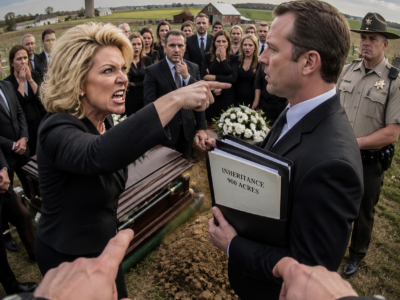
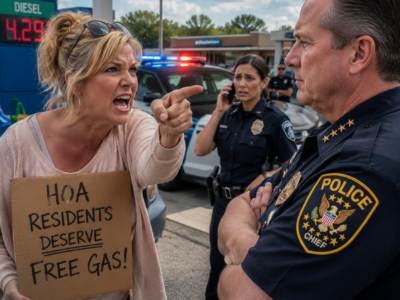
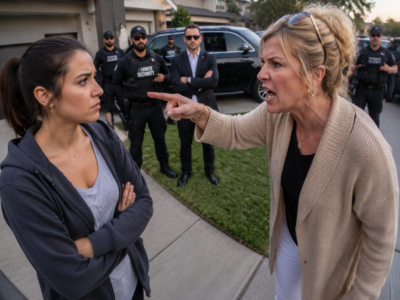
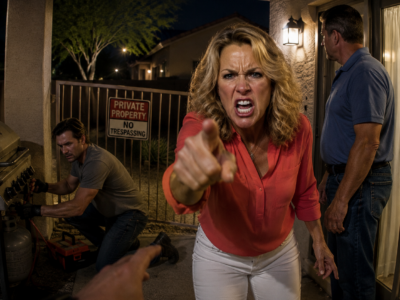
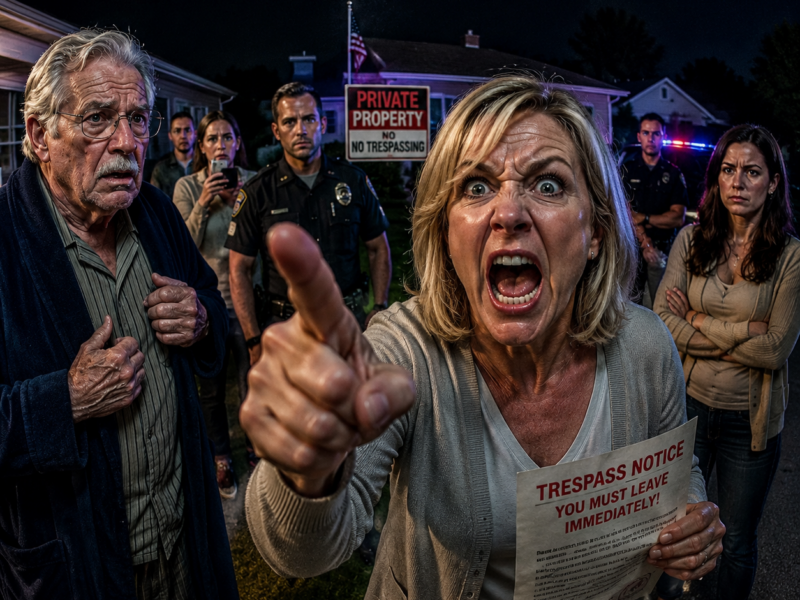
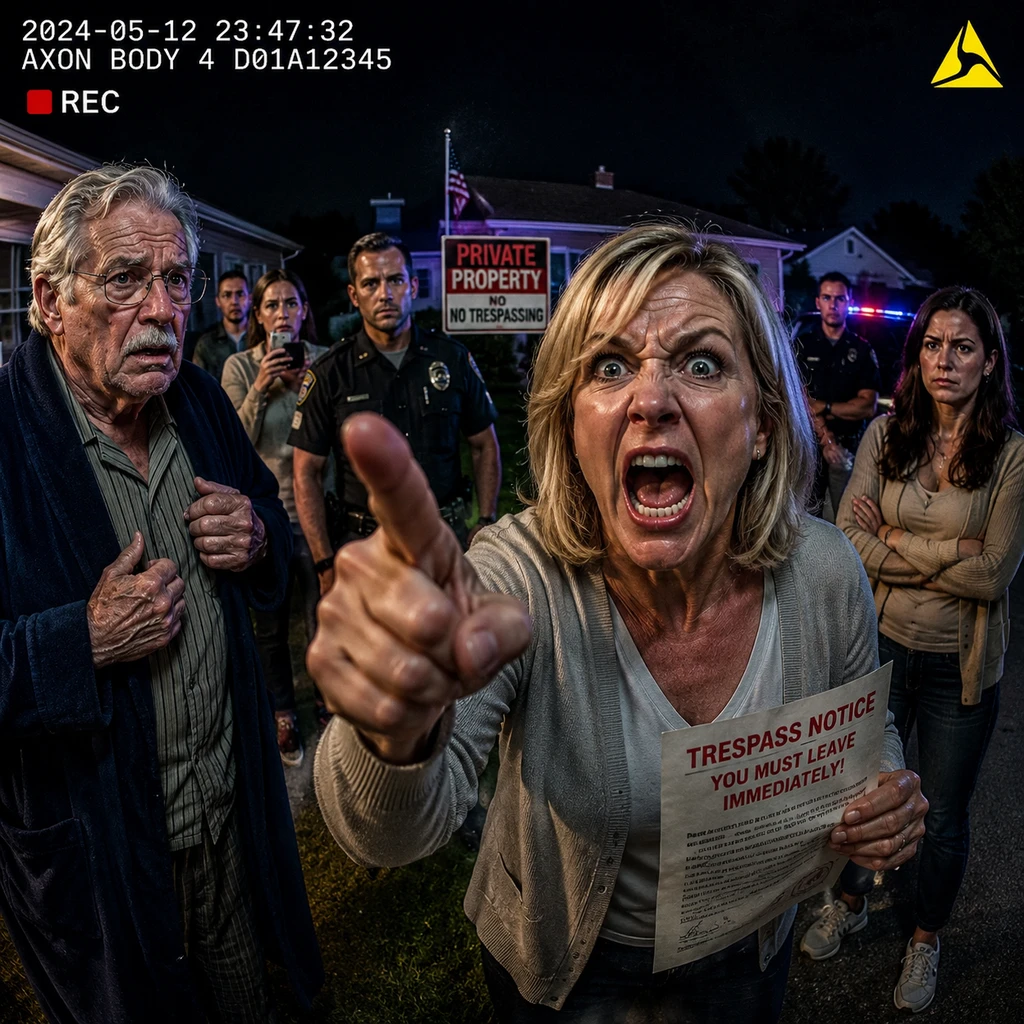
At 12:17 in the morning, while my grandfather stood barefoot on his own porch in a bathrobe, Sylvia Hartwell pointed one manicured finger at his chest and told the police, “Arrest him before he hurts somebody.”
The only thing in Grandpa’s hand was my grandmother’s blue coffee mug.
He had not threatened anyone.
He had not stepped off his porch.
He had not even raised his voice.
But under the white porch light, with half the neighborhood standing in the wet grass filming on their phones, my grandfather looked like the kind of man people forget has rights. Seventy-eight years old. Silver hair messed from sleep. Shoulders hunched from years of building fences, fixing tractors, burying his wife, and trying not to ask anybody for help.
Two police cruisers blocked his driveway.
An HOA board member in golf shorts was cutting the chain on his side gate.
Another woman had a clipboard and a flashlight.
And Sylvia Hartwell, president of the Cedar Ridge Homeowners Association, stood at the bottom of the porch steps in a pink pantsuit like she was hosting a press conference instead of trespassing on an old man’s land after midnight.
“Sir,” one officer said, keeping his hand near his belt, “we need you to step down here and talk to us.”
Grandpa blinked at him.
“This is my house,” he said.
His voice cracked a little on the word my.
That was the moment I saw the live video on my phone.
I was forty minutes away, asleep on my sister’s couch after helping with her newborn, when my phone began buzzing like a trapped insect. First one notification. Then five. Then twelve.
CEDAR RIDGE COMMUNITY WATCH.
POLICE AT OLD MAN CALLAHAN’S.
SYLVIA FINALLY DID IT.
Somebody tagged me beneath a shaking video.
Emma, isn’t this your grandpa?
I clicked it, and my blood went cold.
There he was.
Walter Callahan, the man who taught me to ride a bike, change a tire, and never sign anything without reading the small print twice, standing on his porch while strangers swarmed the yard he had owned since before Cedar Ridge was even a developer’s dream.
Then I heard Sylvia’s voice through the phone speaker.
“He is noncompliant, unstable, and dangerous. We have warned him for months.”
Grandpa looked confused.
Not weak.
Confused.
There is a difference, and people like Sylvia know how to use that difference against older people. They wait until the person is tired, isolated, embarrassed, or outnumbered. Then they dress up cruelty as procedure.
I jumped off the couch so fast I knocked over a lamp.
My sister asked what was wrong.
I only said, “They’re at Grandpa’s.”
By the time I got into my car, Sylvia had already crossed the first line.
By the time I reached Cedar Ridge, she had crossed three more.
And by sunrise, the woman who thought she could raid an old man’s property in the middle of the night would be crying in front of the same cameras she had invited.
Because she did not know one thing about my grandfather.
He had spent his whole life looking harmless.
He had never been harmless.
1. The House That Refused to Disappear
Grandpa’s house sat at the end of Briar Hollow Lane, in a little pocket of North Carolina that used to be all pine trees, red clay, and farmland before builders came in with pretty signs and expensive promises.
The developers called the neighborhood Cedar Ridge Estates.
Grandpa still called it “the back pasture.”
He had bought the old farmhouse in 1979 with my grandmother, Ruth. Back then, the road was gravel, the mailbox leaned sideways, and the closest neighbor was a man named Earl who kept goats and believed weather forecasts were government propaganda.
Grandpa spent forty years turning that place into something steady.
He built the porch himself.
He planted the pecan trees in a line so Grandma could see them from the kitchen window.
He poured the concrete for the garage with two friends and a borrowed mixer.
There was a small barn behind the house, a tool shed, a vegetable garden, a flagpole, and an old blue Ford pickup he refused to sell because, according to him, “a truck that starts is not junk.”
To most people, it looked like an aging farmhouse surrounded by new money.
To us, it was family history.
The trouble started when the land around him got sold.
A developer bought three hundred acres and carved it into a “premium lifestyle community.” That meant white fences, matching mailboxes, artificial ponds, walking trails, and rules about everything from roof colors to how long your garage door could stay open.
Grandpa’s property was not part of the HOA.
That sentence matters.
It matters the way a locked door matters.
His deed was older than the subdivision. His driveway connected to the new road through a recorded easement. His house sat like an island inside the curve of Cedar Ridge, surrounded by people who paid dues to an association he had never joined.
For a while, nobody cared.
Most neighbors liked him. He fixed lawnmowers for free. He gave tomatoes away in paper bags. He let kids pick pecans in the fall. When Grandma Ruth was alive, she baked pies for every family that moved in.
Then Sylvia Hartwell arrived.
Sylvia moved into the largest house on Briar Hollow with her husband, Ken, who worked in commercial insurance and looked permanently exhausted. She was the type of woman who could smile with only the bottom half of her face. Her hair was always perfect, her nails always pale pink, and her voice had that smooth, sharp tone people use when they want to insult you without technically raising their volume.
Within six months, she joined the HOA board.
Within nine months, she became president.
Within one year, Grandpa started receiving letters.
The first one complained about his mailbox.
The second complained about his truck.
The third complained about “visible exterior storage,” which meant the firewood stacked beside his garage.
Grandpa read every letter at the kitchen table with his glasses low on his nose.
Then he would slide it back into the envelope, write “NOT SUBJECT TO HOA AUTHORITY” across the front, and file it in a shoebox.
“You should get a lawyer,” I told him the first time I saw the pile.
He shrugged.
“Lawyers cost money. Ink is cheap.”
I laughed then.
I should not have.
Because people like Sylvia do not stop when you ignore them. They take silence as weakness. They take patience as permission.
And Grandpa had a lot of patience.
He had survived factory layoffs, prostate surgery, Grandma’s cancer, and a roof collapse during Hurricane Fran. A bossy HOA president did not scare him.
But she annoyed him.
That was worse.
The first time I met Sylvia, she was standing at Grandpa’s fence taking pictures of his barn.
Not from the road.
Not from public space.
She had one foot through the gap beside the gate, leaning in with her phone like she had discovered a crime scene.
Grandpa was in the yard with a rake.
“Can I help you?” he called.
She smiled.
“Oh, Mr. Callahan. I’m just documenting some concerns.”
“My concerns or yours?”
Her smile tightened.
“Community concerns.”
He leaned on the rake.
“Community ends at the fence.”
That was Grandpa. Quiet, dry, stubborn as old tree roots.
Sylvia looked at me then, maybe expecting me to apologize for him. I did not.
I had dealt with enough controlling people in my own life to know that they often start with language that sounds reasonable. Community standards. Safety. Property values. Compliance. Nobody says, “I want power over you because it makes me feel important.”
They say, “We’re just trying to keep the neighborhood nice.”
And sometimes they are.
I will be fair about that.
I have seen neighbors leave trash cans out for a week. I have seen rental houses turn into party houses. I understand why rules exist.
But rules become dangerous when the person enforcing them enjoys the punishment more than the order.
Sylvia enjoyed punishment.
You could see it in her eyes whenever Grandpa refused to bend.
2. The Letters Turned Mean
By spring, the letters changed tone.
They stopped saying “friendly reminder.”
They started saying “final notice.”
Grandpa was accused of maintaining an “unapproved agricultural structure,” though the barn had been there before half the board members were born.
He was accused of “displaying unauthorized signage” because he had a hand-painted wooden sign near his garden that said RUTH’S TOMATOES.
That sign had been Grandma’s.
She painted it the summer before she died. Her hands were already shaking by then, so the letters leaned a little. Grandpa had sealed it with three coats of varnish and placed it by the garden every year.
Sylvia called it a violation.
That one got to him.
I found him one Saturday standing beside the sign with his hands in his pockets, just staring at it.
“You okay?” I asked.
He nodded.
But his jaw was tight.
“Your grandma made this,” he said.
“I know.”
“They said it’s advertising.”
I looked around at the empty garden, the leaning birdhouse, the porch swing with faded cushions.
“Advertising what?”
He gave a small, bitter laugh.
“Memory, I guess.”
That was the first time I felt real anger.
Not annoyance.
Anger.
Because there is a special kind of cruelty in bothering old people over things that keep them connected to the dead. You can call it policy. You can dress it up in typed letters and official logos. But at the heart of it, it is still cruelty.
I told him again to get a lawyer.
This time he said he had already made a call.
“To who?”
“Friend of your grandmother’s.”
Grandpa was mysterious like that. He collected people the way other men collected tools. Former students, old mechanics, county clerks, retired deputies, church ladies, judges he had built cabinets for, widows whose gutters he had cleaned after storms.
I did not press him.
Maybe I should have.
Sylvia’s next move was public humiliation.
At the monthly HOA meeting, she put a photo of Grandpa’s property on the projector under the heading “Ongoing Compliance Threats.”
Grandpa did not attend because, again, he was not a member.
But Mrs. Alvarez from two houses down recorded it for us.
In the video, Sylvia stood at the front of the clubhouse with a laser pointer.
“We have one property,” she said, “that continues to undermine the appearance, safety, and reputation of Cedar Ridge.”
A man asked, “Isn’t that house outside the HOA?”
Sylvia smiled like she had been waiting for that question.
“The legal boundaries are more complicated than Mr. Callahan would like everyone to believe.”
They were not complicated.
They were inconvenient.
There is a difference.
Then she said something that made my stomach turn.
“We are also concerned about his mental state.”
Grandpa paused the video when Mrs. Alvarez showed it to us.
He stared at Sylvia’s frozen face on the screen.
“My mental state,” he repeated quietly.
“She’s trying to build a story,” I said.
He nodded.
“I know.”
And he did.
That was what none of us understood at the time. Grandpa was not ignoring Sylvia because he was confused. He was letting her talk. Letting her write. Letting her record herself.
He knew something about people who crave control.
Given enough rope, they do not just hang themselves.
They build the gallows, invite witnesses, and demand applause.
Still, the stress started showing.
He stopped sleeping well.
He checked the gate twice every night.
He kept the porch lights on.
One afternoon, I found a county tax notice on the table and saw his hands trembling as he opened it. For a second, I did not see the man who once carried me on his shoulders at the state fair. I saw an old man alone in a house full of memories, being slowly hunted by paperwork.
That scared me more than the midnight raid would later scare me.
Because harassment does not always look dramatic at first.
Sometimes it looks like envelopes.
Sometimes it looks like a clipboard.
Sometimes it looks like a woman in a pink suit telling a room full of people that your grandfather is unstable because he refuses to let her control land she does not own.
3. The First Time Sylvia Came at Night
The first late-night incident happened in June.
Grandpa called me at 10:42 p.m.
He never called that late.
When I answered, he said, “Don’t panic.”
Which, of course, made me panic immediately.
“What happened?”
“Somebody’s at the gate.”
I sat up in bed.
“Who?”
“Looks like Sylvia and two others.”
“What do you mean, at the gate?”
“I mean at the gate.”
His voice was calm, but I could hear wind through the phone. He was outside.
“Grandpa, go inside.”
“I’m on the porch.”
“Go inside and lock the door.”
He sighed.
“Emma.”
“Do it.”
He did, mostly because he loved me and partly because he knew I had inherited his stubbornness.
He stayed on the phone while I pulled up the security camera app. We had installed cameras after the first property-line argument. Grandpa had complained about them for a week, saying a man should not need cameras to prove his porch was his porch.
But he let me install them.
The video showed Sylvia standing outside the gate with a flashlight. Beside her was Martin Phelps, the HOA treasurer, a nervous little man with round glasses who always looked like he was about to apologize and then never did. The third person was a younger woman named Ashley, who ran the HOA social media page and treated every neighborhood disagreement like content.
Sylvia shined the flashlight through the gate.
“I can see the trailer,” she said.
Martin shifted beside her.
“We should come back tomorrow.”
“No. He moves things when warned.”
That trailer belonged to my cousin. It had been parked behind Grandpa’s barn for two days while my cousin recovered from a back injury. It was not visible from the street unless you trespassed or craned your neck through the gate like a raccoon.
Grandpa watched from inside.
“They’re taking pictures,” he said.
“I’m calling the police.”
“No.”
“Yes.”
“Emma, don’t.”
“Why not?”
“Because I want them to finish.”
That sentence chilled me.
“What are you doing?”
“Documenting.”
Grandpa had set up an extra camera in the pecan tree.
I did not know that.
The camera caught everything. Sylvia stepping onto the lower rail of the gate. Sylvia reaching over to try the latch. Sylvia telling Martin, “If he refuses access during an emergency inspection, that strengthens our case.”
Emergency inspection.
That phrase would come back later.
The next morning, Grandpa received another letter. This one claimed the HOA had “observed hazardous activity” and reserved the right to take “immediate corrective measures” if the property continued to threaten community safety.
I read it three times.
It was vague on purpose.
Vague language is useful when people want to scare you without committing to facts.
I told Grandpa to send everything to a lawyer.
He said he already had.
“To the friend of Grandma’s?”
He smiled faintly.
“Something like that.”
I should explain something about my grandfather.
He was not loud.
He did not threaten lawsuits.
He did not brag.
He was the kind of man who let people underestimate him because correcting them took too much energy. He had a high school diploma, calloused hands, and old boots. People like Sylvia saw that and assumed he was simple.
But Grandpa had spent thirty-two years teaching shop and mechanical drafting. He could read plans, maps, permits, surveys, and contracts. He had built half the cabinets in the county courthouse during summers. He knew where records lived. He knew names. He knew dates.
And after Grandma died, when sleep got hard and the house got too quiet, he began organizing every piece of paper connected to that property.
Deeds.
Surveys.
Easements.
Tax maps.
Letters.
Certified mail receipts.
Photos.
Video logs.
He had three binders in the bottom drawer of Grandma’s china cabinet.
One was labeled LAND.
One was labeled HOA.
One was labeled SYLVIA.
I saw them once and laughed.
“Grandpa, this is intense.”
He looked at me over his glasses.
“People who mean trouble count on you being messy.”
I think about that line a lot.
Especially now.
4. The Board Meeting That Lit the Fuse
The situation exploded in August at a special HOA meeting.
Grandpa only went because Sylvia sent a letter to every house in Cedar Ridge announcing a vote on “legal action concerning the Callahan property nuisance.”
Mrs. Alvarez brought the letter over in tears.
“I’m sorry,” she told him. “This is wrong.”
Grandpa thanked her, folded the letter, and put it in the Sylvia binder.
Then he put on his brown jacket and asked me to drive him.
The clubhouse was packed.
People love drama when it does not cost them anything. They came with travel mugs, folding arms, whispered opinions. Some looked sympathetic. Some looked annoyed. A few looked excited, which bothered me most.
Sylvia sat at the front table with the board, wearing a cream blazer and a pearl necklace. She looked polished and ready. Beside her sat an attorney named Brent Wallace, who had the tired confidence of a man billing by the hour.
Grandpa and I sat in the back.
When Sylvia saw him, her eyes brightened.
Not softened.
Brightened.
Like she had been hoping he would show up.
She began with a slideshow.
Photos of Grandpa’s barn.
Photos of his truck.
Photos of the tomato sign.
Photos of the flagpole.
Then a blurry nighttime photo of my cousin’s trailer behind the barn.
“This,” Sylvia said, “is what residents see when entering our premium community.”
A man behind me whispered, “I don’t see it from my house.”
His wife elbowed him.
Sylvia continued.
“Mr. Callahan has repeatedly refused to comply with Cedar Ridge standards. He has created visual blight, safety concerns, and legal uncertainty that affects all of us.”
Grandpa raised his hand.
Sylvia ignored him.
He kept it raised.
Finally, someone said, “Let him speak.”
Sylvia’s smile became sharp.
“Mr. Callahan is not a member of this association, as he frequently reminds us, so this is not an open forum for him.”
Grandpa stood anyway.
The room got quiet.
He was not tall like he used to be. Age had folded him a bit. But there was still something in him that made people listen.
“My property is not in your association,” he said. “Never has been. Never will be. My deed says so. County map says so. Your own developer said so when he built around me.”
Brent Wallace leaned toward his microphone.
“Mr. Callahan, legal interpretation is not quite that simple.”
Grandpa looked at him.
“It is when you read.”
A few people laughed.
Sylvia flushed.
“Sir, your hostility is exactly why this has become a concern.”
There it was again.
The story.
Not the facts.
The story.
Grandpa was hostile. Grandpa was unstable. Grandpa was dangerous. Grandpa was the problem. Sylvia was just protecting the community.
I stood up before I could stop myself.
“He’s not hostile. He’s defending his home.”
Sylvia looked at me like I was a stain on the carpet.
“And you are?”
“His granddaughter.”
“Then perhaps you can encourage him to cooperate before this escalates.”
I wanted to say something sharp. Something ugly. Something that would feel good for ten seconds and make everything worse.
Grandpa touched my arm.
One small touch.
Sit down.
So I did.
Then Sylvia made her mistake.
She announced the HOA would pursue emergency enforcement authority if Grandpa failed to remove all violations within ten days.
Grandpa asked, “Authority from who?”
Sylvia said, “From the proper channels.”
“What proper channels?”
She did not answer.
After the meeting, people gathered in clusters outside. Some came to Grandpa and apologized. Others avoided eye contact. That is how communities fall apart, by the way. Not because everybody agrees with the bully, but because too many people decide silence is safer.
In the parking lot, Sylvia approached us.
No cameras then. No microphone.
Just her, Grandpa, and me under a yellow streetlamp.
“You are embarrassing yourself,” she said.
Grandpa looked tired.
“No, ma’am. You’re embarrassing your office.”
Her nostrils flared.
“You think that old deed protects you from everything?”
“It protects me from you.”
She stepped closer.
“You have no idea what I can do.”
Grandpa’s face changed then.
Not much.
Just enough.
He looked at her the way he used to look at a student holding a running saw wrong.
Careful. Quiet. Fully awake.
“Sylvia,” he said, “you’re standing at the edge of a line. I’d advise you not to cross it.”
She smiled.
“Or what?”
He did not answer.
He just walked away.
That silence drove her crazy.
People like Sylvia need a reaction. If you refuse to give them one, they go looking for a bigger stage.
The midnight raid was her bigger stage.
5. The Night Before
The day before the raid was a Thursday.
Hot, sticky, and restless.
The kind of Southern summer day where the air feels like it has been used already.
Grandpa spent the morning replacing a hinge on the barn door. I brought him lunch around noon. Tomato sandwich, kettle chips, sweet tea. He ate on the porch while I complained about work, bills, and the price of car insurance.
Normal things.
Looking back, that hurts.
Life gives you normal hours right before everything breaks, and you never know enough to treasure them.
He asked about my sister’s baby.
I showed him pictures.
He smiled the real smile then, the one that made his whole face younger.
“Looks like Ruth,” he said.
“She looks like a potato.”
“Your grandma looked like a potato once too.”
I laughed so hard I nearly spilled tea.
The garden buzzed with cicadas. A neighbor’s dog barked somewhere down the lane. Grandpa’s old truck sat by the garage, blue paint faded, windshield dusty.
Then a white SUV slowed in front of the house.
Grandpa’s smile disappeared.
Sylvia.
She did not stop.
She just rolled by slowly, phone raised in one hand.
I stood.
Grandpa stayed seated.
“Don’t,” he said.
“She’s filming your house again.”
“I know.”
“Grandpa.”
“I know.”
That was when he told me about the hearing.
“What hearing?”
He wiped his hands on a napkin.
“County mediation. Monday morning. My attorney filed notice.”
I stared at him.
“Your attorney?”
“Your grandmother’s friend’s son. He’s a property lawyer in Raleigh.”
“You didn’t tell me?”
“Didn’t want you worrying.”
“That is the most grandfather thing you’ve ever said.”
He shrugged.
The attorney had sent a formal letter to the HOA demanding they stop contacting Grandpa, stop entering the property, and correct false claims made to residents. The county mediation was supposed to establish, on record, that the HOA had no authority over his land.
Monday.
Just four days away.
That timing mattered.
Because by Thursday night, Sylvia knew she was about to lose the official route.
So she chose another one.
Fear.
At 11:38 p.m., she called the non-emergency police line and reported suspicious activity at Grandpa’s property.
We learned that later.
She said there were “unknown men moving equipment in the dark.”
There were not.
She said she heard “what sounded like a cry for help.”
No one had cried for help.
She said Mr. Callahan had become “increasingly aggressive toward residents.”
He had not.
Then, and this part still makes my hands shake when I think about it, she told the dispatcher she was the HOA president and had “emergency access authorization” to inspect an unsafe structure.
She made herself sound official.
That is one of the oldest tricks in the world.
Say enough serious words in a calm voice, and busy people may believe you long enough for damage to happen.
At 11:56 p.m., Sylvia texted four board members and two volunteers.
EMERGENCY INSPECTION TONIGHT. POLICE EN ROUTE. NEED WITNESSES.
Only two board members came.
Martin Phelps, because he was too weak to say no.
And Ashley, because drama was oxygen to her.
She also brought a handyman named Dale to cut the gate chain.
That detail tells you everything.
You do not bring bolt cutters to a welfare check.
You bring bolt cutters when you already decided the gate is coming open.
At 12:11 a.m., the first police cruiser arrived.
At 12:14, the second.
At 12:15, Sylvia told the officers Grandpa was refusing lawful access.
Grandpa was asleep.
At 12:16, Dale cut the chain.
At 12:17, Grandpa stepped onto the porch in his bathrobe, holding Grandma’s blue mug.
That was the image the whole neighborhood saw.
Not because Sylvia wanted the truth recorded.
Because she believed the truth would obey her.
6. The Midnight Raid
When Grandpa opened the door, the yard was full of light.
Red and blue from the cruisers.
White from flashlights.
Yellow from the porch.
Everything looked unreal, like a stage built in a nightmare.
He saw strangers by his gate. He saw Sylvia near the walkway. He saw a uniformed officer standing beside his porch steps.
For one second, he thought someone had died.
That is what he told me later.
At his age, when police come at midnight, your mind does not go to property disputes. It goes to hospitals. Accidents. Family.
He opened the storm door.
“What happened?” he asked.
Sylvia answered before the officer could.
“Mr. Callahan, this has gone far enough.”
Grandpa looked at her.
“Why are you in my yard?”
Officer Brandon Ellis, the younger of the two, glanced between them.
“Sir, we received a report of possible distress and suspicious activity.”
Grandpa frowned.
“I was asleep.”
Sylvia threw out her arm toward the barn.
“There are structures back there that may be occupied. We have reason to believe there are unauthorized persons on the property.”
“That’s a barn,” Grandpa said.
“Sir,” the officer said, “do you live alone?”
Grandpa’s face hardened.
“Yes.”
“Is anyone else inside?”
“No.”
“Any weapons in the house?”
That question landed hard.
Grandpa looked at the officer’s hand near his belt.
Then he looked at Sylvia, who had gone still.
She wanted that question.
She wanted him framed as a threat.
“I have a shotgun locked in a safe,” Grandpa said carefully. “Same as half the houses on this road.”
Sylvia snapped, “He just admitted it.”
Grandpa turned to her.
“You need to leave.”
That was when she pointed at him.
“Arrest him before he hurts somebody.”
The neighbors had started coming out by then.
Porch lights flicked on one by one. People stood in pajamas, shorts, bathrobes. Phones rose in the dark like small glowing windows.
Mrs. Alvarez was there. So was DeShawn Miller, who lived across the street and worked nights as a paramedic. He had just gotten home and still wore his uniform pants.
DeShawn started recording.
Sylvia noticed.
“Please stop filming,” she said sharply. “This is an active enforcement action.”
DeShawn did not lower his phone.
“By who?”
She ignored him.
Ashley began filming too, but with commentary.
“This is what happens when residents refuse to follow basic standards,” she said into her phone.
Grandpa heard her.
His face fell in a way I will never forget.
Not fear exactly.
Humiliation.
And that is what made the whole thing so ugly. It was not enough for Sylvia to scare him. She needed an audience.
Officer Ellis asked Grandpa to step down from the porch.
Grandpa said no.
“This is my porch.”
The older officer, Sergeant Miller, seemed less convinced by Sylvia. He asked to see the emergency authorization paperwork.
Sylvia handed him a folder.
I have seen that folder in evidence photos since. It was labeled CALLAHAN ACTION PLAN.
Action plan.
For a seventy-eight-year-old man’s garden and barn.
Sergeant Miller shined his flashlight over the paper.
“Ma’am, this appears to be an HOA document.”
“It grants us emergency inspection access.”
“Signed by who?”
“The board.”
Martin shifted near the gate.
Sergeant Miller looked at him.
“You’re board?”
Martin swallowed.
“Treasurer.”
“You signed this?”
Martin opened his mouth.
Sylvia cut in.
“The board approved action.”
“That’s not what I asked.”
Martin looked at the ground.
“I didn’t sign that.”
The air changed.
Even on the shaky video, you can feel it.
Sylvia’s head whipped toward him.
“Martin.”
He flinched.
“I approved discussion. Not this. Not tonight.”
Grandpa gripped the mug with both hands.
Officer Ellis stepped away from the porch and toward Sergeant Miller.
“Ma’am,” Sergeant Miller said, “without a warrant or clear emergency, you don’t have authority to enter private property.”
Sylvia’s voice rose.
“This property affects our community. He has been warned repeatedly.”
“That’s civil.”
“He is unstable.”
“That’s not probable cause.”
She hated that.
You could see it.
She had built the night around one expectation: that the police would accept her version, intimidate Grandpa, and give her raid the shine of authority.
But Sergeant Miller was not playing along.
So Sylvia escalated.
She walked toward the garage.
“Dale, document the violations.”
Dale hesitated.
“Ma’am—”
“Now.”
Dale and Ashley moved toward the side yard.
Grandpa stepped off the porch.
“Don’t go in there.”
Officer Ellis held up a hand.
“Sir, stay back.”
“That’s my garage.”
Sylvia turned.
“Then you should have complied before it reached this point.”
And then she did the thing that made the night unforgivable.
She opened Grandpa’s garage door.
Not fully. Just enough to slip inside.
But enough.
Enough to cross from harassment into invasion.
Enough to make an old man’s private space feel unsafe.
Enough to turn a neighborhood dispute into something that would follow her for the rest of her life.
7. What She Found in the Garage
Grandpa’s garage was not pretty.
It smelled like sawdust, motor oil, and old cardboard. There were coffee cans full of screws, pegboards lined with tools, fishing rods in the corner, and a workbench scarred by forty years of projects.
It was not a violation.
It was a life.
Sylvia stepped inside like she owned the air.
Ashley followed with her phone.
Dale stayed near the door, looking miserable.
Grandpa tried to move forward, but Officer Ellis blocked him again.
“Sir, please.”
Grandpa’s voice broke.
“My wife’s things are in there.”
That should have stopped everyone.
It did not stop Sylvia.
She shined her flashlight around and began narrating.
“Unsecured chemicals. Improper storage. Fire hazard. Potential vermin activity.”
There was a sealed gas can. A shelf of paint. A bag of grass seed.
Normal garage things.
Then she saw the cedar chest.
It sat beneath the window, covered with a folded quilt. Grandpa had built that chest for Grandma on their twentieth anniversary. After she died, he kept her letters, church programs, recipe cards, and Christmas ornaments inside.
Sylvia pointed.
“What’s in that?”
Grandpa said, “Leave it alone.”
His voice was different.
Low.
Not threatening.
Pained.
That should have stopped her too.
It did not.
She lifted the quilt.
Grandpa moved fast for his age, stepping around Officer Ellis.
“Don’t touch that.”
Officer Ellis caught his arm.
“Sir.”
Grandpa pulled away.
Not violently.
Just instinctively.
The mug slipped from his hand.
Grandma’s blue mug hit the porch step and shattered.
For half a second, everyone froze.
I was not there yet, but I have watched the footage enough times that the sound lives in me.
A small crack.
Ceramic on wood.
Then Grandpa looked down at the pieces.
His face changed in a way that still makes me cry.
That mug had sat beside Grandma’s bed during chemo. She used it for tea, then broth, then ice chips when swallowing got hard. After she passed, Grandpa kept it near the coffee maker. He did not talk about it. He just used it every morning.
And now it was broken at his feet because Sylvia Hartwell could not leave an old man alone.
Sylvia glanced at the pieces, then back at the garage.
She did not apologize.
Instead, she said, “This is exactly the kind of emotional volatility we’re concerned about.”
That sentence traveled through the crowd like a slap.
Mrs. Alvarez gasped.
DeShawn said, “Are you serious?”
Sergeant Miller stepped forward.
“Everybody out of the garage. Now.”
Sylvia ignored him and opened the cedar chest.
That was the line.
Not the legal line. She had crossed that already.
The human line.
The line decent people feel in their bones.
She lifted a stack of papers, saw old photographs, and frowned as if disappointment itself offended her.
Grandpa’s voice went quiet.
“Those are Ruth’s.”
Sylvia looked at the papers again.
Maybe she realized, too late, that the chest was not hiding violations.
It was hiding grief.
But pride is a dangerous thing when it gets cornered.
She tossed the papers back too quickly. Some slid out, scattering across the garage floor. A photo of Grandma on their wedding day landed near Dale’s boot.
Grandpa made a sound I had never heard from him.
Not a shout.
Not a sob.
Something in between.
That was the moment my car turned onto Briar Hollow Lane.
I saw the police lights first.
Then the neighbors.
Then my grandfather standing in his bathrobe, surrounded by people who had mistaken his loneliness for weakness.
I parked crooked in the street and ran.
Sylvia saw me coming.
For the first time that night, she looked uncertain.
Good.
She should have.
Because I had spent the entire drive calling everyone Grandpa had been too proud to call.
His attorney.
My sister.
The county sheriff’s office.
And one person Sylvia never expected.
The man who had written the original exemption agreement for the developer thirty years earlier.
He was eighty-two.
He was retired.
And he was furious.
8. When I Reached the Porch
I ran so hard my lungs burned.
“Grandpa!”
He turned when he heard me.
The look on his face nearly stopped me cold. Relief, shame, anger, all tangled together. Older people often get embarrassed when they are mistreated in public. That has always bothered me. The person being harmed feels ashamed while the person causing harm stands there with a clipboard.
I went straight to him.
“Are you hurt?”
He shook his head.
But he was staring at the broken mug.
I looked down.
The pieces were scattered near the porch step, blue shards catching the police lights.
For a second, I forgot everyone else.
“Oh, Grandpa.”
He swallowed.
“She broke Ruth’s mug.”
Sylvia snapped from the garage doorway, “No one broke anything. He dropped it while acting aggressively.”
I turned toward her.
I do not remember deciding to speak.
I just did.
“Get out of his garage.”
Her eyebrows lifted.
“Excuse me?”
“You heard me.”
Officer Ellis stepped between us.
“Ma’am, please calm down.”
That almost set me off. I know officers say that to keep control, and I understand the job is difficult. I really do. But there is something deeply frustrating about arriving to find your grandfather’s gate cut, his garage invaded, his dead wife’s belongings scattered, and then being told to calm down.
Still, I forced myself to breathe.
I had worked customer service long enough to know that sometimes the person who stays calm gets heard. Not because they are more right, but because the system likes calm people better.
So I lowered my voice.
“Officer, my name is Emma Callahan. Walter Callahan is my grandfather. This property is not part of Cedar Ridge HOA. They have no authority to enter. They cut his chain. They opened his garage. They touched personal property. I want every person not wearing a badge removed from this land.”
Sylvia laughed once.
“Oh, that’s cute.”
Sergeant Miller looked at her.
“Ma’am, step out of the garage.”
“I am conducting an inspection.”
“No, you’re not.”
“I have documentation.”
“You have an HOA form with disputed signatures and no legal order. Step out.”
She did.
But slowly, like she wanted everyone to know she was choosing to comply.
People like Sylvia can turn even retreat into theater.
I pulled out my phone and opened the folder Grandpa had shared with me weeks earlier. Deed. Survey. County map. Easement.
I showed it to Sergeant Miller.
He studied the first page.
Then the second.
Then he looked at Grandpa.
“Sir, you own this parcel independently?”
Grandpa nodded.
“Since 1979.”
Sergeant Miller turned to Sylvia.
“Why did you tell dispatch you had emergency access authority?”
Sylvia’s voice became polished again.
“Because the property presents ongoing safety risks.”
“That’s not what I asked.”
“I acted in good faith.”
No, she did not.
Good faith does not bring bolt cutters.
Good faith does not open a grieving widower’s cedar chest.
Good faith does not accuse a man of being dangerous while standing in his garage without permission.
Martin finally spoke.
“I told her we should wait for Monday.”
Sylvia’s face went pale.
“Martin, stop talking.”
But he did not.
Maybe guilt finally found a spine in him.
“She said if we didn’t act before mediation, we’d lose leverage.”
There it was.
Clear as a gunshot.
Leverage.
Not safety.
Not emergency.
Leverage.
Ashley lowered her phone.
Dale took three steps away from the gate like distance could save him.
Officer Ellis looked sick.
Sergeant Miller asked Sylvia to sit on the porch rail while they sorted things out.
She refused.
He told her again.
This time, not as a suggestion.
The crowd murmured.
And because the universe has a sense of timing, that was when a black sedan pulled up behind the police cruisers.
Out stepped Grandpa’s attorney, Daniel Reeves.
He wore jeans, a wrinkled button-down shirt, and the expression of a man who had been woken up for nonsense and intended to make somebody pay for it.
Behind him came another older man with a cane.
Arthur Bell.
Retired county attorney.
The man who drafted Grandpa’s exemption agreement.
Arthur looked at the cut chain, the open garage, the scattered papers, and Sylvia sitting stiffly under the porch light.
Then he said, loud enough for half the street to hear, “Well, Sylvia, this is about the dumbest thing I’ve seen in thirty years.”
Nobody laughed.
But I wanted to.
I really did.
9. The Paper That Ended the Raid
Daniel Reeves did not yell.
That made him scarier.
He walked up to Sergeant Miller, introduced himself, and handed him a printed packet from a folder. Not dramatic. Not flashy. Just paper.
“Officer, this is the recorded deed, subdivision plat, exemption agreement, and my cease-and-desist letter delivered to the Cedar Ridge HOA five business days ago.”
Sylvia stood.
“That letter was under review.”
Daniel glanced at her.
“Sit down.”
Two words.
Flat.
Beautiful.
She sat.
Arthur Bell leaned on his cane beside Grandpa.
“Walter,” he said softly, “you all right?”
Grandpa nodded, though he was not.
Arthur looked at the broken mug.
His face tightened.
“I’m sorry.”
That nearly broke me.
Because sometimes kindness does what cruelty cannot. It makes you feel the wound.
Daniel continued speaking with Sergeant Miller. He explained the property boundaries. He explained the easement. He explained that the HOA had no jurisdiction, no inspection rights, and no emergency power over Grandpa’s parcel.
Then he showed the signed delivery receipt for the cease-and-desist letter.
Sylvia had signed it herself.
That meant she knew.
She had known before she called police.
She had known before she cut the chain.
She had known before she opened the garage.
Sergeant Miller asked if Daniel wanted to file a complaint.
Daniel looked at Grandpa.
This was the moment everyone expected Grandpa to back down. He was old. Tired. Embarrassed. Standing barefoot in front of neighbors.
But he bent down, picked up one large piece of the blue mug, and held it in his palm.
Then he said, “Yes.”
Sylvia’s head snapped up.
“Walter, don’t be ridiculous.”
He did not even look at her.
“Yes,” he repeated.
That one word changed everything.
The officers began taking statements.
Dale admitted Sylvia told him to cut the chain.
Martin admitted the board had never approved a midnight inspection.
Ashley admitted she had been instructed to record “evidence of noncompliance,” not a welfare concern.
Mrs. Alvarez gave a statement about previous harassment.
DeShawn provided video.
I provided the security camera footage from Grandpa’s app, including the moment Sylvia entered the garage.
Sylvia kept interrupting.
“I am the HOA president.”
“I had community authority.”
“He has been hostile.”
“This is being taken out of context.”
That phrase always shows up when people get caught doing exactly what they did.
Taken out of context.
What context makes it acceptable to raid an old man’s property at midnight?
What context makes it acceptable to break a lock, enter a garage, touch a dead woman’s belongings, and then blame the widower for being emotional?
There was no context.
Only entitlement.
At 1:43 a.m., Sergeant Miller told Sylvia she was being cited pending further investigation for trespass and property damage. Formal charges would be reviewed later.
She looked stunned.
Not sorry.
Stunned.
Those are different things too.
She had spent so long treating rules as weapons that she seemed genuinely confused to find one pointed back at her.
The officers did not arrest her that night. I know some people wanted that dramatic ending right there. Handcuffs. Tears. Instant justice.
Real life is usually slower.
Messier.
Paperwork takes longer than outrage.
But they did escort her off the property.
The neighbors watched in silence as she walked down Grandpa’s driveway, her pink suit bright under the police lights, her face stiff with humiliation.
At the gate, she turned back.
“This is not over,” she said.
Grandpa finally looked at her.
“No,” he said. “It isn’t.”
And for the first time since I was a child, I saw something in my grandfather that reminded me of a storm coming across open land.
Quiet from a distance.
Unstoppable once it arrived.
10. The Morning After
Nobody slept that night.
After the police left, the yard looked wounded.
The chain lay in the grass.
The garage door hung half open.
Grandma’s papers were spread across the workbench where we had gathered them, trying not to bend the corners. The wedding photo had a boot print on the edge. Not across her face, thank God. Just the white border.
Grandpa sat at the kitchen table with the broken pieces of the mug in front of him.
I made coffee nobody drank.
My sister arrived at 3:10 a.m. with the baby asleep in a carrier and fury written all over her face. She hugged Grandpa carefully, like he might crack.
He patted her back.
“I’m all right.”
“You are not all right,” she said.
He smiled faintly.
“No. But I’m here.”
That was Grandpa’s way.
Do not dramatize pain.
Do not deny it either.
Just name the ground beneath your feet.
By sunrise, the video had spread through the neighborhood, then the county, then beyond. DeShawn posted only one clip at first: Sylvia pointing at Grandpa and telling police to arrest him. He blurred addresses and kept it focused on the incident.
Ashley, in a move that still amazes me, deleted her own video. But the internet is not kind to people who try to erase things after uploading them. Several neighbors had screen recordings.
By 9 a.m., local reporters were calling.
By noon, Cedar Ridge’s management company issued a statement saying the board president’s actions were “not authorized by the association.”
That was not entirely true.
They had fed the monster.
Maybe they had not approved that specific night, but they had laughed at her jokes, nodded through her presentations, ignored her threats, and cashed the dues that paid for her letters.
People love to pretend bad behavior appears suddenly.
It rarely does.
Usually, it grows in public while everyone calls it “not my problem.”
Grandpa did not want to speak to reporters.
I respected that.
Daniel Reeves told us to say nothing publicly until he filed the complaint.
The legal side moved fast for once.
By Monday morning, the mediation that Sylvia had tried to beat became something else entirely. Instead of arguing about Grandpa’s alleged violations, Daniel presented video of the raid.
The county mediator watched with a face like stone.
Sylvia attended with Brent Wallace, the HOA lawyer, and two board members who looked like they wanted to crawl into the air vent.
Grandpa wore his brown jacket.
I sat beside him.
When the clip showed the mug breaking, Grandpa looked down at his hands.
I wanted to reach for him, but I did not. Sometimes dignity means letting someone sit with their pain without making it a performance.
Daniel laid out the facts.
Grandpa’s land was exempt.
The HOA knew.
The HOA had been notified.
Sylvia entered anyway.
The board had allowed a pattern of harassment.
Then Arthur Bell testified about the original development agreement.
His voice was old but steady.
“That property was specifically excluded because Mr. Callahan refused to sell. The developer agreed. The county recorded it. There has never been ambiguity.”
The mediator turned to Brent Wallace.
“Do you dispute that?”
Brent looked like a man who wished he had chosen dentistry.
“No.”
Sylvia whispered something to him.
He ignored her.
That was the first public crack in her power.
Not the video.
Not the police report.
That moment.
Her own lawyer refusing to repeat her fantasy.
11. Sylvia’s Counterattack
Sylvia did not go quietly.
People like her rarely do.
The next week, she sent an email to the entire neighborhood. The subject line was COMMUNITY SAFETY AND MISINFORMATION.
In it, she claimed she had acted out of concern for residents. She said videos were being “weaponized.” She said Grandpa’s family was “pursuing a smear campaign.” She said the HOA board needed unity against “outside interference.”
Outside interference.
About my grandfather.
On his own land.
I read the email three times, each time angrier than before.
But Daniel told us not to respond.
“Let her keep writing,” he said.
Grandpa smiled a little at that.
“More rope.”
“Exactly,” Daniel said.
The second email was worse.
Sylvia hinted that Grandpa had “declining cognitive stability.”
That phrase lit something in me.
I wanted to write back to everyone. I wanted to tell them he still balanced his checkbook by hand, still remembered every neighbor’s kid’s name, still knew which socket wrench was missing from a drawer he had not opened in three months.
But the most insulting part was not even the lie.
It was the strategy.
She was trying to make age itself suspicious.
That happens more than people admit. An older person gets angry, and suddenly they are unstable. They forget a name, and suddenly they cannot make decisions. They resist being controlled, and suddenly somebody suggests they need “help.”
Of course, some elderly people do need help. My own grandmother needed help near the end, and there is no shame in that. But using age as a weapon against someone’s independence is rotten.
I will say that plainly.
It is rotten.
The neighborhood reaction surprised me.
Maybe I had been too cynical.
Maybe the mug changed things.
Maybe people saw their own parents in Grandpa.
Whatever the reason, the silence broke.
Mrs. Alvarez organized a petition demanding Sylvia resign.
DeShawn printed property maps and put them in mailboxes.
A retired nurse named Janet wrote a long reply explaining that “concern” does not require bolt cutters.
Even Martin Phelps resigned from the board and sent an apology to Grandpa.
It was awkward, stiff, and clearly reviewed by a lawyer, but still.
He wrote, “I failed to stop something I knew was wrong.”
Grandpa read that line twice.
Then he folded the letter and put it in the binder.
“Do you forgive him?” I asked.
Grandpa thought about it.
“I don’t know yet.”
That answer felt honest.
People rush forgiveness because discomfort makes them impatient. They want the harm wrapped up neatly so everyone can move on. But the person hurt does not owe the room a clean ending.
Grandpa did not owe Martin peace.
He did not owe Sylvia grace.
He did not owe Cedar Ridge a quick return to normal.
Normal was what allowed this to happen.
12. The Lawsuit
The lawsuit was filed in county court two weeks after the raid.
Callahan v. Cedar Ridge Homeowners Association, Sylvia Hartwell, and others.
It alleged trespass, property damage, invasion of privacy, intentional infliction of emotional distress, and a handful of other claims I will not pretend to fully understand. I am not a lawyer. I just know the complaint read like someone finally translated Grandpa’s humiliation into a language institutions respect.
Facts.
Dates.
Exhibits.
Photos.
Video stills.
The broken chain.
The broken mug.
The damaged wedding photo.
The unauthorized emails.
The false statements to dispatch.
The forged-looking emergency authorization form.
That form became a problem for Sylvia.
A big one.
During discovery, Daniel requested board records. Meeting minutes. Emails. Drafts. Text messages. Anything related to Grandpa.
What came back was worse than we expected.
Sylvia had been pushing for months to force Grandpa into compliance, not because of safety, but because she wanted the HOA to pressure him into selling a strip of land behind his barn.
That strip would allow Cedar Ridge to extend a walking trail and raise property values on the back lots.
There it was.
The real reason.
Not the mailbox.
Not the truck.
Not the tomato sign.
Land.
It is almost always land, money, pride, or all three.
Sylvia had written in one email, “If Callahan feels enough pressure, his family may convince him to sell.”
His family.
That meant me. My sister. My cousins.
She thought we could be used as tools against him.
Another email said, “The old man is emotionally attached but not legally sophisticated.”
I laughed when Daniel read that one aloud.
Not because it was funny.
Because arrogance that large almost becomes art.
Grandpa, emotionally attached and not legally sophisticated, had saved every envelope she ever sent.
He had recorded every gate incident.
He had hired a property attorney before she even knew she was cornered.
He had baited her with patience and watched her mistake it for ignorance.
The worst message came from Sylvia to Ashley the afternoon before the raid.
“If we establish emergency concern before Monday, it changes the optics.”
Optics.
I hate that word now.
It means appearance. It means spin. It means how something looks instead of what it is.
Sylvia was not trying to protect anyone.
She was trying to create a scene.
She got one.
Just not the one she wanted.
The HOA’s insurance company got involved quickly after that. Insurance people are allergic to uncertainty, and Sylvia had created a wildfire.
The board voted to remove her as president pending litigation.
She tried to fight it.
She claimed sexism.
She claimed ageism because people criticized her tone.
She claimed she was being targeted by “anti-HOA extremists,” which made DeShawn laugh so hard he nearly choked on coffee.
But the board was done.
Not noble.
Scared.
There is a difference, but sometimes fear still moves people in the right direction.
Meanwhile, the police investigation continued. Sylvia was not dragged away in handcuffs, no matter what some online commenters demanded. But she was charged with misdemeanor trespass and property damage. Dale received a lesser citation and agreed to testify. Ashley avoided charges by cooperating. Martin gave a sworn statement.
Grandpa did not celebrate.
He kept fixing things.
That was how he coped.
He repaired the garage latch.
He replaced the chain with a heavier one.
He glued Grandma’s mug back together piece by piece, though it could never hold coffee again. He put it on the kitchen shelf beside her photo.
“It’s still hers,” he said when I looked at it.
I had to leave the room for a minute.
Some grief is too tender to watch directly.
13. The Day Sylvia Came Back
Three months after the raid, Sylvia came back to Grandpa’s house.
Not at midnight this time.
Broad daylight.
No police.
No clipboard.
No pink suit.
She parked at the road and walked up to the gate wearing sunglasses and a gray coat. I was there helping Grandpa stack firewood.
When I saw her, my first instinct was to grab my phone.
Grandpa saw that and nodded.
So I recorded.
Not secretly. Openly.
She stopped outside the gate.
“Walter,” she called.
Grandpa leaned on a piece of firewood.
“What do you want?”
Her mouth tightened at the camera, but she kept going.
“I wanted to speak privately.”
“No.”
Just one word.
Calm.
Final.
She looked offended, which was amazing considering everything.
“I came to apologize.”
Grandpa said nothing.
Sylvia removed her sunglasses.
Her eyes were red, but I did not know if that was from crying, lack of sleep, or anger. Maybe all three.
“I made mistakes,” she said.
Grandpa waited.
“I was trying to protect the community.”
I felt my jaw clench.
There it was. Not an apology. A defense in softer clothes.
Grandpa heard it too.
“No, you weren’t.”
Her lips parted.
He walked closer to the gate, slow but steady.
“You wanted my land. You wanted control. You wanted to scare me before that hearing.”
She looked at me, then back at him.
“It got out of hand.”
“You put your hands on Ruth’s things.”
Her face shifted.
For the first time, maybe, she understood that the real wound was not legal.
It was personal.
“I didn’t know what was in the chest,” she said.
“You didn’t have the right to know.”
That sentence landed hard.
I have repeated it to myself many times since.
You did not have the right to know.
People like Sylvia believe curiosity plus authority equals permission. It does not. Not in a garage. Not in a phone. Not in a family. Not in a grief you were never invited into.
She swallowed.
“I’m sorry about the mug.”
Grandpa looked toward the kitchen window, where the repaired mug sat on the shelf.
“So am I.”
“Walter, I may lose my home over this.”
He did not answer right away.
The wind moved through the pecan trees. A truck passed behind her. Somewhere down the lane, a dog barked.
Finally, Grandpa said, “Then you’ll know how it feels to have someone threaten the place you belong.”
Sylvia’s face crumpled—not fully, just enough for me to see the fear underneath the polish.
For a second, I almost felt sorry for her.
Almost.
Then I remembered Grandpa barefoot under police lights.
I remembered the mug breaking.
I remembered her saying emotional volatility while his wife’s photo lay on the garage floor.
My sympathy stopped at the gate.
Sylvia put her sunglasses back on.
“I hope you’re happy,” she said.
Grandpa’s expression did not change.
“No,” he said. “But I’m done being quiet.”
She left.
That was the last time she came to the property.
14. The Courtroom
The criminal case was small compared to the civil lawsuit, but it mattered to Grandpa.
He wanted the record clear.
He wanted it written somewhere official that he had not imagined the violation. That it had not been a misunderstanding. That people had entered his property without the right to do so.
The hearing took place in a county courtroom that smelled like old wood and coffee.
Sylvia sat with her attorney, looking smaller than she used to. Ken, her husband, sat behind her. He stared at his hands most of the morning.
Grandpa wore a navy suit I had not seen since Grandma’s funeral.
Before we went in, he stood by the courthouse window and adjusted his tie.
“You nervous?” I asked.
“Yes.”
That surprised me.
He smiled at my face.
“Courage isn’t the absence of nerves, Em.”
“I know.”
“No, you don’t. Not yet. But you will.”
In court, Sergeant Miller testified first. He was careful, professional, and honest. He said he did not observe any emergency that justified entry. He said Sylvia represented her authority in a way that was misleading. He said once documents were reviewed, it became clear the HOA had no enforcement power over Grandpa’s parcel.
Then DeShawn testified about what he saw.
Then Dale.
Dale looked like he wanted to disappear. He admitted he cut the chain because Sylvia told him the HOA had legal authority and police approval.
“Did the officers instruct you to cut the chain?” the prosecutor asked.
“No.”
“Did Mr. Callahan give permission?”
“No.”
“Did you believe there was immediate danger?”
Dale paused.
“No. Not really.”
Sylvia’s attorney tried to make it sound like confusion.
The prosecutor made it sound like choice.
Both were probably true.
Then Grandpa took the stand.
Seeing him there hurt.
He looked dignified, yes. Strong, yes. But also old. And I hated that he had to explain pain to strangers under fluorescent lights.
He described waking up to police lights.
He described being accused.
He described seeing Sylvia enter the garage.
Then the prosecutor asked about the mug.
Grandpa’s hands folded together.
“My wife used it when she was sick,” he said.
His voice stayed steady, but barely.
The courtroom went very quiet.
“She passed four years ago. I kept it because…” He stopped.
The judge leaned forward slightly.
Grandpa cleared his throat.
“Because when you live with someone forty-six years, little things aren’t little.”
That was the sentence local news quoted later.
Little things aren’t little.
The mug was not expensive. Maybe ten dollars when Grandma bought it. But value is not always market value. Sometimes value is mornings. Hospitals. Hands. Memory. Love that stayed after the person left.
Sylvia accepted a plea agreement on the trespass charge. She paid fines, restitution, and received probation with community service. The property damage charge was handled through the agreement.
Some people online said it was not enough.
Maybe it wasn’t.
But when the judge looked at her and said, “Your title as HOA president gave you no authority to violate another citizen’s home,” Grandpa closed his eyes.
That was what he needed.
Not revenge.
Recognition.
There is a kind of peace in hearing the truth spoken by someone who cannot be interrupted by Sylvia Hartwell.
15. What Happened to Cedar Ridge
The civil case settled before trial.
The amount was confidential, which means everyone guessed and nobody knew. I will only say this: it was enough for Grandpa to repair everything, cover legal fees, donate to the volunteer fire department, and build something Grandma would have loved.
A greenhouse.
Not a little plastic one.
A real one, with glass panels, benches, heaters, and a rain barrel system. He built it beside the garden where Ruth’s tomato sign still stood.
The HOA also had to issue a written retraction to all residents.
Not a vague statement.
A real one.
It acknowledged that Grandpa’s property was not subject to Cedar Ridge HOA rules. It acknowledged that prior statements about violations were inaccurate. It acknowledged that the midnight entry was unauthorized.
Grandpa framed that letter and hung it in the garage.
I thought that was petty.
He said it was historical.
Fair enough.
Cedar Ridge changed too.
Not overnight.
Communities do not heal like movie endings. People still whispered. Some still believed Sylvia had “gone too far but meant well,” which is one of those phrases that makes me want to walk into the woods and scream.
But the board changed.
New rules required legal review before any enforcement action near non-HOA property.
Meetings had to be recorded.
Residents formed a committee to review fines and complaints.
The management company sent a trainer to explain boundaries, authority, and basic common sense, though they used more professional language than that.
Martin moved six months later.
Ashley deleted the HOA social media page and started posting sourdough bread instead. Honestly, good for her.
Dale sent Grandpa a check for the chain and a handwritten apology. Grandpa cashed the check but kept the apology in the binder.
Sylvia and Ken sold their house the following spring.
I watched the moving truck from Grandpa’s porch.
That sounds nosy.
It was.
Grandpa watched too, though he pretended to be checking the bird feeder.
When Sylvia’s SUV pulled away for the last time, she did not look toward our house.
Ken did.
He raised one hand.
Not quite a wave.
Grandpa raised his back.
That was all.
No dramatic confrontation.
No final speech.
Just the end of a chapter that had taken too much from everyone.
Later, I asked Grandpa if he felt satisfied.
He thought for a long time.
“I feel older,” he said.
That answer stayed with me.
Because fights like this cost something, even when you win. Maybe especially when you win. People cheer the victory, but they do not always see the nights you lost sleep, the meals you forgot to eat, the way your home felt different after strangers crossed the threshold.
Grandpa won.
But the garage was never just a garage again.
Not at first.
For months, he checked the lock before bed.
Sometimes twice.
16. The Greenhouse
The greenhouse changed him.
Or maybe it gave him somewhere to put what the fight had left behind.
He started with tomatoes, of course.
Then peppers.
Then herbs.
Then flowers he claimed were “for the bees,” though I caught him cutting zinnias and putting them beside Grandma’s photo.
Neighbors came by again, slowly.
Not the curious ones.
The real ones.
Mrs. Alvarez brought empanadas and helped label seed trays.
DeShawn built a better motion light near the gate.
Janet, the retired nurse, started dropping by with coffee on Tuesdays.
Kids came in the summer to learn how to plant seedlings. Grandpa made them wash their hands, respect the tools, and stop yanking plants like they were pulling weeds from a cartoon.
He was happy in those moments.
Not the same as before.
But happy.
One Saturday, almost a year after the raid, Cedar Ridge held its first open community day without Sylvia. The new board invited Grandpa to set up a table with vegetables from Ruth’s garden.
He almost said no.
I could see it.
The pride. The hurt. The fear of being turned into a symbol.
Then a little girl from down the street came to the gate with her mother and asked if “Mr. Walter” would bring the funny-shaped carrots.
Grandpa looked at her serious little face.
“Well,” he said, “if the carrots are invited.”
So he went.
He wore a clean shirt and brought tomatoes, carrots, peppers, and small paper bags of pecans. Someone had made a sign that said CALLAHAN FARM STAND.
Grandpa stared at it.
“Farm stand,” he muttered. “Your grandmother would laugh herself sick.”
But he smiled.
People came by all afternoon.
Some apologized.
Some bought vegetables.
Some avoided the subject entirely, which was fine. Not every wound needs to be poked in public.
Near the end, a man I did not know approached Grandpa and said he had just moved into Cedar Ridge.
“I heard about what happened,” he said.
Grandpa’s face closed a little.
The man continued, “I just wanted to say, my mother’s eighty-one. Lives alone in Tennessee. If somebody did that to her, I’d hope her neighbors stood up.”
Grandpa looked at him for a moment.
Then nodded.
“Me too.”
That was the thing.
The raid became neighborhood legend, yes. People exaggerated parts. Added drama. Claimed they were closer to the action than they were.
But beneath all that, something real remained.
A reminder.
Your neighbor is not a project.
Your neighbor is not a violation.
Your neighbor is not a stepping stone for your authority.
And an old person’s quiet life is not empty just because you cannot see what it holds.
17. Grandpa’s Own Line
Two years later, Grandpa had a small sign made for the gate.
Not the angry kind.
Not one of those signs with threats and skulls and giant red letters.
Just black lettering on cedar wood.
PRIVATE PROPERTY. GOOD NEIGHBORS WELCOME. TRESPASSERS ARE NOT.
Underneath, in smaller letters, he added:
RUTH’S GARDEN — EST. 1979.
I asked if he wanted to mention the HOA.
He gave me a look.
“No free advertising.”
That made me laugh harder than it should have.
By then, life had moved forward.
My sister’s baby was walking.
The greenhouse was full.
The lawsuit was over.
Sylvia was gone.
But the story stayed with me, maybe because it was never just about an HOA.
It was about how easily authority can become cruelty when nobody checks it.
It was about how older people get dismissed until they are forced to prove they still own their own lives.
It was about neighbors deciding whether comfort matters more than courage.
And it was about Grandpa, who looked fragile under those police lights but had spent months quietly building the truth into a wall no one could knock down.
I have thought a lot about what I would have done if DeShawn had not filmed. If Grandpa had not saved documents. If Daniel had not answered the phone. If Sergeant Miller had simply believed Sylvia because she sounded official.
That is the part that still scares me.
Not just what happened.
How close it came to working.
Sylvia almost turned a lie into a record.
Almost turned trespassing into enforcement.
Almost turned an old man defending his home into proof that he was dangerous.
Almost.
But almost is where truth survived.
Grandpa lived three more years after the raid.
Good years, mostly.
Not perfect. Age does what age does. His knees got worse. His hearing faded. He started letting me drive at night, which felt like a miracle and a warning at the same time.
In his last summer, the tomatoes came in heavy.
Too many for us.
He sat on the porch while I filled bags for neighbors.
The blue mug, repaired and useless for drinking, sat on the windowsill behind him.
He nodded toward it once.
“You know what your grandma would say about all this?”
“What?”
“She’d say I was too stubborn.”
“She’d be right.”
He smiled.
“Then she’d say Sylvia picked the wrong old man.”
I looked at him, thin and silver-haired in the afternoon light, and felt my throat tighten.
“She did,” I said.
Grandpa closed his eyes, listening to the cicadas.
“She picked the wrong family too.”
He passed away that autumn in his sleep.
Peacefully, which is the mercy everyone asks for and not everyone gets.
At his funeral, half of Cedar Ridge came.
DeShawn spoke.
Mrs. Alvarez cried.
Even Martin sent flowers.
The card said, “He taught me that silence is not the same as peace.”
I placed Grandma’s repaired blue mug beside their shared headstone for one afternoon, then brought it home before the rain.
The property stayed in the family.
We did not sell the strip behind the barn.
We did not remove the tomato sign.
Every summer, we open the greenhouse to the neighborhood kids, and every year someone asks about the sign on the gate.
I tell them the short version.
An HOA president thought rules made her powerful.
An old man knew records made him ready.
And one midnight, under police lights, she crossed the line.
The long version is harder.
The long version includes fear, humiliation, grief, and the sound of a blue mug breaking on porch steps.
But it also includes neighbors finally speaking up.
A courtroom telling the truth.
A greenhouse full of tomatoes.
And my grandfather standing barefoot on his own porch, refusing to surrender the one place in the world where his memories still had roots.
That is the ending Sylvia never understood.
Grandpa did not win because he was loud.
He won because the land was his.
The truth was his.
And when the whole neighborhood watched, he still had enough strength left to say one word.
“Yes.”
Yes, file the complaint.
Yes, tell the truth.
Yes, hold the line.
And he did.