Part 2 – I Inherited A 1,700-Acre Ranch With The HOA’s Power Lines Crossing It — So I Shut Their Grid Down
I Inherited A 1,700-Acre Ranch With The HOA’s Power Lines Crossing It — So I Shut Their Grid Down
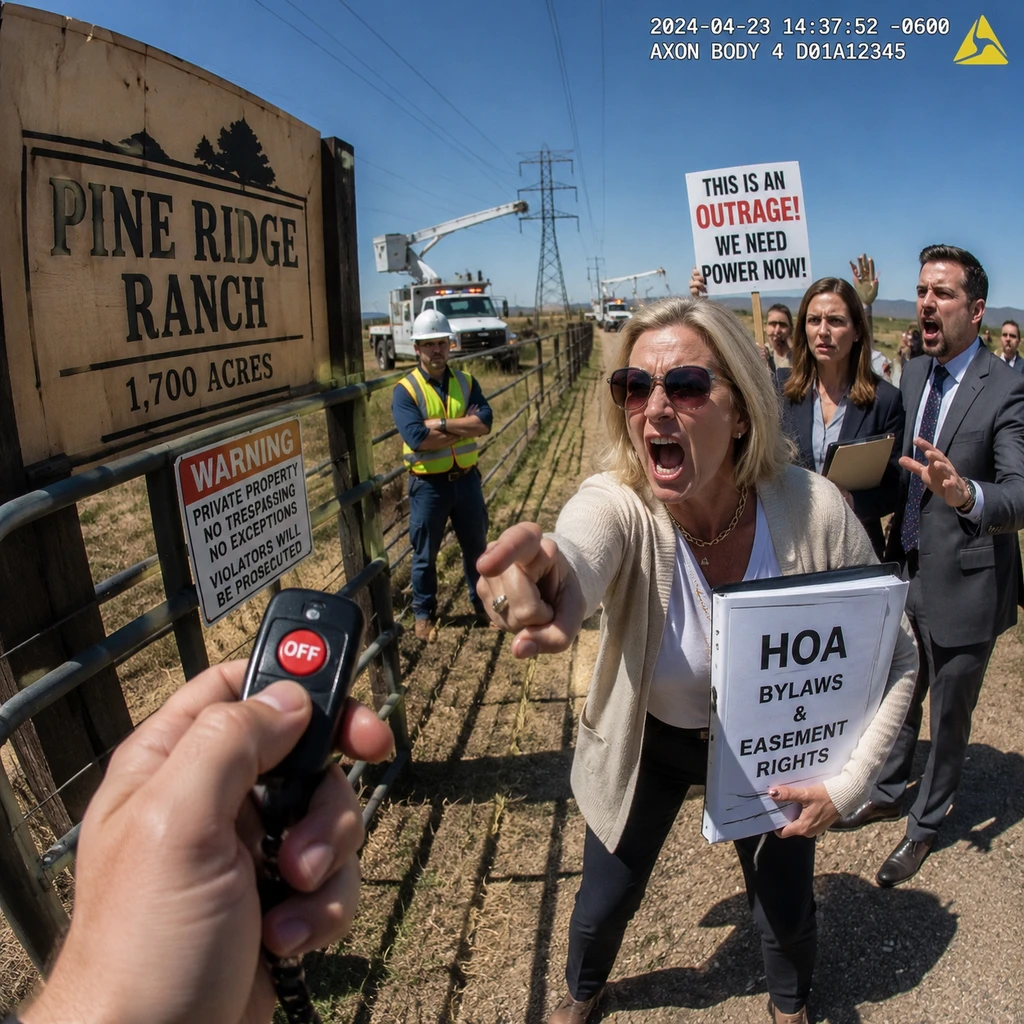
The morning I shut down Silver Pine Estates, their HOA president showed up screaming in the middle of my cattle road like I had personally unplugged her heartbeat.
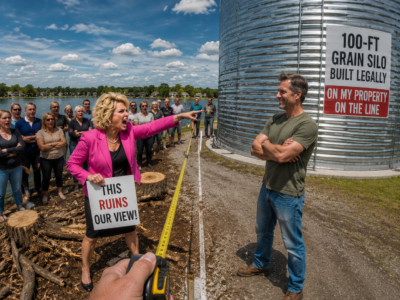
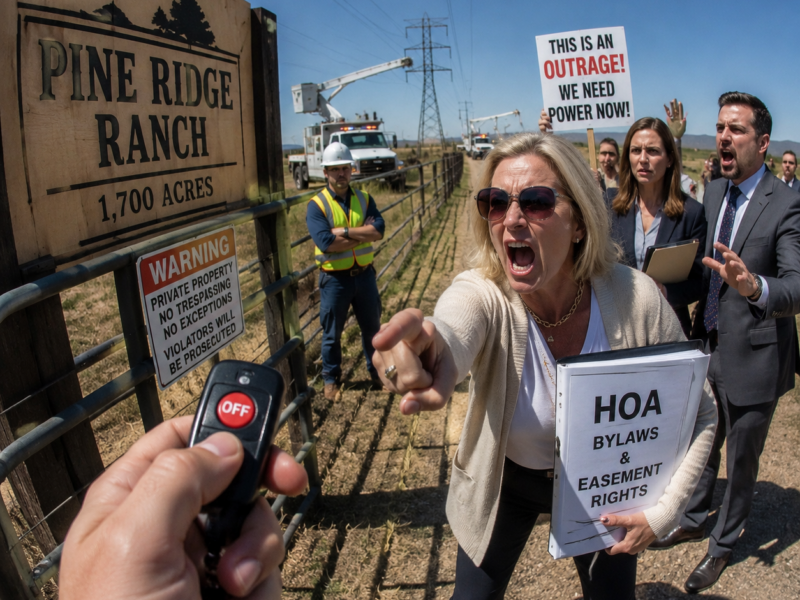
“We need that power!” Marlene Whitcomb shouted, her blonde braid whipping in the wind, one hand stabbing toward the power poles that cut across my pasture like a scar. “You can’t do this! There are families in there!”
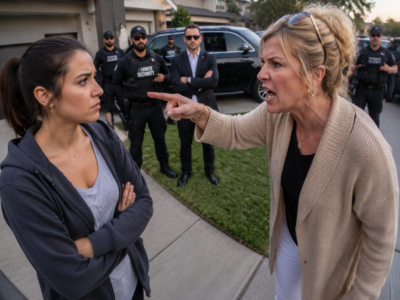
Behind her, two county deputies stood beside their cruisers with their lights flashing red and blue over my cows. A utility truck idled near the fence. A man in a gray work shirt held a clipboard like it might protect him from the storm about to break open.
And me?
I was leaning against a cedar fence post in a red flannel shirt, boots dusty, arms crossed, watching the whole performance like I had been expecting it for months.
Because I had.
“Not on my land,” I said.
Marlene’s face twisted.
“You selfish son of a—”
“Careful,” Deputy Harlan cut in, not loudly, but with the kind of tired voice cops use when they have already decided who is lying and who is just standing there with paperwork.
The wind pushed hard across the plains. You could smell rain coming from the west, that metallic, heavy smell that makes cattle lift their heads. The old power lines hummed above us, carrying electricity from the county road, over my north pasture, across my creek bed, and into Silver Pine Estates, a gated subdivision full of stone mailboxes, manicured lawns, and people who thought a ranch was pretty as long as they never had to smell one.
For twelve years, those lines had crossed Mercer Ranch without a legal easement.
For twelve years, the HOA had pretended they owned the right to them.
For twelve years, my uncle had fought them until his hands shook too badly to hold a pen.
Then he died.
And they thought I would be easier.
They were wrong.
The utility supervisor, a quiet man named Dennis Rowe, looked at me first, then at the deputies, then at Marlene.
“Ma’am,” he said, “this disconnect is authorized.”
“Authorized by who?”
“The property owner. The co-op. County safety office. And the court declined your emergency injunction yesterday.”
Marlene’s mouth opened.
No sound came out.
That was the first moment she realized the yelling might not work.
A second later, the lineman climbed into the bucket lift. The truck arm rose toward the transformer. A few HOA residents had gathered near the subdivision gate half a mile down the road, watching from behind the black iron fence. Some looked angry. Some looked scared. Most looked confused.
I did not enjoy that part.
Let me say that plainly.
There is a difference between revenge and a boundary. Revenge is hot. A boundary is cold. Revenge wants applause. A boundary just stands there, even when people curse at it.
I had given them warnings. Certified letters. Meetings. Maps. Thirty days. Then sixty. Then ninety.
They ignored every one of them.
They cut my fence twice.
They drove survey stakes through my hay field.
They called my uncle a bitter old cowboy in the same breath they used to steal from him.
And now Marlene Whitcomb, president of Silver Pine HOA and self-appointed queen of every mailbox within three miles, stood in front of two deputies yelling like the laws of Colorado were supposed to bend because her clubhouse pool heater had gone dark.
The lineman reached the switch.
Marlene lunged forward.
Deputy Harlan stepped in front of her.
“Do not cross that fence line,” he said.
She pointed at me with a trembling finger.
“This isn’t over, Caleb Mercer.”
I looked past her, toward the old wooden barn my great-grandfather built, toward the creek that still ran silver through the grass, toward the cattle bunching near the shade. I thought of my uncle Wade sitting at his kitchen table with unpaid medical bills, a dead wife’s photograph, and a stack of letters from an HOA that had never once asked permission like decent people.
“No,” I said. “It’s finally starting.”
The lineman pulled the cutout.
The hum died.
Down the road, Silver Pine Estates went silent.
The electric gate froze halfway open. The decorative fountains stopped. The security cameras blinked out. The clubhouse lights died behind tinted glass.
Then something nobody expected happened.
A pump hidden inside a fake stone utility shed on the edge of their golf pond shut off too.
And ten minutes later, water began draining out of Silver Pine’s private lake.
That was when the real crime surfaced.
That was when everyone learned the power line was only the beginning.
1. The Ranch Nobody Thought I Would Keep
When people hear that you inherited 1,700 acres, they picture a rich man’s blessing.
They picture sunsets. Horses. A porch. Maybe a cold beer in your hand while the land rolls out in front of you like a movie scene.
They do not picture back taxes.
They do not picture broken water tanks, cattle with foot rot, two miles of fence sagging after a spring storm, or a lawyer gently explaining that your dead uncle had been sued by people who wanted land they had no right to touch.
Mercer Ranch sat outside a small Colorado town called Prairie Hollow, about forty minutes from the interstate and a lifetime away from city thinking. The ranch had been in my family since my great-grandfather bought the first section after coming home from World War II. Over time, the place grew through hard work, stubbornness, and the kind of luck you only recognize years later.
By the time my uncle Wade owned it, Mercer Ranch was 1,700 acres of grassland, creek bottom, old cottonwoods, cattle pasture, and wind that never seemed to rest.
I grew up there during summers.
My father had left ranching early and moved to Denver to sell insurance. He used to say Wade was married to the land and divorced from common sense. Maybe that was true. But Wade taught me how to fix a fence, how to read weather by watching cows, how to keep your word even when nobody was watching, and how to stay quiet when another man was trying to make you angry.
That last lesson came in handy.
I had not planned to come back.
I was forty-two, divorced, and working construction management in Colorado Springs when Wade’s neighbor Rosa called me.
“Caleb,” she said, “you need to come home.”
I knew from her voice.
Not the words. The voice.
Wade had been sick for a while, but he hid pain the way old ranchers hide money: badly, stubbornly, and with suspicion toward anyone trying to help. He died in his sleep on a Tuesday morning in late October, sitting in the same recliner where he used to watch Broncos games and yell at the refs like they could hear him through the TV.
His funeral was small. Ranch people do not always show grief loudly. They come with casseroles, tighten loose gates without being asked, and stand in the cold with their hats in their hands.
The surprise came two days later.
Wade left the ranch to me.
Not to my father. Not to a land trust. Not to a developer, though three had made offers while Wade was alive.
To me.
His will was plain.
Caleb Thomas Mercer receives the entirety of Mercer Ranch, including surface rights, water rights, improvements, livestock, equipment, and all associated claims.
Under that, in Wade’s handwriting, he had added one sentence.
Don’t sell the north pasture to Silver Pine. They already stole enough.
At the time, I did not understand it.
I knew Silver Pine Estates existed. Everyone did. It was the gated subdivision that appeared on the east side of the ranch about twelve years earlier, all stone pillars and fake rustic street names like Elk Velvet Drive and Homestead View Court. It had a clubhouse, a private lake, a nine-hole “executive golf experience,” and homes built for people who wanted rural beauty with suburban control.
They liked the view.
They did not like the smell.
They liked open space.
They did not like cattle.
They liked sunsets over my uncle’s pasture.
They did not like that the pasture belonged to someone else.
The first time I drove the north fence line after the funeral, I saw the power poles. They ran from the county road, cut diagonally across my land for almost two miles, crossed the creek, then disappeared into a utility corridor behind Silver Pine’s gate.
I had seen those lines before as a kid, but never thought about them. Kids do not think about easements. They think about fishing holes and snakes and whether an uncle will let them drive the old Ford.
Now I owned the land underneath them.
And once you own land, you start seeing everything differently.
Every rut in the road becomes your repair.
Every broken latch becomes your problem.
Every stranger driving through becomes a question.
So when I found fresh tire tracks near the poles and a set of orange survey flags hammered into my pasture, I stopped my truck and got out.
The flags had little printed tags.
Silver Pine Utility Improvement Project.
I remember standing there with my hand around one of those flags, feeling something sharp move through my chest.
Not anger yet.
Recognition.
I had worked enough job sites to know the look of people preparing to build before they had permission. Survey first. Pressure later. Then paperwork dressed up like inevitability.
I pulled the flags one by one and tossed them into the bed of my truck.
That evening, I found Wade’s old office in the back of the ranch house. It smelled like dust, coffee, and peppermint tobacco. His desk was a mess of bills, cattle records, vet receipts, seed catalogs, and notebooks filled with weather observations going back twenty years.
In the bottom drawer, inside a red folder marked SILVER PINE — DO NOT TRUST, I found the beginning of the story.
Letters.
Maps.
Photographs.
And a copy of a temporary construction license signed twelve years earlier.
Temporary.
Revocable.
Ninety days.
That word stuck in my head.
Ninety days.
Yet the power lines were still there twelve years later.
That was the first night I realized my inheritance came with a war already attached to it.
2. The Woman at the Gate
Marlene Whitcomb arrived three days after I pulled the survey flags.
She did not call first.
She did not knock at the house.
She drove through my open cattle gate in a white Lexus SUV, followed by a pickup with the Silver Pine HOA logo on the door and a man in khakis who looked like he had never stepped in manure and hoped to keep that record clean.
I was fixing a corral panel when they pulled up.
Marlene stepped out wearing a red quilted vest, spotless boots, and the expression of someone who had mistaken confidence for authority her whole life.
“You must be Caleb,” she said.
I set down the wrench.
“Depends who’s asking.”
She gave a tight little laugh, already annoyed that I had not greeted her like a customer.
“I’m Marlene Whitcomb. President of Silver Pine Estates Homeowners Association.”
The man beside her lifted a hand.
“Trevor Bell, community operations.”
He said it like that meant something.
Marlene looked past me at the ranch house, the barn, the cattle, the mud near the trough. Her face said she saw wasted potential. That bothered me more than if she had insulted me out loud.
“We’re sorry about your uncle,” she said.
“Thank you.”
“He was…” She paused, searching for a polite word and finding the wrong one. “Difficult.”
I smiled a little.
“He said the same about you.”
Trevor shifted his clipboard.
Marlene’s eyes hardened.
“We noticed our survey markers were removed from the north pasture.”
“Your markers were on my land.”
“The utility corridor has been there for over a decade.”
“That doesn’t make it yours.”
She looked at Trevor, then back at me, like she was dealing with a child.
“Caleb, I understand this is all new to you. But Silver Pine depends on that power infrastructure. The lines have crossed this property since the development was built. Your uncle understood that.”
“No,” I said. “My uncle signed a ninety-day construction license.”
“That’s not how we interpret it.”
I almost laughed.
That sentence might be the whole history of bad neighbors in America.
That’s not how we interpret it.
People say that when the paper is against them but they still want what they want.
I wiped my hands on a rag.
“Do you have a recorded easement?”
Trevor cleared his throat.
“There are documents.”
“Recorded with the county?”
“We can provide what’s relevant.”
“That’s a no.”
Marlene stepped closer.
“We are not here to argue. We’re here because the HOA has scheduled improvements. We need access to those poles this week.”
“No.”
Her eyebrows lifted.
“Excuse me?”
“No.”
Simple words can sound rude when someone expects surrender.
Trevor frowned.
“Mr. Mercer, blocking utility access can create serious liability.”
“I’m not blocking the county road. I’m blocking private access across private land without a legal easement.”
Marlene’s smile disappeared.
“Your uncle let this become personal. I hope you won’t repeat his mistakes.”
There it was.
The first threat.
Soft. Polished. Wrapped in concern.
I had heard that tone on construction projects from developers who wanted inspectors to look away. I had heard it in divorce court from lawyers who smiled while pulling knives out of briefcases. I had heard it from people who believe rules are for whoever has less money.
I leaned on the fence.
“My uncle is dead, Mrs. Whitcomb. You can stop talking about him like he’s still in your way.”
For half a second, something like embarrassment crossed her face.
Then it vanished.
“You don’t understand what you’ve inherited.”
“I’m starting to.”
She glanced at the pasture, at the power poles, at the thin line of Silver Pine rooftops visible over the rise.
“That line feeds essential community services.”
“What services?”
“Security. Gate operations. Common-area lighting. Irrigation. Water features. Communications.”
“Sounds like amenities.”
“Safety amenities.”
“That’s cute.”
Trevor made a note on his clipboard.
Marlene pointed at me.
“I’m trying to be neighborly.”
“No,” I said. “You’re trying to be early.”
“Early?”
“You came before your lawyer because you thought I might be scared.”
Her cheeks flushed.
“Silver Pine will protect its interests.”
“So will I.”
They left angry.
That was fine.
Angry people make mistakes faster.
That night, I drove into town and visited the county clerk’s office the next morning as soon as it opened. A woman named Janice helped me search the records. She had known Wade for years and called him “a pain in the rear with a good heart.”
We searched deeds, plats, easements, utility agreements, subdivision records, and every recorded document tied to Mercer Ranch and Silver Pine Estates.
There was no permanent easement.
None.
There was the ninety-day construction license. There were letters from Wade refusing further access. There was a notice of termination dated eleven years earlier.
The power line was still there.
I remember Janice looking over her glasses at me.
“Well,” she said, “that’s not nothing.”
No, it was not.
It was the first solid stone in a wall I would spend months building.
3. What Land Really Means
Here is something people who have never owned rural land often misunderstand.
Land is not just scenery.
It is work.
It is responsibility.
It is memory.
It is also a magnet for people who think unused space means available space.
That north pasture looked empty to Marlene. To her, it was a view corridor, a utility route, maybe future lots if she could ever pry it loose.
To me, it was Wade teaching me to drive stick in a hay truck at thirteen. It was the place my aunt Lila scattered wildflower seed after her first cancer surgery. It was the low spot where cattle sheltered from hail. It was the creek bank where I caught bluegill with a bent hook and a worm I dug myself.
And yes, it was property.
That matters too.
Some folks get uncomfortable when you say that. They think defending property sounds cold. I disagree. Property is not sacred because money is sacred. Property is sacred because boundaries are the only thing standing between peaceful people and aggressive ones.
That does not mean you never compromise.
Good neighbors compromise all the time.
They ask before crossing.
They close gates.
They fix what they break.
They do not show up with survey flags and a Lexus and explain your land to you.
The first real trouble came during a thunderstorm two weeks after Marlene’s visit.
I was eating leftover chili at the kitchen counter when Rosa called.
“Your cows are on County Road 18.”
I was out the door in thirty seconds.
Rain hit sideways. Lightning flashed over the hills. By the time I reached the north fence, six cows and two calves had pushed through a cut section near the power poles. Not storm damage. A clean cut. Bolt cutters.
Rosa was already there in her old Dodge, hazard lights blinking, waving traffic down while her grandson Miguel held a flashlight.
We spent two hours getting cattle back through the gap.
If you have never tried to move wet, nervous cattle in a lightning storm while semitrucks hiss by on a county road, let me tell you, it humbles a person. You can have all the legal documents in the world and still find yourself ankle-deep in mud yelling, “Come on, girls,” at a cow that does not care about your lawsuit.
When we finally patched the fence, Rosa stood beside me in the rain, her gray hair plastered to her face.
“Silver Pine?” she asked.
“I don’t know.”
She gave me a look.
Rosa had run cattle longer than I had been alive. She did not waste words.
The next morning, I found tire tracks leading from the subdivision side and fresh boot prints around pole seventeen. Someone had crossed in, cut the fence, inspected the pole, and left.
I called the sheriff’s office.
Deputy Harlan came out.
He was in his fifties, broad through the shoulders, with a face that looked carved by bad coffee and winter wind. He walked the fence line, took photos, and sighed.
“Can you prove who cut it?”
“No.”
“You got cameras?”
“Not here.”
“Get some.”
That was practical advice. Not satisfying, but practical.
I installed trail cameras along the north fence that afternoon.
Three days later, one caught a Silver Pine maintenance truck entering through the same cut area at 6:42 a.m.
The driver was Trevor Bell.
The video showed him stepping out, looking around, then walking to the pole with a tablet in his hand.
That was when I hired a lawyer.
Her name was Maya Cardenas. She worked out of Fort Collins, handled land use disputes, and had the calmest voice of anyone I had ever met. She had grown up on a dairy farm before law school, which meant she understood both legal language and why a cut fence makes ranch people homicidal.
She reviewed the documents in Wade’s folder.
Then she sat back and said, “They have a problem.”
“How big?”
“Big enough that they’re going to pretend it’s yours.”
That turned out to be one of the most accurate sentences anyone said during the whole mess.
Maya sent Silver Pine a formal notice: no recorded easement existed; all access across Mercer Ranch was revoked; any future entry would be trespass; the HOA had sixty days to propose removal or lawful relocation of the private line; all maintenance must be coordinated through counsel.
Silver Pine responded in three days.
Not with proof.
With outrage.
Their attorney claimed an “implied easement,” “community reliance,” “historic use,” “equitable necessity,” and about ten other phrases that sounded heavy until Maya explained that none of them magically created a recorded right across land after the owner had repeatedly objected.
Then Marlene escalated.
She sent a message to every homeowner in Silver Pine.
Due to hostile actions by the new owner of Mercer Ranch, essential community power access is being threatened. The HOA board is pursuing all remedies to protect residents from this reckless interference.
By noon, I had strangers calling my ranch phone.
One man said his dues paid for that line.
A woman called me greedy.
Another asked if I wanted children trapped behind a dead gate.
That last one got under my skin.
Not because it was true.
Because it was designed to.
So I did what people should do more often before believing neighborhood gossip.
I checked the facts.
The homes inside Silver Pine were not powered by the line across my ranch. Their houses had separate residential service from the east county feeder. The line across my land powered the HOA’s clubhouse, entrance gate, private cameras, irrigation controls, fountain pumps, golf shed, and “community lake circulation system.”
In other words, Marlene was using families as human shields for a pool heater and a fake lake.
That made me angry.
Not loud angry.
Quiet angry.
The kind that makes you keep receipts.
4. The Clubhouse Meeting
Maya told me not to attend the HOA meeting.
“Nothing good happens in a room full of angry people and microphones,” she said.
She was right.
I went anyway.
Sometimes you need to see the people being lied to. Not because you can convince all of them, but because later, when the truth comes out, you want to remember who looked ashamed and who enjoyed the lie.
Silver Pine’s clubhouse sat on a rise overlooking my pasture. It had fake timber beams, a stone fireplace, leather chairs nobody looked comfortable sitting in, and a wall of windows facing west so residents could watch sunsets over land they did not own.
That irritated me more than it should have.
About seventy people showed up. Retirees, young families, remote workers, a couple of men in golf polos, one woman holding a baby. They were not villains. Most were just homeowners who had bought into a story and trusted the wrong board.
Marlene stood at the front beside Trevor and two board members. She wore a navy blazer and used a wireless microphone, which told me everything I needed to know about her relationship with attention.
When she saw me walk in with Maya, her smile froze.
“Well,” she said into the microphone, “Mr. Mercer has decided to join us.”
Heads turned.
Maya leaned toward me.
“Don’t talk unless I tell you.”
That was hard advice.
Marlene began with a slideshow titled Protecting Silver Pine’s Future.
There were photos of the gate, the clubhouse, the lake, children riding bikes, American flags on porches, and finally a picture of my north pasture with a red line drawn across it.
“This corridor,” Marlene said, “has served Silver Pine for twelve years. It is part of our community infrastructure. Unfortunately, after the passing of Mr. Wade Mercer, his nephew has taken an aggressive position that threatens our safety and property values.”
A man in the second row muttered, “Typical.”
Maya wrote something on her legal pad.
Marlene continued.
“We have attempted neighborly communication. We have offered cooperation. But Mr. Mercer has removed survey markers, blocked maintenance access, and sent threatening legal letters.”
I felt heat rise in my face.
Threatening legal letters.
That phrase always amazes me. When someone violates boundaries, a letter telling them to stop feels threatening. But the trespass? The cut fence? The years of unauthorized use? Somehow that is just “history.”
Marlene clicked to the next slide.
It showed a proposed “utility enhancement route” crossing deeper into my ranch, with new poles, an access road, and a fenced equipment pad near the creek.
I sat forward.
Maya’s pen stopped moving.
That was the first time I saw the full size of what they wanted.
Not just to keep the old line.
To expand it.
Marlene said, “This improvement will ensure long-term community resilience.”
Maya whispered, “Absolutely not.”
Then Marlene made her mistake.
She asked if I wanted to speak.
I stood before Maya could stop me.
The room went quiet.
I walked to the front, not because I wanted the microphone, but because I wanted them to see me without Marlene between us.
“My name is Caleb Mercer,” I said. “Most of you don’t know me. You know what you’ve been told. So let me tell you what I know.”
Marlene folded her arms.
I looked at the residents.
“The line crossing my ranch was authorized under a ninety-day temporary construction license twelve years ago. That license expired. My uncle terminated access. There is no recorded permanent easement. Your board has been asked to provide one. They haven’t.”
A man near the back said, “That’s not what we heard.”
“I believe that.”
That quieted him more than arguing would have.
I continued.
“Your homes are not powered by that line. Your emergency services are not powered by that line. The line feeds HOA common areas, gate systems, irrigation, golf facilities, cameras, and pumps. If anyone here has medical equipment or a safety concern, contact the electric co-op directly. Don’t take my word for it. Don’t take Marlene’s. Check.”
Marlene stepped toward me.
“That is misleading.”
Maya stood.
“It is accurate.”
The room shifted.
Not fully. Not dramatically. But enough.
A woman with the baby raised her hand.
“Then why are we paying an easement maintenance fee?”
I turned toward her.
“What fee?”
She looked confused.
“Our dues statement. There’s a line item. Mercer Corridor Easement Maintenance. It’s like eighty-three dollars a month.”
Maya’s head turned slowly toward Marlene.
That was the second crack in the wall.
Marlene laughed too quickly.
“That’s an internal budgeting term.”
“For an easement you don’t have?” Maya asked.
Trevor’s face went pale.
The room began murmuring.
Marlene lifted the microphone.
“This is exactly why legal matters should not be debated in emotional public settings.”
I almost admired the nerve.
Almost.
A retired man in the front row stood up. He had a cane and a voice like gravel.
“My wife and I have paid that fee for nine years.”
Marlene said, “George, please sit down.”
“No. I want to know where the money went.”
That was when the meeting stopped being about me.
And that was when Marlene Whitcomb started losing control.
5. Wade’s Red Folder
After the clubhouse meeting, the story spread fast.
Small towns do not need social media, but they use it anyway.
By the next morning, half of Prairie Hollow had an opinion. Some thought I was standing up for family land. Some thought I was being stubborn. A few said I should take the money and move on.
That last opinion usually came from people who had never been asked to sell anything that held their dead family’s fingerprints.
I spent the next week going through Wade’s office like an archaeologist digging through grief.
There were boxes under boxes.
Old tax returns. Vet bills. Photographs of calves. Letters from my aunt Lila. A newspaper clipping from the year Silver Pine broke ground, showing Marlene Whitcomb smiling beside a developer named Grant Voss under a banner that read Luxury Living Meets Open Country.
Open country.
My country, apparently.
At the back of a filing cabinet, I found another folder. This one was not red. It was black, tied with twine.
Inside was a notebook.
Wade’s handwriting filled every page.
Dates. Times. Names. Incidents.
March 14 — SP truck entered north pasture without call. Claimed “routine access.” Told them no.
May 2 — Marlene asked about buying 300 acres. Said “you can’t run cattle forever.”
June 19 — Lila upset after phone call. Marlene said development “inevitable.”
August 8 — Line sparked near creek during dry lightning storm. Called co-op.
September 1 — calf found dead near pole 12 after storm. Unsure if related. Photos.
October 11 — Voss offered below-market cash deal. Said legal costs would bury me.
My hands tightened on the notebook.
That was the part people never see in property disputes: the slow grinding down. Not one dramatic event. Not one villainous speech. Just pressure. Calls. Letters. Warnings. Offers disguised as favors. People waiting for age and illness to do what their lawyers cannot.
I found photographs of burn marks around pole twelve. I found a veterinary invoice for the dead calf. I found a letter from Mountain Plains Electric Cooperative stating the line was “customer-owned infrastructure beyond the primary service point” and that Silver Pine, not the co-op, was responsible for maintenance and legal right-of-way.
Then I found the recording.
It was on an old digital voice recorder inside a Ziploc bag.
A note taped to it read: Meeting with M.W. and G.V. — keep.
I charged it with a cable from Wade’s junk drawer and pressed play.
For a moment, only static.
Then Marlene’s voice.
“You’re making this harder than it needs to be, Wade.”
Wade sounded tired.
“It’s my land.”
Grant Voss laughed softly.
“For now.”
My stomach turned.
Marlene said, “The community depends on that corridor. You signed access.”
“Ninety days.”
“You allowed continued use.”
“I objected in writing.”
Grant spoke again.
“Wade, you’re one man. We’re forty-seven households and growing. A judge is going to look at necessity.”
“It’s not necessary. Move it to the east road.”
“That costs money.”
“Then spend it.”
There was a long silence.
Then Marlene’s voice lowered.
“Your medical bills must be heavy.”
I stopped breathing.
She continued.
“Lila’s treatments were not cheap. You don’t have children. You don’t have to die fighting dirt and cows.”
Wade said nothing.
Marlene said, “Sell us the north section. Keep the house. Keep enough pasture to play cowboy. Let progress happen.”
The recording crackled.
Then Wade’s voice came through, weak but clear.
“My wife’s ashes are in that north pasture.”
Nobody spoke for several seconds.
Then Grant said, “Sentiment doesn’t stop development.”
I shut the recorder off.
I sat there in Wade’s office until dark.
I am not ashamed to say I cried.
Not loudly. Not dramatically.
Just enough that I had to take my glasses off and sit with my elbows on my knees, hating that Wade had faced that kind of cruelty while I was living three hours away, busy with my own life, telling myself he liked being alone.
That guilt stayed with me.
Maybe it still does.
We tell ourselves family members are stubborn because it lets us ignore how tired they are. Wade had sounded difficult on the phone. Short. Irritable. Dismissive of help.
Now I understood.
He had been under siege.
The next morning, I drove to the north pasture before sunrise. Frost silvered the grass. The cows were dark shapes near the creek. The power lines cut across the pink sky.
I stood by pole twelve and thought about my aunt Lila’s ashes somewhere in that grass.
Then I called Maya.
“Whatever this costs,” I said, “we fight.”
She did not answer right away.
Then she said, “Good. Because I found something too.”
6. The Fake Easement
Maya’s discovery came from a homeowner named Natalie Price.
She was the woman from the clubhouse meeting with the baby. She and her husband had moved to Silver Pine three years earlier after selling their house in Denver. They wanted space, good schools, safer streets. Normal reasons. Human reasons.
Natalie emailed Maya a copy of her HOA closing packet.
Inside was a document labeled Mercer Corridor Easement Agreement.
My name was not on it.
Wade’s was.
At first glance, it looked official enough to fool someone signing a mountain of home purchase paperwork. There were legal descriptions, notary stamps, signatures, even a map.
But Maya noticed three problems immediately.
First, it had never been recorded with the county.
Second, the legal description was wrong. It described a strip of land that did not match the actual pole route.
Third, Wade’s signature was dated April 18, two years earlier.
On April 18, Wade had been in the hospital after a stroke.
Maya sent me a copy.
I stared at the signature for a long time.
It looked like Wade’s name if someone had studied it from a check and tried too hard.
Too smooth.
Wade’s real signature had become shaky after Lila died. He joked that his hand had started writing like a drunk spider. The signature on the fake easement looked clean, confident, and completely wrong.
Maya’s voice was controlled when she called.
“I’m not saying forgery yet.”
“I am.”
“Caleb.”
“He was in the hospital.”
“I know. We need records.”
We got them.
Hospital admission logs. Physical therapy notes. A discharge summary showing Wade had weakness in his right hand and difficulty writing. A nurse’s note from April 18 stating he was unable to sign medication paperwork and gave verbal consent.
That fake easement had been shown to buyers.
It had been used to justify HOA dues.
It had been used to create the illusion that Silver Pine had rights it did not have.
But it was never recorded, because recording it would invite scrutiny from the county clerk, title companies, and anyone who might compare the date.
Instead, they kept it inside closing packets and HOA disclosures, where people were least likely to question it.
That made me furious in a new way.
Not just for Wade.
For the homeowners too.
I did not like being painted as their enemy, but I also understood something: most of them had been sold a fantasy with missing pages. They were told the view was protected, the lake was sustainable, the infrastructure was secure, and the rancher next door was cranky but manageable.
Nobody told them the power line ran on borrowed time.
Nobody told them the “easement fee” might be smoke.
Nobody told them their HOA president had built community comfort on another family’s exhaustion.
In my opinion, that is the worst kind of leadership.
Not loud corruption.
Comfortable corruption.
The kind that smiles at meetings, speaks in community language, and trusts that everyone is too busy with work, kids, mortgages, and doctor appointments to read the documents.
Maya filed for declaratory judgment and injunctive relief.
Silver Pine countered with everything they had. They claimed reliance, necessity, historical access, estoppel, and public safety. Their attorney suggested I was “weaponizing grief” to extract money from innocent homeowners.
That phrase made me want to throw the papers across the room.
Weaponizing grief.
People will say anything when they are caught standing on your neck.
The first court hearing took place in a county courtroom with buzzing fluorescent lights and wooden benches polished by decades of restless people.
Marlene came dressed in cream-colored wool and pearls. Trevor sat behind her. Grant Voss, the developer, appeared for the first time, older than in the newspaper clipping but still wearing the same smooth smile.
I wore a jacket Maya told me to buy because apparently judges prefer men not to look like they came straight from loading hay.
The judge, Helen Arkwright, was sharp-eyed and impatient with theatrics. That helped.
Silver Pine’s attorney argued that disconnecting the line would endanger residents.
Maya stood and calmly presented utility records showing the homes had separate residential power.
Silver Pine’s attorney argued that the line was essential to security.
Maya presented photos of manual gate releases, battery backup requirements, and the HOA’s own maintenance manual.
Silver Pine’s attorney argued that Wade had consented.
Maya presented the temporary license, termination letters, county records showing no permanent easement, and hospital documentation from the date of the alleged agreement.
That changed the room.
Judges are trained not to react much, but Judge Arkwright looked over her glasses at Silver Pine’s table.
“Counsel,” she said, “is your client relying on this unrecorded document as evidence of a property interest?”
Their attorney hesitated.
“We believe it reflects the parties’ understanding.”
“Was it recorded?”
“No, Your Honor.”
“Was Mr. Mercer medically capable of executing documents on that date?”
“We have not had the opportunity to fully investigate—”
Maya stood.
“Your Honor, they distributed it to homeowners for years.”
The judge’s mouth tightened.
By the end of the hearing, Silver Pine did not get its emergency injunction.
Instead, the court ordered no further expansion, no unapproved access, preservation of all HOA records related to the line, and a thirty-day window to coordinate safe disconnection or prove lawful authority.
Marlene left the courtroom without looking at me.
Grant Voss did look.
His smile was gone.
That should have made me feel better.
It didn’t.
Because people like that do not stop when they lose a hearing.
They look for another door.
7. The Night They Brought the Backhoe
The backhoe came on a Friday night.
Of course it did.
Bad actors love Fridays. Everybody is tired. Offices are closed. Lawyers are at dinner. Deputies are stretched thin. If you can create facts on the ground before Monday, you can call them “existing conditions” later.
I was in the barn checking a heifer close to calving when my phone buzzed.
Trail camera alert.
The image showed headlights near the north pasture.
Then another image.
A flatbed truck.
Then a backhoe.
Then Trevor Bell opening my gate with bolt cutters.
For a second, I just stared.
Not because I was surprised.
Because part of me had hoped they were smarter than that.
I called 911, then Maya, then Rosa.
By the time I reached the north pasture in my truck, they had already driven two vehicles inside. A portable light tower glared white over the grass. Three men in work jackets stood near pole seventeen. The backhoe bucket was down, its teeth pressed into my soil.
Trevor saw my headlights and froze.
I parked across the access track, blocking the way out.
Then I got out.
“What are you doing?”
Trevor walked toward me with forced confidence.
“Emergency stabilization work.”
“On private land?”
“We have authorization.”
“From who?”
He held up paper.
I did not take it.
“Court order says no access without approval.”
“This is a safety issue.”
Behind him, one of the workers started backing away from the machine.
They had the look of contractors who had been told this was handled and were slowly realizing it was not handled.
I pointed at the backhoe.
“Turn it off.”
Trevor shook his head.
“You’re interfering with utility safety.”
“No. You’re trespassing with excavation equipment.”
Marlene’s Lexus came flying down the track ten minutes later, bouncing over ruts like the suspension owed her money. She got out before it fully stopped.
“This is harassment!” she yelled.
I almost laughed.
“You cut my gate.”
“You left us no choice.”
That sentence is dangerous.
People say it right before doing exactly what they wanted to do anyway.
Deputy Harlan arrived with another deputy and took one look at the backhoe.
His shoulders dropped.
“For God’s sake,” he muttered.
Marlene rushed to him.
“Deputy, thank goodness. Mr. Mercer is blocking emergency utility work.”
Harlan looked at me.
“Caleb?”
I pointed to the cut chain on the gate, the backhoe, the court order folded in my truck.
“They entered without permission. Court order says no access. I want them removed.”
Harlan read the order under his flashlight.
Then he looked at Trevor.
“Who cut the lock?”
Trevor said nothing.
Marlene jumped in.
“This is a civil matter.”
Harlan’s face hardened.
“Ma’am, cutting a chain and driving excavation equipment onto private land after a court order is not just civil.”
The contractors suddenly became very interested in leaving.
One of them said, “We were told there was an easement.”
“There isn’t,” I said.
He looked at Trevor with murder in his eyes.
I do not blame him. Working men do not like being used as shields by rich people with bad paperwork.
Harlan ordered the equipment removed. Trevor got cited. The contractors packed up and left. Marlene stood in the road, shaking with rage.
Before she got into her Lexus, she turned to me.
“You have no idea how many people you’re hurting.”
That one landed, because hurting people was exactly what I did not want.
I went home sick with anger and doubt.
That is the honest truth.
It is easy to sound tough after the fact. It is easy to say I knew I was right. But that night, sitting alone in Wade’s kitchen, I wondered if I was becoming the villain in someone else’s story.
Then Natalie Price called.
Her voice was quiet.
“I heard what happened.”
“How?”
“Marlene sent an alert saying you blocked emergency repairs.”
I rubbed my eyes.
“Of course she did.”
“She also said the gate may fail and kids could be trapped.”
“The gate has a manual release.”
“I know. My husband checked after your meeting.”
A baby cried in the background.
Natalie lowered her voice.
“Mr. Mercer, people are starting to ask questions. The board won’t answer. They removed the easement fee from the online portal today.”
That got my attention.
“Removed it?”
“Yes. Past statements too. But I downloaded ours.”
For the first time that night, I smiled.
“Good.”
She paused.
“I’m sorry. For believing her.”
I looked around Wade’s kitchen, at the old cabinets, the calendar still on October, the coffee mug he would never use again.
“You’re not the first person to trust the wrong neighbor,” I said.
After we hung up, I stepped outside.
The storm had cleared. Stars spread over the ranch like spilled salt. Far off, coyotes called from the creek bottom.
I thought about what Wade had written.
They already stole enough.
Then I made a promise out loud, though nobody was there to hear it.
“They don’t get one more inch.”
8. The Power Behind the Lake
The hidden pump was discovered by accident.
A week after the backhoe incident, Mountain Plains Electric sent an inspection team to assess the line before any disconnection. Dennis Rowe, the utility supervisor, walked the route with me, Maya, a county safety officer, and two linemen.
Dennis was not dramatic. He was the kind of man who could tell you bad news in the same tone he used to ask for coffee.
At pole nineteen, near the creek bend, he stopped.
“That’s odd.”
“What?”
He pointed toward a patch of brush near the fence separating my ranch from Silver Pine’s golf area.
“There’s a secondary feed.”
I followed his gaze.
A small line ran from the pole down through conduit, then underground toward what looked like a decorative stone shed on the Silver Pine side.
I had seen that shed before. Everyone had. It sat beside their private lake, covered in fake rock veneer, with ornamental grass planted around it.
I assumed it housed irrigation equipment.
Dennis checked the map.
“That’s not on the service diagram.”
Maya’s eyes sharpened.
The county officer took photos.
Because it was on Silver Pine property, we could not open it that day. But once Maya requested updated electrical diagrams through discovery, the truth began leaking out.
The shed powered a high-capacity pump.
The pump fed Silver Pine’s lake circulation and water replacement system.
The lake, according to marketing materials, was “spring-fed.”
It was not spring-fed.
It was partially supplied by water drawn from a diversion line connected near Mercer Creek, inside an area where Wade had senior water rights.
Now, water law in Colorado can make smart people cry. I am not going to pretend I understood every piece of it then. But I understood enough.
You do not casually take water.
Not out here.
Water is life. Water is cattle. Water is hay. Water is the difference between a ranch surviving August or selling cows early at a loss. People in cities talk about views. Ranchers talk about water because water decides whether the view has anything alive in it.
Maya brought in a water rights consultant named Paul Henley. He was seventy, smelled faintly like pipe tobacco, and carried rolled maps under his arm like a battlefield general.
He traced the creek, the diversion, the pump line, and Wade’s filed rights.
Then he looked at me.
“You’ve got a problem.”
“How bad?”
He tapped the map.
“If this pump has been supplementing their lake from your side, they’ve been taking water they had no right to take.”
“For how long?”
He gave me a grim look.
“That’s the expensive question.”
We found the answer in Silver Pine’s own maintenance invoices.
Pump repairs.
Filter replacements.
Emergency lake refill after drought.
Line flushing.
Electrical load reports.
The records went back eight years.
Eight years of water being pulled from a system tied to my ranch, disguised as lake maintenance, powered by a line they had no legal right to maintain.
That changed everything.
The dispute was no longer just about poles.
It was about land, water, forged documents, false homeowner fees, and a board that had apparently hidden the truth under landscaping and legal language.
Marlene denied everything.
Grant Voss denied everything.
Trevor claimed he only followed instructions.
Silver Pine’s attorney suddenly became much less aggressive.
Then the homeowners found out.
Not from me.
From Natalie.
She and a group of residents requested financial records under HOA rules. When the board delayed, they organized. When Marlene called them “misinformed,” they got louder. When she shut down comments at a meeting, George, the retired man with the cane, stood up and said, “You work for us, not the other way around.”
I wish I had seen that in person.
I heard it was beautiful.
Within two weeks, Silver Pine had split into two camps.
Marlene’s loyalists still blamed me. They said I was trying to bankrupt the community. They said rural families hated newcomers. They said I should have negotiated quietly.
The other camp wanted answers.
Where did the easement fees go?
Who drafted the fake agreement?
Why was the line never relocated?
Why did the lake need so much water?
Why were homeowners told the rancher had signed off?
That is the thing about truth.
At first, it feels slower than lies. Lies sprint. Truth limps behind carrying documents.
But once truth arrives, it stays.
9. The Deadline
The court gave Silver Pine thirty days to prove a lawful property right or coordinate disconnection.
They failed.
Then they asked for more time.
Judge Arkwright gave them another thirty days, but with conditions: no trespass, no expansion, no work on the line without written permission, full disclosure of related financial records, and a plan for alternate service along the east county road.
They delayed again.
Marlene claimed rerouting the line would cost more than $600,000.
Maya’s expert estimated $310,000.
Then it came out Silver Pine had spent nearly $700,000 over five years on clubhouse renovations, lake features, legal fees, landscaping, and “executive community consulting,” some of it paid to a company connected to Grant Voss.
That number did not sit well with homeowners.
People will tolerate a lot until they realize their dues paid for someone else’s deception.
The final disconnect notice went out in early April.
Mountain Plains Electric sent it by certified mail. Maya sent hers. The county safety office sent one too.
The line would be disconnected from the service point at 6:00 a.m. on April 22 unless Silver Pine produced a valid court order.
They tried.
The emergency hearing happened the day before.
Marlene testified that disconnection would cause chaos.
Maya asked her what specific homes would lose power.
Marlene avoided answering.
Maya asked whether any medical devices depended on the line.
Marlene said she was “not personally aware.”
Maya asked whether the gate could be manually opened.
Marlene said yes, but it would be inconvenient.
Maya asked whether the clubhouse, pool, irrigation, cameras, and lake pump were the primary loads on the line.
Marlene said she would need to consult operations.
Then Dennis Rowe testified.
He explained, in the driest possible language, that the line was customer-owned infrastructure without documented right-of-way across Mercer Ranch, that it had known safety issues, that alternate service could be installed from the east, and that disconnection would not affect residential meters.
Judge Arkwright denied the injunction.
She did not smile.
She did not scold.
She simply said, “The court will not compel a private landowner to host unrecorded infrastructure indefinitely for the convenience of an association that has failed to establish a lawful property interest.”
I wrote that sentence down.
Not because I needed to remember it.
Because Wade would have liked it.
That evening, I did not sleep much.
I walked the ranch after dark, checking gates, checking cattle, checking things that did not need checking. The air was cool. The moon sat low over the pasture. Silver Pine glowed beyond the rise, every streetlamp and porch light making it look peaceful.
I wondered how many people in those houses were scared because of what Marlene had told them.
I wondered how many hated me.
I wondered how many would understand later.
That is the difficult part of standing your ground: you do not get to control the story while people are still angry. You only get to control your actions.
So I made sure mine were clean.
Maya confirmed with the utility that no residential service would be cut. The county confirmed emergency access. I offered, through counsel, a temporary supervised access window for Silver Pine to install manual gate staffing and portable lighting at their own cost. I also offered to allow emergency vehicles through my south road if the gate malfunctioned.
Marlene rejected the offer.
Of course she did.
Accepting it would mean admitting the crisis was manageable.
At 5:30 the next morning, I drove to the north pasture.
The utility truck was already there.
So were the deputies.
So was Marlene.
And she had brought an audience.
10. The Morning the Grid Went Dark
Marlene stood in the road with Trevor, two board members, six residents, and a man filming with a phone held sideways like he was producing breaking news.
She had dressed for battle: red vest, tight jeans, boots too clean for the mud, hair braided over one shoulder. Her face was pale with fury, but her eyes were bright.
That worried me.
People who think they can still win in public will say anything.
The utility crew parked near the service pole outside my fence. Dennis Rowe walked over and handed copies of the disconnect order to Deputy Harlan, Maya, and Silver Pine’s attorney, who looked like he deeply regretted his career choices.
Marlene marched toward me.
“You can stop this right now.”
“No.”
“We are willing to discuss compensation.”
“You were willing yesterday too. After twelve years.”
“This is extortion.”
“No,” Maya said from beside me. “Extortion is demanding use of private land while charging homeowners for a nonexistent easement.”
The residents behind Marlene stirred.
One man called out, “Is that true?”
Marlene spun around.
“Do not engage with them.”
That did not help her.
The wind picked up. Dust moved across the road. A cow bawled from the pasture, annoyed by all the vehicles.
The man filming stepped closer to me.
“Sir, do you admit you’re shutting off power to an entire neighborhood?”
I looked straight into his phone.
“No. I’m enforcing a court-recognized property boundary. Residential homes have separate power. The line feeds HOA facilities that crossed my land without a legal easement.”
Maya nodded slightly.
Good answer.
Marlene shoved herself into the frame.
“He is lying! Our community depends on this line!”
Dennis Rowe spoke up.
“Ma’am, we have load records. We’ve explained this.”
“You work with him!”
Dennis blinked.
Utility men do not enjoy being dragged into drama.
“I work for the co-op,” he said. “And I work with electricity, which is less emotional than this.”
Even Deputy Harlan almost smiled.
Then Marlene made her last big play.
She turned toward the residents and shouted, “If this power is cut, your property values collapse! Your security fails! Your lake dies! Your children are less safe! Remember who did this!”
That is when George stepped forward with his cane.
He was wearing a brown jacket and a veteran’s cap. His wife stood behind him holding a folder.
“No,” George said. “We’ll remember who hid it.”
Marlene stared at him.
George looked at me.
“Mr. Mercer, I don’t like losing services. But I read the documents. Wade Mercer told them no.”
For a second, the whole road went quiet.
Something in my throat tightened.
I nodded once.
“Thank you.”
The bucket truck engine changed pitch.
The lineman rose toward the transformer.
Marlene rushed forward, but Deputy Harlan blocked her.
“Stay back.”
“You can’t let him do this!”
“The court already did.”
She jabbed a finger at me.
“I will bury you in lawsuits.”
“You already tried.”
The lineman reached the cutout.
I heard the faint hum of current above us, a sound so ordinary that nobody notices it until it disappears.
He looked down at Dennis.
Dennis checked his watch.
6:13 a.m.
He gave the signal.
The lineman opened the switch.
The hum stopped.
Half a mile away, the Silver Pine entrance gate froze halfway through its morning cycle. The clubhouse lights went out. The fountain in the roundabout dropped from a cheerful spray to a sad trickle. The cameras mounted along the fence blinked dark one by one.
Nobody cheered.
I did not smile.
It felt too heavy for that.
Then a resident pointed toward the lake.
“What’s happening over there?”
At first, it was subtle.
The decorative waterfall stopped.
Then the lake surface shifted.
Near the fake stone pump shed, water began pulling back from the rocks, exposing a dark wet ring around the edge.
Within minutes, the lake level had dropped enough that everyone could see an intake pipe hidden under the bank.
Maya whispered, “Oh my God.”
Dennis looked at the pipe, then at me.
Deputy Harlan lowered his sunglasses.
Marlene’s face changed.
Not anger now.
Fear.
The man filming swung his phone toward the lake.
“What is that?”
Nobody answered.
The pump had stopped.
And without the pump, Silver Pine’s beautiful private lake began telling the truth in public.
11. When the Residents Turned
The video went everywhere.
Not national news. Not that kind of everywhere.
But local everywhere.
Prairie Hollow community pages. County forums. HOA watchdog groups. A Denver real estate account. A ranching page that mostly posted fence jokes and angry opinions about weather.
The clip showed Marlene screaming about power, the utility disconnect, the gate freezing, and then the lake draining enough to expose the hidden pipe.
People love simple villains, and for a day or two, some tried to make me one.
Then Natalie posted documents.
The fake easement.
The dues statements.
The county record search.
The court order.
The utility letter.
That changed the comments fast.
Silver Pine residents began comparing closing packets. Some had the fake easement. Some did not. Some had paid the “Mercer Corridor Easement Maintenance” fee for years. Newer residents had paid a “community infrastructure stabilization” fee instead.
Same ghost. Different sheet.
The HOA board scheduled an emergency meeting.
This time, Marlene did not control the room.
Maya told me not to attend.
This time, I listened.
But Natalie called afterward and told me what happened.
George demanded an independent audit.
A young father named Ryan asked why the board represented the line as permanent when no easement was recorded.
A retired accountant named Elaine presented five years of dues increases tied to “ranch corridor risk.”
Someone asked Trevor whether he cut my gate.
He said he was following board direction.
Someone asked Marlene whether she knew Wade was hospitalized when the alleged easement was signed.
Marlene said, “I am not going to respond to defamatory insinuations.”
That sentence did not save her.
The board voted to place her on administrative leave pending investigation.
She refused to recognize the vote.
Then three board members resigned on the spot.
By midnight, Silver Pine was in open revolt.
A week later, homeowners petitioned for a special election. The county opened inquiries into the water diversion. The district attorney requested documents related to the alleged easement. The state real estate commission began reviewing disclosures tied to home sales.
Grant Voss disappeared from public view, which is what men like him do when consequences start looking expensive.
Trevor cooperated.
That surprised me until Maya explained that people lower on the ladder often start telling the truth once they realize the people above them have no intention of taking the fall.
He gave a deposition that lasted six hours.
According to Trevor, the HOA and developer knew the easement issue existed from the beginning. Grant Voss had pushed the temporary construction route across Wade’s land because it was cheaper than running service around the east road during development. He promised to relocate it before final build-out.
He never did.
When Wade objected, they delayed.
When Lila got sick, they pressured.
When Wade refused to sell, they created “internal documentation” to satisfy buyers and lenders without recording anything.
Trevor claimed he did not know the signature was fake.
Maybe that was true.
Maybe it was not.
I stopped expecting perfect justice. Perfect justice is rare. Usually, you get pieces. A document here. A resignation there. A check that arrives years late and still cannot buy back what was taken.
The water issue became the biggest bomb.
Paul Henley’s report showed that the pump had supplemented Silver Pine’s lake during dry months using water connected to Mercer Creek’s diversion system. Whether through illegal tapping, misrepresented infrastructure, or unauthorized modification, the result was the same: water that should have supported my pasture and creek bottom had been used to keep a decorative lake pretty for real estate brochures.
That one made ranchers furious.
Even people who thought I was being stubborn about the power line changed their tone when water theft entered the conversation.
Because out here, taking water is not a misunderstanding.
It is an attack.
I found one of Wade’s notes after that report came out.
Pasture thinner near creek. Thought drought. Maybe not.
I sat with that note for a long time.
Wade had noticed. Of course he had. He knew that land like a man knows his own scars. But he had been old, sick, grieving, and surrounded by people telling him he was unreasonable.
That is another cruelty of bullying. It makes a person doubt what they can still see with their own eyes.
I wished I could tell him he had been right.
Maybe, in a way, the lawsuit did.
12. The Offer I Almost Took
Two months after the disconnect, Silver Pine’s new interim board requested mediation.
Marlene was gone by then.
Not gone gone. People like Marlene rarely disappear cleanly. She still sent emails to loyalists. She still posted online about “landowner extremism.” She still claimed she was the victim of a coordinated smear campaign.
But she no longer controlled Silver Pine.
The mediation took place in a conference room above a bank in Fort Collins. I sat with Maya on one side. Across from us sat the interim board: George, Natalie, Elaine, and a man named Priya Shah’s husband, Amit, who had somehow become the calm voice of a neighborhood in chaos.
Their new attorney looked exhausted but honest, which was refreshing.
They opened with an apology.
A real one.
George took off his veteran’s cap and set it on the table.
“Mr. Mercer,” he said, “we can’t undo what happened to your uncle. But we can say plainly that the community benefited from something it had no right to use. Most of us didn’t know. But that doesn’t erase the benefit.”
I looked at him and believed him.
That was harder than anger.
Anger is easy to hold. Grace is heavier.
Natalie spoke next.
“We need time to reroute service. We also need to resolve claims without bankrupting families who were lied to.”
Maya had warned me this moment would come.
The law might be on my side, but outcomes still required choices. I could push for maximum damages, fight for years, and possibly crush homeowners who had not personally forged anything. Or I could separate accountability from revenge.
I am not going to pretend I was noble right away.
Part of me wanted them to feel every ounce of what Wade felt.
Part of me wanted the clubhouse sold, the lake drained, the gates removed, Marlene’s name dragged through every courtroom in the state.
That part of me had a point.
But Wade’s voice lived in my head too.
Don’t become them.
So we negotiated.
Silver Pine would permanently abandon and remove the unauthorized line across Mercer Ranch.
They would pay for environmental review and restoration of the affected pasture and creek area.
They would fund a third-party audit of all fees collected under false easement descriptions.
They would pursue claims against responsible former board members, management companies, and developer entities before assessing ordinary homeowners.
They would pay damages to Mercer Ranch from available insurance, reserve funds tied to infrastructure, and settlement contributions from Grant Voss’s company.
They would acknowledge in writing that no easement existed and that Wade Mercer had objected repeatedly.
That last part mattered more to me than Maya expected.
Money repairs fences.
Truth repairs names.
The hardest issue was temporary power.
The HOA wanted a short-term license to run limited service for gate safety, security lighting, and fire-related systems while the new route was built.
My first answer was no.
Absolutely not.
No more lines.
No more access.
No more people on my land.
But the new board did something Marlene never had.
They asked properly.
They showed maps. They named loads. They excluded the clubhouse, pool, irrigation, lake, cameras facing my ranch, and all nonessential amenities. They agreed to daily penalties for violations. They agreed to supervision. They agreed to remove everything by a fixed date.
Maya looked at me.
“It’s your call.”
I thought of Natalie’s baby. George’s wife. The ordinary residents who had been lied to. I thought of my own divorce, how it felt to inherit consequences from someone else’s choices. I thought of Wade, who could be hard but was never cruel.
So I said yes.
Not because they deserved my trust.
Because I trusted the paperwork.
That temporary license became one of the cleanest documents I have ever seen. Dates, times, access limits, insurance, penalties, restoration, emergency contacts, and big bold language stating it created no permanent rights.
The new line along the east county road was completed four months later.
The temporary service was removed two days before the deadline.
For the first time in twelve years, no Silver Pine power crossed Mercer Ranch.
I walked the old route after the poles came down.
The land looked strange without them.
Open.
Quiet.
Like a room after an argument finally ends.
13. Marlene’s Last Stand
Marlene did not go quietly.
That would have required self-awareness.
She sued me personally for defamation, emotional distress, interference with community governance, and about six other claims that sounded like they had been assembled from an internet search at 2:00 a.m.
Maya read the complaint and actually laughed.
I had never heard her laugh before.
“That good?” I asked.
“No. That bad.”
Marlene claimed I had orchestrated a campaign to destroy her reputation.
The problem with that argument was simple: I had barely spoken publicly at all. Most of the damaging information came from court records, HOA documents, utility letters, homeowner statements, and her own behavior on video.
There is an old saying that truth is a defense.
There should be another one: stop filming yourself committing arrogance.
Her case was dismissed before it got far.
But the district attorney’s inquiry into the forged easement continued. I will not dress it up more than the facts allowed. Criminal cases are difficult, especially when documents pass through management companies, developers, board members, assistants, notaries, and years of plausible denial.
What did happen was this:
The notary stamp on the fake easement belonged to a former employee of Grant Voss’s development company who had left the state. Investigators found irregularities in other documents. The state opened a broader review. Grant’s company eventually entered a civil settlement with Silver Pine and Mercer Ranch without admitting criminal wrongdoing.
That phrase always annoys people.
Without admitting wrongdoing.
As if writing a check large enough to choke a horse is just something innocent folks do for exercise.
Marlene was not charged with forgery, but she was named in civil claims by homeowners for misrepresentation and breach of fiduciary duty. Her insurance carrier fought coverage. Her loyal friends got quieter. Her house went up for sale the following spring.
The day the moving truck came, I happened to be mending fence near the east ridge.
I saw her white Lexus drive slowly down the county road.
For a second, it stopped near my gate.
I expected her to roll down the window, maybe say something sharp enough to leave a mark.
She did not.
She just looked at the ranch.
Maybe she hated me.
Maybe she hated Wade.
Maybe she hated the land for refusing to become what she wanted.
Then the Lexus drove away.
I felt no triumph.
That surprised me.
After all that, I expected satisfaction. Some clean movie feeling. The villain leaves, the hero stands tall, music rises.
Real life is quieter.
Mostly, I felt tired.
And relieved.
And sad for all the damage one person’s pride can cause when nobody checks it early.
That is something I believe more strongly now: communities do not fall apart because one person gets bossy. They fall apart because too many decent people decide it is easier to stay quiet.
Silver Pine had plenty of good people.
They just waited too long.
To their credit, they learned.
The new board rewrote rules, published financials, removed the fake lake marketing, shut down the decorative pump system permanently, and converted the golf pond area into native grass and a walking trail. They took down cameras facing my ranch. They installed a simple gate with proper emergency access.
No more fake rustic luxury nonsense.
No more pretending the countryside was a backdrop.
Some residents still disliked me.
That was fine.
I did not need to be invited to barbecues.
But a few waved when they drove by.
Natalie sent a Christmas card with a photo of her baby wearing a tiny cowboy hat. George brought me a pie his wife made and said, “This is not a bribe.”
I told him if it was apple, I might accept it anyway.
It was apple.
I accepted.
14. The Cost of Winning
People ask sometimes whether it was worth it.
That question is complicated.
Financially, the settlement helped. Mercer Ranch received enough to pay legal fees, repair damaged fence lines, restore the creek area, upgrade water systems, and cover taxes for a while. Silver Pine, through its claims against the developer and insurance, absorbed most of the cost without destroying ordinary homeowners.
But no lawsuit makes you whole.
Wade did not get his final years back.
Lila did not get to see the north pasture protected.
I did not get the version of returning home where grief was simple and the biggest problem was fixing the barn roof.
Instead, I inherited a fight.
And fights change you.
For months, I slept badly. Every truck near the gate made me tense. Every letter from a lawyer made my stomach tighten. I learned more about easement law, HOA governance, water rights, utility safety, and human denial than I ever wanted to know.
I also learned who shows up.
Rosa showed up.
Miguel showed up.
Maya showed up professionally, but also humanly, with the kind of steady anger good lawyers carry when someone tries to bury the truth.
Natalie showed up even when her own neighbors called her disloyal.
George showed up with a cane and a folder.
Dennis Rowe showed up with facts and refused to be bullied by noise.
That matters.
One real-life thing I learned through all this is that documentation is not cold. Documentation is protection. Save letters. Take photos. Record dates. Keep copies. Not because you want conflict, but because memory gets attacked when money is involved.
Another thing I learned is that politeness without boundaries is just an invitation.
I used to think being reasonable meant meeting people halfway.
Now I think being reasonable means knowing when halfway is just the first place they plan to take from you.
I am not anti-HOA by nature. Some associations keep roads maintained, handle snow removal, manage shared wells, and stop one neighbor from building a junkyard beside another neighbor’s porch. Rules are not evil just because people misuse them.
But any organization becomes dangerous when it forgets the difference between managing its own community and controlling someone else’s life.
Silver Pine forgot.
Marlene never knew.
One evening the following fall, I found Wade’s old hat hanging by the mudroom door. I had left it there after the funeral and somehow never moved it. Dust sat on the brim. The sweatband still had the shape of him.
I took it with me to the north pasture.
The old poles were gone by then. The ground scars had been reseeded. The creek ran clearer after the illegal pump line was removed. Cattle grazed where utility trucks used to cut ruts.
I stood near the spot where the disconnect happened and placed Wade’s hat on the fence post.
Then I said, “We won.”
The wind moved through the grass.
No answer came.
But for the first time since the funeral, the silence felt peaceful.
15. Two Years Later
Two years later, Mercer Ranch is still mine.
That sentence feels simple, but it carries more weight than most people know.
The north pasture is under a conservation agreement now. Not one that hands control to strangers, but one that prevents subdivision development after I’m gone. I did that for Wade, for Lila, and maybe for myself. Because temptation wears different clothes over time, and land near growing towns only becomes more valuable.
I still run cattle, though fewer than Wade did. I lease part of the hay ground to Miguel, who is building his own herd and has more energy than sense, which is probably what ranching requires. Rosa still tells me what I’m doing wrong. Usually, she is correct.
The old Silver Pine power route is now a strip of native grass and wildflowers.
In spring, it blooms yellow and purple.
That seems almost too neat, like something a writer would invent. But land has a way of healing that feels fictional if you are impatient and miraculous if you stay long enough to watch.
Silver Pine changed too.
Not perfectly.
No neighborhood becomes humble overnight.
But the gates are open more often now. The new board holds meetings people actually attend. Dues statements are readable. The clubhouse is less fancy. The lake is smaller, no longer advertised as spring-fed, and surrounded by native plants instead of thirsty bluegrass.
Some residents started buying beef from me.
That still makes me laugh.
The first time Natalie came by with her little boy, he pointed at one of my cows and asked if it was angry.
“No,” I said. “She’s just thinking.”
He nodded like that made perfect sense.
Natalie looked out over the pasture.
“I’m glad this didn’t become houses,” she said.
“So am I.”
She hesitated.
“I used to think land like this was just waiting for something to happen to it.”
I knew what she meant.
A lot of people think that.
Waiting for homes. Waiting for roads. Waiting for money.
But land is already happening.
Grass is happening. Water is happening. Calves are happening. Hawks are happening. Old family stories are happening under your boots whether you notice or not.
I said, “That’s how people get talked into ruining things.”
She nodded.
Before she left, her son handed me a drawing. It showed a cow, a fence, a big sun, and a man in a red shirt standing beside a power pole with a giant X over it.
At the top, in crooked letters, he had written:
NO STEALING POWER.
I put it on Wade’s refrigerator.
Maybe that was childish.
I didn’t care.
One summer evening, George came by and sat with me on the porch. He had gotten slower, but his mind was sharp as ever. We drank iced tea and watched the sun go down over the same pasture Silver Pine once tried to claim as a utility corridor.
“You ever regret shutting it off?” he asked.
I thought about it.
“No.”
He smiled.
“That was fast.”
“I regret it had to happen. That’s different.”
George looked toward the distant roofs of Silver Pine.
“Fair.”
The sky turned orange, then purple. The cattle moved like shadows. Somewhere beyond the barn, a meadowlark called.
George tapped his cane lightly against the porch boards.
“Wade would’ve liked you.”
I swallowed.
“He did like me.”
“You know what I mean.”
I did.
For years, I had wondered if leaving the ranch meant I had failed some test I did not know I was taking. Wade never said that. He never guilted me. But guilt does not need facts to survive. It feeds on silence.
Now, sitting there, I realized inheritance is not about deserving.
It is about answering.
Someone hands you a piece of their life, and eventually you have to answer what you will do with it.
I did not save the ranch alone. I did not beat Silver Pine because I was tougher or smarter than everyone else. I won because Wade kept records, Maya knew the law, Natalie asked questions, George stood up, Rosa told the truth, Dennis refused nonsense, and Marlene finally ran out of shadows to hide in.
But I did answer.
When the moment came, when the woman in the red vest stood in my road screaming “We need that power,” when the deputies waited, when the lineman looked down from the bucket, when everyone expected me to soften because making boundaries public is uncomfortable, I answered.
Not with a speech.
Not with revenge.
With one sentence.
Not on my land.
And that was enough.
16. The Clear Ending
The official ending came in a county records office, not a courtroom.
That feels right somehow.
Courtrooms are built for conflict. Records offices are built for memory.
Maya and I stood beside Janice, the county clerk, while the final documents were filed: release of claims, restoration certification, abandonment of unauthorized utility route, water infrastructure removal confirmation, and Silver Pine’s recorded acknowledgment that no permanent easement had ever existed across Mercer Ranch.
Janice stamped the last page.
Thump.
Just like that, twelve years of lies became public history.
She slid a copy across the counter to me.
“You should frame this one,” she said.
I almost did.
Instead, I took it home and put it in Wade’s red folder.
The folder is thicker now.
It holds everything.
The temporary license.
The termination letters.
The fake easement copy.
The court orders.
The settlement.
Photos of the poles coming down.
A picture of Wade and Lila standing in the north pasture, young and sunburned, smiling like they had no idea how hard life would get.
On the outside of the folder, under Wade’s old handwriting, I added one line of my own.
They tried. They failed. The ranch stayed.
That is the ending.
Not that Marlene was ruined, though she lost power.
Not that Silver Pine suffered, though it paid heavily.
Not that I became rich, because ranches eat money even when they win lawsuits.
The ending is simpler.
The land stayed whole.
The creek ran where it was supposed to run.
The cows grazed without utility trucks cutting through them.
The sky over the north pasture opened clean again.
And whenever I pass the spot where the old power pole stood, I remember that morning. The shouting. The flashing police lights. The dead hum. The fake lake draining in front of everyone.
I remember Marlene’s face when she realized a boundary she had mocked was stronger than her influence.
I remember Wade’s voice on that recording saying, “It’s my land.”
And I answer him every time, quietly.
“It still is.”