Part 2 – HOA Karen Crossed the Line Involving Our Newborn — She Didn’t Know Who I AmHOA Karen Crossed the Line Involving Our Newborn — She Didn’t Know Who I Am
HOA Karen Crossed the Line Involving Our Newborn — She Didn’t Know Who I Am
Let me briefly recap part 1
The first time Brenda Carlisle reached for my newborn, I learned there is a kind of fear that does not start in your mind.
It starts in your bones.
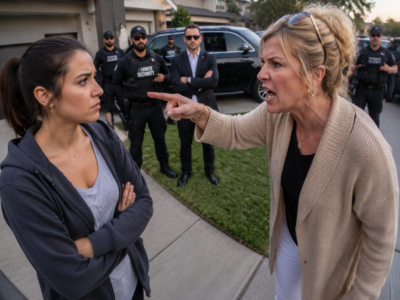
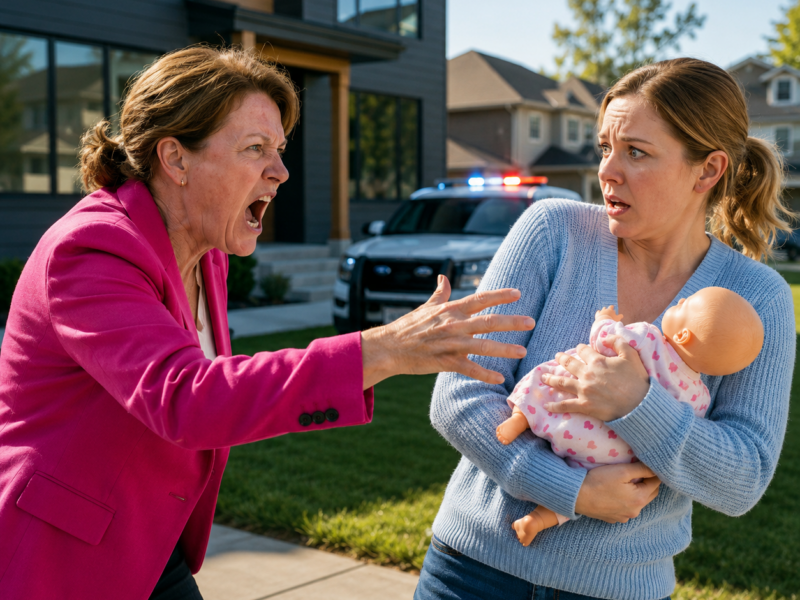
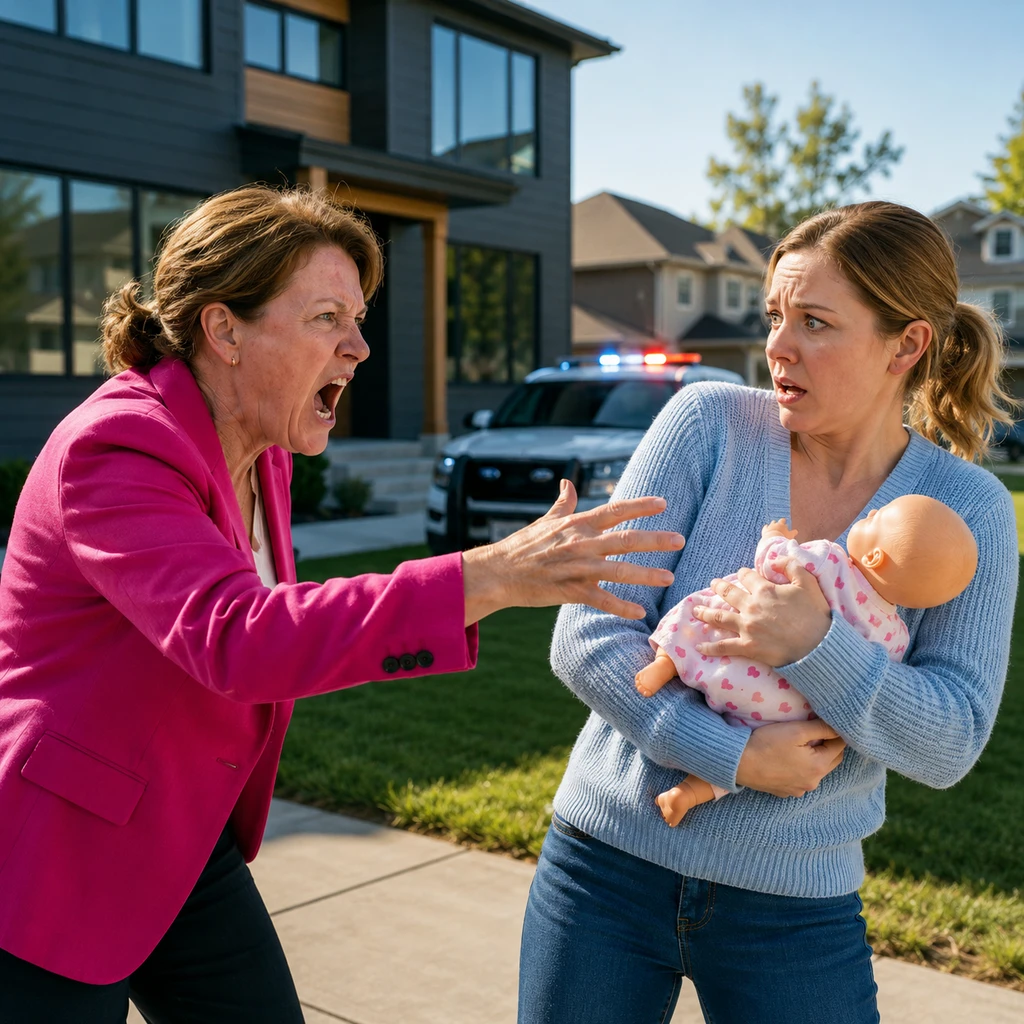
One second, I was standing in my own driveway with my daughter tucked against my chest, her tiny face half-hidden in a yellow blanket, her breath warm through my sweater. The next second, Brenda was lunging toward me in a hot-pink blazer, her mouth twisted with authority she did not have, her fingers open like she had every right to touch what was mine.
“Give me the baby,” she snapped.
I stepped back so fast my heel scraped the concrete.
“Do not touch my child.”
“She needs to be inspected,” Brenda said, breathless and angry. “We have had reports. You are violating community occupancy rules.”
My daughter made a small sound against my collarbone. Not a cry. More like a startled little whimper. That sound went through me sharper than any scream could have.
Behind Brenda, two HOA board members stood near the sidewalk with clipboards, both suddenly very interested in the grass. Across the street, three neighbors stared from their porches. A delivery driver had stopped halfway down the road. The whole neighborhood seemed frozen, watching a woman in a blazer try to turn motherhood into a compliance issue.
Then Brenda pointed at me and shouted the sentence that would later end her presidency.
“You are not allowed to keep an unregistered infant in this residence!”
I almost laughed.
I would have, if my daughter had not been in my arms.
Instead, I pulled Nora closer and said, slowly, “This is my house. This is my baby. And you are going to step away from us.”
Brenda’s face changed. She was used to people apologizing. Explaining. Folding. She was not used to a sleep-deprived mother looking at her like she had just crossed a line that could not be uncrossed.
So she did what people like Brenda do when the truth stops obeying them.
She took out her phone and called 911.
“Yes,” she said, turning slightly away but making sure I could hear every word. “I need officers at 229 Cedar Hollow Lane. There is a woman here with a newborn, and she is acting unstable. She is refusing a welfare check. I believe the child may be in danger.”
The world went cold.
Not because I feared the police.
Because I knew what those words could do.
Unstable.
Newborn.
Child in danger.
Those are not casual words. They are gasoline words. They change the way officers arrive. They change the way a mother is seen before she speaks. They can turn a driveway into a scene, a baby blanket into evidence, and a tired woman into a suspect.
I had spent eleven years hearing those words in courtrooms.
Brenda Carlisle did not know that.
She did not know I was Claire Bennett, Assistant District Attorney for Harrington County, head of the Family Protection Unit, the woman who trained officers, social workers, and school officials on child endangerment, false reporting, and emergency removal standards.
She did not know I had prosecuted real abuse cases. Real neglect. Real violence. Real mothers begging for help. Real children who needed saving.
She did not know I could tell the difference between a welfare concern and a weaponized lie.
Seven minutes later, two patrol cars rolled onto my street.
Brenda smiled like she had won.
The first officer stepped out, looked at her, then looked at me.
His face went pale.
“Ms. Bennett?”
Brenda’s smile cracked.
The second officer turned on his body camera immediately.
I adjusted Nora in my arms and said, “Officer Daniels, I’m personally involved. Please treat this like any other call. Body cameras on. I want a supervisor, and I want CPS notified that this appears to be a false welfare report tied to HOA harassment.”
Brenda stared at me.
“Ms. Bennett?” she repeated. “Who are you?”
I looked at her, then down at my daughter, whose tiny fingers had curled around the edge of my sweater.
“I’m her mother,” I said. “That should have been enough.”
My husband Luke and I moved into Cedar Hollow Estates because we wanted quiet.
That sounds almost funny now, considering what happened, but it was true. We wanted sidewalks, decent neighbors, a small backyard, and a room with morning light for the baby we had waited five years to hold.
Five years is a long time when you are trying to become parents.
It is long enough for baby shower invitations to start feeling like paper cuts. Long enough for every holiday photo to remind you what is missing. Long enough to stop telling people you are “hoping soon” because hope starts sounding embarrassing after the third specialist and the second miscarriage.
I do not talk about that part easily. Even now, it feels private. But it matters because when Nora finally came, early and tiny and furious at the world, I was not just happy.
I was stunned.
The first time the nurse placed her on my chest, I looked at Luke and saw him crying in a way I had only seen once before, at his father’s funeral. He was a firefighter, the kind of man who could walk into smoke without blinking, but that six-pound baby undid him completely.
“She’s here,” he whispered.
That was all.
She’s here.
After years of waiting, that sentence felt like the whole universe opening a door.
We bought the house in Cedar Hollow while I was seven months pregnant. It was a gray two-story with a wide porch, clean windows, and a maple tree in the front yard. The nursery faced east. Luke said that meant she would wake up with the sun.
I told him she would probably wake up whenever she wanted, because babies are tiny dictators with soft heads.
We laughed about it then.
The neighborhood looked perfect from the outside. Fresh lawns. White mailboxes. Bike trails. Little American flags near the sidewalks. Houses that looked different enough to seem custom but similar enough to make the HOA feel proud of itself.
I knew there was an HOA. I was not naïve. I read the packet before closing. Trash cans hidden after pickup. No broken-down cars. Exterior paint approval. Reasonable noise rules. Fine. I had no interest in turning the front yard into a tire shop.
What I did not know was that Cedar Hollow’s HOA was run by Brenda Carlisle.
Brenda introduced herself three days after we moved in.
I was sitting on the porch with swollen feet and a glass of ice water when she walked up the driveway wearing white pants, a bright pink blazer, and a smile that did not reach her eyes. She carried a welcome basket covered in cellophane.
“Claire Bennett?” she said.
“Yes.”
“I’m Brenda Carlisle, president of the Cedar Hollow Homeowners Association.”
President came before neighbor.
That should have warned me.
She handed me the basket. Inside were lemon muffins, a refrigerator magnet with trash pickup dates, and a thick booklet of HOA rules with pink tabs sticking out like tiny threats.
“We are so pleased to welcome you,” she said. “Cedar Hollow is a family-friendly community, of course, but we are also a standards community.”
I rested one hand on my belly.
“That sounds… organized.”
Her eyes dropped to my stomach.
“When are you due?”
“Six weeks.”
Her smile froze for half a second.
“Oh. How lovely.”
It was not lovely in her mouth. It sounded like she had just noticed a stain on the carpet.
Then she leaned closer.
“When the baby arrives, be sure to update the occupancy record with the management office.”
I blinked.
“The occupancy record?”
“Yes. For safety, parking, emergency planning, noise expectations, pool access, visitor volume, that sort of thing.”
I had reviewed the packet. I knew there was a resident contact form for emergencies. There was nothing requiring a newborn to be “registered” with the HOA.
“We’ll update emergency contact information if needed,” I said.
Her smile tightened.
“Good. We like to prevent misunderstandings early.”
That was Brenda’s gift: making a threat sound like an administrative favor.
After she left, Luke came outside and looked in the basket.
“Are those muffins safe?”
“Probably legally.”
He picked up the rulebook and flipped through the tabs.
“She highlighted the noise section.”
“She noticed the baby.”
He looked at my belly.
“Our unborn daughter is already causing neighborhood tension.”
“That’s my girl.”
We laughed.
I wish that joke had stayed a joke.
Nora was born four weeks early after a blood pressure scare that turned a routine appointment into a hospital admission. One minute I was arguing with Luke about whether we needed more burp cloths. The next, a doctor was saying words like “monitoring,” “risk,” and “delivery today.”
Labor was not cinematic. It was bright lights, fear, pain, nurses moving fast, Luke’s hand crushed in mine, and a tiny cry that sounded too small to belong to a person.
Nora spent nine days in the NICU.
Nine days of wires, alarms, hand sanitizer, whispered prayers, and learning how to celebrate one ounce gained like it was a national holiday. When we finally brought her home, I was so tired I felt transparent.
But she was home.
That first night, Luke carried her through the front door like he was holding the Constitution.
“Welcome home, Nora Jane,” he said.
I cried because postpartum hormones are no joke, and because the house suddenly felt real.
For two weeks, we lived in a soft blur. Feeding. Pumping. Diapers. Tiny socks. Pediatrician visits. Luke making coffee he forgot to drink. Me staring at Nora’s chest to make sure she was breathing. My mother coming over with soup. Luke’s sister dropping off groceries. A lactation consultant visiting twice. Friends leaving casseroles on the porch like offerings to exhausted gods.
Then the first HOA notice arrived.
Violation: Unapproved Porch Items Visible From Street.
I opened the envelope while holding Nora against my shoulder.
The “porch items” were a folded stroller, a diaper delivery box, and a small bassinet my mother had set outside for ten minutes while cleaning the nursery rug.
I laughed at first.
Not because it was funny.
Because my body had no energy left for disbelief.
Luke read it that night after his shift.
“You have to be kidding me.”
“I wish.”
“She fined us?”
“Warning first.”
He rubbed his face.
“I’ll move the stroller.”
That was exactly what Brenda counted on.
Small surrender.
Small exhaustion.
Small shame.
No one wants to fight an HOA over a stroller when they have a newborn who wakes every two hours. So we moved it.
The second notice came five days later.
Noise Concern: Repeated Infant Disturbance During Quiet Hours.
I stared at the page for a long time.
Quiet hours were 10 p.m. to 7 a.m. Nora was three weeks old. She cried sometimes because she was hungry, gassy, overtired, alive. That is what babies do. I was already raw from sleep deprivation, still healing physically, still carrying the strange anxiety that comes after bringing home a medically fragile newborn.
That letter hit differently.
It did not feel silly.
It felt cruel.
I emailed Brenda.
A newborn crying is not an HOA violation. Please do not send further notices related to normal infant care.
She replied nine minutes later.
Mrs. Bennett, Cedar Hollow fully supports families. However, support must be balanced with residents’ right to peaceful enjoyment. Please consider whether additional sound mitigation measures are appropriate.
Sound mitigation.
For a newborn.
I showed Luke. He wanted to call her immediately.
I stopped him.
“Not tonight.”
“She’s harassing us.”
“I know.”
“You’re too calm.”
“I’m not calm. I’m documenting.”
That was my habit. Maybe my profession. Maybe survival. I made a folder on my laptop titled HOA — Nora. That title alone made me angry.
The third notice arrived after my mother parked in the driveway overnight to help me while Luke worked a twenty-four-hour shift.
Unauthorized Extended Guest Presence.
The fourth came after a home health nurse visited.
Possible Business Activity From Residence.
The fifth came after a diaper subscription box sat by the front door for three hours.
Excessive Deliveries Creating Visual Clutter.
Each one sounded small if you read it alone. That was the trick.
A stroller. A cry. A visitor. A delivery.
But together, they became a net.
And I was tired enough to feel it tightening.
One Tuesday afternoon, I was nursing Nora in the living room when the doorbell rang. Rusty, our old golden retriever, lifted his head and sighed like even he was done with the neighborhood.
I checked the doorbell camera.
Brenda stood on the porch with a man in a blue polo shirt.
I did not answer.
Nora was latched. I was not getting up for Brenda Carlisle.
The doorbell rang again.
Then Brenda knocked.
Then she leaned toward the camera.
“Mrs. Bennett, we need to conduct a brief compliance check.”
I opened the app and spoke through the camera.
“This is not a good time.”
Her face tightened.
“It will only take a moment.”
“No.”
The man beside her shifted awkwardly.
Brenda said, “We have received reports of unusual traffic and possible childcare activity.”
I looked down at Nora, who was peacefully destroying the schedule I had tried to create.
“Childcare activity?”
“Multiple visitors. Deliveries. Infant noise.”
“I have a newborn.”
“That is why we need clarification.”
I felt my voice change.
“Brenda, leave my porch.”
She stared into the camera.
“We will note your refusal.”
“You do that.”
She left, but slowly, making sure the camera saw her writing on the clipboard.
That night, Luke found me sitting on the nursery floor with Nora asleep in my arms and tears running down my face.
I hated that he saw me like that.
Not because crying is weakness. It is not. But because I had spent years being strong in rooms where strength was required, and motherhood had stripped me down to something softer and more breakable.
He sat beside me without speaking.
After a while, I said, “I prosecute people who actually hurt children. I know what real danger looks like. And this woman is using that language because our baby cries and we have visitors.”
Luke’s jaw tightened.
“Then we fight.”
“I don’t want to fight. I want to sleep.”
He put his arm around me carefully, so he would not wake Nora.
“I know.”
That is what people do not understand about harassment. Sometimes it works not because the bully is powerful, but because the target is exhausted. New parents are exhausted. Grieving people are exhausted. Elderly people are exhausted. Sick people are exhausted. And controlling people have a terrible instinct for finding those soft spots.
Brenda found mine.
But she misjudged what was underneath.
The first real escalation came on a Friday morning when Luke was at the firehouse.
I had just finished feeding Nora and was carrying her outside for five minutes of sunlight. The pediatrician had suggested short, gentle morning light near the porch because she had mild jaundice early on. It was nothing dramatic, but after the NICU, every small health instruction felt sacred.
I stood on the front walkway, Nora wrapped in a yellow blanket, when Brenda appeared at the edge of the driveway.
She did not walk from her house. She came from around the side, which meant she had been near our gate.
My whole body tightened.
“Good morning,” she said, too brightly.
“Why are you on my property?”
“I’m on the front approach, which is visible from common street frontage.”
“That is not an answer.”
She held up a folder.
“We need to resolve the infant registration issue.”
“There is no infant registration issue.”
“Mrs. Bennett, every resident must be accounted for.”
“She is four weeks old.”
“Exactly. An unregistered occupant.”
I stared at her.
Some phrases are so absurd your brain refuses to process them at first.
“You want me to register my newborn with the HOA?”
“We require updated household records.”
“No, you don’t.”
Her face hardened.
“You signed the covenants.”
“I read the covenants.”
“I’m not here to debate legal interpretation.”
That sentence almost made me laugh. People who say that usually know the legal interpretation is bad for them.
Nora shifted in my arms.
Brenda’s eyes locked on her.
Then she said, “May I see her face?”
“No.”
“It’s just verification.”
“Verification of what?”
“That the child is healthy and properly cared for.”
Something inside me went still.
Very still.
“Brenda,” I said, “you need to leave.”
She lifted her chin.
“We have had concerns.”
“From whom?”
“Concerned residents.”
“What concerns?”
“Crying. Visitors. Your refusal to allow a compliance check. Your emotional tone in written correspondence.”
My emotional tone.
I was a mother with a premature newborn being harassed on my own walkway, and she had the nerve to call my tone the problem.
I stepped back toward the porch.
She stepped forward.
“Do not walk away from me.”
That was the first time I saw her mask slip fully. Not just bossy. Not just smug. Angry. Entitled. A woman who believed her authority expanded every time someone resisted it.
I said one last time, “Leave.”
She did, but only after pointing at me and saying, “You are creating a record against yourself.”
That line bothered me.
Because it was not just a threat. It was a plan.
That afternoon, I called my friend Maya Ortiz, a private civil attorney who had once worked in fair housing litigation before moving into estate and property law.
I told her everything.
She listened without interrupting.
Then she said, “Claire, she’s not enforcing rules. She’s building a paper trail.”
“I know.”
“She may be setting up a claim that you’re operating unauthorized childcare, violating occupancy rules, or creating a nuisance. Or she’s just trying to scare you. Either way, don’t meet with her alone. Don’t let her inside. Save everything.”
“I already am.”
“Good. Also, I know you’re an ADA, but don’t handle this like a prosecutor. Handle it like a homeowner with counsel.”
That was good advice.
Important advice.
When you work in law, people assume you can solve every legal problem with one stern email. Real life is not that clean, especially when you are personally involved. I could not and would not use my office to crush a neighbor dispute. That would make me everything Brenda would later accuse me of being.
So I became careful.
Maya sent a letter to the HOA demanding they stop contacting us about our newborn, stop attempting inspections, stop misrepresenting their authority, and preserve all records related to complaints, enforcement notices, and board communications.
For four days, things went quiet.
It was the kind of quiet that does not feel peaceful.
It feels like a held breath.
Then came the Saturday morning that changed everything.
Luke had been called in early because two firefighters were sick. My mother was supposed to come by later, but I wanted air, so I put Nora in a soft wrap against my chest and stepped outside. It was one of those perfect suburban mornings people put in real estate brochures. Blue sky. Lawns shining with dew. Kids riding bikes at the end of the street. A neighbor washing his truck. The smell of coffee and cut grass.
For a moment, I felt normal.
That is all I wanted.
Normal.
I walked slowly down the driveway, one hand supporting Nora’s back. She was asleep, her mouth slightly open, one tiny fist tucked under her cheek.
Then Brenda came around the corner.
She was not alone.
Two HOA board members followed her: Phil Danvers, a retired insurance agent, and Carol Price, who always looked like she regretted being included in things but never enough to leave. Both had clipboards.
Brenda wore the pink blazer again.
Of course she did.
She marched straight toward me.
“Mrs. Bennett, we need to speak with you immediately.”
“No.”
Her eyebrows shot up.
“No?”
“No. You can speak to my attorney.”
“This concerns child welfare.”
I felt heat rise in my chest.
“You do not get to use those words casually.”
“We have received credible concerns that an infant is being kept in violation of community occupancy requirements and that the mother may be refusing wellness contact.”
“The mother is standing in her driveway asking you to leave.”
Carol looked uncomfortable.
Phil cleared his throat.
“Claire, maybe if you just filled out the form—”
I turned to him.
“Do not call me Claire while standing in my driveway with a clipboard about my baby.”
He looked down.
Brenda stepped closer.
“Let me see the child.”
“No.”
“I need to confirm—”
“No.”
“She may be overheated in that wrap.”
“She is fine.”
“You’re being defensive.”
“You’re being invasive.”
Then Brenda reached toward the blanket.
Not far enough to grab Nora fully. Not enough to snatch her from my arms. But enough that her fingers brushed the edge of the fabric near my daughter’s head.
That was it.
That was the line.
I moved back, turned my body sideways, and shielded Nora with both arms.
The sound that came out of me did not feel planned.
“You cannot touch my baby.”
It echoed down the street.
A garage door stopped halfway open across from us. A dog barked. Phil took one step back. Carol whispered, “Brenda, don’t.”
But Brenda’s face had gone hard with humiliation.
“You are unstable,” she said.
I stared at her.
There it was.
The word she had been circling for weeks.
Unstable.
Not tired. Not postpartum. Not protective.
Unstable.
A word that could put a mother under suspicion before anyone asked what happened.
She pulled out her phone and dialed 911.
I did not interrupt. I did not yell. I did not give her anything she could use.
I simply stepped backward toward my porch, Nora held tight, and turned so my doorbell camera captured everything.
When Brenda told the dispatcher I was acting unstable and the child might be in danger, I felt rage so clean it almost calmed me.
Because now it was no longer hidden in letters.
It was recorded.
The officers arrived quickly.
Officer Daniels recognized me first. He had testified in one of my cases two years earlier. Officer Reed, his partner, recognized me a few seconds later. Both looked uncomfortable, not because of me, but because they understood immediately what kind of call they had walked into.
I made my request calmly.
Body cameras. Supervisor. CPS notification that the report appeared false. Separate statements. No special treatment.
Brenda kept trying to interrupt.
“She is using her position,” she said.
I looked at Officer Reed.
“I am on maternity leave. I am a homeowner and a mother. My attorney has already contacted the HOA about harassment. I will cooperate like any other parent.”
Brenda snapped, “Then hand over the baby so they can see she’s safe.”
Officer Daniels turned to her.
“Ma’am, we do not take infants from parents during a welfare check unless there is a lawful basis.”
“I reported danger.”
“What danger did you observe?”
Brenda blinked.
“She refused inspection.”
“By whom?”
“The HOA.”
Officer Reed’s face did not move, but I saw his jaw tighten.
“The HOA does not conduct child welfare inspections.”
Phil looked like he wanted to evaporate.
Carol quietly said, “I told her this was too much.”
Brenda glared at her.
A supervisor arrived fifteen minutes later. Sergeant Wallace. He was older, careful, and smart enough to ask short questions.
He asked Brenda what she saw.
She said I was hostile.
He asked what I did.
She said I refused to let her see the baby.
He asked what medical concern she observed.
She said Nora cried often.
He asked whether she had touched the child.
Brenda hesitated.
“No.”
Carol spoke before she could stop herself.
“She reached for the blanket.”
Brenda spun around.
“I did not touch the child.”
I said, “My camera recorded the whole interaction.”
That was the sentence that changed the morning.
Sergeant Wallace looked at me.
“You have video?”
“Yes.”
Brenda’s face lost color.
I showed them the doorbell footage. Then the driveway camera. Then the prior porch video where Brenda requested a “compliance check.” Then the notices about infant noise and occupancy. Then Maya’s letter.
The officers watched quietly.
Nora slept through almost all of it, which felt like grace.
When the CPS on-call worker arrived, Brenda seemed to regain confidence for half a second. Then the caseworker stepped out of her car and said, “Claire?”
Her name was Denise Harper. We had worked together on emergency custody cases for years. She looked at me, then at Nora, then at Brenda, then at the officers.
“What exactly was reported?” she asked.
Sergeant Wallace summarized.
Denise’s expression changed in a way only people in child welfare recognize. Not anger first. Assessment. She looked at Nora’s color, breathing, position, clothing. She asked me a few routine questions. Feeding? Diapers? Pediatrician? Recent appointments? Any medical concerns?
I answered.
Then she looked at Brenda.
“Mrs. Carlisle, are you a mandated reporter?”
Brenda lifted her chin.
“I am HOA president.”
“That is not what I asked.”
“I am responsible for community safety.”
“Did you observe abuse or neglect?”
“I observed refusal.”
“Refusal to allow you to inspect a newborn?”
Brenda’s silence was answer enough.
Denise closed her notebook.
“There is no basis for child protective action here.”
Brenda’s mouth fell open.
“You were here for three minutes.”
“I have enough information to determine there is no immediate safety concern, and I will document the report as unfounded unless additional evidence appears.”
“But—”
Denise’s voice sharpened.
“False or malicious reports take resources away from children who are actually in danger.”
That landed on me harder than I expected.
Because it was exactly what I had wanted to say, but could not say without sounding like I was using my professional anger for personal revenge.
Brenda stepped back.
For the first time, she looked unsure.
Sergeant Wallace gave her a formal warning for trespass and harassment. He told her to stay off our property and direct any HOA communication through counsel. He also said the 911 call would be reviewed because she had used emergency services for a civil enforcement matter and made claims not supported by evidence.
Brenda tried one last time.
“She is intimidating everyone because she works for the county.”
I looked at her.
“No, Brenda. You tried to use the county against my baby.”
The street went quiet.
That was the truth, and everyone knew it.
The story spread through Cedar Hollow by dinner.
Not accurately, of course.
Stories never travel in straight lines.
By 5 p.m., someone said Brenda had “rescued a baby from a dangerous situation.” By 6 p.m., someone else said I had “threatened the HOA with prosecution.” By 7 p.m., the neighborhood Facebook group was burning.
Brenda posted first.
Today I attempted to perform a good-faith welfare check involving an unregistered infant after multiple resident concerns. I was met with hostility and intimidation from a county official. No one should be above community safety standards.
She did not mention reaching toward Nora.
She did not mention the camera.
She did not mention the false wording to 911.
She did not mention CPS finding no concern.
She definitely did not mention that the “county official” was the child’s mother.
Luke came home from the firehouse at 8:30. He found me at the kitchen table, Nora asleep in the bassinet beside me, my laptop open, screenshots saved.
He looked at my face and said, “What happened?”
I told him.
All of it.
I had kept myself together all day. With the officers. With CPS. With Maya. With my mother on the phone. But when I said the words “she reached toward Nora,” my voice broke.
Luke went very still.
Firefighters have a kind of quiet that scares me more than yelling. He stood by the table, one hand gripping the back of a chair, breathing slowly.
“Did she touch her?”
“No. The blanket. Maybe barely. I moved.”
He closed his eyes.
“Claire.”
“I know.”
He crouched beside Nora’s bassinet and looked at her for a long time.
Then he said, “We are done being polite.”
And we were.
Maya filed a civil complaint the following week.
Not a dramatic lawsuit written for television. A real one. Clean. Specific. Strong.
Harassment. Trespass. Intentional infliction of emotional distress. Interference with quiet enjoyment. Abuse of HOA authority. Discriminatory enforcement based on familial status. False reports. Demand for injunction. Preservation of records.
She also filed complaints with the state HOA oversight office and the fair housing division. I recused myself from any criminal review connected to Brenda, because that was the only ethical way to handle it. The neighboring county prosecutor was asked to review the false reporting issue.
Everything became paperwork.
People hate paperwork until it protects them.
Then paperwork becomes a shield.
The HOA board panicked first.
Not publicly. Publicly, they issued a bland statement about “reviewing communication policies.” Privately, Phil called Luke and said maybe we could resolve things “neighbor to neighbor.”
Luke put the phone on speaker.
Phil said, “Nobody wanted this to get out of hand.”
I said, “It got out of hand when Brenda tried to touch my child.”
Silence.
Phil cleared his throat.
“I wasn’t comfortable with that.”
“But you stood there.”
That silence was longer.
And that is something I want to say clearly: bystanders are not always villains, but silence helps villains work. Phil did not reach for Nora. Carol did not call 911. But they stood behind Brenda with clipboards, giving her performance the appearance of authority.
That matters.
Carol came to our door two days later.
She stayed on the sidewalk.
“I know I’m not allowed on the property,” she said.
I stepped onto the porch but kept the door partly closed behind me.
Nora was asleep inside.
Carol looked tired. Older than she had on Saturday.
“I’m sorry,” she said.
I did not answer right away.
She swallowed.
“I should have stopped her earlier. Not just that day. Earlier.”
That was the first honest sentence I had heard from anyone on the board.
“What happened?” I asked.
Carol looked down the street.
“Brenda said residents were complaining about noise. Then she said there might be unauthorized childcare. Then she said if we didn’t document it, the HOA could be liable if something happened to the baby.”
I almost laughed from anger.
“Liable for my newborn crying?”
“I know. It sounds insane now.”
“It sounded insane then.”
She nodded.
“You’re right.”
I respected that she did not defend herself.
That is rare.
Carol gave Maya an affidavit the next week.
So did two other neighbors.
Then the stories started coming.
A young couple with twins had been fined repeatedly for “noise disturbances,” even though their babies were colicky and their pediatrician had written a note after the parents became desperate.
A grandmother raising her grandson had been told his toys in the yard created “visual disorder.”
A single father had received warnings because his child’s therapist visited twice a week and Brenda suspected “unlicensed business activity.”
A Muslim family had been cited for “excessive visitor traffic” during a naming ceremony for their newborn.
A Black mother down the street told Maya that Brenda once asked whether “all those children” lived in her home when her nieces were visiting for the weekend.
Every story had the same structure.
A family living normal family life.
Brenda labeling it disorder.
The HOA sending paper.
People paying, apologizing, hiding, shrinking.
One mother cried on the phone with me and said, “I thought I was just failing at being a good neighbor.”
That sentence broke my heart.
Because shame is one of the most effective tools of control. Make a young mother think her crying baby is a violation. Make a widow think her grandson’s toys are trash. Make a family think visitors are suspicious. Make people feel like ordinary life is something they should apologize for.
I have a strong opinion about that now.
A neighborhood that cannot tolerate children is not “peaceful.”
It is sterile.
And a rulebook that cannot distinguish between nuisance and normal life is not protecting community. It is draining the humanity out of it.
The emergency HOA meeting happened three weeks after Brenda’s 911 call.
The clubhouse was packed.
I had never seen so many people care about HOA governance. Usually these meetings attracted retirees, budget hawks, and one man named Gary who asked about mulch every time. That night, people stood against the walls. Parents held babies. Kids sat on the floor with tablets. Older residents whispered. The air felt electric.
Brenda sat at the front table in another pink blazer, face set, hands folded.
Phil sat beside her looking like a man who had spent three weeks reading emails he wished did not exist. Carol sat on the other side, pale but steady.
Maya sat with Luke and me in the second row. Nora slept in a carrier at my feet, wrapped in yellow again. I had almost left her with my mother, but then I thought, no. This whole thing started because Brenda wanted the neighborhood to treat my baby like a violation.
So Nora came.
Brenda opened the meeting.
“For the past several weeks,” she said, “this board has been subjected to attacks, distortions, and threats because we attempted to uphold community standards and child safety.”
A murmur moved through the room.
She continued, “I will not apologize for caring about the welfare of children.”
That did it.
I stood.
Maya touched my wrist, but did not stop me.
I looked straight at Brenda.
“You did not care about my child’s welfare when you reached toward her after I told you no.”
The room went silent.
Brenda’s face flushed.
“I did no such thing.”
Maya stood then.
“We have video.”
Three words.
That was all it took.
Phil closed his eyes.
Carol looked down.
Brenda’s mouth tightened.
The board had planned to keep public comment controlled. That failed immediately.
First came Mrs. Patel, mother of the twins. She held one baby while her husband held the other.
“Our sons had reflux and colic,” she said. “They cried every night for months. We were already exhausted. Then we got HOA letters. I cried harder than the babies did because I thought everyone hated us.”
Then came Malcolm Reed, the single father.
“My daughter has occupational therapy,” he said. “Brenda called it business traffic. My child already feels different. Your letters made her ask if she was the reason we might have to move.”
Then the grandmother, Mrs. Elaine Porter, stood with her grandson beside her.
“He leaves toy trucks in the yard,” she said. “Because he is six. My husband died, my daughter is gone, and this boy is the reason I get up in the morning. Don’t tell me his toys hurt this neighborhood.”
People began clapping.
Then Amina Hassan spoke about the naming ceremony.
“We invited family to celebrate our baby,” she said. “Brenda sent a notice about excessive visitor traffic. That day was sacred to us. She made it feel shameful.”
By the time I walked to the microphone, the room had changed.
Not everyone was on my side. There are always people who defend order because order has never been used against them. But enough people had heard enough truth.
I did not bring a speech.
I brought the folder.
“I work in child protection,” I said. “I have seen real danger. I have seen children hurt by adults who were supposed to love them. I have seen what happens when warning signs are missed. So let me be very clear: child safety matters. It matters deeply. But using child safety language to punish normal family life is wrong. It is dangerous. And it takes attention away from children who actually need help.”
Brenda stared at me.
I kept going.
“My newborn was not unsafe because she cried. She was not an unauthorized occupant. My mother was not suspicious for visiting. A nurse was not business activity. A diaper box was not visual clutter. And no HOA president has the right to reach toward a baby because a mother refuses a compliance check.”
The room erupted.
This time, the applause did not stop quickly.
Luke took my hand when I sat down. His fingers were shaking.
The board voted that night to suspend Brenda’s enforcement authority pending independent review.
Brenda called it illegal.
Maya smiled.
That smile meant paperwork was coming.
The independent review uncovered what we already suspected.
Brenda had created something called the Household Compliance Initiative without a proper board vote. It targeted “high-activity homes,” “frequent visitors,” “unregistered occupants,” and “family-related nuisance patterns.” The language sounded neutral until you looked at the homes selected.
Families with babies.
Families with young children.
Multi-generational households.
Single parents.
Immigrant families.
Disabled residents receiving home services.
People whose lives did not look like Brenda’s idea of quiet suburban perfection.
Her emails were worse.
One said, If we allow infant noise without response, we lose enforcement credibility.
Another said, New residents must understand that family status does not override community standards.
Then the one that made Luke walk out of the room:
Bennett is vulnerable right now. We should establish the record before she returns to work and becomes more difficult.
Vulnerable.
She had seen my maternity leave, my exhaustion, my newborn, and decided it was an opportunity.
That still makes my stomach turn.
The civil case settled before trial, but not before a judge issued a temporary injunction that barred Brenda and the HOA from contacting us directly, coming onto our property, issuing child-related notices, or making reports about us without documented, good-faith evidence of actual danger.
The settlement required the HOA to rescind all baby-related violations, refund fines to affected families, pay our attorney fees, rewrite its rules, and submit to monitoring by an outside management company for two years.
Brenda resigned.
Not gracefully.
She sent one final email to the neighborhood saying she had been “silenced for protecting standards.”
No one replied publicly.
That was the first wise thing Cedar Hollow had done in months.
The neighboring county prosecutor offered Brenda a diversion agreement for the false 911 report after reviewing the call, the video, and witness statements. She had to complete community service, pay the cost of the emergency response, attend legal training about false reporting and harassment, and agree not to hold HOA office during the diversion period.
Some people wanted harsher consequences.
Part of me did too.
I am not going to pretend I floated above anger like some saint in a courtroom painting. I was angry. I still am, sometimes. When I remember her fingers reaching toward Nora’s blanket, I feel something fierce and old rise in me.
But the goal was never revenge.
The goal was safety.
Our safety. Nora’s safety. The safety of every family who had been made to feel like their children were problems.
That goal was met.
Cedar Hollow changed after Brenda.
Not overnight. Real communities do not heal like movie endings. People still argued. Someone still complained about basketball hoops. Gary still asked about mulch at every meeting. But the fear lifted.
The HOA rewrote the rules in plain language.
No infant or child “registration” beyond lawful emergency contact forms.
No enforcement action based on normal child noise.
No direct contact about health, medical care, or family composition.
No wellness reports except for genuine, observed safety concerns.
No board member entering or approaching a resident’s child.
No fines without clear rule citations, evidence, and appeal rights.
Simple.
Basic.
Almost embarrassing that it had to be said.
But sometimes the most important rules are the ones decent people assumed everyone already understood.
Spring came slowly that year.
Nora grew out of the yellow blanket. She started smiling at ceiling fans. Then rolling. Then making serious little noises like she was filing complaints against gravity. Luke returned to his normal shifts. I went back to work, not the same as before, but steadier.
The first day I returned to court, I sat in my car for ten minutes before going inside.
I thought I would feel strong.
Instead, I felt split.
Part of me was the prosecutor again. The woman with files, witnesses, statutes, deadlines. The woman who knew how to stand up and speak clearly.
The other part of me was still on that driveway, holding my baby while someone tried to turn my motherhood into suspicion.
Maybe that is what becoming a parent does. It does not make you weaker. It makes the world sharper. Every danger has a face now. Every injustice feels less abstract. Every lie told about a child feels personal.
I did my job better after Nora.
Not easier.
Better.
Because I understood something in my body that I had previously understood only in theory: when a parent is falsely accused, the fear is physical. It steals breath. It stains the home. It makes you look at your own front door differently.
That does not mean real reports should be ignored. Never. Children must be protected. But systems built to protect children must never be used as weapons by people angry about control.
That line matters.
I believe it with everything in me.
By summer, Cedar Hollow held a neighborhood picnic.
I almost did not go.
Luke said we should.
“Not for them,” he said. “For us.”
So we went.
Nora wore a little blue sunhat and tried to eat the corner of a napkin. Mrs. Patel’s twins were crawling in opposite directions. Malcolm’s daughter showed me a drawing of our house with a giant heart over it. Amina brought sweets and insisted I take some home. Mrs. Porter’s grandson ran around with a toy truck, leaving it in the grass exactly where a six-year-old should.
No one called it visual disorder.
Carol approached me near the lemonade table.
She had resigned from the board but stayed in the neighborhood.
“I’m glad you came,” she said.
I nodded.
“I wasn’t sure I would.”
“I understand.”
We watched Nora bounce on Luke’s knee.
Carol said, “I should have stopped Brenda sooner.”
“Yes,” I said.
She flinched slightly, but I did not soften it. Some truths deserve to stand.
Then I added, “But you told the truth when it mattered.”
She looked relieved and sad at the same time.
“I’m trying to do better.”
“That counts.”
Across the park, Phil was helping set up folding chairs. He had apologized too, awkwardly and more than once. I accepted, but I did not pretend everything was fine. Forgiveness is not the same as amnesia. Trust has to be rebuilt by behavior, not speeches.
The new HOA president was Amina Hassan.
She had not wanted the job. That was probably why she was good at it.
At the first meeting under her leadership, she said, “The HOA exists to maintain shared property, not to monitor private families.”
That line received more applause than any budget update in Cedar Hollow history.
Brenda moved away in September.
Her house sold to a retired teacher and her adult daughter, who introduced themselves by bringing cookies and asking whether the neighborhood was “as intense as the documents made it sound.”
I said, “It’s improving.”
The day Brenda left, I saw her one last time.
I was walking Nora in the stroller. Brenda stood near a moving truck, directing two men carrying boxes. She looked smaller without the neighborhood orbiting her. Still polished. Still proud. But smaller.
She saw me and looked away first.
Then, unexpectedly, she walked toward us.
I stopped with one hand on the stroller.
She did not step close.
Good.
For a few seconds, neither of us spoke.
Finally, she said, “I hope you’re satisfied.”
I looked at Nora, who was chewing on a teething ring with deep concentration.
“I’m peaceful,” I said.
Brenda’s mouth tightened.
“You ruined my reputation.”
“No,” I said. “You reached toward a newborn and lied to 911. Your reputation reported accurately.”
Her eyes flashed.
“I was trying to protect the community.”
I had heard that phrase too many times.
I leaned slightly over the stroller, not because Nora needed protection from Brenda anymore, but because my body remembered.
“Brenda, a community that needs protection from babies has lost its mind.”
She did not answer.
She walked away.
That was the last time I ever spoke to her.
Nora’s first birthday came on a warm Sunday afternoon.
We held the party in our backyard. Nothing fancy. Cupcakes. Balloons. A bubble machine Luke bought at the last minute because he panicked in the party aisle and came home with enough decorations for a county fair.
My mother came. Luke’s firehouse crew came. Maya came with a tiny pink sweater she swore was “not legal advice.” Neighbors came too: the Patels, Amina, Malcolm and his daughter, Mrs. Porter and her grandson, Mr. Alvarez with tomatoes no one asked for.
Children ran through the yard.
Babies cried.
Someone spilled juice on the patio.
A toy truck sat in the grass.
A stroller was parked on the porch.
No one fined anyone.
At one point, I stepped inside to get more napkins and found myself standing alone in the kitchen, listening to the noise outside. For a second, I remembered that first letter. The stroller notice. The noise warning. Brenda’s hand reaching. My voice shouting, You cannot touch my baby.
Then Nora laughed outside.
A full, bright, ridiculous baby laugh.
The sound pulled me back.
I went to the window and watched Luke holding her near the cake, his face softer than I had ever seen it. She had frosting on her cheek. Her blue dress was already stained. Her sunhat was missing. She was perfect.
Maya came to stand beside me.
“You okay?”
“Yes,” I said.
And for once, I meant it.
People sometimes ask me what the lesson is.
They expect me to say, “Don’t mess with an ADA.”
That is the fun version. The social media version. The line that makes people cheer.
But it is not the real lesson.
The real lesson is this: nobody should have to be a prosecutor to be believed in their own driveway.
Nobody should need legal training to say, “Do not touch my child.”
Nobody should have to build a folder of evidence to prove that a newborn crying is not a violation.
And nobody with a title, a blazer, a clipboard, or a board seat should be allowed to turn normal family life into a weapon against tired parents.
Yes, document everything.
Yes, know your rights.
Yes, ask for the rule in writing.
Yes, get help before you are too exhausted to fight.
But also remember this: your home is not a showroom for someone else’s standards. It is where your baby cries, your family visits, your porch gets cluttered, your life happens in real time. A real community makes room for that.
Brenda Carlisle crossed the line involving our newborn because she thought motherhood had made me vulnerable.
She was partly right.
Motherhood did make me vulnerable.
It also made me precise.
It made me fierce.
It made me unwilling to surrender even one inch where my daughter’s safety was concerned.
She did not know who I was when she called 911.
But more importantly, she did not know who she was reaching toward.
Nora Jane Bennett.
Six pounds at birth.
NICU graduate.
Late-night screamer.
Porch-stroller owner.
The child we waited five years to bring home.
The baby Brenda called an unregistered occupant.
The daughter I would protect with every law I knew and every breath I had.
In the end, Brenda lost her title, the HOA lost its power to harass families, and Cedar Hollow became what it had always claimed to be.
Family-friendly.
Not because the rulebook said so.
Because the families finally stood up and made it true.