Captain Dumped Coke on My Head for a Laugh — Not Realizing My Last Name Would End His Career…
Captain Dumped Coke on My Head for a Laugh — Not Realizing My Last Name Would End His Career…
“You look like you could use a shower, sweetheart.”
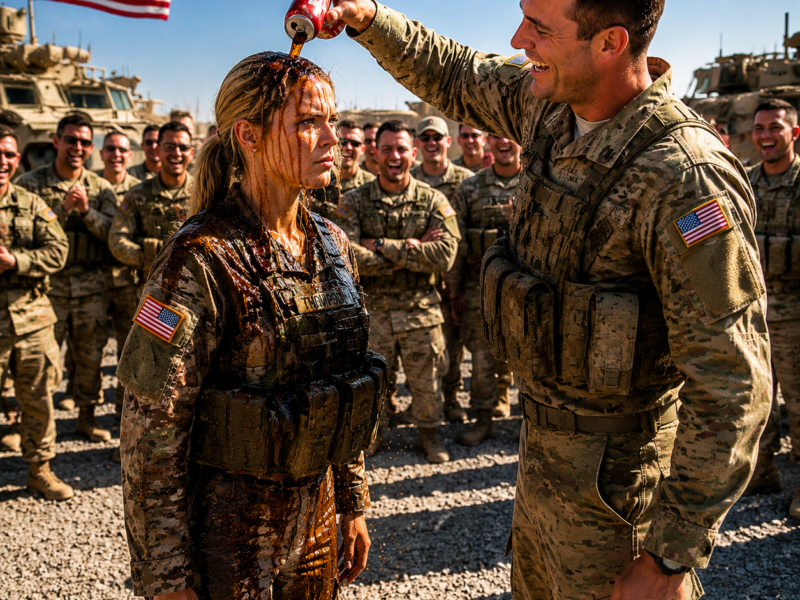
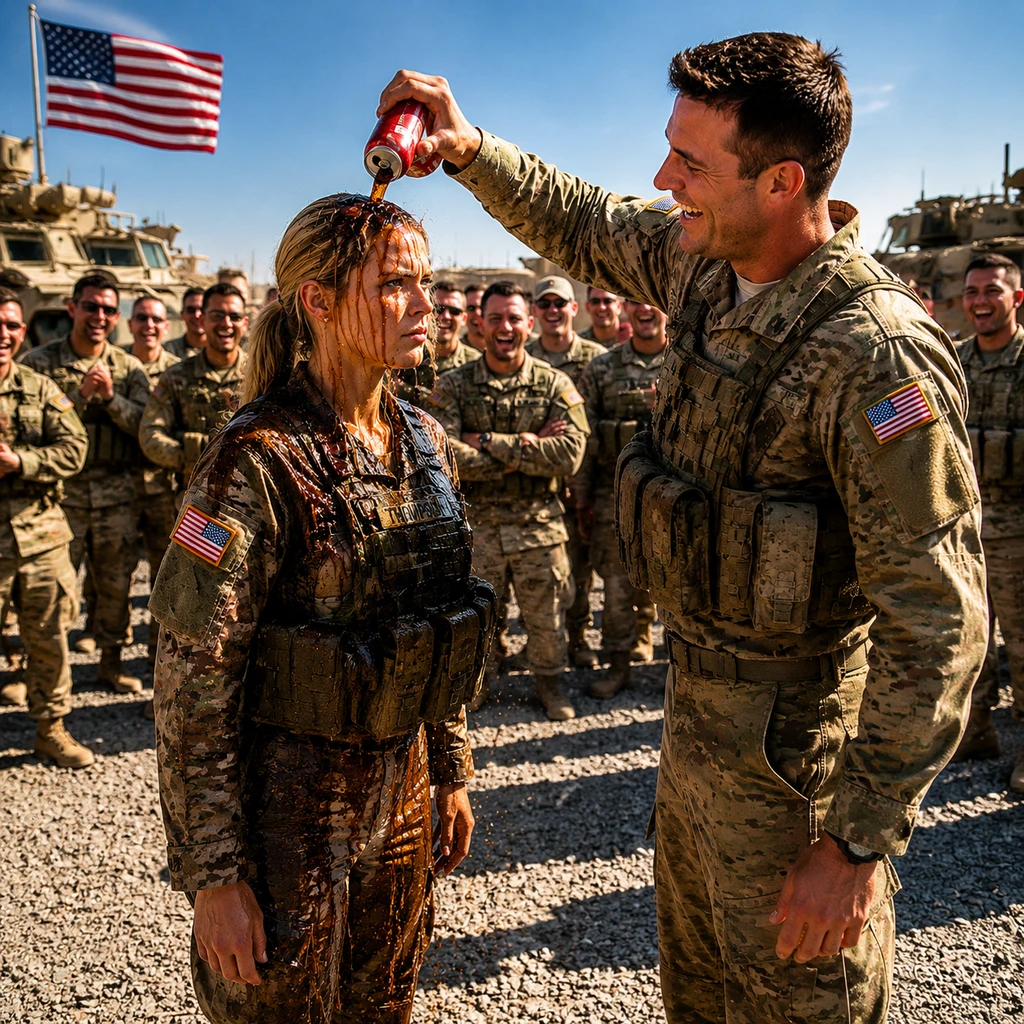
That was the last thing Captain Mason Drake said before he dumped an entire can of Coke over my head in front of thirty soldiers.
The soda ran down my face, soaked my uniform, and dripped off my chin onto the hot gravel of a forward operating base in eastern Afghanistan. Men looked away. One of them laughed because he was scared not to. Captain Drake smiled like humiliating me was just another perk of wearing bars on his chest.
I didn’t scream.
I didn’t cry.
I just memorized every face watching.
And seventy-two hours later, his career started bleeding out.
PART 1 — The Joke That Wasn’t a Joke
Captain Mason Drake poured Coke over my head because he thought my silence meant weakness.
He was wrong.
I was standing in the motor pool at Forward Operating Base Ryal at 0700 hours, July heat already rising off the gravel like the earth itself was angry. The kind of heat that made your blouse stick to your back before breakfast. The kind that turned dust into paste on your boots. The kind that made every small insult feel louder because everyone was already tired, already sweating, already one mistake away from snapping.
I was twenty-nine years old, a First Lieutenant, and six months into my first deployment as a logistics officer.
Not glamorous.
Not loud.
Not the kind of job that got speeches at Memorial Day ceremonies or applause in small-town parades.
But every convoy that rolled out with water, fuel, ammunition, medical kits, replacement tires, and working radios had my fingerprints on it. Every infantry squad that didn’t run dry in the middle of nowhere had someone like me behind them, checking manifests at midnight and arguing with supply chains nobody else wanted to understand.
That morning, my platoon was finishing maintenance checks on three MRAPs before a scheduled run to a smaller outpost near the valley road.
One missed inspection could strand a vehicle.
One loose bolt could kill a driver.
One lazy signature could turn a normal morning into a folded flag on somebody’s porch back in Kansas or Georgia or Ohio.
So I was not in the mood for Captain Mason Drake.
He came strolling into my motor pool like he owned the sun.
He had that smile some men wear when they have never been seriously told no. Clean boots for a man who always claimed to be “in the dirt.” Sunglasses hooked on his collar. A clipboard he never used. Two soldiers behind him who looked like they wanted to be anywhere else.
“Well, well,” he said, loud enough for everyone to hear. “Bravo Company shows up and suddenly the Girl Scouts are running the motor pool.”
A few soldiers froze.
My sergeant, Staff Sergeant Alvarez, looked at me from beside the lead vehicle.
I gave him one small shake of my head.
Not here.
Not in front of the troops.
Drake kept walking, glancing at my maintenance logs like he knew what he was looking at.
He didn’t.
“You sure you don’t need help, Lieutenant?” he asked. “Convoy readiness can be a little complicated when you’re used to desk work.”
I kept my voice flat.
“Captain Drake, these vehicles are under my command this morning. If you have a specific operational concern, I’ll document it.”
He smirked.
“Oh, she documents.”
More nervous silence.
One of his soldiers stared at the ground.
Drake stepped closer.
“Tell me something, Sutton. Have you ever even been outside the wire, or do they just let you play soldier with the binders?”
That one landed.
Not because it was clever.
Because every soldier in that motor pool knew I had run more convoy missions in six months than some officers bragged about for years.
I turned fully toward him.
“I have coordinated and personally ridden on thirty-eight convoy operations since January,” I said. “If you have questions about those operations, bring them to Lieutenant Colonel Holt.”
For one second, the smile slipped off his face.
Not long.
Just enough.
He hated being corrected by a woman in front of enlisted men.
I had seen that look before.
At Fort Lee.
At Fort Benning.
At every table where a man assumed confidence belonged to him by default.
Drake looked around, searching for a way to win the moment back.
Then his eyes landed on the cooler near the shade net.
Somebody had filled it with bottled water and a few sodas for the maintenance crew.
He walked over, opened it, and pulled out a red can of Coke.
“Relax, Lieutenant,” he said, shaking the can slowly. “You look tense.”
My stomach went cold.
Alvarez moved half a step forward.
I raised one finger without looking at him.
Stop.
Drake popped the tab.
Foam hissed over his hand.
Then he lifted the can over my head and poured.
Slowly.
Deliberately.
Not a splash.
Not an accident.
A performance.
Cold soda hit my patrol cap, ran down my forehead, into my eyebrows, along my cheeks, down my neck, soaking the collar of my uniform. It crawled under my blouse and stuck to my skin in the heat.
Thirty soldiers watched.
The motor pool went so quiet I could hear the Coke dripping onto the hood of the Humvee beside me.
Drake laughed.
“You look like you could use a shower, sweetheart.”
That word.
Sweetheart.
He knew exactly what he was doing.
He wasn’t joking.
He was reminding everyone that no matter my rank, no matter my work, no matter my record, he believed he could reduce me to a woman standing there humiliated while men watched.
I wanted to hit him.
I wanted to grab the maintenance log off that Humvee and break it across his smug mouth.
I wanted to tell him my father had warned me about men like him.
But my father’s voice came back first.
Not loud.
Not angry.
Steady.
Discipline is knowing the difference between the moment to act and the moment to wait.
So I waited.
I wiped nothing from my face.
I said nothing.
I picked up the maintenance log, turned one page, and marked a missed inspection entry on vehicle two.
My hand did not shake.
Then I keyed my radio.
“Alvarez, redirect second crew to the rear axle inspection. Ramirez, confirm comms check on vehicle three. No one leaves this line until every deficiency is logged and corrected.”
My soldiers moved immediately.
That mattered.
They did not look at Drake.
They looked at me.
Drake’s smile tightened when nobody laughed the way he wanted them to.
I turned and walked back toward my office, soda dripping down my sleeves.
Behind me, he called out, “Come on, Sutton. Don’t be dramatic. It was just a joke.”
I stopped.
Only for half a second.
Then I kept walking.
Because I already knew something Captain Mason Drake didn’t.
There were cameras on the motor pool.
There were thirty witnesses.
There was a pattern in his file.
And in seventy-two hours, a Brigadier General named Owen Sutton was scheduled to land on that base for a regional command inspection.
Captain Drake thought he had poured Coke on some random lieutenant.
He had no idea whose daughter he had just humiliated.
And worse for him, he had no idea I didn’t need my father to save me.
I only needed the truth to arrive on time.
PART 2 — I Didn’t Cry, I Built a Case
By the time I closed my office door, my uniform was sticky, my throat was burning, and my rage was so quiet it scared even me.
I stood there for a moment, alone, listening to the hum of the portable air conditioner struggling against the Afghan heat.
A brown drop slid from my hairline onto my desk.
Then another.
Then another.
I took off my patrol cap and placed it carefully on a plastic chair.
Not threw it.
Placed it.
Because if I started throwing things, I might not stop.
My office was nothing fancy. Plywood walls. A folding desk. Two metal chairs. A whiteboard full of convoy timelines. A coffee mug from Texas A&M. A faded photo taped near my monitor of my father, my brother, and me standing on our back porch in Boulder, Colorado.
It had been taken the morning I commissioned.
My father was in dress blues.
Brigadier General Owen Sutton.
At home, he was Dad.
At work, he was a man who could silence a room by breathing.
He had served two tours in Iraq, one in Afghanistan, and carried himself with the kind of discipline people either respected or feared. When I was twelve, he put a rifle in my hands on a quiet range outside Boulder and taught me to breathe before I pulled the trigger.
“Your first reaction is rarely your best one,” he told me. “Control the first reaction, and you control what happens next.”
So I breathed.
In through my nose.
Out through my mouth.
The Coke had dried against my neck.
I wanted a shower. I wanted a new uniform. I wanted five minutes where I did not have to be the calmest person in the room.
Instead, I opened my laptop.
Subject line: Incident Report — Unprofessional Conduct / Potential Hazing.
I wrote everything.
Time.
Location.
Names.
Words used.
Actions taken.
Witnesses present.
I did not exaggerate.
I did not editorialize.
I did not write that Captain Drake was a sexist bully with a fragile ego and a smile that made my skin crawl.
I wrote facts.
Captain Mason Drake entered the motor pool without operational necessity.
Captain Mason Drake made repeated comments questioning my competence and experience.
Captain Mason Drake shook and opened a can of soda.
Captain Mason Drake poured it over my head in front of approximately thirty soldiers.
Captain Mason Drake used the term “sweetheart.”
Captain Mason Drake stated it was “just a joke.”
I attached the motor pool camera number from the security board.
Then I sat back.
My hands finally started shaking.
Not from fear.
From the effort it took not to become what men like Drake expected.
Emotional.
Hysterical.
Difficult.
Unable to “take a joke.”
That was the trap.
If I yelled, he would win.
If I stayed silent forever, he would win.
So I chose the narrow road between them.
Professional.
Documented.
Unforgiving.
Twenty minutes later, Staff Sergeant Alvarez knocked once and stepped in without waiting.
He had a towel in one hand and a look on his face I had never seen before.
Shame.
Not for himself.
For what he had been forced to witness.
“Ma’am,” he said quietly. “You okay?”
I almost laughed.
It would have sounded ugly.
“I’m operational.”
“That’s not what I asked.”
I looked up at him.
Alvarez was from El Paso. Married. Two kids. The kind of NCO who could fix a broken process with duct tape, caffeine, and pure contempt. He had seen enough bad leadership to smell it before it entered a room.
“I’m writing it up,” I said.
“Good.”
He set the towel on my desk.
Then he placed a small black object beside it.
A USB drive.
I stared at it.
“What’s that?”
“Motor pool security footage,” he said. “Camera three caught the whole thing. Camera five caught the angle from behind him.”
I said nothing.
He added, “Sergeant Wilkes pulled it before anyone could decide the cameras were mysteriously down.”
For the first time that morning, I felt something like relief.
Not happiness.
Not satisfaction.
Relief.
“Who else saw clearly?” I asked.
“Pretty much everyone. But the ones who will talk? Me. Wilkes. Ramirez. Holloway. Two of Drake’s guys too, if command doesn’t scare them stupid.”
That was the second truth about bullies.
They rarely act alone.
They build little kingdoms out of silence.
And every kingdom has cracks.
“Get written statements,” I said. “Voluntary. No pressure. Facts only.”
Alvarez nodded.
Then he hesitated.
“Permission to speak freely?”
“Granted.”
His jaw flexed.
“He’s done this before.”
I looked at him.
“Define this.”
“Not Coke. Not exactly. But comments. Public humiliation. Calling female officers ‘princess’ or ‘honey.’ Making soldiers do push-ups for laughing at the wrong time. He made a specialist stand outside the chow hall last month with a sign that said, ‘I forgot how clocks work’ because the kid was late after a radio shift.”
A familiar cold settled in my stomach.
This was not an incident.
This was a pattern.
“Names?” I asked.
“I can get them.”
“Get them.”
He turned to leave.
“Sergeant.”
He stopped.
“Thank you.”
His face softened.
“No, ma’am,” he said. “Thank you for not letting him teach our soldiers that this is leadership.”
After he left, I changed uniforms in the small shower trailer behind the admin building. I scrubbed Coke from my hair with government-issued shampoo that smelled like floor cleaner. I watched brown water spiral down the drain and wondered how many women before me had stood under military showers washing off humiliation they never reported.
When I returned, my inbox already had three statements.
By noon, there were seven.
By evening, eleven.
Some were short.
Some were careful.
One from Private First Class Daniel Reed, one of Drake’s own soldiers, hit me hardest.
Captain Drake laughed while pouring the soda. Lieutenant Sutton remained calm. I felt uncomfortable but did not speak because Captain Drake is in my chain of command and has retaliated before.
Retaliated before.
There it was.
The word that turns a joke into a warning sign.
The next morning, I walked into Lieutenant Colonel Aaron Holt’s office with my report printed, signed, and organized in a folder.
Holt was my battalion commander.
A fair man.
Not warm.
Not fatherly.
Fair.
He read the report without interrupting. Then he watched the footage on the USB drive.
His face did not change.
That told me everything.
Good commanders don’t perform outrage.
They move.
When the video ended, he folded his hands on the desk.
“Lieutenant Sutton,” he said, “are you seeking any special consideration because of your family connection?”
“No, sir.”
“And if your father were not arriving this week?”
“I would still be sitting here.”
He nodded once.
“Good answer.”
Then he picked up his phone.
By lunchtime, my report had been forwarded up the chain with the witness statements, camera footage, and a recommendation for a command-directed investigation.
For four hours, I believed the system might work.
Then Holt called me back in.
He looked older than he had that morning.
“That was fast,” I said.
“It was.”
My stomach dropped.
He removed his glasses and rubbed the bridge of his nose.
“Lieutenant Colonel Trent Rowe, Drake’s battalion commander, wants to handle the matter informally.”
I stared at him.
“Informally.”
“Yes.”
“As in?”
“Private counseling. No formal investigation.”
I felt my pulse in my teeth.
Holt’s mouth tightened.
“His exact words were that officers in a combat environment need to toughen up and avoid making personnel issues out of harmless jokes.”
Harmless.
The word echoed in my head.
A harmless joke did not require witnesses to be afraid.
A harmless joke did not come with camera angles.
A harmless joke did not have a history behind it.
“Sir,” I said carefully, “with respect, that is unacceptable.”
“I agree.”
“Then what happens now?”
Holt looked directly at me.
“Now it’s on record.”
That was not justice.
But it was something.
A record is a seed.
And if you bury the truth deep enough, sometimes it grows teeth.
I left his office calm.
I passed soldiers in the hallway.
I passed Drake near the TOC.
He gave me a lazy salute and a grin.
“Still mad, Sutton?”
I stopped.
Looked at him.
And smiled.
Not big.
Not friendly.
Just enough to make his grin falter.
“No, Captain,” I said. “I’m patient.”
He laughed because he didn’t understand the difference.
But he would.
Because the next morning, the helicopter carrying Brigadier General Owen Sutton landed in a storm of dust.
And Captain Mason Drake still had no idea what my last name meant.
PART 3 — The General Arrived, and the Base Went Silent
When my father stepped off that helicopter, half the base straightened their posture before they even knew his name.
That was the effect he had.
The Black Hawk touched down just after 0830, blades hammering the air, dust whipping across the landing zone. I watched from behind a line of concrete barriers near the logistics office, far enough away to remain professional, close enough to feel twelve years old for one dangerous second.
Brigadier General Owen Sutton climbed out in full combat uniform, sunglasses on, jaw set, one hand on his gear strap.
He did not look around like a tourist.
He looked around like a man already counting failures.
The base commander met him first.
Then the senior staff.
Then the inspection team.
Nobody came to get me.
Good.
That was how it had to be.
My father and I had agreed before my deployment that there would be no special treatment. No private lunches. No surprise visits. No “checking on my daughter” while he wore a star on his chest.
In uniform, I was Lieutenant Sutton.
He was General Sutton.
The Army was small enough already without people whispering that I had been carried by my last name.
But blood is a strange thing.
Even from a distance, I could tell when he was angry.
Not because he showed it.
Because he became still.
That morning, he was very still.
The first day of his inspection moved like a storm front. Meetings with senior leadership. Reviews of logistics flow. Maintenance readiness. Supply delays. Convoy security procedures. Medical evacuation coordination. He asked questions that made majors sweat and colonels sit up straighter.
By lunch, word had spread across the FOB.
General Sutton was sharp.
General Sutton was not there for handshakes.
General Sutton had read the reports.
That last part was what made me look up from my desk.
Reports.
All of them?
At 1400, Staff Sergeant Alvarez came in with a stack of updated convoy manifests.
“He’s asking about the motor pool tomorrow,” he said.
“Who?”
He gave me a look.
“The general, ma’am.”
I kept writing.
“That’s part of the inspection.”
“He asked for you to brief readiness.”
My pen stopped for half a second.
Then I continued.
“Then I’ll brief readiness.”
Alvarez leaned against the doorframe.
“You know, Captain Drake has been running his mouth all morning.”
I looked up.
“What did he say?”
“That generals always show up after the hard work is done. That he’ll charm the old man. That this whole complaint thing is going away because Lieutenant Colonel Rowe has it handled.”
I almost admired the stupidity.
Almost.
“Did he say anything about me?”
Alvarez’s face darkened.
“He said you probably called Daddy.”
There it was.
The insult under every insult.
If I succeeded, it was because of my father.
If I reported misconduct, it was because I was protected.
If I stood up straight after being humiliated, it was because some powerful man stood behind me.
Men like Drake could not imagine a woman having a spine of her own.
“Did anyone respond?” I asked.
“Private Reed said, ‘Maybe you shouldn’t have poured soda on an officer then, sir.’”
My eyebrows rose.
Alvarez looked proud.
“Kid may live after all.”
The next morning, I walked into the briefing room with my uniform pressed, hair tight, boots clean, and every number memorized.
My father stood at the front beside Lieutenant Colonel Holt and the base commander.
He did not smile.
I did not either.
I saluted.
“First Lieutenant Ember Sutton, logistics platoon leader, Fifth Armored Division, reporting as directed, sir.”
He returned the salute.
“Proceed, Lieutenant.”
For twenty-three minutes, I briefed vehicle readiness, maintenance cycles, route delays, parts shortages, fuel consumption, and convoy risk mitigation. My voice never wavered. My slides were clean. My numbers were exact.
My father interrupted three times.
Not softly.
Not because I was his daughter.
“Why was vehicle two marked mission-capable with a deferred axle inspection?”
“Because the initial entry was incomplete, sir. The issue was corrected before movement.”
“Who caught it?”
“I did, sir.”
“Why are replacement tires delayed?”
“Supply bottleneck at Bagram, sir. We’ve already rerouted through an alternate source pending approval.”
“Who approved the reroute?”
“I requested it through battalion yesterday. Approval came at 0600.”
He held my gaze for one extra second.
Then nodded.
“Continue.”
When it ended, he said only, “Thank you, Lieutenant.”
I saluted and left.
In the hallway, I let out the breath I had been holding.
Not because I feared him.
Because I respected him too much to disappoint him.
Twenty minutes later, Lieutenant Colonel Holt was called into a private meeting.
I learned later what happened inside.
My father did not begin with small talk.
He placed a printed report on the table.
“Explain this.”
Holt looked down.
My incident report.
The witness statements.
The camera log.
The notes about Captain Drake’s prior complaints.
Holt’s face went tight.
“Sir, I forwarded the complaint with a recommendation for formal investigation.”
“I saw that,” my father said. “I also saw the response.”
The base commander shifted in his chair.
My father turned one page.
“Lieutenant Colonel Rowe declined formal action and classified it as an informal counseling matter.”
“Yes, sir.”
“Why?”
Holt answered honestly.
“Captain Drake’s father is a retired colonel. He and Lieutenant Colonel Rowe are close. I believe Rowe intended to contain the issue.”
My father’s voice stayed low.
“Contain misconduct, or conceal it?”
Nobody answered.
That was answer enough.
He reached for the phone.
“Get Lieutenant Colonel Rowe and Captain Drake in this building.”
The base commander hesitated.
“Sir, do you want legal present?”
“Yes,” my father said. “And the Inspector General representative. And preserve every second of motor pool footage from the last thirty days.”
That sentence changed everything.
Because the Coke was only what happened to me.
The last thirty days were what happened to everyone else.
Drake arrived forty minutes later wearing the expression of a man annoyed by inconvenience, not afraid of consequences.
Lieutenant Colonel Rowe came with him, shoulders tight, eyes sharp.
A JAG officer sat near the wall with a notebook.
The IG representative stood in the corner.
My father sat at the head of the table.
No raised voice.
No dramatic speech.
Just a printed file and a silence that did more damage than shouting ever could.
“Captain Drake,” he said, “describe the incident in the motor pool involving First Lieutenant Sutton.”
Drake leaned back slightly.
“Well, sir, it was a minor misunderstanding.”
My father said nothing.
Drake cleared his throat.
“We were joking around. Morale gets rough out here. I made a harmless joke. Lieutenant Sutton took it the wrong way.”
“Did you pour a can of Coke over her head?”
Drake blinked.
“I mean, yes, but—”
“Did she consent to that?”
“No, sir, but it wasn’t—”
“Did you call her sweetheart?”
His jaw tightened.
“I don’t recall the exact wording.”
The JAG officer wrote something down.
My father opened a folder and read from a witness statement.
“You look like you could use a shower, sweetheart.”
The room went still.
Drake’s face changed.
Just a flicker.
The first crack.
Lieutenant Colonel Rowe stepped in.
“Sir, Captain Drake has already been counseled. I believed this was best handled at the lowest level.”
My father turned his head slowly toward him.
“Did you review the witness statements?”
Rowe hesitated.
“I reviewed the summary.”
“Did you review the footage?”
“No, sir. I did not believe—”
“Did you review prior informal complaints regarding Captain Drake’s conduct?”
Rowe’s mouth opened.
Closed.
My father let the silence sit there.
Then he said, “So you declined formal investigation without reviewing the evidence.”
Rowe’s face reddened.
“Sir, with respect, deployed environments require discretion. Not every interpersonal conflict needs escalation.”
My father leaned back.
“Pouring soda over a subordinate officer’s head in front of soldiers is not interpersonal conflict. It is humiliation. It is abuse of authority. It is conduct unbecoming. And when ignored, it becomes culture.”
Drake shifted in his chair.
He still did not understand.
Not fully.
Then my father turned back to him.
“Captain Drake, do you know who First Lieutenant Ember Sutton is?”
Drake looked confused.
“She’s a logistics officer, sir.”
“Yes.”
My father’s eyes did not move.
“She is also my daughter.”
The room died.
Not quiet.
Dead.
Drake’s face drained so fast he looked ill.
Rowe looked at the table.
The JAG officer stopped writing for half a second, then started again.
My father continued.
“Understand me clearly. This investigation is not happening because she is my daughter. It is happening because she is an officer in the United States Army who was publicly degraded by another officer while her chain of command attempted to minimize it.”
He leaned forward.
“If Captain Drake had treated her with the respect her rank and service required, he would not be sitting here.”
Drake swallowed.
“Sir, I didn’t know—”
My father cut him off.
“That is the problem. You should not have needed to know.”
That sentence traveled faster than any official memo.
By dinner, every soldier on that FOB had heard some version of it.
You should not have needed to know.
Not who her father was.
Not who might protect her.
Not what consequences might come.
Respect was not supposed to depend on fear.
That afternoon, Captain Mason Drake was temporarily relieved of duties pending a command-directed investigation.
Lieutenant Colonel Rowe was ordered to provide written justification for his decision to avoid formal action.
The motor pool footage was preserved.
Statements were collected again, this time by people outside Drake’s chain of command.
And once soldiers realized someone was actually listening, the floodgates opened.
Specialist Henry wrote about being mocked in front of the chow hall.
Private Reed wrote about threats after he corrected a time error.
A female medic from another unit wrote that Drake had called her “combat Barbie” during a joint training brief.
A warrant officer submitted a statement about Drake falsifying readiness pressure to make his company look better before an inspection.
Then came the thing nobody expected.
A civilian contractor named Marla Jennings walked into the IG office with a thumb drive.
She worked communications maintenance and had been near the motor pool the day of the Coke incident.
But that was not what mattered.
Her thumb drive contained audio from three weeks earlier.
Captain Drake, laughing in the TOC, saying, “You don’t have to be good if your daddy knows the right colonel.”
He had not been talking about me.
He had been talking about himself.
And once investigators heard that recording, they stopped looking at one bad joke and started looking at the entire ugly machine behind him.
That was when Captain Drake finally got scared.
Not because he had humiliated me.
Because for the first time in his career, he could not charm, threaten, or inherit his way out of the truth.
PART 4 — He Lost Everything He Thought Made Him Untouchable
Captain Mason Drake apologized only after he realized his father’s name could not save him.
He requested to speak with me on the fourth day of the investigation.
The request came through proper channels, wrapped in the kind of language cowards use when they want forgiveness documented but not earned.
Captain Drake would like the opportunity to personally express regret regarding the misunderstanding.
Misunderstanding.
Even then, he could not call it what it was.
Lieutenant Colonel Holt asked if I wanted to accept.
“No, sir,” I said.
He nodded like he had hoped I would say that.
“You don’t owe him closure.”
I appreciated that.
Because too many people confuse forgiveness with paperwork.
Drake did not want forgiveness.
He wanted a witness.
He wanted me to soften.
He wanted to walk into some future board and say, “Lieutenant Sutton accepted my apology.”
No.
He had chosen a public humiliation.
He could face a public record.
The investigation lasted nine days.
Nine days of interviews, statements, footage review, personnel file checks, and quiet panic from every officer who had ever laughed along with Drake because it was easier than confronting him.
The final findings were worse than even I expected.
The Coke incident was substantiated.
The hostile remarks were substantiated.
Retaliatory behavior was substantiated.
Prior complaints had been minimized or buried.
Lieutenant Colonel Rowe had failed to take appropriate action after receiving credible evidence.
And Captain Mason Drake’s “leadership style” was officially described in the report as corrosive to good order, discipline, and trust.
Corrosive.
That word followed him like smoke.
He was formally relieved from his position.
He received a General Officer Memorandum of Reprimand placed permanently in his official file.
Not local.
Not temporary.
Permanent.
In the Army, that is not a slap on the wrist.
That is a locked door.
Promotion?
Gone.
Command?
Gone.
That shiny future he had been so certain belonged to him because of his last name?
Gone.
He was reassigned to a rear staff position for the remainder of the deployment, tucked away where he could no longer poison soldiers under the cover of charisma and rank.
Lieutenant Colonel Rowe did not escape clean either.
He was not destroyed overnight.
Men like him rarely are.
But his decision was reviewed, documented, and attached to the command climate assessment. His next evaluation carried language that looked polite to civilians and fatal to officers.
Failed to exercise appropriate judgment in addressing substantiated misconduct.
That sentence ended his climb.
Quietly.
Professionally.
Permanently.
The day Drake left the motor pool for the last time, I was standing near vehicle three reviewing a parts manifest with Alvarez.
Drake walked past in silence.
No grin.
No sunglasses on his collar.
No audience.
Just a man carrying a cardboard box and trying not to look like everyone could see through him.
Private Reed stood near the tool bench.
Drake glanced at him.
Reed did not look down.
That, more than anything, told me something had changed.
Bullies survive by teaching everyone to lower their eyes.
Accountability teaches them to lift their heads again.
Drake stopped ten feet from me.
For a moment, I thought he might say something stupid.
He opened his mouth.
Then looked at Alvarez.
Then at Reed.
Then at the camera mounted on the pole above the motor pool.
And closed it.
Smartest decision he had made all month.
After he left, Alvarez handed me the manifest.
“Ma’am?”
“Yes?”
“You know the guys are calling camera three ‘the Coke witness’ now.”
I stared at him.
He tried to keep a straight face.
Failed.
I laughed.
Not loudly.
Not for long.
But enough.
It was the first time I had laughed since that morning.
That evening, my father finished the final portion of his inspection.
He never pulled me aside dramatically.
Never hugged me in front of anyone.
Never gave a speech about his daughter.
That was not his way.
But as his team prepared to depart, I was ordered to deliver one final logistics summary to the command tent.
When I finished, everyone filed out except him.
For the first time all week, we were alone.
Only for thirty seconds.
He stood by the table, looking at a map of Regional Command East.
I stood at attention because I did not know what else to do.
“At ease, Lieutenant,” he said.
I relaxed.
Barely.
He turned.
His face was still the general’s face.
But his eyes were my father’s.
“I read your original report,” he said.
“Yes, sir.”
“It was precise.”
“Thank you, sir.”
“You did not embellish.”
“No, sir.”
“You did not hide.”
“No, sir.”
He looked toward the open tent flap, where soldiers moved through the dust and heat.
Then he said, quieter, “You were angry.”
It was not a question.
“Yes, sir.”
“Good.”
That surprised me.
He saw it.
“Anger tells you when something is wrong,” he said. “Discipline decides what you do about it.”
My throat tightened.
I refused to cry.
Not because crying was weak.
Because if I started, I knew I would not stop quickly, and we did not have that kind of time.
He stepped closer.
“I have been proud of you many times, Ember.”
My name.
Not Lieutenant.
Ember.
“But never more than this week.”
For one second, I was back on that porch in Boulder, seventeen years old, trying to stand straight while he pinned my ROTC scholarship letter to the fridge like it was a medal.
Then the general returned.
He put his cover on.
“Carry on, Lieutenant Sutton.”
I saluted.
“Yes, sir.”
He left on a helicopter thirty minutes later.
No dramatic goodbye.
No movie ending.
Just dust, rotor wash, and work waiting for everyone left behind.
That was the thing about justice.
It did not stop the war.
It did not make the heat less brutal.
It did not erase what had happened in the motor pool.
The next morning, I was back at work before sunrise.
Convoys still needed fuel.
Radios still failed.
Tires still shredded on bad roads.
Soldiers still needed water, batteries, ammunition, and someone stubborn enough to make sure bureaucracy did not get them killed.
But something had shifted.
When I walked through the motor pool, soldiers stood a little taller.
Not because I was the general’s daughter.
Most of them already knew by then, of course.
Rumors are faster than helicopters.
But that was not why their respect changed.
They had watched me get humiliated.
They had watched me stay calm.
They had watched me use the system instead of screaming into it.
And then they had watched the truth do what anger alone could not.
It left marks.
Years later, people would ask if I was glad my father arrived when he did.
The honest answer is complicated.
Yes, his presence forced the command to stop pretending the incident was small.
Yes, his rank made it harder for cowards to bury the truth.
But my father did not create the evidence.
He did not write the report.
He did not pull the footage.
He did not gather the witnesses.
He did not make Captain Drake open that Coke.
Drake did that.
I simply made sure he owned it.
I stayed in the Army long enough to make captain.
Then I left on my own terms and built a career in disaster relief supply chains, moving food, medicine, generators, and emergency equipment into places torn apart by hurricanes, floods, fires, and earthquakes.
Different uniform.
Same mission.
Get people what they need before the worst moment gets worse.
Sometimes, at conferences or military-adjacent events, someone would hear my name and ask if I was “that Sutton.”
The one from the FOB Ryal story.
The Coke story.
The general’s daughter story.
I always corrected them.
“No,” I would say. “I’m the lieutenant who filed the report.”
Because that was the part that mattered.
Not the soda.
Not the humiliation.
Not even Drake losing the career he thought he could bully his way through.
The part that mattered was this:
A man tried to turn me into a joke in front of thirty soldiers.
I turned him into a lesson.
And somewhere, every soldier who watched learned the same thing Captain Mason Drake learned too late.
Rank can give you authority.
It cannot give you character.
And if you mistake silence for surrender, you may not hear the door closing until your whole future is already on the other side.