(Part 2) Settlers Mocked His 4-Cabin Compound — 4 Families Warm on 1 Fire While the Whole Town Froze
(Part 2) Settlers Mocked His 4-Cabin Compound — 4 Families Warm on 1 Fire While the Whole Town Froze
.
.
Part 2: The Fire That Changed the Town
Wong Afong did not speak immediately.
He folded the paper once, then again, and laid it beside the lamp as if it were too heavy to carry in his hand. The warmth of the room remained steady, but something in the air had shifted. Whitfield, who had entered the compound expecting to win at least a small personal victory over his own embarrassment, now sensed that he had walked into something larger than a winter shelter.
He watched Wong carefully.
The mason’s face was unreadable, but his silence was not the silence of defeat. It was the silence of a man reading the shape of a coming storm.
Whitfield glanced at the paper again. “What is it?”
Wong did not answer right away. He looked toward Minn, who was seated near the hearth with one of the children asleep against her shoulder. Then he looked toward the central fire, where the coals glowed a deep, steady red. Only after that did he meet Whitfield’s eyes.
“It is from town records,” he said at last. “They say the structure is illegal.”
Whitfield felt a sharp discomfort. “I issued the citation months ago.”
Wong nodded. “I know.”
“And?”
Wong’s expression tightened only slightly. “And now they want to come inspect it again.”
That was not what Whitfield had expected.
He crossed his arms. “Then let them inspect it. You’ve done nothing wrong now that the building is finished. If anything, it’s the most comfortable house on this hill.”
Wong’s mouth moved, almost into a smile, but not quite. “Comfort is not always what they object to.”
There was a quietness in his tone that made Whitfield uneasy. He did not ask more. Instead, he walked to the wall and rested his palm once more on the brick flu plate. The heat was still there, enduring without effort. It struck him now that the structure did not behave like the cabins he knew. It behaved more like a machine designed from first principles. Fire entered. Heat was absorbed. Warmth returned. Waste was minimized. Cold was denied access.
He understood enough to know that what he had dismissed as absurd was in fact a carefully engineered system.
By morning, word of Whitfield’s visit had spread through the settlement.
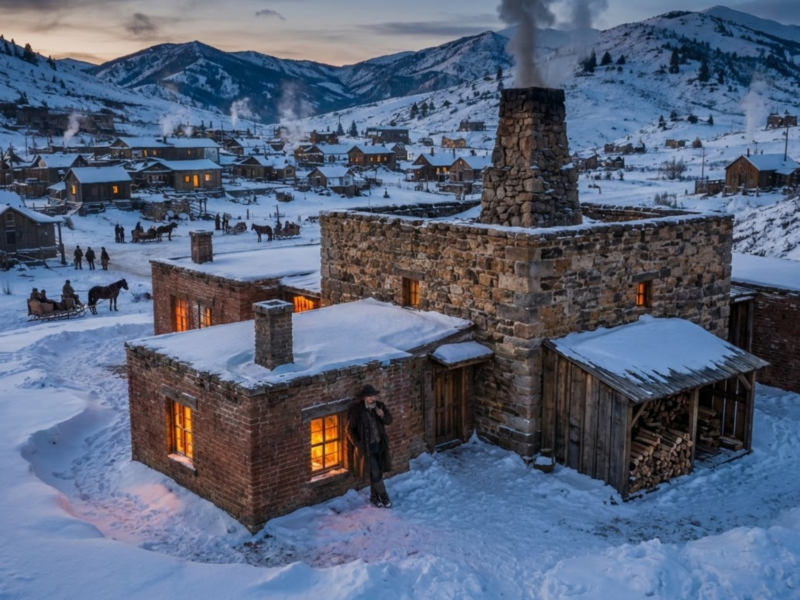
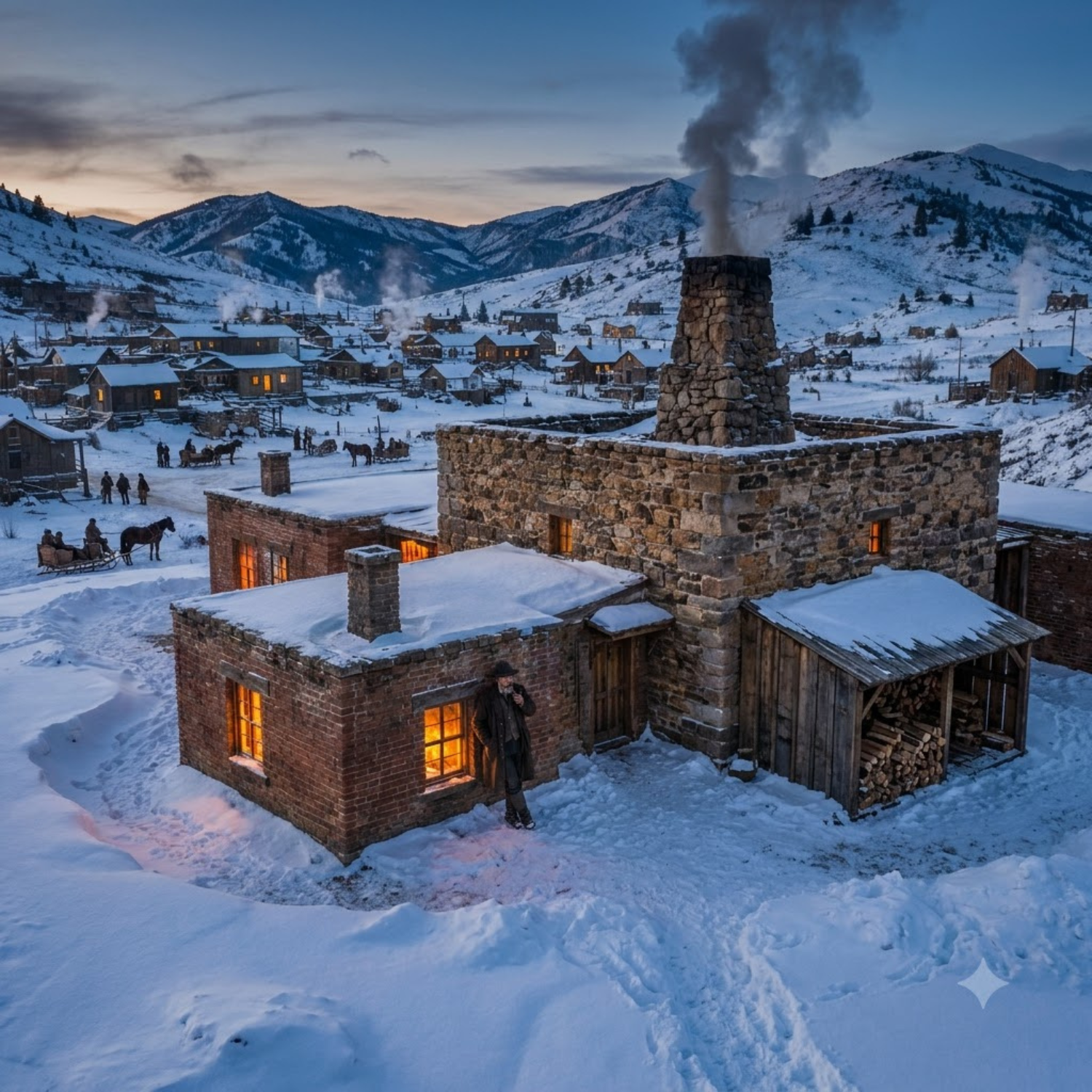
People came pretending they had business nearby. They stood at the edge of the terrace and studied the compound from a distance, looking for signs of smoke leak, roof sag, or structural danger. They found none. In fact, what they found was even more unsettling: the exterior walls were dry, the passages were still, and a faint but unmistakable warmth seemed to rise off the brick even in the open air.
Minn moved through the cabins without coat or shawl, tending to the children and setting out food. Weii and Jyn, who had once coughed through every cold night in their canvas shelter, now ran through the passageways with flushed cheeks and bright eyes. The compound did not merely keep out the winter. It changed the shape of the family’s life.
There was room to breathe.
Room to sleep.
Room to think.
That, more than anything else, unsettled the town.
A structure that could keep four families warm on a fraction of the fuel was not just a building. It was a challenge to the entire frontier economy. Coal and wood were expensive. Labor was expensive. Cold was accepted as a fact of life because no one imagined another method. But Wong’s compound suggested that the cost of survival need not be so high. It suggested that the old rules could be rewritten.
And the people of Virginia City did not like that idea.
The county inspection came three days later.
Whitfield was present, as requested, though he felt conflicted before the visit even began. Two assistants from the record office came with him, along with a carpenter and a man from the sheriff’s office. They arrived with rolled plans, a measuring rod, and the guarded expressions of men expecting to find a flaw.
Wong received them politely. He showed them the central hearth chamber, the shared flue walls, and the roofed passages connecting the cabins. He demonstrated the way the hot gases traveled through the brick channels. He pointed out the thickness of the masonry and the careful shaping of the joints. He explained, as simply as he could, that heat was not being lost in the usual violent rush but captured and stored in the mass of the structure.
One of the assistants snorted.
“The whole thing ought to smoke itself into ruin.”
“It does not,” Wong replied.
“Because you’ve been lucky.”
Wong looked at him for a long moment. “Luck did not lay these bricks.”
Whitfield almost smiled, but the moment passed.
The inspection should have ended there, but one of the men — the carpenter — had noticed the porridge bowl on the shelf and insisted on proving the point for himself. He touched the wall, then drew back with surprise. The temperature was unmistakable. Not a trick. Not a temporary flare. The heat remained steady through the brick.
The sheriff’s man frowned. “It’s too warm.”
Whitfield looked at him. “That is not normally considered a defect.”
“In a fireplace, maybe. In a wall? It can mean hidden fire, trapped gases, collapse.”
Wong answered immediately. “Or it can mean stored energy.”
The inspection team could not deny what they felt. The structure was not overheating. It was not filling with smoke. It was not venting improperly. It was working exactly as Wong had designed it. Though the legal language remained awkward, the practical reality was undeniable. No one in the compound was in danger. No one was freezing. And the fuel use, by every estimate Whitfield could verify, was far lower than the town’s ordinary cabins required.
The report should have ended the matter.
Instead, it made it worse.
Because now the neighbors knew they had been wrong.
And men who are wrong in public often become angrier than men who are simply afraid.
That winter deepened into something harsher than the season itself. A clear sky event settled over the region, stripping away the cloud layer that usually trapped a little warmth in the valley. The nights grew harder, colder, and longer than anyone had predicted. The wind came down off the Sierra Nevada in relentless waves. Metal became brittle. Coal dust froze into the seams of the loading equipment. Water in buckets formed hard shells around the rim by evening. Every ordinary cabin in town had to fight the cold with constant stoking.
Wong’s compound did not.
The fire in the central hearth remained small but steady, and the masonry did the rest. The thick brick walls took in the heat during the burn and released it slowly, hour after hour. The cabins stayed warm through the night even when the fire was reduced to coals. The children slept without coughing. Minn stopped wrapping them in borrowed canvas. Wong himself could work indoors without numb fingers. The family began eating more regularly, sleeping more deeply, and living with a calm they had never known in the mining camps.
Other families noticed.
At first they came to ask questions. Then they came to watch. Then they came to ask Wong whether such a thing could be built for them.
Wong did not boast. He never said that his way was the only way. He only explained what he knew: that the structure had to be planned from the beginning, that the masonry needed mass, that the fire had to be balanced against the draft, that a single central source could feed multiple chambers if the channels were proportioned correctly. He did not speak like a salesman. He spoke like a craftsman describing a process that, if done carelessly, could fail.
People listened because the evidence stood around them in brick and warm air.
Whitfield listened too.
It troubled him more than he expected. He was a man who had built his authority on knowing the practical limits of things. But every night he returned to a drafty room and a stove that consumed more fuel than seemed decent. Every night he felt the cold seep through the floorboards and gather in the corners. And every night he thought of Wong’s wall, warm enough to heat a bowl of rice porridge.
By February, the story had reached beyond Virginia City.
A newspaper in San Francisco printed a short account of the compound, describing the unusual geometry and the success of the shared thermal core. The article was awkward in places and exaggerated in others, but it carried the essential truth: a Chinese mason in Nevada had built a form of winter shelter that performed better than the standard frontier cabins.
The story traveled through the immigrant networks quickly. Wong’s name began to appear in conversations in neighboring counties. Men who had once laughed at the design now copied its general principles, though not always its exact proportions. Some built smaller versions. Some tried to imitate the shared flue walls without enough mass. A few failed. Others succeeded.
And then came the real test.
Late in the winter, another brutal cold wave struck the territory, worse than anything the town had yet seen. The wind howled for days. Snow drifted across roads and froze into hard ridges. Livestock suffered. Fuel prices climbed. Some families in ordinary cabins burned through nearly all of their reserves. Two boarding houses had to move people into the warmest rooms and shutter the rest.
Wong’s compound held.
The walls kept their heat. The passages stayed livable. The central hearth needed only modest fueling. The four cabins remained comfortable while the town outside battled for survival. The families inside did not merely endure; they lived.
That fact could no longer be denied.
Whitfield, who had once been certain the structure would fail, now found himself defending it in public. He amended his earlier notes. He returned to the records and wrote a more careful assessment of the compound’s safety and draft performance. He did not phrase it as an apology — men like Whitfield rarely do — but everyone understood the meaning.
In March of 1890, the success became formal. The design was drawn up in a Chinese-language newspaper in San Francisco and circulated as a practical model for similar settlements. It was not praised as an aesthetic innovation. It was praised as survival engineering. Thick walls. Shared heat. Thermal storage. Reduced fuel demand. Stable winter comfort.
By the following autumn, other families across Story County and neighboring areas had begun adapting the concept.
The town changed slowly at first, then all at once. Builders started thinking about thermal mass instead of just size. Hearths were no longer understood as simple sources of fire but as systems of distribution. Masonry acquired a new respect. People who had once prized speed over endurance began to understand that a structure could be smarter than it looked.
Whitfield watched all of this with a strange feeling in his chest, somewhere between humility and admiration.
One evening, after the last of the autumn work was done, he visited Wong’s compound alone.
The children were older now. Minn was setting bowls on the table. The central hearth glowed low and steady. Outside, the wind had begun again, that familiar high-country moan that promised another cold season. But inside the brick walls, the air remained warm and dry.
Whitfield stood in the passageway a moment before speaking.
“I was wrong,” he said.
Wong did not look surprised. He only waited.
“I thought the thing couldn’t work,” Whitfield continued. “I thought one fire feeding four houses was asking for trouble. I thought the law was enough to tell me so.”
Wong gave a small nod. “The law knows what has failed before. It does not always know what can succeed.”
Whitfield glanced at the wall, then at the children, then at the shelf where a fresh bowl of porridge steamed softly.
He smiled, this time without embarrassment.
“You built a mountain that remembers the sun,” he said again.
Wong’s expression softened. “No,” he replied. “I built a way for a family to keep it.”
The wind moved against the outer wall, but could not enter.
And in that warm, quiet room above the silver camp, the cold of Nevada seemed suddenly smaller than the mind that had learned how to defeat it.
Continue with Part 3 at the link below 👇
(Part 3) Settlers Mocked His 4-Cabin Compound — 4 Families Warm on 1 Fire While the Whole Town Froze