(Part 2) Cast Out by Her Family, She Inherited a Ruined Estate—Then the Locked Chapel Opened
(Part 2) Cast Out by Her Family, She Inherited a Ruined Estate—Then the Locked Chapel Opened
.
.
Part 2 — The Last Secret of Ashcraftoft
By the time spring arrived on the Yorkshire moors, Ashcraftoft Manor no longer looked like a corpse of stone.
It looked awake.
The ivy had been cut back. The roof repaired. The shattered windows replaced with tall panes that caught the light in clean, severe lines. Inside, the great rooms had been restored with careful restraint. Genevieve had no interest in turning the manor into a museum of wealth. She wanted it alive, disciplined, and impossible to ignore.
But there was one room she had not touched.
The chapel.
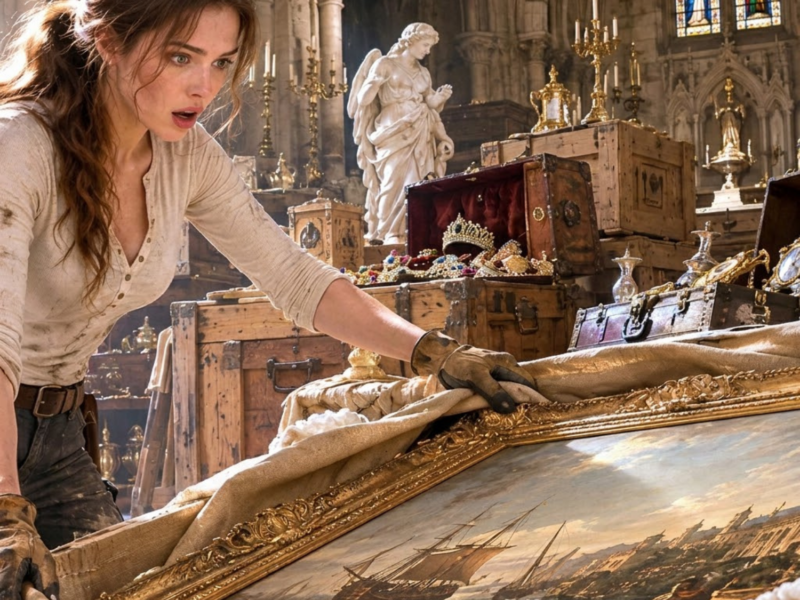
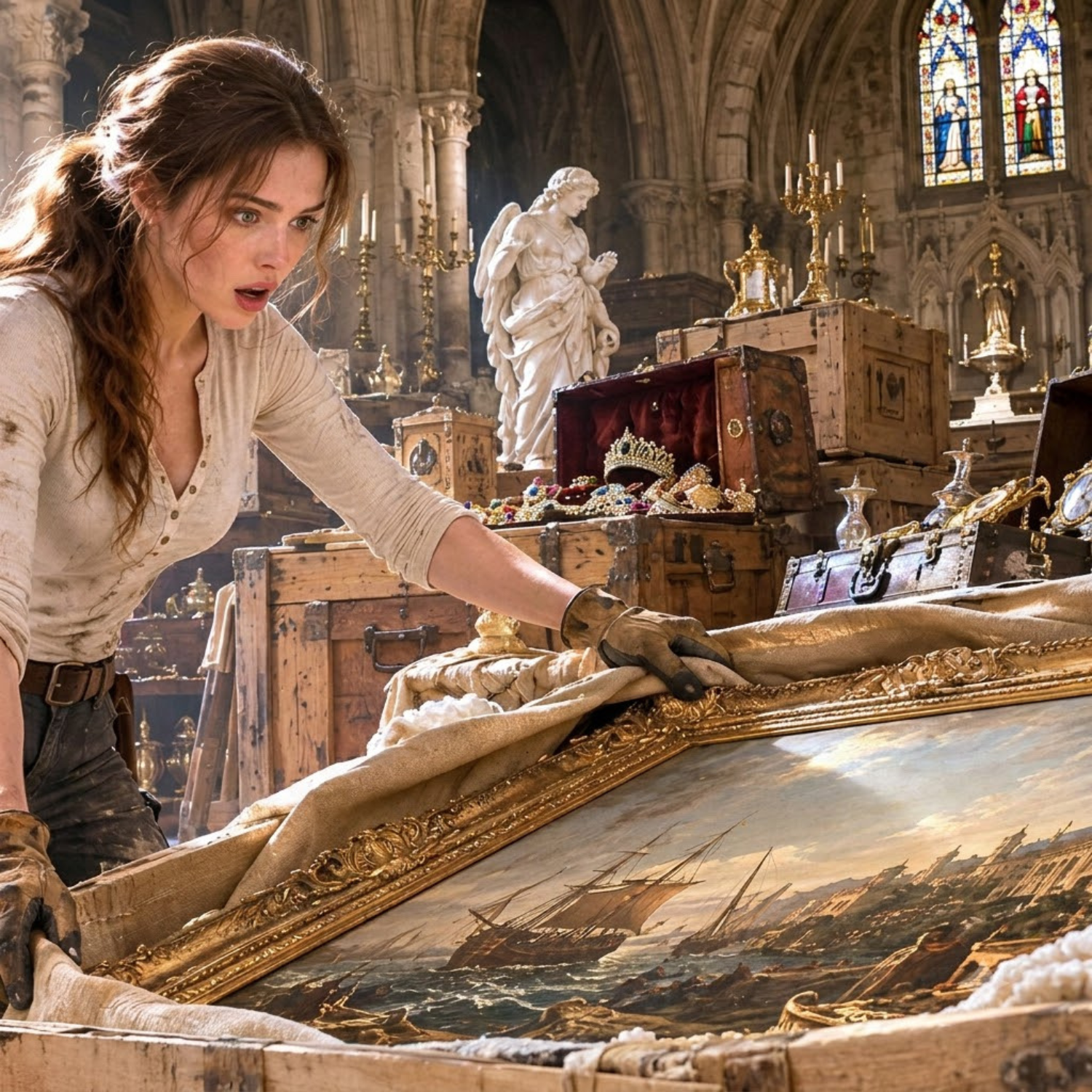
The hidden vault beneath the library remained open, its steel door now framed by a glass walkway and temperature control systems. The treasures inside had been catalogued, authenticated, and partially liquidated through a maze of private channels. The rest had been secured under the Ashcraftoft trust, shielded from public record and from Richard’s reach forever.
Nathaniel said the collection was so extraordinary that even fragments of it would reshape the art market.
Genevieve said she did not care about the market.
What she cared about was the final page in Alistister’s ledger.
There had been one line at the bottom, written in a different hand from the rest.
When the house remembers, go beneath the choir.
She had not shown that line to Nathaniel.
She had not shown it to anyone.
Because after the takeover, after the boardroom humiliation, after the legal storms that followed the collapse of Harrington Logistics, Genevieve began to suspect the chapel was not the end of the inheritance.
It was the warning.
The first clue came in late March, when the restoration team uncovered a section of stonework beneath the old chapel floor that should not have existed. Nathaniel was with her when they found it. Behind a removable slab lay a narrow staircase descending farther into the earth.
The air below was colder than the chapel above.
And drier.
That was the first strange thing.
The second was the smell.
Not mold. Not rot. Not dust.
Paper.
Genevieve descended the stairs with a flashlight in one hand and a firearm in the other, though she had never fired the weapon outside of a private range. Nathaniel followed, muttering that he disliked hidden basements in old houses because hidden basements always contained either skeletons or secrets, and he preferred skeletons only slightly less.
At the bottom, they found a room lined with steel shelving and sealed archive boxes.
Not treasure.
Records.
Ledgers. Letters. Photographs. Deeds. Shipping manifests. Bonds. Bank correspondence. Photocopied pages from government files. A lifetime of documents collected, indexed, and hidden with obsessive precision.
Alistister Harrington had not merely hidden wealth.
He had hidden evidence.
Evidence of who he had bought. Who he had financed. Which ports had been compromised. Which ministers had been paid. Which rivals had been ruined. Which artworks had been looted and quietly moved into private collections under false names. It was a shadow history of a century, and Harrington was threaded through it like wire through stone.
Nathaniel ran a gloved hand over one box label and went still.
“What is it?”
He swallowed. “If this is what I think it is, your grandfather didn’t just protect assets. He documented the entire illegal network around them.”
Genevieve opened the nearest archive box and found letters between Alistister and men in government offices, bankers in Zurich, and art dealers in Paris. There were names she recognized from newspaper scandals and names she did not. Some letters concerned wartime recovery. Others concerned private auctions. A few referenced “the boy” and “the accident” and “the silence afterward.”
At the bottom of one box, wrapped in oilcloth, lay a sealed envelope with her name on it.
She stared at it for a long moment before opening it.
Inside was a letter in Alistister’s hand.
Genevieve,
If you are reading this, then either you are the only one in the family with enough sense to look beneath the vanity of the house, or the others were foolish enough to believe wealth only lives where it can be counted.
It does not. Wealth is memory. Wealth is leverage. Wealth is what men are willing to bury and what others are willing to kill for.
I did not trust your father with the whole of it. Arthur was kind, but kindness is not the same as judgment. Richard is a fool, and Victoria always confused appearances for power. You, however, were born with the one trait this family has always needed: patience.
There is more beneath Ashcraftoft than the chapel. Beneath the archive room lies the true vault. I did not leave it for any of them. I left it for the one Harrington who would understand that inheritance is not a gift. It is a test.
When the time comes, go where the stone is coldest.
A.H.
Genevieve read the letter twice, then a third time.
Nathaniel watched her face. “What is it?”
She handed it to him.
He read it silently and then looked up. “Beneath the archive room.”
They found the next hidden passage three days later.
It had been masked by a false stone wall behind a shelving system in the basement archives. Alistister had built it with the same monastic precision as the chapel vault, but this one was older in design, more brutal. Less like a room and more like a fortress.
The corridor descended to a chamber with walls lined in reinforced concrete and steel. At its center stood a sealed cabinet the size of a wardrobe.
Not locked.
Guarded.
The floor around it carried an engraved brass plate with one sentence:
PROPERTY OF THE HARRINGTON FOUNDATION — DO NOT OPEN WITHOUT TRUSTEE AUTHORIZATION
Genevieve’s mouth tightened.
“The old bastard planned this for decades,” Nathaniel said quietly.
The cabinet itself opened with a key Genevieve found taped behind the brass plate. Inside were three things.
A bound packet of trust documents. A black notebook. And a photograph.
The photograph showed Alistister, younger by forty years, standing beside a woman Genevieve did not recognize, both of them in front of what looked like a remote warehouse in Switzerland. Behind them stood crates identical to the ones hidden in the chapel.
On the back, in Alistister’s hand, was written:
If Victoria ever learns what is in the second vault, she will burn the house to the ground.
Genevieve looked up sharply.
Nathaniel frowned. “Second vault?”
She opened the black notebook.
It was not a ledger. It was a set of coded references to properties, trusts, and political favors. One line caught her eye immediately:
Baltic route / 1981 / underwritten transfer / child record sealed / mother informed only after execution
Her stomach turned.
Then another line:
Arthur believed the boy died. Victoria knew better.
Genevieve looked up from the page. “What boy?”
Nathaniel went quiet.
She turned pages faster now, and with each one the truth became more monstrous.
The family had not only hidden art and bullion. Years earlier, during a discreet asset transfer connected to a postwar collection recovery network, there had been a child. A boy who had been adopted through a private arrangement and then erased from records after a legal dispute involving inheritance, nationality, and an offshore trust. The pages suggested Victoria had known. Arthur had not. Alistister had watched in silence.
The “year the boy fell” in the old riddle was not a horse accident.
It was a death in the family record. A disappearance made official.
And the final line in the notebook was worse:
If the second vault is ever opened, Genevieve must know the child did not die.
She read it again.
Then she read it a third time.
Nathaniel saw the change in her face before she spoke. “There’s someone alive.”
He did not ask how she knew. He knew her well enough by then to understand the difference between fear and certainty.
Within twenty-four hours, Genevieve was in London.
Not the London of boardrooms and hostile takeovers, but the London of archives, old registries, and private investigators with quiet voices. She sent Nathaniel to cross-reference everything he could find about the family’s historical trusts. She went herself to a solicitor who had once handled estate matters for the Harringtons under strict confidentiality.
The solicitor’s expression when she mentioned the boy was immediate and involuntary.
That was answer enough.
“There were arrangements made,” he said carefully. “Years ago. Highly irregular. Sealed by court order and private settlement. Your grandfather had an interest in all of it.”
“Where is the record now?”
He hesitated. “In storage. Or destroyed. Depending on who you ask.”
“Ask again.”
She laid a letter on the desk. Not the original, but a scanned copy of a directive signed by Alistister Harrington that referenced a private transfer and a sealed beneficiary.
The solicitor’s face changed.
“You should not have that,” he said.
“I know.”
He exhaled slowly, as if the room had become too small for his lungs. “There was a child. A boy. Officially, he was said to have died. But there were rumors that the death certificate was never properly filed, that the adoption route was interrupted, that Victoria had insisted the matter be closed immediately. It was all buried beneath layers of family trust law and private settlement.”
Genevieve felt ice move through her chest. “Alive?”
The man looked away. “I cannot confirm that.”
But she knew the answer was yes.
The second vault had not been for money.
It had been for a person.
Back at Ashcraftoft, she and Nathaniel opened the trust packet.
What they found was an older inheritance structure, sealed under Alistister’s personal authority, naming a beneficiary only by initials:
T.H.
The documents made clear that if certain conditions were met, the beneficiary would be entitled to a private portion of the Harrington assets, a separate identity file, and a key to an external property in the Scottish Highlands.
The last page contained a note:
If the house is reclaimed, find Thomas Harrington before Richard does.
Genevieve stared at the page.
Thomas.
Her family had a dead Thomas.
But there was another one.
A living one.
Nathaniel looked at her carefully. “You think your grandfather hid an heir?”
“I think,” Genevieve said slowly, “that my grandfather hid the one person Victoria could never allow to exist.”
The search became urgent after that.
For the next several weeks, Genevieve used every connection she had built to trace the remnants of the sealed transfer. She followed quiet trails through old legal paperwork, charity registries, orphanage records, and private medical archives. Most of the trail had been deliberately broken. But Alistister had been a man who trusted paper less than memory. He had left enough fragments behind to build a path.
A train manifest in Scotland led to a village trust.
A village trust led to an old lawyer’s estate. An old lawyer’s estate led to a decommissioned chapel outside Inverness.
And in that chapel, behind a false altar, Genevieve found the final proof.
A hidden tin box containing a birth record, a sealed identity amendment, and a photograph of a young boy no older than ten. The back of the image was labeled simply:
Thomas Harrington, 1962.
Genevieve held the picture under the light and studied the boy’s face.
He had Arthur’s eyes.
Not Richard’s.
Not Victoria’s.
Arthur’s.
Nathaniel stood beside her, silent.
“This changes everything,” he said at last.
“No,” Genevieve replied. “It explains everything.”
The boy had not died in the accident the family had told itself. He had been removed. Hidden. Reassigned. The family narrative had been built on a lie so complete that even the official grief had been false.
And if Thomas Harrington was alive, then someone had had to protect him.
Someone besides Alistister.
That realization led Genevieve to the next truth, and it was the cruelest one yet.
Victoria knew.
Not everything, perhaps. But enough. She had known there was a child hidden somewhere in the family web. She had helped silence the question because she feared what the answer would do to her own position in the inheritance chain. Richard, who had always been the loudest fool in the room, had likely only inherited the surface of the conspiracy, not its depth.
And Arthur?
Arthur had died believing the wrong son was dead.
Genevieve returned to Ashcraftoft in a fury she barely contained.
If there was a living Thomas Harrington, then the family fortune had another rightful claim. If that claim was proven, Richard’s collapse would not just be financial. It would be historical. Genetic. Legal. The entire dynasty would split open under the weight of its own buried truths.
She found Nathaniel in the chapel with the final archive pages spread before him.
“Look at this,” he said.
He pointed to a chain of correspondence that had been almost invisible under the years of storage. Letters between Alistister and a private doctor. A mention of treatment. A relocation. A new name. A destination in the north of Scotland.
And one final line in the margin, written in Alistister’s hand:
When Genevieve is ready, tell her the truth. She is the only one who will use it properly.
She looked up slowly.
It was not just treasure hidden in Ashcraftoft.
It was succession.
A second heir.
A sealed story.
A buried child who had probably grown into a man somewhere under another name.
And the moment Genevieve understood that, the chapel lights flickered.
Not once.
Twice.
Then all at once, the power died.
The room dropped into darkness.
Nathaniel cursed under his breath. “Generator?”
“I didn’t switch anything off.”
A second later, her phone buzzed with a single unknown message.
No greeting. No signature.
Just five words:
Stop looking for Thomas.
Genevieve stared at the screen.
Then another message arrived.
He is already here.
She turned sharply toward the chapel entrance.
And in the black glass beyond the vault door, someone was standing in the dark.
Not Richard.
Not Victoria.
A man.
Watching.
Waiting.
And wearing a family ring Genevieve had only ever seen in old photographs.
Continue with Part 3 at the link below 👇
(Part 3) Cast Out by Her Family, She Inherited a Ruined Estate—Then the Locked Chapel Opened