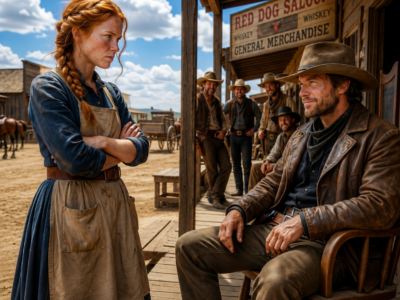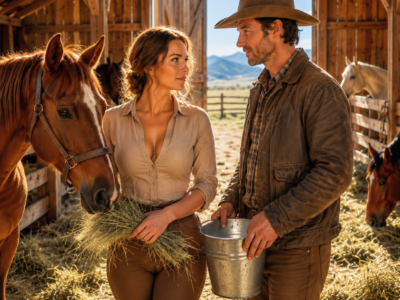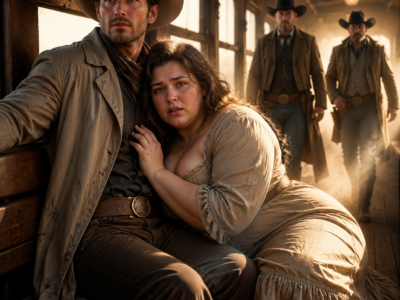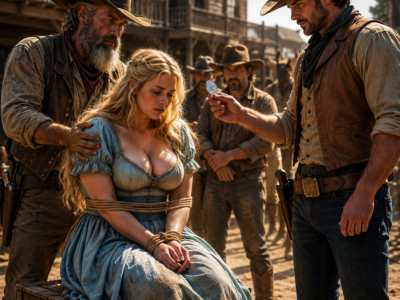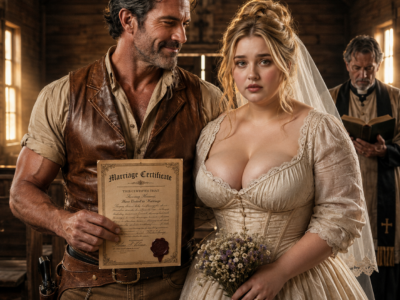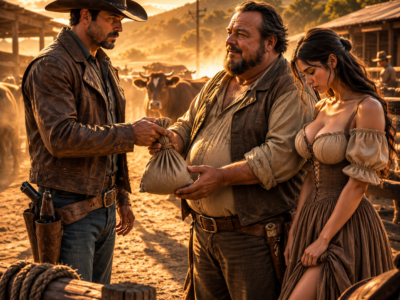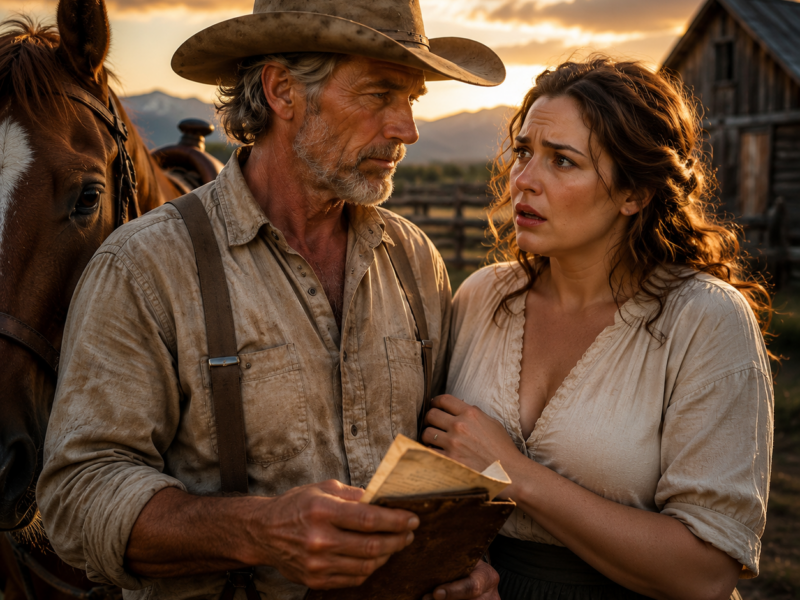
“Spat on and forced off the ranch under a burning sunset sky — the woman they called worthless returned with a buried inheritance secret that left the cowboy and the entire town completely silent and
The ledger was bound in cracked, dark calfskin that left a faint, powdery residue on her fingertips every time she turned a page. It didn’t look like much—just a relic from a time when Texas was more dirt and cattle than oil and glass.
But Clara knew what those faded blue ink lines represented. They were the original surveyor logs for the entire northern ridge of Oakhaven, signed and sealed before the county line was even drawn.
“You look at these numbers,” she whispered to the empty room, her thumb tracing a faded signature at the bottom of a 1924 deed.
“And you realize the whole town is built on a lie.”
The auto body shop below gave a sudden, heavy metallic groan as the automated garage doors shut for the night. The sound vibrated right through Clara’s thin soles, but she didn’t blink.
She was looking at the name Vance.
Marcus Vance—her great-grandfather. He was the man who had physically dragged the cedar posts up the ridge to mark the boundaries of what would later become the Blackwood family’s multi-million-dollar crown jewel. He was the one who had died with nothing but dirt under his fingernails and a stack of uncashed checks that the local bank refused to honor because the Blackwoods owned the bank, too.
“They thought they buried it,” Clara said softly, her voice flat against the cheap linoleum walls.
“They thought if you wait fifty years, the mud turns into legal title.”
She picked up a cheap ballpoint pen and a yellow legal pad, resuming her nightly work. For thirty-six months, she had been cross-referencing these original 1922 deeds with the public tax assessments published on the county’s outdated website. It was slow, mind-numbing work. It required an eye for the small things—the missing five-acre parcels that seemed to vanish from the tax rolls during election years, the sudden shifts in water rights that always coincided with a Blackwood cousin marrying a county commissioner.
A sudden, sharp wrap on her front door made her freeze.
The pen hovered a fraction of an inch above the paper. It was past eleven o’clock. The auto shop was locked up, and the street below was empty except for the occasional long-haul truck rumbling toward the interstate.
Clara slowly reached under the table, her fingers brushing the cold, heavy handle of the iron skillet she kept nearby.
“Clara?”
The voice through the thin wood was muffled, but she recognized the rasp instantly. It was Miller.
She stood up, her joints popping after hours of sitting in the hard wooden chair. She unlatched the deadbolt, leaving the security chain engaged, and opened the door just three inches.
Miller was standing on the narrow iron walkway outside, his canvas coat soaked through with Houston’s heavy, miserable humidity. He looked smaller than he had in Oakhaven, his shoulders slightly rounded under the weight of the damp air, his gray hair plastered to his forehead.
“How did you find me, Miller?” Clara asked, her voice showing neither anger nor welcome.
Miller took off his grease-stained Stetson, holding it against his chest like a shield.
“A town like this has three diners that open before dawn, Clara,” he said, his breath hitching slightly.
“You always did like the early shift. Mind if I come in? My knees don’t do well with this coastal damp.”
Clara looked at him for a long, heavy five seconds. Then she slid the chain back and opened the door.
Miller stepped into the small room, his eyes instantly tracking to the Formica table, the yellow legal pad, and the ancient leather ledger lying open under the yellow bulb. He didn’t look surprised. He just looked tired—the kind of tired that comes from carrying someone else’s secrets for thirty years.
“They’re drilling the northern ridge, Clara,” Miller said, not waiting for her to offer him a seat.
“Julian signed the lease with an outfit out of Dallas last Tuesday. They brought the heavy rigs in forty-eight hours ago.”
Clara walked back to the table, her hand resting flat on the 1922 deed.
“He can’t lease what he doesn’t own, Miller.”
“He thinks he owns it,” Miller countered, stepping closer to the table, his eyes fixed on the old blue ink.
“The county clerk told him the title was clear. Julian’s already spent the first three hundred thousand of the advance on a horse from Argentina that he don’t even know how to ride.”
Clara let out a small, dry laugh that sounded like gravel shifting under a boot.
“Julian always was a short-sighted fool. He inherits his grandfather’s arrogance but none of the old man’s sense. Old Arthur at least knew which judges to buy to keep the dirt from moving.”
“Arthur’s dying, Clara,” Miller said quietly.
The words hung in the small, humid room, heavy as the grease from the shop below.
“The machine’s doing most of the breathing for him now. The doctor says he won’t see the weekend. Julian’s already got the liquidation papers drawn up for the cattle side of the operation. He wants the whole place turned over to the oil boys by the first of the month.”
Clara didn’t look up. She turned a page in the ledger, the old parchment making a dry, whispering sound.
“Why are you here, Miller? You’ve been the foreman at Blackwood since before I was born. You watched them drive my family out of the county. You held the horses while they tore down our old cabin.”
Miller winced, his weathered face tightening. He reached out, his rough, scarred fingers hovering over the edge of the table but not quite touching her things.
“I did what I was paid to do, Clara,” he said, his voice dropping an octave.
“But I didn’t know about the ridge. Not until three weeks ago when the old man called me into the bedroom. He couldn’t speak much, just kept pointing at the floorboards under his desk. I pulled out a lockbox. This ledger was supposed to be in it. It wasn’t. Just a note from you.”
Clara finally looked up, her clear eyes locking onto his.
“I took what belonged to my grandfather, Miller. I didn’t steal it. I recovered it.”
“I know,” Miller said.
He reached into his canvas coat and pulled out a heavy, tarnished brass key, setting it down on the yellow pad right next to her pen.
“The old man told me to give you this if you ever came back. It opens the private filing cabinet in the basement of the Billings land office. The original federal grant from 1914 is in there, Clara. The one that says the Blackwood lease expires the minute the land stops being used for livestock.”
Clara looked at the key. The brass was green with age around the edges, stamped with a serial number that matched the county records she had memorized over the last three years.
“If Julian drills,” she whispered, the pieces finally clicking together in her mind, “the lease voids automatically. The land reverts to the original grant holder.”
“To the Vance estate,” Miller said, nodding once.
“To you.”
Clara stood up, her trench coat hanging on the back of the chair. She didn’t look at the small apartment, the rusted coffee can under the sink, or the grease-stained ceiling. She looked at the key.
“Get the truck, Miller,” she said, her voice steady and cold as a winter creek.
“We’re going back to Oakhaven.”