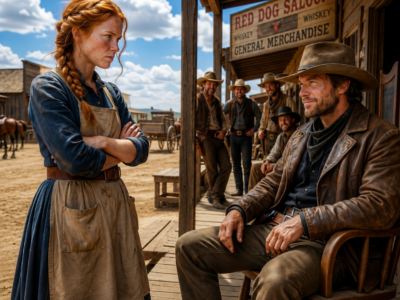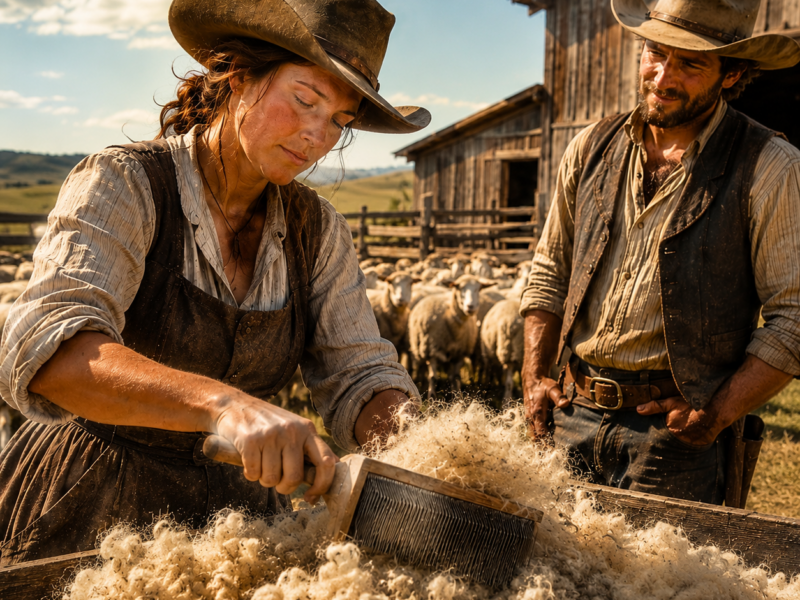
“HE SAID SHE WAS JUST THERE TO CLEAN WOOL…” — The new farmhand was humiliated in front of the entire ranch… but when her hidden skill turned a failing sheep operation into a booming empire overnight, the owner who mocked her was left watching everything slip out of his control in silence.
I didn’t look down at the dark circle of grease and tobacco spit spreading on the hemlock floorboards. If I did, he’d know he’d gotten under my skin. Instead, I kept my eyes locked on his—on the broken red veins around his nose, the yellowing whites of his eyes, and the sheer, arrogant triumph twisting his jaw.
“Perfectly,” I repeated, my voice dropping an octave, flat and ice-cold.
“Good,” he barked, straightening up to his full, imposing six-foot-two. He took a deliberate step back, chest puffed out under his canvas coat, enjoying the audience of shearers who had gone quiet along the line. “Now get back to work. Those bellies aren’t going to skirt themselves.”
He turned on his heel, his heavy, iron-shod boots clattering against the floorboards as he strode toward the loading bays, shouting orders at a young boy dragging a burlap bale. The tension in the shearing shed didn’t leave with him; it just settled into the dust motes dancing in the high shafts of morning light.
I stood there for a long three seconds, letting the roar of the gasoline-powered generator and the rhythmic snip-snip-snip of the mechanical shears fill the silence he’d left behind. The air was thick with the stench of raw lanolin, sheep manure, and the sour sweat of twenty men who hadn’t washed their flannels since the roundup started.
Nora didn’t look at me. She kept her head down, her shears flying with a vicious, practiced speed, slicing the thick, greasy fleece away from a thrashing ewe’s belly in one smooth, continuous ribbon. But I saw the tightness in her shoulders. She knew as well as I did that the old man was running this outfit straight into the dirt.
Slowly, I reached down and picked up the heavy osnaburg broom. My hands were pale, and the blisters from the first three days of the mountain frost had popped and hardened into raw, angry craters along my palms. He wasn’t wrong about that. I was an outsider, a city girl with a degree from a land-grant college who thought a spreadsheet could solve a hundred years of bad habits.
But he was dead wrong about the sheep.
I began to sweep, pushing the heavy, grease-soaked wool scraps and dirt into a neat pile near the edge of the platform. With every stroke of the broom, my mind ran through the numbers. Marcus’s books were a bloodbath. They were running three thousand head on a range that could only support two. The winter storms were coming early—the frost in the valley proved it—and if they didn’t trim the flock and sell off the barren ewes by next Tuesday, the mountain would do it for them, for free, leaving nothing but carcasses in the spring.
“Don’t let him get to you, kid,” a low voice muttered from the next station.
It was Silas, an old-timer whose skin looked like oil-tanned leather and whose knuckles were permanently swollen from fifty years of working the shears. He didn’t stop working, his eyes focused on the pink skin of the sheep beneath his blade.
“He’s been spitting on this floor since before your daddy was in knee-pants,” Silas said, grunting as he flipped the ewe onto her side. “He thinks if he yells loud enough, the wool market will go back to 1994.”
“I’m not worried about his spitting, Silas,” I said, leaning on the broom handle, watching the grease pile up. “I’m worried about his math.”
Silas spat a stream of dark brown juice into the sawdust. “Math don’t keep you warm when the blizzard hits, girl.”
“No,” I replied, looking toward the open barn doors where the gray, heavy clouds were already swallowing the peaks of the Tetons. “But knowing how much hay you have left in the barn does. And right now, you guys are three hundred tons short.”
Silas paused for a fraction of a second, the shears hovering just above the ewe’s flank. It was the only sign he’d heard me, the only crack in the wall of local indifference. Then, the blades started whirring again.
I didn’t say another word. I went back to sweeping the grease, keeping my mouth shut and my eyes wide open. Let them think I was just the cleaning girl. Let them think I was fragile. Every hour they ignored me was another hour I spent finding the rot in their foundation. Sundown was coming, and when the frost finally turned into a freeze, they’d see exactly what my soft hands were capable of.