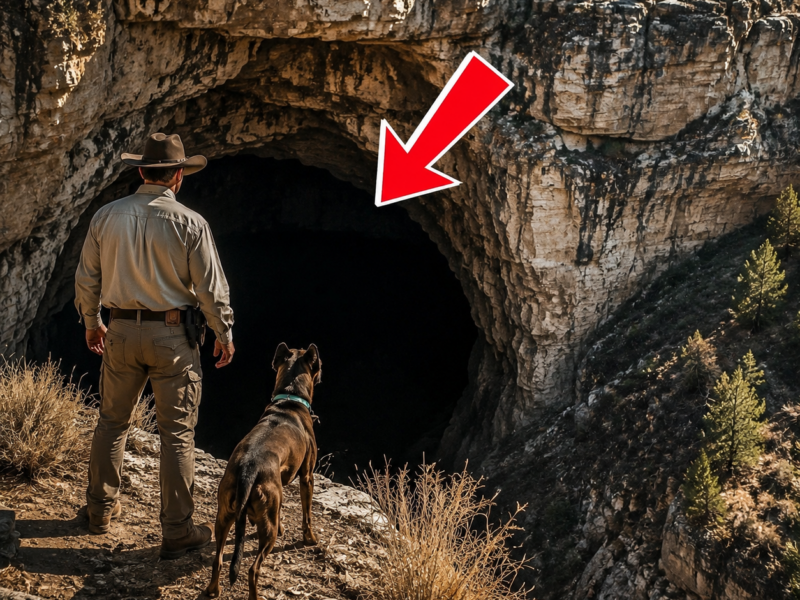
“DON’T GO IN THAT CAVE…” — They laughed at him for years… but the moment he stepped closer, the desert finally revealed why no one ever came back.
That’s my great regret. In our line of work, you’re trained to look for patterns, for anomalies. But when the anomaly is wrapped in the package of the town lunatic, you write it off. It’s a defense mechanism. If Arthur was right, it meant the world was a much weirder, more dangerous place than any of us wanted to admit.
So, I buried it. I went back to the paperwork, back to the petty domestic disputes, back to tracking down the local kids who kept spray-painting the water tower. I let the mundane routine of the badge numb the memory of that strange, rhythmic thrumming under the desert floor. I convinced myself that the old man was just losing his grip on reality, sun-baked and hollowed out by decades of isolation in a shack that smelled of stale tobacco and boiled coffee.
Until six months later, when the earth stopped pretending.
It started on a Tuesday in mid-November, right around midnight. I was sitting at my desk in the station, nursing a lukewarm cup of black coffee that tasted like battery acid, when the windowpanes began to hum. It wasn’t the rattling vibrato of a passing semi-truck on the interstate, nor was it the violent, sudden shaking of a tectonic fault line. It was a low, resonant drone that vibrated right through the soles of my boots, traveled up my spine, and settled deep inside my chest cavity.
A nauseating, rhythmic pulse. Thump. Thump. Thump.
It was exactly what Arthur had described out on the flats, only it wasn’t a faint echo anymore. It was loud. It was terrifyingly close. And he was right—it was faster. The intervals between the pulses had shrunk from seconds to fractions of a second, mimicking the panicked, frantic heart rate of a massive creature trapped in the dark, waking up from a very long sleep.
Before I could even reach for my radio, the dispatch console lit up like a Christmas tree. Every single line was ringing simultaneously. Half the county was awake, terrified, demanding to know if the military had finally dropped something nuclear out at the bombing range, or if an earthquake was about to swallow the town whole.
I didn’t answer the calls. I didn’t even tell my deputy where I was going. I grabbed my heavy winter jacket, my maglite, and my keys, and I drove straight out toward the reservation line, tearing down the empty blacktop at eighty miles an hour.
The desert under my high beams looked entirely wrong. The scrub oaks and ancient Joshua trees weren’t swaying in the wind—there was no wind, the air was dead and stagnant—but their branches were shivering violently, shedding dead leaves and needles in a frenzy of micro-vibrations. The sand itself seemed fluid, shifting and dancing in tiny, geometric ripples across the asphalt, organizing itself into bizarre patterns as if reacting to an invisible frequency.
When I finally pulled up to Arthur’s place, the headlights washed over an empty porch. The front door was wide open, swinging lazily on a single cracked hinge, banging softly against the doorframe.
“Arthur!” I yelled, stepping out of the cruiser. The moment my boots hit the dirt, a wave of intense vertigo hit me so hard I had to lean heavily against the hood of the car to keep from vomiting. The earth wasn’t just shaking; it felt like it was breathing. The ground beneath me was expanding and contracting in a sickening, subtle rise and fall.
I drew my sidearm and clicked on my flashlight, sweeping the beam across the cluttered, junk-strewn yard. The light caught a trail of deep, dragged footprints in the dust, leading away from the shack and heading straight out into the black expanse of the open caldera.
I followed them, the rhythmic thrumming growing louder with every step I took into the dark, vibrating so violently now that my teeth literally clicked together in my skull. Up ahead, rising over the crest of a low sandstone ridge, I saw a faint, subterranean glow. It wasn’t the harsh orange of fire or the clean white of electricity. It was a deep, sickening pulse of violet light, pushing up through the cracks of the ancient, broken bedrock.
And there, standing at the very edge of a newly opened fissure, was Arthur.
He didn’t look like a lunatic anymore. He stood perfectly straight, his shoulders square, looking like a man who had finally reached the end of a very long, very exhausting vigil. He didn’t even turn around when he heard my boots crunching on the gravel behind him. He just stared down into the glowing abyss.
“I told you, Sheriff,” he whispered, his voice incredibly clear despite the deafening, mechanical roar of the machinery grinding beneath our feet. “It’s not a map. It’s a cage. And the locks just broke.”