THE UNFORTUNATE DAUGHTER-IN-LAW
Chapter 1: Morning Light, Heavy Shadows
The Pacific Ocean crashed against the cliffs below with a rhythmic violence that had once comforted Emily Carter but now sounded like a countdown. She stood at the floor-to-ceiling windows of the master bedroom, her hand resting unconsciously on her swollen belly—five months along now, the gentle curve visible beneath her silk maternity robe.
Outside, the Malibu morning was perfect. The kind of perfect that graced magazine covers and tourism brochures—cerulean sky, golden sunlight dancing on turquoise water, palm trees swaying in the salt-scented breeze. But inside the sprawling Mediterranean-style villa perched on Point Dume, the air felt thick with unspoken threats.
“Mommy?”
Emily turned at the small voice. Her daughter Lily stood in the doorway, clutching her stuffed rabbit, Mr. Hops. At two years old, Lily had inherited her mother’s cornflower blue eyes and strawberry blonde curls, but her father’s strong jawline gave her a determination that belied her tender age.
“Good morning, sweet pea,” Emily whispered, crossing the room to scoop her daughter into her arms. She winced slightly—her back had been aching for days, a constant reminder of the pregnancy and the physical toll of keeping up with Eleanor Whitmore-Carter’s impossible standards.
Eleanor. The name alone sent a chill down Emily’s spine.
Her mother-in-law had arrived three weeks ago from the family estate in Connecticut, ostensibly to “help prepare for the new baby.” But help, in Eleanor’s vocabulary, meant something closer to surveillance and criticism. The woman moved through Emily’s home like a general inspecting occupied territory, finding fault with everything from the organic baby food Emily prepared to the way she folded towels.
“Is Grandma awake?” Lily asked, her small face scrunching with what Emily recognized as anxiety. Even at two, Lily sensed the tension that coiled through the house like smoke.
“I don’t know, baby. Let’s go downstairs quietly, okay?”
The grand staircase of the Carter estate spiraled down three floors, each step polished marble that clicked under Emily’s bare feet. The house—no, mansion—was a testament to old money and older prejudices. Built by Eleanor’s grandfather in the 1920s during the oil boom, expanded by her father during the tech boom, and now maintained by Emily’s husband James as a weekend retreat from their primary residence in Manhattan.
James. Emily’s heart ached at the thought of him. He’d been in Tokyo for ten days, closing a merger that would add another billion to the Carter family fortune. Ten days of Eleanor’s increasingly erratic behavior. Ten days of Emily walking on eggshells so thin they might as well have been made of glass.
The kitchen was empty when they arrived, thank God. Emily set Lily in her high chair and began preparing breakfast—scrambled eggs with spinach, whole grain toast, fresh berries. The kind of nutritious meal she’d learned to make during her short-lived career as a nutritionist before marrying James and becoming, as Eleanor put it, “a proper Carter wife.”
She’d met James three years ago at a charity gala in the Hamptons. She was twenty-two, fresh out of NYU with a degree in dietetics, working for a non-profit that provided meals to food-insecure families. He was twenty-seven, already running the venture capital arm of Carter Industries, with a reputation for being ruthless in business but surprisingly gentle in private.
Their courtship had been a whirlwind—dinners at Per Se, weekends in Paris, walks through Central Park at midnight. James had been enchanted by Emily’s lack of pretension, her genuine laugh, her refusal to be impressed by his wealth. She’d fallen in love with his intelligence, his unexpected kindness to strangers, the way he listened when she spoke about her dreams of opening a community health center.
But marriage to James Carter meant marriage to the Carter family. And the Carter family meant Eleanor.
“You’re using the wrong pan.”
Emily jumped, nearly dropping the carton of eggs. Eleanor stood in the doorway, already dressed for the day in a cream-colored St. John knit suit, her silver hair swept into a chignon so tight it seemed to pull her face into a permanent expression of disapproval. At fifty-five, Eleanor Whitmore-Carter was still striking—tall, elegant, with the kind of bone structure that aged well and the kind of eyes that could freeze blood.
“Good morning, Eleanor,” Emily managed, keeping her voice steady. “I didn’t hear you come down.”
“Obviously.” Eleanor crossed to the stove, her Louboutin heels clicking against the marble. “Those are the copper pans. For display. You should be using the All-Clad. Honestly, Emily, how many times must I tell you?”
“I’m sorry. I thought—”
“You thought.” Eleanor’s laugh was sharp as broken glass. “That’s your problem, dear. You think. When what you should be doing is listening. Learning. You’ve been in this family for three years, and you still act like you’re living in some… some apartment in Queens.”
Emily felt the familiar heat rise to her cheeks. She had grown up in Queens, actually—a modest two-bedroom in Forest Hills where her mother still lived, working double shifts as a nurse to make ends meet after Emily’s father died. But mentioning her background was like handing Eleanor ammunition.
“I’ll use the other pan,” Emily said quietly, switching out the cookware.
“And don’t give Lily those berries. They’re not organic.”
“They are organic, Eleanor. I bought them at the farmer’s market yesterday.”
Eleanor’s eyes narrowed. “The one on Main Street? That hippie nonsense? I told you, we have accounts at Gelson’s and Whole Foods. Proper establishments. Not some… some roadside stand run by god-knows-who.”
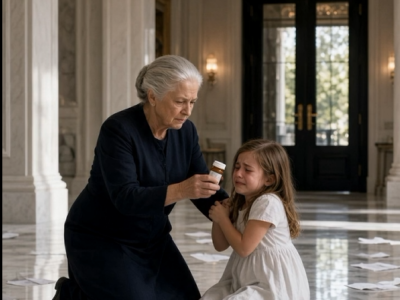
Lily began to whimper, sensing the tension. Emily reached for her daughter, but Eleanor moved faster, plucking the child from her high chair with surprising strength.
“Grandma’s here, darling,” Eleanor cooed, her voice transforming into something almost sweet. “Grandma will take care of you. Unlike some people who can’t even manage a simple breakfast.”
Emily watched her daughter stiffen in Eleanor’s arms. Lily didn’t cry often—she was a sunny, easygoing child—but when she did, it was usually around her grandmother.
“Please, Eleanor, she’s just eaten. She needs to—”
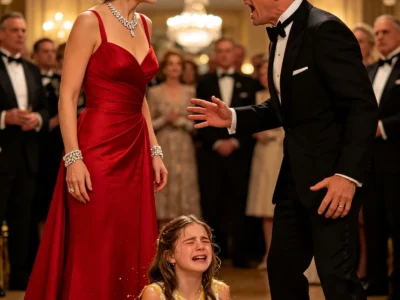
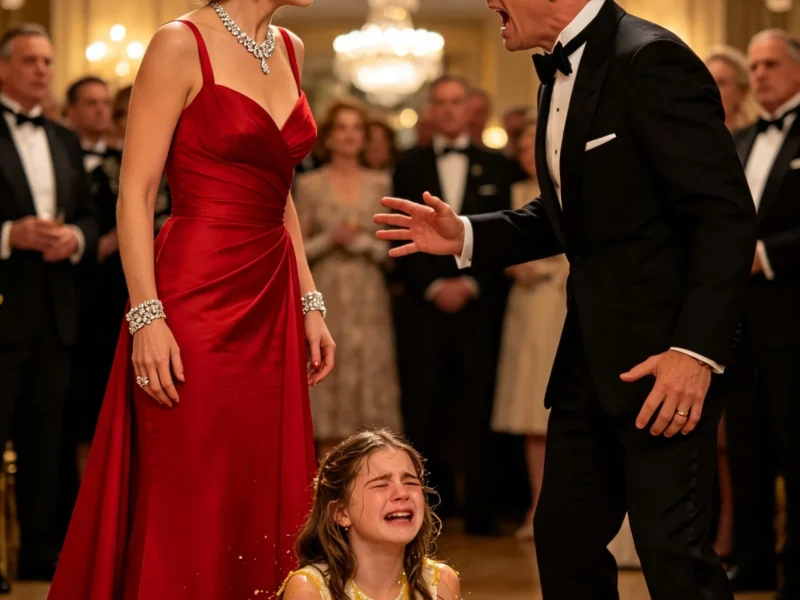
“She needs discipline,” Eleanor interrupted, setting Lily down none too gently on the tile floor. The child stumbled, catching herself on the kitchen island. “And so do you. Honestly, Emily, look at yourself. Robe at nine in the morning. Hair a mess. When James gets home tomorrow, is this what you want him to see? His wife looking like a… like a welfare mother?”
The words hit like physical blows. Emily’s hand went automatically to her hair—she’d pulled it back in a messy bun, yes, because she’d been up since five with pregnancy nausea. Her robe was cashmere, a gift from James, but suddenly she felt naked, exposed, inadequate.
“I’m pregnant, Eleanor,” she said, her voice barely above a whisper. “I don’t feel well in the mornings. I’m doing my best.”
“Your best?” Eleanor stepped closer, her perfume—something expensive and cloying—filling Emily’s nostrils. “Your best isn’t good enough for my son. Do you know what James could have had? The Van der Woodsen girl. Old money. Breeding. A trust fund larger than your mother’s lifetime earnings. But no. He brought home a… a nutritionist from Queens.”
Emily backed away until she hit the counter. Her heart was hammering against her ribs, and she felt a cramp low in her abdomen—not sharp, but persistent. She’d been having them for days, she’d told herself they were just Braxton Hicks, normal for a second pregnancy.
“I think I need to sit down,” she said.
“Of course you do. Always needing something. Needing rest, needing help, needing understanding.” Eleanor’s voice rose, carrying through the vast kitchen. “When I was pregnant with James, I worked twelve-hour days at the foundation. I entertained. I traveled. I didn’t lie around in robes complaining about morning sickness.”
“Please, Eleanor, I’m just—”
“You’re just lazy,” Eleanor snapped. “And ungrateful. Do you know how many women would kill to be in your position? Living in this house? Married to my son? And you can’t even keep it together for three weeks while he’s away.”
Lily began to cry in earnest now, fat tears rolling down her cheeks as she clung to Emily’s leg. Emily bent to pick her up, ignoring the twinge in her back, ignoring the cramping that seemed to be getting stronger.
“Shh, baby, it’s okay,” she murmured into Lily’s hair. “Mommy’s here.”
“Don’t coddle her,” Eleanor commanded. “She’s manipulating you. Just like you’re manipulating James. Playing the sweet, innocent act. But I see through you, Emily. I know what you are. A gold-digger. A social climber. Someone who trapped my son with a pregnancy—”
“That’s enough.”
The voice came from the doorway, and for a moment Emily thought she was hallucinating. She turned, Lily heavy in her arms, and there he was.
James.
But not the James who’d left for Tokyo ten days ago. This James looked like he hadn’t slept in days—dark circles under his green eyes, his normally perfect dark hair disheveled, his custom Tom Ford suit wrinkled as if he’d been wearing it for forty-eight hours straight.
“James?” Emily’s voice cracked. “You’re… you’re early. You said tomorrow.”
“I caught an earlier flight.” His eyes moved from his wife to his mother, and Emily saw something she’d never seen in James Carter’s face before. Pure, unadulterated rage. “I heard everything, Mother. Every goddamn word.”
Eleanor’s composure slipped for just a second, her eyes widening. “James, darling, you don’t understand. I was just trying to help. Emily’s been so difficult lately, so emotional with the pregnancy. I was merely trying to set boundaries—”
“Get out,” James said quietly. Dangerously quiet.
“James, listen to me—”
“I said get out.” He stepped into the kitchen, his presence filling the space. At six-foot-two, with broad shoulders and the kind of athletic build that came from daily tennis matches and weekend sailing, James Carter commanded attention. But it was his eyes that held Eleanor now—cold, hard, utterly without mercy. “Pack your things. The car will take you to the airport. Don’t come back.”
“You’re throwing me out?” Eleanor’s hand went to her chest, her pearls. “For her? For this… this girl who—”
“For the woman I love,” James interrupted. “For the mother of my children. For the person who has shown more grace and dignity in three years than you’ve shown in your entire life.”
He crossed to Emily then, his expression softening as he looked at his wife and daughter. Emily felt tears streaming down her face—she hadn’t even realized she was crying. The cramping was worse now, a sharp pain that made her gasp.
“James,” she whispered. “Something’s wrong. The baby…”
She saw the moment fear replaced anger in his eyes. He reached for her just as her knees buckled, just as the world tilted and went gray around the edges.
“Emily!”
The last thing she heard before darkness took her was Lily screaming “Mommy!” and James shouting for someone to call 911.
Chapter 2: The Weight of History
Three years earlier…
The Hamptons in August were insufferable, James thought, adjusting his tie as he stepped out of the town car. The heat was oppressive, the humidity thick enough to swim through, and the crowd at the Whitmore Foundation gala was the usual mix of old money pretending to care about charity and new money desperate to prove they belonged.
He’d rather be anywhere else. Tokyo, perhaps, where he’d just closed a deal that would net Carter Industries two hundred million. Or his apartment in Tribeca, with a good book and a better scotch.
But his mother had commanded his presence, and Eleanor Whitmore-Carter’s commands were not suggestions.
“James!” She materialized from the crowd like a shark through clear water, all teeth and predatory grace. “There you are. I’ve been looking for you everywhere. There are people you need to meet.”
“Mother, I just arrived. Can I at least get a drink first?”
“Don’t be difficult.” She looped her arm through his, her grip iron-strong despite her slender frame. “The Van der Woodsens are here. Their daughter Charlotte just graduated from Yale Law. Stunning girl. Old family. They’d be perfect connections for you.”
James suppressed a sigh. At twenty-seven, he was already worth nine figures personally, running one of the most successful VC firms in Manhattan. He didn’t need “connections.” But Eleanor had been trying to marry him off since he turned twenty-five, convinced that her son needed a wife from the right bloodline to complete his ascent to the uppermost echelons of American aristocracy.
“Mother, I’m not interested in the Van der Woodsen girl or any other debutante you’ve got lined up.”
“Don’t use that tone with me.” Eleanor’s smile remained fixed as she steered him toward a cluster of people near the bar. “I’m only thinking of your future. Your legacy. The Carter name means something, James. It means responsibility. Tradition. You can’t just marry… anyone.”
They stopped before a group that included the Van der Woodsens—James recognized them from photos in the Times society pages—and a young woman who could only be Charlotte. She was beautiful, he admitted objectively. Blonde, blue-eyed, with the kind of polished perfection that came from generations of careful breeding and excellent orthodontics.
“James, you remember the Van der Woodsens,” Eleanor was saying. “And this is their daughter Charlotte. Charlotte, my son James.”
“Mr. Carter.” Charlotte extended a hand, her smile calculated to show just the right amount of interest without desperation. “I’ve heard so much about your work in sustainable tech. Fascinating.”
“Miss Van der Woodsen.” James shook her hand briefly. “Pleasure.”
The conversation that followed was excruciating—ten minutes of tennis scores, summer homes in Nantucket, and the relative merits of various Ivy League business schools. James found his attention wandering, his eyes scanning the crowd for an escape route.
That’s when he saw her.
She stood near the buffet table, of all places, wearing a simple navy dress that looked like it came from Ann Taylor or maybe J.Crew. Not couture, certainly not designer. But on her, it looked better than the thousand-dollar gowns surrounding her. She was laughing at something an elderly man was saying, her head thrown back, her strawberry blonde hair catching the light from the chandeliers.
She wasn’t classically beautiful—not in the Charlotte Van der Woodsen way. Her nose was a little too small, her mouth a little too wide, her cheeks sprinkled with freckles that spoke of summers spent outdoors rather than in dermatologists’ offices. But she had something the other women in the room lacked.
Life. Genuine, unvarnished, infectious life.
“James, are you listening?” Eleanor’s sharp tone brought him back.
“Sorry, Mother. What?”
“I was saying that Charlotte is thinking of joining the foundation board. We could use fresh blood, young perspectives.”
“That’s wonderful,” James said automatically, his eyes drifting back to the girl by the buffet. She was helping an elderly woman navigate the steps now, her hand steady on the woman’s elbow, her face kind.
“James, pay attention. Charlotte asked you a question.”
“Forgive me, Miss Van der Woodsen. I was distracted by…” He gestured vaguely. “The crowd. It’s warm in here, isn’t it?”
He didn’t wait for a response. He couldn’t. Something was pulling him toward the buffet table, toward the girl with the laughing eyes and the genuine smile.
“Excuse me,” he said, already moving away. “I need some air.”
He approached her from the side, not wanting to startle her. She was fixing a plate for the elderly woman now, selecting items with care, explaining something about sodium content.
“…so if you’re watching your blood pressure, Mrs. Goldstein, maybe skip the cured meats and go for the grilled vegetables. The tomatoes are excellent, and they have lycopene, which is good for your heart.”
“You’re an angel, dear,” the old woman said, patting her hand. “My granddaughter never pays such attention.”
“That’s what I’m here for,” the girl said warmly. “Enjoy your dinner, Mrs. Goldstein. I’ll check on you later.”
She turned then, nearly colliding with James.
“Oh! I’m so sorry, I didn’t see you there.” She looked up at him—she was small, maybe five-foot-three—and her eyes widened slightly. Recognition dawned, though not the kind he was used to. She wasn’t recognizing James Carter, billionaire heir. She was recognizing… something else. “You’re… you’re the guy who funded GreenPlate, aren’t you? I saw your photo in Fast Company.”
James blinked. GreenPlate was his pet project—a startup that used AI to reduce food waste in restaurants. It was tiny compared to his other investments, something he’d done because he hated waste, not because it would make money. “You know about GreenPlate?”
“I know everything about food systems,” she said, her face lighting up with genuine enthusiasm. “I’m Emily. Emily Parker. I work for Nourish NYC—we provide meals to families in food deserts. I actually wrote a paper on GreenPlate’s distribution model for my thesis at NYU.”
“You’re a student?”
“Recent graduate. Just finished my dietetics degree in May.” She stuck out her hand, and he shook it, noting the firmness of her grip, the lack of hesitation. “Sorry, I’m probably talking too much. I get excited about this stuff.”
“Don’t apologize. It’s refreshing.” He realized he was smiling, really smiling, for the first time all evening. “I’m James.”
“I know.” She grinned, unabashed. “James Carter, the ‘Golden Boy of Venture Capital.’ That’s what Forbes called you, anyway. Though I think it’s a stupid nickname. Makes you sound like a racehorse.”
James laughed out loud, startling himself. When was the last time he’d laughed like that? “It is a stupid nickname. My mother loves it, though.”
“Your mother’s terrifying,” Emily said, then clapped her hand over her mouth. “Oh my God, I’m so sorry. I shouldn’t have said that. She’s your mom. I’m sure she’s lovely.”
“She’s terrifying,” James agreed, enjoying the way Emily’s eyes crinkled when she was embarrassed. “It’s okay. I won’t tell her you said so. Though she probably already knows. She has a sense for these things.”
They stood there for a moment, the noise of the party fading around them. James felt something shift in his chest, a loosening of a knot he hadn’t known was there.
“Emily,” he said, “would you like to get out of here? There’s a diner down the road that makes excellent pancakes. And I think if I have to make small talk with one more person who thinks ‘sustainable’ means ‘tax deductible,’ I might scream.”
She studied him for a long moment, her head tilted to one side. “Is this a line? Are you trying to pick me up, Mr. Carter?”
“Would it work if it was?”
“Probably not.” But she was smiling. “But I am hungry. And those mini-quiches look suspiciously old. So… okay. But I’m paying for my own pancakes. I have principles.”
“Deal.”
They slipped out of the gala together, Emily making excuses to her supervisor, James leaving a text for his mother that he knew would result in three days of icy silence. He didn’t care. For the first time in years, he felt like himself—not James Carter, heir to the throne, but just James. A guy who wanted pancakes with a girl who knew about lycopene.
The diner was everything he’d hoped for—chrome and vinyl, a jukebox playing Springsteen, a waitress named Flo who called them “hon” and kept their coffee cups full. Emily ordered blueberry pancakes with extra butter and real maple syrup, and James found himself ordering the same, though he couldn’t remember the last time he’d eaten something so… normal.
“So,” Emily said, pouring syrup with abandon, “why did you really leave the party? You could have any woman in that room. Charlotte Van der Woodsen was practically undressing you with her eyes.”
James grimaced. “My mother’s choice, not mine. She thinks I need a wife from the right family.”
“And you don’t?”
“I think I need a wife I can talk to. Someone who looks at me like I’m a person, not a portfolio.” He met her eyes. “Someone who gets excited about food distribution systems.”
Emily laughed, that full-throated, head-thrown-back laugh he’d noticed earlier. “Okay, that’s fair. But I’m warning you, Mr. Carter—I have opinions. Strong ones. About everything. My mother says I was born arguing.”
“Good. I like opinions.”
They talked for three hours. About food insecurity and systemic inequality. About James’s dream of using technology to solve real problems, not just make rich people richer. About Emily’s plan to open a community health center in the Bronx, combining nutrition education with medical care. About their childhoods—his isolated and golden, hers messy and warm.
“My dad died when I was sixteen,” Emily said quietly, tracing patterns in the syrup on her plate. “Heart attack. He was only forty-five. That’s why I got into nutrition—preventative care, you know? If he’d eaten better, managed his stress…”
“I’m sorry,” James said, and meant it. “My father’s alive, technically. But he’s been absent my whole life. Always traveling, always working. I think I saw him for a total of three months during my entire childhood.”
“That sounds lonely.”
“It was.” He reached across the table, touching her hand briefly. “But less so now.”
She didn’t pull away.
When they finally left the diner, the stars were out over the Hamptons, thick and bright away from the city lights. James walked her to her car—a beat-up Honda Civic that made him smile—and opened the door for her.
“This was… unexpected,” Emily said, looking up at him.
“Good unexpected?”
“The best kind.” She hesitated, then stood on her toes and pressed a quick kiss to his cheek. Her lips were soft, smelling of maple syrup and coffee. “Call me, James Carter. If you want to talk about food systems. Or other things.”
“I will,” he promised. “Emily… thank you. For tonight. For being real.”
“Always,” she said, and drove away into the night.
He stood in the parking lot for a long time after she left, watching the taillights disappear, feeling something he hadn’t felt in years.
Hope.
Chapter 3: The Campaign
Eleanor Carter did not accept defeat gracefully.
She’d known, of course, the moment James didn’t return to the gala that something had changed. When he arrived at the family estate the next morning, his eyes distant and dreamy in a way she’d never seen, she’d known exactly what had happened.
He’d met someone. Someone unsuitable.
“Tell me,” she’d commanded over breakfast, the silver coffee service gleaming between them.
“Her name is Emily Parker. She’s a nutritionist. She works for a non-profit.”
Eleanor had set down her cup with deliberate care. “A nutritionist.”
“Yes.”
“Who works for a non-profit.”
“Yes.”
“From where?”
James had met her eyes, and she’d seen the defiance there. The challenge. “Queens. Forest Hills. Her mother is a nurse at Mount Sinai.”
The silence had stretched between them, heavy with unspoken meaning. Eleanor had imagined many scenarios for her son’s future wife—diplomat’s daughter, senator’s niece, perhaps European royalty if they were lucky. She had not imagined… this.
“James,” she’d said carefully, “you’re being hasty. You’re young. You have time to make the right choice.”
“I’ve made my choice, Mother.”
“You’ve known her for one night.”
“I’ve known her for one night, and I know more about her than I know about any woman you’ve tried to set me up with. She’s kind, Mother. Genuinely kind. She cares about people. She makes me laugh.”
“She’s a social climber,” Eleanor had snapped, her composure cracking. “They all are, these girls. They see the money, the name—”
“She didn’t know who I was,” James interrupted. “Not really. She knew my name from a magazine, but she didn’t care. She cared about my ideas. About GreenPlate. She cared about me.”
“She’s playing you.”
“She’s not.” James had stood, his chair scraping against the marble floor. “And I’m going to see her again. I’m going to see her as many times as she’ll let me. And if things continue the way they started… I’m going to marry her.”
Eleanor had felt something cold settle in her chest. “If you do this, James… if you bring this girl into our family… there will be consequences.”
“What consequences, Mother? You’ll cut me off? Take away my trust fund?” James had laughed, but there was no humor in it. “I don’t need your money. I haven’t needed it since I made my first million at twenty-four. But I need you to understand something: I love her. And if you can’t accept that, if you can’t accept her, then you and I are going to have a problem.”
He’d left then, walking out of the breakfast room with his back straight and his head high. Eleanor had sat alone for a long time, staring at the cold coffee in her cup, feeling the ground shift beneath her feet.
She would not lose. She never lost. But she would have to be strategic. Direct confrontation wouldn’t work with James—he was too much like his father in that way, stubborn and principled once he’d made up his mind. No, she would have to be subtle. She would have to make Emily Parker see that she didn’t belong, that she could never belong. She would have to break the girl’s spirit slowly, carefully, until she either left on her own or became so diminished that James would lose interest.
It was for his own good, Eleanor told herself. James would thank her eventually. When he was married to someone appropriate, someone who understood the responsibilities of the Carter name, he would realize she’d saved him from a terrible mistake.
The campaign began immediately.
When James brought Emily to meet her—three months into their relationship, serious enough that marriage was being discussed—Eleanor was ready. She’d researched everything: Emily’s father’s early death, her mother’s financial struggles, Emily’s student loans, her modest apartment in Astoria. She knew about the ex-boyfriend from college, the speeding ticket from two years ago, the time she’d been fired from a waitressing job for being “too slow.”
She used none of it directly. That would be crude. Instead, she used insinuation, implication, the raised eyebrow and the subtle comment.
“How… quaint your apartment is, Emily. So… efficient.”
“Your dress is lovely. Is it… vintage? Or just… last season?”
“Your mother must be so proud, seeing you at a place like this. I imagine it’s quite different from… where she usually dines.”
Emily had met each comment with grace, with that genuine smile that made Eleanor want to scream. The girl didn’t break. She didn’t even seem to notice the barbs, or if she did, she chose not to react.
Worse, James noticed nothing. He was besotted, blinded by love, seeing only Emily’s virtues and none of her deficiencies. He proposed on their six-month anniversary, during a weekend in Paris, with a ring that cost more than Emily’s mother’s house.
Emily said yes. Of course she did. They always did.
The wedding was small—James insisted, overruling Eleanor’s desire for a society event at the Metropolitan Club. They married in a garden in Central Park, with Emily’s mother and a dozen friends against James’s business associates and Eleanor’s frozen smile.
Eleanor began her work in earnest after the honeymoon.
She criticized everything—Emily’s cooking, her cleaning, her choice of friends, her clothes, her hair, her “career” (which Eleanor insisted on putting in quotation marks, as if working for a non-profit wasn’t real work). She visited constantly, unannounced, finding fault with dust on the baseboards or the wrong brand of olive oil in the pantry.
When Emily became pregnant with Lily, Eleanor’s criticism intensified. “You’re eating too much. You’ll get fat, and James will lose interest.” “You’re not eating enough. The baby will be sickly.” “You’re working too hard. Don’t you care about your child?” “You’re not working at all. Lazy girl, lying around all day.”
James defended his wife, of course. But he was busy—building his empire, traveling constantly, working eighty-hour weeks. He saw only what Eleanor allowed him to see: Emily tired but coping, Emily stressed but managing. He didn’t see the late-night tears, the way Emily’s hands shook when she knew Eleanor was coming, the way she stopped eating when her mother-in-law was around because her stomach was always in knots.
Eleanor was careful. She never left marks. Her weapons were words, insinuations, the constant drip-drip-drip of criticism that wore away at Emily’s confidence like water on stone. She made Emily doubt herself, doubt her worth, doubt her right to be in that world.
And it was working. Emily was changing. The bright, confident girl James had fallen in love with was fading, replaced by a anxious woman who jumped at shadows and apologized for existing.
Then Lily was born, and for a moment, Eleanor thought she’d won. The baby was a girl—not the heir Eleanor had hoped for. She made sure Emily knew her disappointment.
“Perhaps the next one will be a boy,” she’d said, holding Lily with barely concealed distaste. “Though at your age… well. We’ll see.”
Emily had been twenty-five then. Eleanor made it sound like she was approaching menopause.
But James adored his daughter. He changed his schedule, working from home more, leaving the office early to spend evenings with Lily. He was a devoted father, a loving husband, and Eleanor saw with growing panic that Emily was… happy. Despite everything, despite all Eleanor’s efforts, Emily was happy in her little family.
So Eleanor doubled down. She moved into the guest house of their new Malibu estate “temporarily” while her Connecticut home was being renovated. She inserted herself into every aspect of their lives, creating dependency, manufacturing crises that required her presence.
And when Emily announced her second pregnancy, Eleanor saw her chance. A second child meant more stress, more vulnerability. Emily would be tired, emotional, hormonally volatile. It was the perfect time to strike.
For ten days, while James was in Tokyo, Eleanor waged war. She criticized Emily’s parenting of Lily (“She’s too clingy. You’re spoiling her.”), her pregnancy symptoms (“In my day, we didn’t complain about every little discomfort.”), her management of the household (“This house is a mess. What do you do all day?”).
She isolated Emily, taking her phone “accidentally,” disconnecting the internet “for repairs,” ensuring Emily had no contact with the outside world, no support system, no reminder that she was loved and valued.
And Emily… Emily took it. She took it because she was raised to be polite, because she didn’t want to cause trouble for James, because she kept hoping that if she just tried hard enough, Eleanor would finally accept her.
She didn’t know that Eleanor would never accept her. That Eleanor’s goal was not improvement but destruction. That Eleanor would rather see her son miserable and divorced than happy with a woman she deemed unworthy.
The morning of James’s early return, Eleanor had decided to escalate. She would break Emily completely, force a confrontation that would make James see his wife as weak, hysterical, unsuitable for the Carter name.
She didn’t know that James had changed his flight. That he’d heard enough from the housekeeper’s concerned calls. That he was coming home to save his wife from his mother.
She didn’t know that her reign of terror was about to end.
Part II: The Breaking Point
Chapter 4: The Marble Floor
The pain was unlike anything Emily had experienced.
It started as a cramp, low and insistent, as she stood in the kitchen with Lily clinging to her leg. But as Eleanor’s words rained down on her—”gold-digger,” “social climber,” “welfare mother”—the pain intensified, spreading across her abdomen in waves that made her breath catch.
She tried to ignore it. She’d had Braxton Hicks before, false labor contractions that were uncomfortable but harmless. This was just stress, just the baby reacting to the tension. If she could get to the couch, lie down, drink some water…
“Don’t coddle her,” Eleanor was saying, pulling Lily away. “She’s manipulating you.”
Lily screamed as her grandmother set her down roughly, stumbling on the slick marble. Emily reached for her daughter, but another wave of pain hit, sharper this time, making her gasp and double over.
“Please, Eleanor,” she managed, her voice barely a whisper. “I need to sit down. Something’s wrong.”
“Of course. Always needing something.” Eleanor stepped closer, her face inches from Emily’s. “You’re pathetic, do you know that? A pathetic little girl playing at being a grown-up. James will tire of you. They always do. And when he does, you’ll have nothing. No money, no status, no—”
“That’s enough.”
The voice cut through Eleanor’s tirade like a knife. Emily looked up, her vision swimming, and saw James in the doorway.
But not the James who’d kissed her goodbye ten days ago, smiling and promising to call every day. This James looked like he’d been through hell—his suit wrinkled, his eyes red-rimmed, his face pale with exhaustion and fury.
“I heard everything, Mother,” he said, his voice terrifyingly quiet. “Every word.”
Eleanor’s composure slipped, just for a moment. “James, darling, you don’t understand. I was trying to help. Emily’s been so difficult, so emotional. I was merely setting boundaries—”
“Get out.”
“James, listen to me—”
“I said get out.” He moved into the kitchen with a predator’s grace, his eyes never leaving his mother’s face. “Pack your things. The car will take you to the airport. Don’t come back.”
Emily felt the world tilt. The pain was constant now, a sharp, stabbing sensation that made her want to scream. She clutched her belly with one hand, reaching for Lily with the other.
“James,” she gasped. “The baby… something’s wrong…”
She saw his face transform, fear replacing rage. He lunged for her just as her knees buckled, just as the darkness rushed in from the edges of her vision.
“Emily!”
She heard Lily crying, heard James shouting, felt his arms around her as she sank toward the floor. But the pain was overwhelming now, a red tide drowning everything else.
Then there was nothing.
When Emily came to, she was lying on the couch in the living room. James was beside her, his hands shaking as he held her face, his eyes wet with tears she never thought she’d see him cry.
“Emily? Emily, can you hear me?”
“James…” Her voice was a croak. “The baby? Lily?”
“Lily’s with Maria,” he said, referring to their housekeeper. “She’s fine. Scared, but fine. The ambulance is on its way. Just hold on, my love. Just hold on.”
“Ambulance?” She tried to sit up, but the pain pinned her down. “James, I don’t need… I’m fine, I just…”
“You’re bleeding, Emily.” His voice broke. “There’s blood. We need to get you to the hospital. Now.”
Bleeding. The word registered slowly, terrifyingly. She looked down and saw the dark stain spreading across her robe, and cold terror gripped her heart.
“The baby,” she whispered. “Oh God, James, the baby…”
“Shh, don’t think about that now. Just breathe. I’m here. I’m here.”
She heard Eleanor’s voice then, shrill and defensive: “It’s not my fault. She fainted. She’s weak. She—”
“Get out of my sight,” James snarled, not looking at his mother. “If you say one more word, I will have you removed by security. Get. Out.”
Emily closed her eyes, letting James’s voice anchor her as the pain ebbed and flowed. She thought of the baby, five months along, just starting to kick, just starting to feel real. She thought of Lily, terrified in the other room. She thought of three years of Eleanor’s cruelty, three years of silence and suffering, and she felt something break inside her—not her body, but the wall she’d built to survive.
She was done being silent.
“James,” she whispered, opening her eyes. “Your mother… she’s been…”
“I know,” he said, his voice rough. “I know, Emily. I’m so sorry. I should have seen it sooner. I should have protected you.”
The ambulance arrived then, paramedics rushing in with equipment and calm, competent voices. They checked her vitals, started an IV, prepared a stretcher. James never left her side, holding her hand as they lifted her, murmuring promises and apologies.
As they wheeled her out, Emily caught a glimpse of Eleanor standing in the hallway, her face pale, her perfect composure finally shattered. Their eyes met, and Emily saw something in the older woman’s gaze that she’d never seen before.
Fear.
Not fear of losing her son—Eleanor had lost James the moment she chose cruelty over kindness. No, this was something deeper. The fear of a woman who’d built her life on control, watching that control slip away. The fear of someone who’d finally gone too far and couldn’t take it back.
Emily held that gaze for a long moment, letting Eleanor see that she knew. That she understood exactly what had been done to her, and that it was over now.
Then the paramedics loaded her into the ambulance, James climbing in beside her, and Eleanor was left behind in the marble hallway of the mansion that would never again be her domain.
Chapter 5: The Hospital
Cedars-Sinai Medical Center was a fortress of glass and steel, a monument to the wealth that flowed through Los Angeles like water. Emily had been here once before, for Lily’s birth—a private suite, the best doctors, every comfort money could buy.
But she’d never been here as an emergency patient, never felt the cold terror of not knowing if her child would survive.
The ER was a blur of activity—doctors in scrubs, nurses with kind eyes, machines beeping and whirring. They asked her questions she could barely answer, checked her blood pressure, her temperature, her cervix. The word “placental abruption” was spoken, and Emily felt James’s hand tighten in hers.
“Is the baby okay?” she asked, her voice trembling. “Please, tell me…”
“We’re going to do an ultrasound,” the doctor said, a kind-faced woman named Dr. Chen. “Right now, your vitals are stable, but we need to see what’s happening with the placenta. Mr. Carter, you’ll need to step out for just a moment.”
“I’ll be right here,” James promised, kissing her forehead. “I love you. Whatever happens… I love you.”
The ultrasound was cold gel and pressure and agonizing waiting. Emily stared at the ceiling, praying to a God she wasn’t sure she believed in, bargaining with the universe. Take anything, she promised. Take my health, my money, my future. Just let my baby be okay.
“There,” Dr. Chen said, her voice relieved. “There’s the heartbeat. Strong and steady.”
Emily burst into tears—relief and terror mingling into something overwhelming. “The baby?”
“The baby is alive, Mrs. Carter. But there’s a partial abruption—the placenta has separated from the uterine wall in one area. It’s not complete, which is good, but you’ll need to be on strict bed rest for the remainder of your pregnancy. No stress, no activity, complete rest.”
“And the bleeding?”
“We’ll monitor it. If it stops and doesn’t restart, if the abruption doesn’t worsen, you should be able to carry to term. But it’s going to be a difficult few months. You’ll need support. Help at home.”
Emily thought of Eleanor, of the guest house, of the constant presence that had become a nightmare. “I can’t go back there,” she whispered. “I can’t…”
“Shh,” Dr. Chen said gently. “One thing at a time. Let’s get you settled in a room, and then you and your husband can figure out the next steps.”
They moved her to a private room on the maternity floor, a space that looked more like a luxury hotel than a hospital room. James was waiting, his face haggard, and when he saw her, he rushed to her side.
“The baby?” he asked immediately.
“Alive,” Emily said, and watched him crumble with relief. “But I need bed rest. For months. No stress.”
“Done,” James said immediately. “Whatever you need. Whatever the doctors say.”
“James…” She took a breath, gathering her courage. “Your mother can’t be there. I can’t… I won’t go back to that house if she’s there.”
James’s face darkened. “She won’t be. I already called security at the Malibu house. She’s packing her things. She’s going back to Connecticut tonight.”
“And after that?”
“She’s never coming back, Emily. Not to our home. Not to our lives.” He sat on the edge of the bed, taking her hands in his. “I should have done this years ago. I knew she was difficult, I knew she had… high standards. But I didn’t know. I didn’t see how bad it had gotten. You hid it so well, and I was so busy, and I told myself it was just normal mother-in-law stuff…”
“It wasn’t,” Emily said quietly. “It was abuse, James. Emotional abuse. She told me I was worthless, that I was a gold-digger, that you would leave me. She isolated me, criticized everything I did, made me feel like I didn’t deserve to be your wife. She… she made me believe it, sometimes. Made me believe I was lucky to be tolerated.”
James’s eyes filled with tears—this strong man, this billionaire who negotiated deals worth billions, crying for her pain. “I’m sorry,” he choked out. “God, Emily, I’m so sorry. I failed you. I promised to protect you, and I failed.”
“You didn’t know,” Emily said, though the words felt hollow. She was so tired, so drained, so overwhelmed by the near-loss of her baby and the sudden exposure of years of secrets.
“I should have known. I should have seen.” He wiped his eyes, straightening his shoulders. “But I know now. And I promise you, on my life, on our children’s lives—she will never hurt you again. I will spend the rest of my life making this up to you. Making you feel safe, loved, cherished. You are the best thing that ever happened to me, Emily Carter. You and Lily and this baby. And I will not let anyone, not even my own mother, take that away.”
Emily looked at him—really looked at him—and saw the truth in his eyes. He meant it. Every word. And for the first time in three years, she felt something she hadn’t allowed herself to feel.
Hope.
But even as hope bloomed, she knew the road ahead would be hard. Bed rest for four more months. A high-risk pregnancy. A toddler to care for. And somewhere out there, a mother-in-law who would not accept defeat easily.
Eleanor Carter had lost this battle. But Emily knew, with a certainty born of three years of warfare, that the war was far from over.
Chapter 6: The Aftermath
Eleanor sat in the back of the black Mercedes as it wound its way toward LAX, her hands folded in her lap, her face a mask of perfect composure. Inside, she was screaming.
She’d been escorted out of her son’s home by security guards. Security guards! As if she were a common criminal, a trespasser. Her own son had ordered it, had stood there with his face like stone while she was humiliated in front of the staff.
The driver—someone James had hired, not her usual man—kept his eyes on the road, wisely silent. Eleanor stared out the window at the Pacific Coast Highway, the ocean glittering in the afternoon sun, and plotted her next move.
She’d underestimated Emily. That was the problem. She’d thought the girl was weak, malleable, easily broken. But Emily had endured three years of subtle torture without breaking, without running to James with complaints. That took a strength Eleanor hadn’t anticipated.
And James… James had chosen his wife over his blood. It was unnatural. It was wrong. Sons were supposed to cleave to their mothers, to prioritize family loyalty above all else. But James had been poisoned by love, by the chemical delusion that passed for romance in the modern age.
Eleanor needed a strategy. She couldn’t attack directly—James had made that clear. But there were other ways. Legal ways. The Carter family had lawyers, had influence, had resources that could be brought to bear. If she couldn’t remove Emily from James’s life through persuasion, perhaps she could do it through other means.
Custody, perhaps. If Emily was unstable—hospitalized for pregnancy complications, clearly unable to handle the stress of motherhood—perhaps Eleanor could make a case for being involved in her grandchildren’s lives. Supervised visitation. Guardianship, if things got bad enough.
It was a long game, but Eleanor had always been patient. She’d waited twenty years for her husband to die so she could control the family fortune without interference. She could wait to remove Emily Parker from her son’s life.
The phone rang, interrupting her thoughts. She glanced at the screen—her lawyer, Harrison Whitfield. Good. She’d need him.
“Harrison,” she answered, her voice cool and controlled. “I have a job for you.”
“Eleanor.” Harrison’s voice was cautious. “I heard about the… incident. At James’s house. Are you alright?”
“I’m fine. But I need you to look into something for me. Emily Parker. I want to know everything. Every secret, every mistake, every vulnerability. If she’s ever done anything that could be used in a custody case, I want to know about it.”
“Eleanor… James is my client too. I can’t work against him.”
“You’re not working against him. You’re working for the family’s best interests. Emily is unstable, Harrison. She endangered her pregnancy through negligence and stress. She’s not fit to be a Carter. I’m protecting my son and my grandchildren.”
There was a long pause. “I’ll see what I can find,” Harrison said finally. “But Eleanor… be careful. James is powerful in his own right now. If he finds out you’re investigating his wife…”
“He won’t find out,” Eleanor said crisply. “Because you’re discreet. That’s why I pay you so well.”
She ended the call and returned to staring at the ocean. The sun was setting now, painting the water in shades of gold and crimson. Beautiful, but cold. Like her.
The Mercedes pulled up to the private aviation terminal, and Eleanor stepped out, her head high. She would return to Connecticut, regroup, plan. She would find Emily’s weaknesses and exploit them. She would wait for the right moment to strike.
And one day, James would see the truth. He would realize his mother had been right all along, that Emily was beneath him, that he’d made a terrible mistake.
Eleanor would make sure of it.
Part III: Reckoning
Chapter 7: The Long Road
Four months later…
Emily sat in the nursery of their new home—a smaller estate in Santa Monica, closer to the hospital, with a medical suite installed on the first floor for her care—and watched the afternoon light filter through the curtains. Her belly was enormous now, nine months along, the baby due any day.
The bed rest had been grueling. Four months of lying down, of being carried to the bathroom, of watching the world through windows while her body did the hard work of keeping her child alive. But it had worked. The abruption had healed, the bleeding had stopped, and now she was days away from meeting her son or daughter.
James had been her rock. He’d moved his office to the house, conducting billion-dollar deals from the bedroom so he wouldn’t leave her side. He’d hired a team of nurses and assistants, not to replace her as a mother, but to support her while she couldn’t move. He’d read to her, watched movies with her, held her hand through the long, boring hours.
And Eleanor… Eleanor had been banished. Not just from the house, but from their lives. James had changed his phone number, blocked her email, instructed his lawyers to communicate only through formal channels. He’d removed her from the board of Carter Industries, frozen her access to family accounts, cut her off from the power she’d wielded for decades.
It was a scorched earth policy, and Emily knew it had cost James dearly. His mother was his only parent, the woman who’d raised him, however imperfectly. Cutting her out was like cutting out his own heart. But he’d done it. For Emily. For their family.
“Mommy?”
Lily toddled into the room, followed by Maria, her nanny. At nearly three now, Lily was talking in sentences, a bright, curious child who’d weathered the chaos of her mother’s pregnancy with remarkable resilience.
“Hey, baby,” Emily said, reaching out her arms. Lily climbed carefully onto the bed, avoiding Emily’s belly, and snuggled into her mother’s side.
“Baby coming soon?” Lily asked, patting Emily’s stomach.
“Very soon, sweetie. Maybe tomorrow. Maybe next week.”
“Baby brother or baby sister?”
“We don’t know yet. It’s a surprise.”
Lily considered this. “I want sister. Like Elsa.”
Emily laughed, wincing slightly as the baby kicked. “We’ll see what we get, okay? Either way, you’ll be the best big sister.”
James appeared in the doorway, his face lighting up when he saw them. “My girls,” he said, crossing to the bed. He kissed Lily’s head, then Emily’s lips. “How are you feeling?”
“Like a whale,” Emily said, but she was smiling. “But a happy whale.”
“Good. Because I have news.” He sat on the edge of the bed, taking her hand. “Mother tried to file for grandparent visitation rights. Through her lawyers. She claims we’re isolating the children from their family, that she’s concerned for their welfare.”
Emily felt a chill, despite the warm room. “What happened?”
“The judge threw it out. I had documentation—hospital records, therapist reports, testimony from staff about her behavior. The judge ruled that supervised visitation might be considered if she completed anger management and family therapy, but only if we agreed. Which we won’t.”
“James… are you sure? She’s your mother.”
“She’s a danger to my family,” James said flatly. “I won’t let her near you or the children. Not until she admits what she did and seeks real help. Which she won’t do, because in her mind, she’s done nothing wrong.”
Emily nodded slowly. She understood James’s position, even if a part of her still felt guilty for coming between mother and son. But she’d spent four months thinking about what Eleanor had done, about the years of abuse she’d suffered in silence. She couldn’t forgive it. Not yet. Maybe not ever.
“There’s something else,” James said, his expression serious. “Harrison Whitfield—Mother’s lawyer—he came to see me yesterday. Off the record. He told me… Emily, she hired him to dig up dirt on you. To find something she could use in a custody battle.”
Emily’s blood ran cold. “What?”
“She wanted him to find evidence that you were unfit, unstable, a danger to the children. She was going to use the pregnancy complications, your hospitalization, to argue that you were mentally ill or negligent.”
“That’s… that’s insane,” Emily whispered. “I was protecting the baby. I was on bed rest because of what she did to me.”
“I know. Harrison knows. He refused to do it, Emily. He told her it was unethical, that there was no evidence of wrongdoing on your part. And then he came to me and told me everything.” James squeezed her hand. “He’s willing to testify if we need to file a restraining order. To document her harassment.”
Emily felt tears prick her eyes. “She really hates me that much? Enough to try to take my children?”
“She doesn’t hate you, Emily. She doesn’t see you as a person. She sees you as an obstacle. Something standing between her and control of her son.” James’s voice was sad. “I think… I think she’s sick, Emily. Not physically, but mentally. She’s obsessed with control, with status, with the family name. She can’t accept that I chose love over lineage.”
“Will she ever stop?”
“I don’t know. But I do know this—we’re stronger than she is. We have something she doesn’t have. Something she never understood.”
“What?”
“Love,” James said simply. “Real love. The kind that sacrifices, that protects, that endures. She has power and money and status, but she doesn’t have love. And that makes her weak.”
Emily looked at her husband—really looked at him—and saw how he’d changed in these four months. The stress had aged him, yes, but it had also strengthened him. He was no longer the dutiful son trying to please an impossible mother. He was a man, fully grown, standing up for his family.
“I love you,” she said, the words catching in her throat. “Thank you. For choosing us.”
“Always,” James promised. “Forever.”
The baby kicked then, hard, and they both laughed, the moment of tension breaking. Lily joined in, patting Emily’s belly and singing a song about frozen princesses.
In that moment, in that sunlit room, Emily felt truly safe for the first time in years. The threat of Eleanor still lingered—she knew it would never fully disappear—but it was distant now, manageable. She had James. She had Lily. She had a new baby coming.
She had her family. And that was enough.
Chapter 8: Birth and Rebirth
The contractions started at 3 AM, three days after James’s revelation about Eleanor’s legal maneuvering. Emily woke to a sharp pain and a gush of fluid, and she knew immediately—this was it.
James was a whirlwind of efficient panic—calling the doctor, packing the hospital bag, waking Lily and Maria, helping Emily to the car. They’d planned for this, rehearsed it, but reality was always different.
The drive to Cedars-Sinai was a blur of pain and anticipation. Emily focused on her breathing, on James’s hand in hers, on the knowledge that this time would be different. This time, she wasn’t afraid. This time, she was surrounded by love.
The delivery was hard—harder than Lily’s had been, complicated by the previous placental abruption and the months of bed rest. But Dr. Chen was there, and James never left her side, and fourteen hours after that first contraction, Emily heard the cry she’d been waiting for.
“It’s a boy,” Dr. Chen announced, lifting the squalling infant onto Emily’s chest. “Healthy, perfect, beautiful.”
Emily wept, holding her son for the first time, counting fingers and toes, marveling at the miracle of him. James kissed them both, his face wet with tears, whispering promises and prayers.
They named him Noah—Noah James Carter—a name that meant rest and comfort. And as Emily held him, watching Lily meet her baby brother with wide-eyed wonder, she felt a chapter closing and a new one beginning.
The old Emily—the one who’d endured Eleanor’s abuse in silence, who’d doubted her worth, who’d been afraid to speak up—was gone. In her place was someone stronger. Someone who knew her value, who’d been tested by fire and emerged whole.
She was Emily Carter, wife and mother. She was enough. She had always been enough.
Chapter 9: The Confrontation
Six weeks after Noah’s birth, Emily received a letter. Elegant stationery, familiar handwriting. Eleanor.
She almost threw it away unopened. But something made her pause. Curiosity, perhaps. Or the need to see how far her mother-in-law would go.
She opened it in the garden, while Noah napped and Lily played in the grass. James was at work—his first full day back in the office after paternity leave.
Dear Emily,
I imagine you are surprised to hear from me. Or perhaps not. Perhaps you expected me to skulk away, defeated, accepting my son’s rejection as my due.
I am not defeated, Emily. I am simply… recalibrating.
I have spent the last six months in reflection. In therapy, if you can believe it. Not because I believe I was wrong— I still believe that you are unsuitable for my son, that your background and education and breeding make you a poor match for the Carter name. But I have come to see that my methods were… counterproductive.
I drove James away. That was my mistake. Not in opposing you, but in allowing him to see my opposition. I should have been subtler. More patient.
But I am patient now. I am willing to wait. Because I know something you don’t, Emily. I know that love fades. That passion cools. That the things James finds charming about you now—your lack of polish, your emotional nature, your “authenticity”—will one day grate. Will become embarrassing. Will remind him of everything he gave up to be with you.
And when that day comes—when James realizes his mistake—I will be here. Ready to welcome him back. Ready to help him rebuild his life with someone appropriate. Someone who understands what it means to be a Carter.
Until then, I wish you well. Enjoy your children. Enjoy your borrowed time in my world. Because it is borrowed, Emily. It is not yours. It never will be.
Eleanor
Emily read the letter twice, her hands steady. Then she folded it carefully and placed it in her pocket. She would show it to James, of course. They would discuss it, perhaps consult with their lawyer. But she wouldn’t let it ruin her day. She wouldn’t let Eleanor’s poison touch this perfect afternoon.
She looked at Lily, chasing butterflies in the sunlight. At Noah, sleeping peacefully in his bassinet. At the life she’d built, the family she’d created.
Eleanor was wrong. Love didn’t fade—not real love. Not the kind she and James had built, brick by brick, through hardship and joy. They were stronger now than they’d ever been. Tested by fire, tempered by pain, bound by something Eleanor would never understand.
Emily was done being the unfortunate daughter-in-law. Done being the girl from Queens who didn’t belong. She was Emily Carter, and this was her life. Her family. Her happiness.
And no one—not Eleanor, not anyone—could take that away.
Epilogue: Two Years Later
The community health center in the Bronx was everything Emily had dreamed of. Bright, welcoming, filled with families who needed help and staff who cared. She’d funded it with Carter money but ran it with her own vision—nutrition education, prenatal care, mental health services, all under one roof.
“Noah, don’t touch that,” she called out, watching her eighteen-month-old son toddle toward a potted plant.
James scooped the boy up, swinging him into the air. “Got him. Lily, stay close to Mommy, okay?”
Lily, now four and a half, skipped ahead, her backpack bouncing. She was in preschool now, reading already, a force of nature in a pink tutu and sneakers.
They were here for the center’s grand opening, a family outing on a Saturday morning. Emily had insisted on keeping her own identity, her own work, even as she embraced her role as James’s wife. The center was her passion, her purpose, her way of giving back to the community that had raised her.
“Mrs. Carter?” A young woman approached, nervous and hopeful. “I’m Sarah. I read about the center in the Times. I… I’m pregnant, and I don’t have insurance, and I heard you help people…”
“Of course we do,” Emily said warmly, taking the girl’s hand. “Come on, let’s get you registered. We’ll take care of you and your baby.”
As she walked with Sarah toward the intake desk, Emily felt James’s eyes on her, warm and proud. She turned and smiled at him—her husband, her partner, her love.
In the corner of the room, a television played silently, showing news footage of a charity gala in Connecticut. Eleanor Whitmore-Carter appeared on screen, elegant and alone, accepting an award for her foundation’s work.
Emily looked at the screen, then at her family, then back at the pregnant girl who needed her help.
She turned off the television and got to work.
The past was past. Eleanor had her world, and Emily had hers. And Emily’s world—built on love, not status; on kindness, not cruelty—was infinitely brighter.
She was Emily Carter. She was home.
And she was, finally, truly happy.
THE END