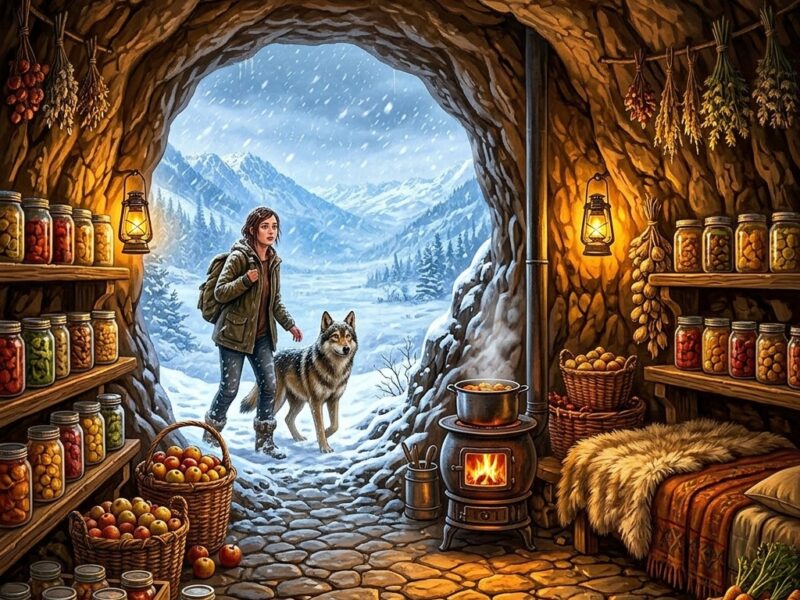
( Part2) Thrown Out With Nothing, Her Dog Led Her to a Warm Hollow in the Rock — It Fed Her All Winter
( Part2) Thrown Out With Nothing, Her Dog Led Her to a Warm Hollow in the Rock — It Fed Her All Winter
.
.
Part 2: The Hollow Home
The first days were a lesson in the brutal arithmetic of manual labor. Alara returned the truck and spent 20 of her remaining $47 on a used pickax, a shovel with a cracked handle, and a sturdy iron-wheeled wheelbarrow. The man at the hardware store, Mr. Henderson, had looked at her purchase and then at her slight frame. “That’s hard country out there, miss,” he’d said, not unkindly. “No place for well, no place to be alone.”
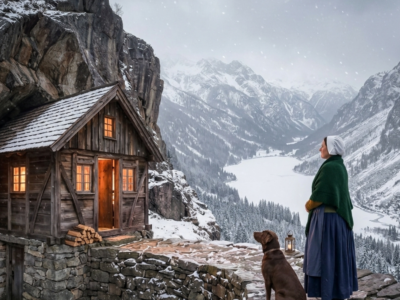
She simply nodded, paid her money, and pushed the wheelbarrow the four miles back to her parcel of rock. The tools clanging a rhythmic, lonely accompaniment to her steps. Her goal was simple: to enlarge the hollow, turning it from a cramped refuge into a livable space. The rock, however, had other ideas. The granite was ancient and unforgiving. The pickax would ring with a high, clear sound, and often all she would have to show for ten minutes of jarring, exhausting work was a handful of glittering dust and a few sharp-edged chips.
Her hands, soft from a life spent indoors, were a geography of pain within hours. Blisters formed, broke, and bled, leaving raw patches of skin that stung with every impact. Her shoulders and back screamed in protest. Every evening, she would crawl back into the warm hollow, her body a single throbbing ache, and fall into a sleep so deep it was like a temporary death, with Jasper curled against her for comfort.
She quickly learned the language of the stone. Some veins were softer, a crumbly feldspar-rich granite that yielded more easily to the pick. Others were veined with quartz, hard as glass and stubbornly resistant to her efforts. She learned to read the subtle changes in color and texture, to follow the paths of least resistance, to work with the rock’s natural fractures and weaknesses instead of fighting against its strength.
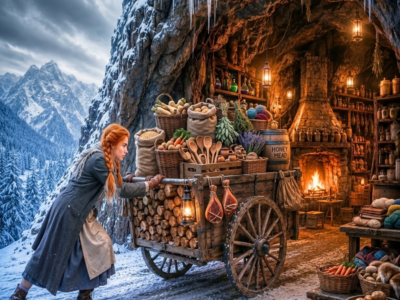
The pile of excavated rubble outside the entrance grew slowly, a testament to her relentless, monotonous toil. Each wheelbarrow full, pushed out into the cold air, felt like a monumental victory. Food and water were a constant, pressing concern. A small seasonal creek trickled through a gully at the edge of her property. She knew it would freeze solid once winter truly set in, so she spent a precious $5 on a large food-grade barrel, which she filled and hauled back to her nascent home. It was her reservoir, her lifeline.
For food, she had a small sack of beans and another of rice, purchased with the last of her money. She rationed them with a miser’s care. She learned to forage, identifying the tough, edible roots of the wild onions that grew near the creek, and the tart, vitamin-rich rose hips that clung to thorny bushes. It was a meager, repetitive diet, but it was enough to fuel her work.
One afternoon, as she struggled to pry a particularly large boulder loose from the wall of her expanding chamber, a shadow fell over the entrance. She looked up, squinting into the bright, cold light to see the silhouette of a man. It was Silas Croft, the owner of the sprawling ranch that bordered her property to the west. He was a tall, lean man in his late 50s, his face a roadmap of wrinkles carved by sun and wind. He was considered the most practical, no-nonsense man in the county.
“Ma’am,” he said, his voice dry as dust. “I don’t mean to pry, but my cattle have been known to wander. Just wanted to make sure you were all right. Didn’t expect to find this.” He gestured vaguely at her excavation. “What in God’s name are you doing?”
Alara felt a flush of defensive anger. She was tired of the pitying looks, the whispers she knew were circulating in town. The mad widow on the anvil, the mole woman. “I’m building my home, Mr. Croft,” she said, her voice steadier than she felt.
Silas put his hat back on, tilting it to shade his eyes. He chewed on his lip for a long moment, his gaze assessing. He wasn’t mocking her; she realized he was genuinely trying to understand something that made no sense according to any rule he had ever lived by. “In there? In the rock?”
She nodded. “It’s warm in there.”
He stepped closer and held his hand near the entrance, his expression shifting from confusion to disbelief. He grunted, a short, sharp sound of surprise. “I’ll be damned,” he muttered. He looked back at her, at the raw blisters on her hands, at the fierce, exhausted determination in her eyes. “Well, it’s your land.” He turned to leave, then paused. “Winter’s coming on fast this year. The old-timers feel it in their bones, says it’s going to be a bad one.”
With that pronouncement, he tipped his hat and walked away, his long strides eating up the barren ground. His visit marked a subtle shift. The isolation had been absolute, but now she was being observed. A few days later, she found a small bundle at the entrance to her hollow. Inside was a pair of thick leather work gloves and a small jar of salve. There was no note. She knew they were from Silas.
It was not an endorsement of her plan, but an acknowledgment of her labor—a gesture of respect from one hard worker to another. She put the gloves on. They were stiff, but they fit, and the relief of swinging the pickaxe without the bite of raw skin on splintered wood was immediate and profound.
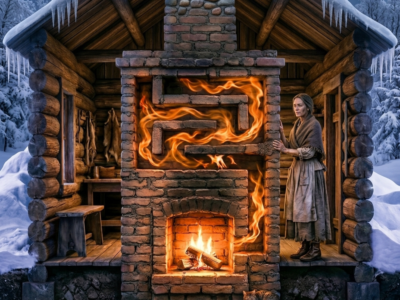
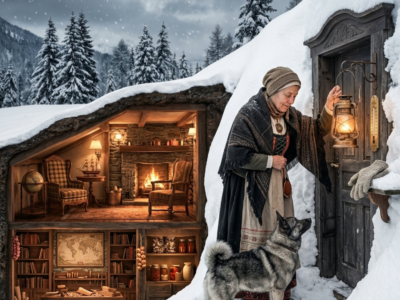
As October bled into November, the hollow grew. It was now a proper room, nearly 15 feet square, with a ceiling high enough for her to stand upright. She had learned to shape the space, leaving a natural stone shelf along one wall and carving out a small niche that would serve as a hearth. The problem of smoke was one she had pondered for weeks. She couldn’t have an open fire filling her subterranean home with soot and suffocating fumes.
Her solution came from studying the rock itself. She noticed a long vertical fissure running up one corner of the chamber. By painstakingly chipping away at it, she managed to create a narrow natural chimney that snaked its way up through 20 feet of rock to a tiny, almost invisible opening on the top of the tor. It was a flue, a gift from the mountain itself.
The greatest discovery, however, came while she was deepening a section of the floor to create a cold storage pit. Her shovel struck something that wasn’t rock. It was wet, yielding clay. And beneath the clay was a slow, steady seepage of water. It wasn’t a spring, but a deep geothermal trickle, filtered through the rock and warmed by the same source that heated her home. The water was clean and carried a faint mineral tang. It was a miracle.
She no longer had to haul water from the creek. She had a well right in her own floor. This discovery changed everything. It unlocked the second part of her grandfather’s wisdom. He had told her stories of Icelandic farmers who used geothermal heat to grow vegetables year-round. With a constant source of warmth and now water, she could do the same.
But the phrase from the Bible her mother used to quote came to her: “He prepareth a table before me in the presence of mine enemies.” Her enemies were the wind and the cold. And her table was a slab of flat rock in the heart of a mountain.
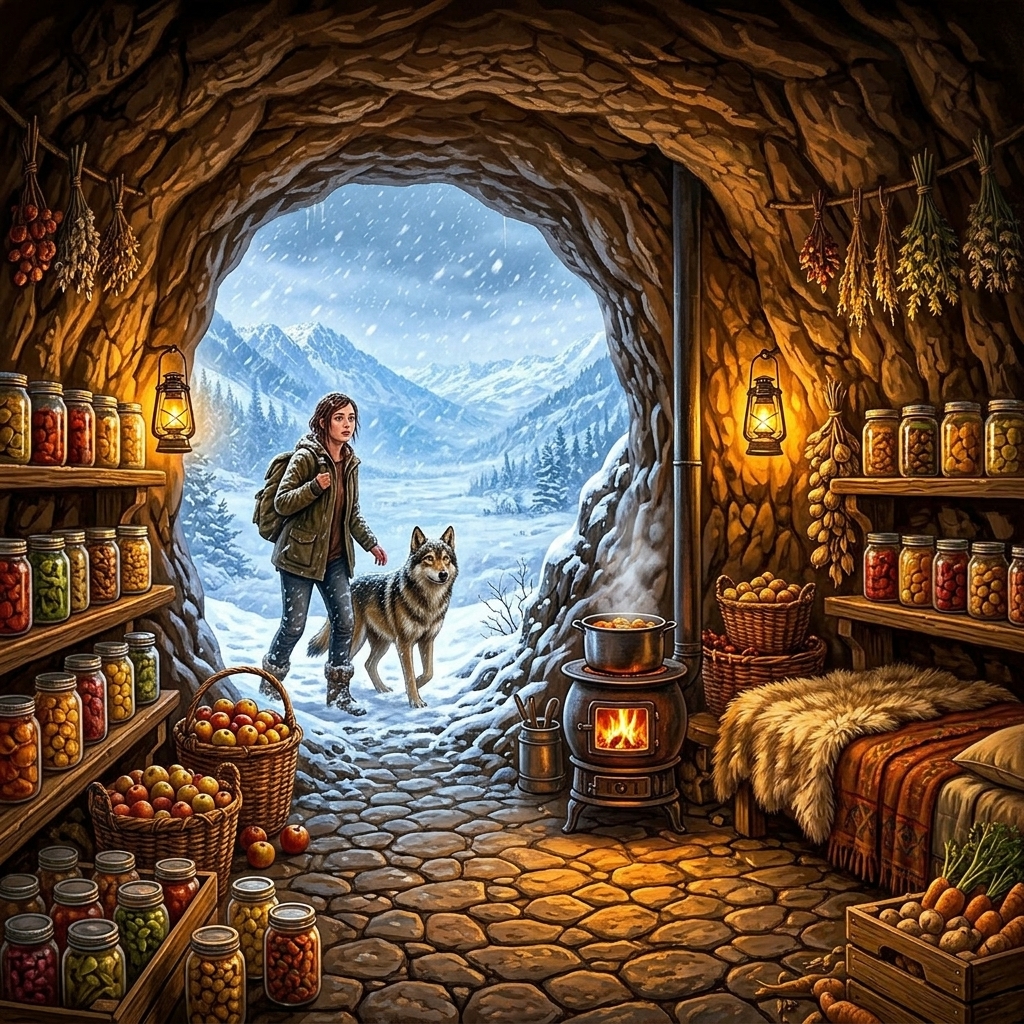
The air grew colder. The creek froze solid. The world outside her stone walls became a place of brutal, crystalline beauty. Frost etched intricate patterns on the outside of her door, but inside, the temperature remained a steady, comfortable 55 degrees. The stone acted as a massive thermal battery, absorbing the earth’s heat and radiating it slowly and constantly.
As the first snows of December fell, Alara felt ready. She had built a sturdy door from weathered gray planks, insulated with packed mud and dried grasses. Inside her hollow, life had found a rhythm. The small garden bed was producing a surprising bounty. The constant, gentle warmth and the moisture from the seeping well created a perfect terrarium.
It was not a feast, but combined with her remaining staples, it was more than enough. She was not just surviving; she was comfortable. She was secure. But the coming storm would test everything she had built.
As the sky turned the color of old pewter and the wind dropped to an unnerving whisper, Silas felt a familiar dread in his gut. The old-timers nodded grimly to each other. They had seen skies like this before. A blizzard was coming—one that could bury houses, freeze cattle solid in the fields, and kill a man in the time it took him to walk from his house to his barn.
The storm hit just after dusk, a deafening shriek followed by a blinding wall of white. Alara heard the storm as a distant, muted roar, the fury of a caged beast clawing at the thick stone walls of her sanctuary. The wind could not find her. The cold could not touch her. But outside, the world was transforming into a frozen hell.
For two days, the blizzard raged without pause. In town, the power went out. Pipes froze and burst. People huddled in their homes, burning furniture to stay warm. For Marcus, the storm was a catastrophe. A section of his barn roof collapsed under the weight of the snow, and he lost a dozen head of cattle.
As the third day dawned, Alara knew she was safe, but Silas was out there, struggling against the storm. Little did she know, fate was about to bring them together in a way neither could have anticipated.
What would happen when the storm finally broke? Would Alara’s sanctuary hold strong against the fury of nature? And would Silas find his way back to her hollow home, seeking warmth and shelter?
The answers awaited them in the heart of the storm.