(Part 2) Thrown Out Before Winter, She Found Her Father’s Hidden Shelter—Then the Blizzard Came
(Part 2) Thrown Out Before Winter, She Found Her Father’s Hidden Shelter—Then the Blizzard Came
.
.
What she understood by the time the cabin roof appeared above the rise was that Voss had not simply filed a false document. He had constructed a system around the false document—a network of suspended credit, withheld assistance, and calculated social pressure designed to ensure that the document never needed to be defended, only waited out. He did not need her to be defeated in any dramatic sense. He needed her to run out of options quietly, to find that every door she tried had already been latched from the inside until the practical reality of her situation did the work his paper only initiated.
It was a thorough plan. She could appreciate the thoroughness of it, the way she could appreciate a piece of equipment built with care for a destructive purpose. Inside the cabin, she sat at the table again. The lamp threw its narrow circle of light. Outside, the wind had picked up, and she could hear it in the cottonwoods along the creek, that high scouring note that preceded a change in the weather’s ambitions.
She thought about her father. Elias Callaway had not been a man given to explanation. He had been a man given to demonstration, to showing rather than telling, to letting the physical world carry the lesson. He had taught her to read weather by watching how the horses stood in a field. He had taught her to judge the load-bearing capacity of a beam by the sound it made when you struck it with a knuckle. He had taught her a hundred things she had learned so thoroughly that she had ceased to think of them as learned things at all, absorbing them into the general fabric of how she understood the world to work.
The summer she was fourteen, he had taken her up the slope of the hill that rose from the western edge of the property, the one the local men called no account land because it was too rocky and steep for grazing or cultivation—the kind of terrain that made a claim look smaller on paper than it actually was. He had been digging for three weeks before he brought her to see it. The excavation was larger than anything she had expected—not a root cellar, which was what the neighbors had assumed when they saw him hauling flat stones from the creek bed in a borrowed mule cart.
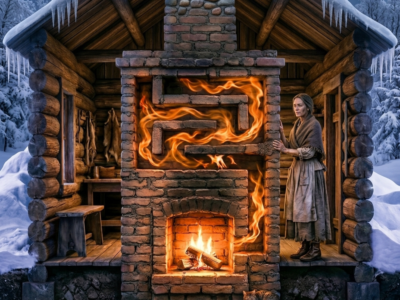
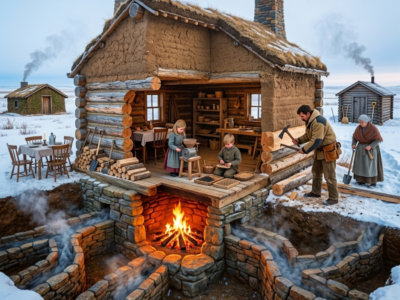
A root cellar was a practical thing, a sensible thing, a 3×4 hole in the ground with a wooden door and a rough shelf for turnips. What her father had dug into the south-facing slope of that hill was something else entirely—10 feet by 12 feet of interior space. The walls lined with flat stones fitted together without mortar, a technique he had taught himself through patient experiment over years of working stone rested from the material itself through the logic of weight and friction and angle.
Each stone was chosen for the flatness of two opposing faces and fitted to its neighbors with a precision that came from understanding how stone wanted to sit rather than forcing it into a shape it resisted. The floor was earth-packed and smooth. The ceiling was heavy timber six inches thick, packed above with two feet of earth and sod. He had her place her palm against the wall. The stone was cool but not cold, a different quality of temperature than the air above ground, which had been near 90° that July afternoon. Down here, the air held a stillness, a constancy that felt almost deliberate.
“The ground remembers August and January,” her father said at last. He was not a poetic man, and the sentence sounded less like poetry than like a physical principle stated in its simplest form. He tapped the stone wall with his finger. “Four feet below the frost line, the temperature doesn’t change. Hot day in July, cold night in February—down here it stays at 50°. The earth holds the heat from summer and won’t release it until spring comes around and puts more heat back in.”
He showed her the two pipes he had already installed—lengths of iron pipe, one set low in the wall near the floor, one running up through the roof timbers. He explained them with the seriousness he brought to all technical things. The low pipe drew in cold, dense air from outside, feeding combustion. The high pipe vented warmer, lighter air upward, creating a slow circulation that kept the oxygen fresh without surrendering more heat than was necessary. “You need both,” he said. “Without the intake, fire would not draw. Without the exhaust, the air would foul and a person would stop thinking clearly before they understood why.”
Ren had asked him why he was building it so far from the cabin. He had been quiet for a moment, leaning on his shovel, looking out through the excavation’s entrance at the pale summer valley below. “You prepare for the winter you don’t see coming,” he said at last—a sickness, a fire, a failure of charity, a man with a piece of paper. He did not elaborate. He did not explain why those four possibilities were paired in his mind or what specific experience had taught him to hold them together. He simply handed her a stone and showed her where it needed to go.
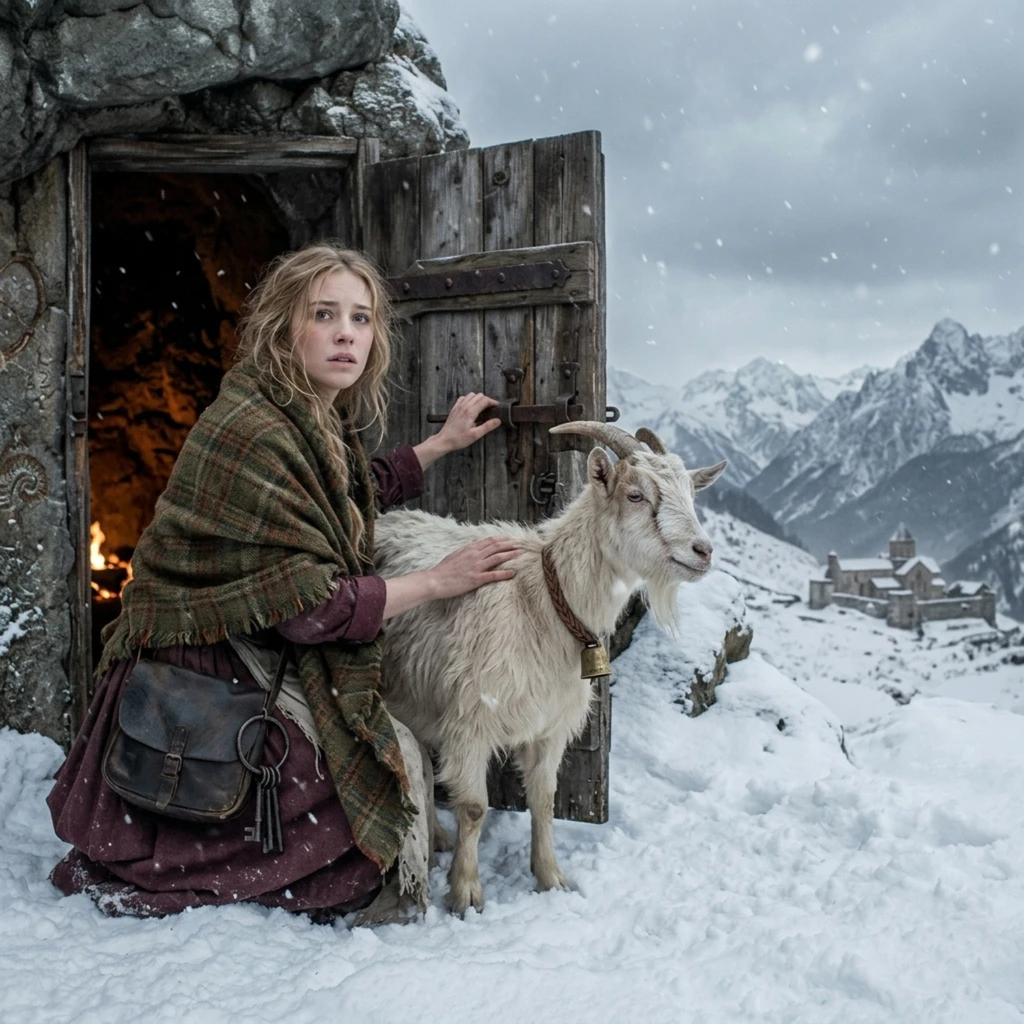
She had understood at fourteen that she was being given something. She had not understood what. She understood now. The night before the seventh day, Ren did not sleep. She moved through the cabin in the dark with the lamp turned low, doing the last things that needed doing. She packed a canvas sack with the salt, the matches, a wet stone, two wool blankets, the small cast iron pot, and the axe. She left most of the furniture where it stood. She left the dishes stacked on the shelf. She left the curtains her mother had sewn from flower sacking hanging in the windows because taking them would have required a kind of deliberate farewell she was not prepared to make.
Before dawn, she went to the small lean-to attached to the barn’s north side where her horse Cinder was stabled. The animal was seventeen years old, a compact bay with a white blaze and the calm, practical temperament of a creature that had long since decided there was no situation worth panic. Ren pressed her forehead briefly against the horse’s neck, breathing in the warm animal smell, then tacked up with the same efficiency she brought to everything. She led Cinder out into the pre-dawn dark. The first snow had not yet fallen, but it was close. She could taste it in the air—the particular mineral absence of smell that preceded snow, the way silence preceded a door opening.
She swung up, settled into the saddle, and turned west. The cabin was behind her. She did not look back at it—not because she was denying herself the sight, but because she had already seen it, had stored it precisely, and carrying the image forward served nothing. What was ahead of her was the hill, the slope, the south-facing exposure, the gnarled old pine at the crest with its bark grown thick over a mark cut into it eleven years ago. She was not running. Running was what Voss had planned for—the panicked eastward departure of the woman on the road to Anvil Creek or the longer road to Sundance diminishing into the landscape and becoming someone else’s problem.
What she was doing was something else entirely. She was moving from one part of her father’s design to another. Behind her, as the first pale light began to separate the sky from the hills, thin smoke rose from the cabin’s chimney with no one inside to tend it. She had banked the fire before leaving, giving any early observer the impression of a house still occupied. Within the hour, the fire would go cold. By the time Voss sent anyone to check, the cabin would be empty, and the tracks would lead west into the territory he had always regarded as no account land—too broken and steep to be worth the trouble of following.
The snow began to fall as she crested the first rise—not gently, not with the tentative quality of a first November dusting, but with the settled, purposeful intensity of something that had made up its