(Part 2) Thrown Out at 18, Her Cat Led Her to a Warm Crack in the Canyon — Inside Was More Than Shelter
(Part 2) Thrown Out at 18, Her Cat Led Her to a Warm Crack in the Canyon — Inside Was More Than Shelter
.
.
Part 2: The Transformation
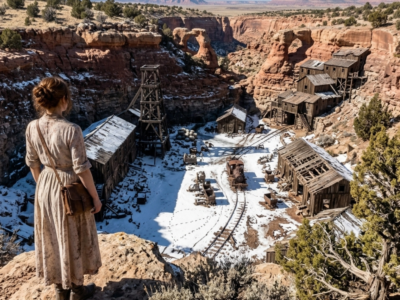
The first flakes of snow fell gently, almost hesitantly, as if nature itself was uncertain about the coming storm. Aara stood at the mouth of Coyote Canyon, staring at the remnants of her great-grandmother’s legacy. She was ready to breathe new life into the ruin, to create something that would not only shelter her but could also withstand the harshness of the winter to come.
Her resolve hardened into something unbreakable. She walked back to Windgap, the journal and the gold coins tucked safely in her sack. The wind felt different now. It was still a threat, but it was no longer her master. It was an adversary she now had a plan to defeat.
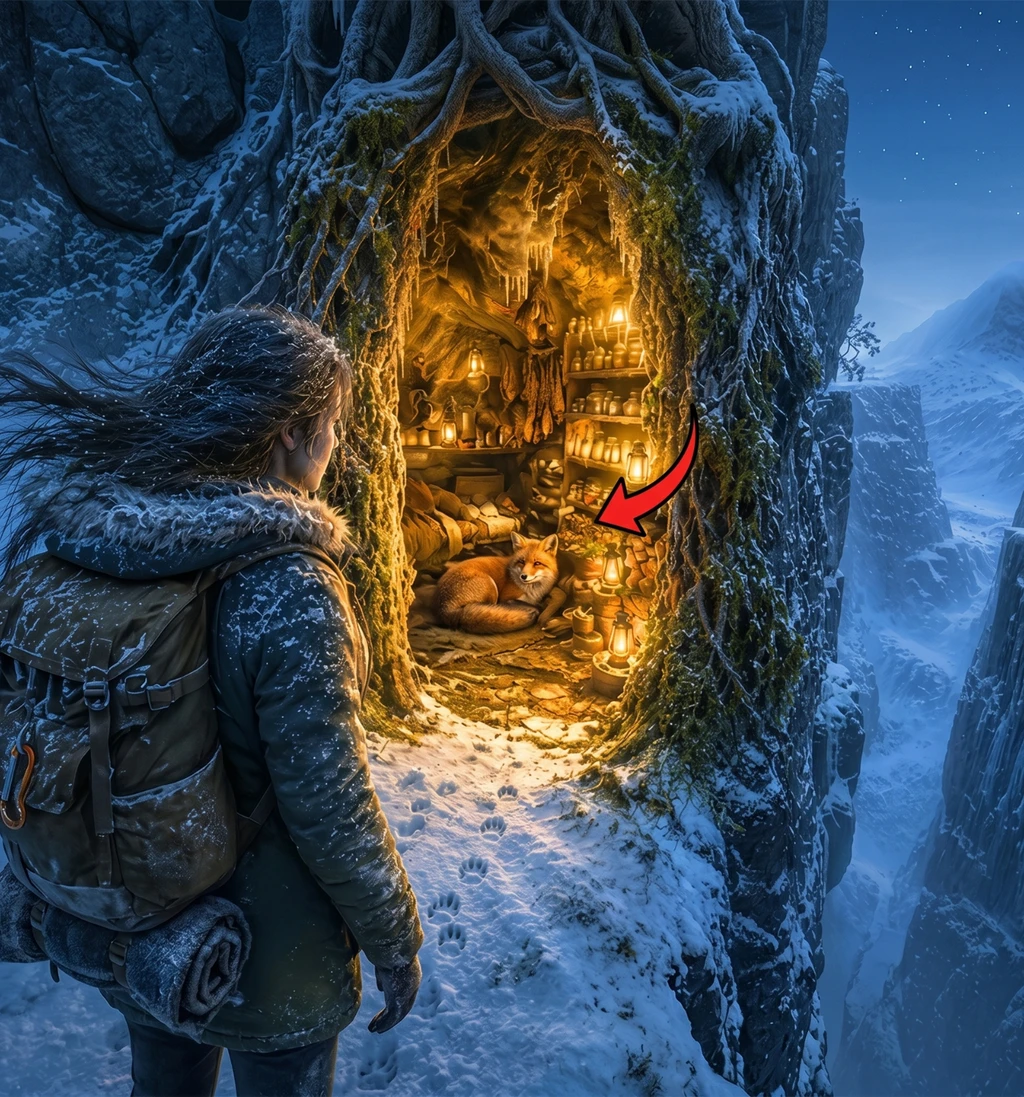
Her second visit to the town was met with a different kind of reception. Mr. Thorne, the town councilman and land assessor, had heard of her arrival. He found her outside the general store, a tall man with a fed face and an air of smug authority. “So, you’re the orphan who inherited the old ruin?” he said, his voice dripping with condescension. “I’m Thorne. I handle the town’s affairs. Let me give you some advice, girl. That land is worthless. The rock is unstable. Sign the deed over to the town for a dollar. Take what little money you have and get on the next bus south before the real snows come. People have died in that canyon. It’s no place for a child playing house.”
Aara met his gaze, her expression unreadable. “I’m not playing,” she said, her voice quiet but firm. “I’m staying.” Thorne let out a short barking laugh. “Staying to do what? Freeze to death? You won’t last until the first blizzard? Mark my words. We’ll be sending a party to collect your body before mid-winter.” His mockery was a wet stone, sharpening her anger into a fine, dangerous edge. It did not break her; it forged her.
Inside the general store, the owner, Silus Croft, introduced himself as a man who had seen too many winters. Aara laid her list on the counter: fire bricks, refractory clay, stovepipe, tools, sacks of cement. It was a long list. Mr. Croft looked at it, then at her, his brow furrowed with a mixture of pity and disbelief. “This is a lot of material, Miss,” he said, his voice a low rumble. “More than you could possibly use to patch a few holes.”
Aara took a deep breath. “I’m rebuilding the stove,” she said simply. “And the wall.” He stared at her as if she’d announced her intention to fly to the moon. He had seen her talk to Thorne. He knew the ruin. “That’s a fool’s errand,” he said, not unkindly. “The winter here is a beast. It will swallow a project like that whole, and you with it.”
Aara held his gaze, unwavering. She pushed the small pouch of gold coins across the counter. “This is a down payment,” she said. “I will work off the rest. I need these things on credit.” Silus Croft looked from the coins to her determined face, then to the raw blisters on her hands, and saw something beyond youthful folly. He saw a core of iron resolve that reminded him of the bedrock of the mountains themselves. He sighed a long, weary sound. “Don’t make me regret this girl,” he said, slowly nodding. “I’ll have the first load delivered to the canyon mouth tomorrow.”
It was not an expression of faith in her plan but in her effort. It was the first crack in the wall of the world’s disbelief. The weeks that followed were a blur of brutal, relentless labor. Mr. Croft’s delivery wagon could only make it to the edge of the canyon trail, leaving Aara to haul every single fire brick, every sack of clay and cement, the rest of the way on a crude sledge she fashioned from salvaged timbers.
Her days were a repeating cycle of hauling, mixing, and building from the first sliver of dawn until her muscles screamed in the frigid twilight. She lived on dried beans and hard biscuits, her body growing leaner, harder, the soft lines of youth giving way to the sinewy strength of a survivor. The physical toll was immense. Her hands were a permanent landscape of calluses and cuts. Her back was a constant deep ache. But with every stone she set, with every brick she laid according to her great-grandmother’s precise diagrams, a sense of profound satisfaction grew within her.
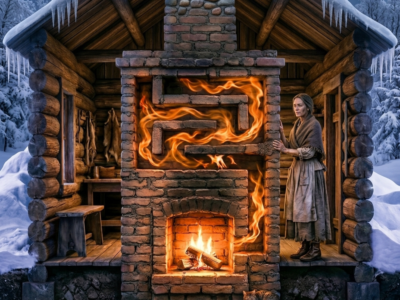
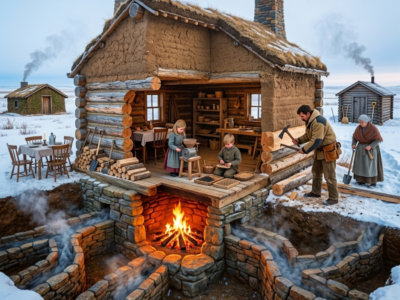
She was not just building a stove; she was resurrecting a legacy. She was shaping her own survival with earth and fire and sweat. She followed the journal page by page, constructing the intricate serpentine flue channels that would capture every last calorie of heat. She rebuilt the collapsed portion of the wall, weaving new stone into the old, her mortar lines clean and strong. She ducted the stove’s air intake deep into the geothermally warmed fissure. The structure that rose from the rubble was a squat, massive thing of stone and clay, more altar than appliance. It was the heart of her small fortress.
As she worked, Jasper was her constant shadow, a silent ginger-furred supervisor, occasionally rubbing against her leg with a rumbling purr of encouragement. The sky continued to darken. The wind grew teeth. One afternoon, as she was sealing the final section of stovepipe, Mr. Croft appeared on the trail, leading a mule packed with supplies. He didn’t say a word at first, simply standing and staring at the work she had done. He walked into the small enclosed space, now roofed with salvaged timbers and layers of sod. He ran a hand over the smooth clay finish of the massive stove.
“You’ve worked hard,” he said, his voice gruff. “Harder than any two men I know.” He unloaded the supplies—flour, salt, pork, kerosene, things she hadn’t asked for but desperately needed. “This is on your account,” he said before she could protest. “Pay me back in the spring if you’re here to do it.” It was a test and a lifeline all in one. His doubt was a final challenge, but his generosity was the first true gesture of human connection she had felt in a very long time.
The harbinger came not as a visual cue but as a voice crackling over the small battery-powered radio Mr. Croft had given her. A meteorologist, his tone grave, spoke of a weather system of historic proportions, a polar vortex anomaly descending from the