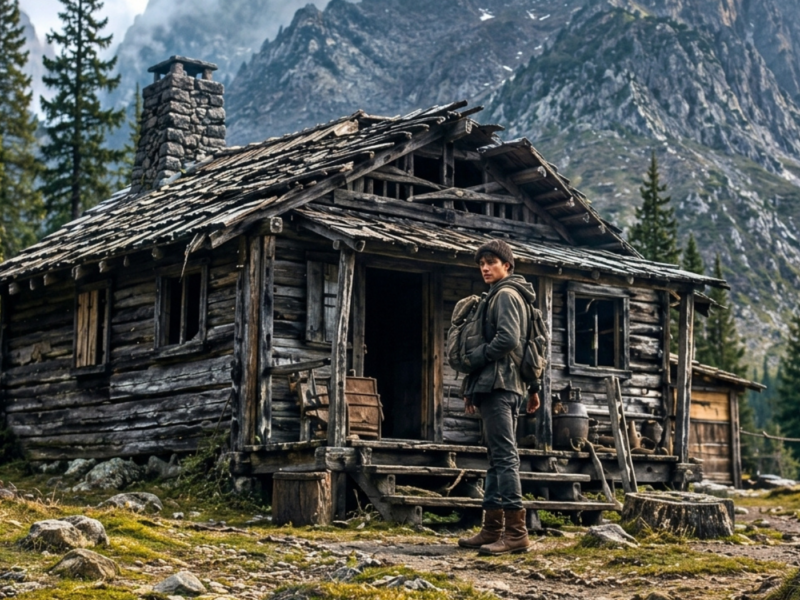
(Part 2) They Said the Mountain Cabin Was Worthless — So at 18, Homeless, I Walked Inside
(Part 2) They Said the Mountain Cabin Was Worthless — So at 18, Homeless, I Walked Inside
.
.
Part 2: The Land That Remembered Everything
The next morning, the creek was louder.
Not because of rain—but because something upstream had changed.
I stood at the edge of the water, watching it move faster than it should have. The surface wasn’t steady anymore. It broke and reformed like it was flowing over something beneath it that wasn’t supposed to be there.
Buster stayed close to my leg, stiff and alert.
He had stopped acting like a farm dog the moment I brought the first vial back.
Now he acted like something was wrong with the land itself.
I returned to the marker stone.
It hadn’t moved.
But the ground around it had.
Fresh shifts in the soil. Subtle, but intentional in a way that didn’t belong to erosion. More like pressure from below.
I knelt and cleared the dirt again.
The oil cloth from yesterday was still there—but now there was something else beside it.
A second mark.
Fresh.
That wasn’t there before.
Someone—or something—had been here recently.
I opened the cloth.
The second vial was identical to the first. Same dark material. Same unnatural density. But the note inside was different.
Shorter.
Colder.
“You are not the first to return.”
My throat tightened slightly as I read it again.
Return.
Not arrive.
Not discover.
Return.
That word changed everything.
Because it implied I wasn’t stepping into something new.
I was stepping back into something unfinished.
That night, I went deeper into the notebook.
The later pages were harder to read. The handwriting grew inconsistent, as if the man had stopped writing in comfort and started writing in urgency.
There were references to the creek no longer behaving naturally.
To soil that “shifted when unobserved.”
To survey markers that didn’t match reality anymore.
And then, buried in the middle of a paragraph:
“The four acres do not appear the same to every map.”
I read that sentence three times.
Then I understood why he never corrected the deed.
Because the land itself wasn’t stable in the way land should be stable.
It changed depending on how it was observed.
That should have been impossible.
But the notebook didn’t care about what should or shouldn’t be possible.
It only recorded what was happening.
The final section of the journal was different again.
Not instructions.
Not warnings.
A decision.
“If the line is ever crossed again, do not try to understand it first. Mark it. Then step back. The mountain responds to certainty, not curiosity.”
That was the last entry.
No date.
No signature.
Just silence after it.
Outside, the wind rose again.
And this time, I could hear something inside it.
Not movement of trees.
Not weather.
But rhythm.
Like footsteps.
Somewhere far beyond the ridge, something had started moving again.
And it knew exactly where I was standing.
I closed the notebook.
Buster growled softly.
I looked toward the forest line where the four missing acres were supposed to be.
The ground looked normal.
That was the problem.
It always did.
And now I understood the final truth my grandfather left behind:
He didn’t hide treasure.
He didn’t hide danger.
He hid a boundary.
And whatever lived beyond it…
was no longer staying behind it.