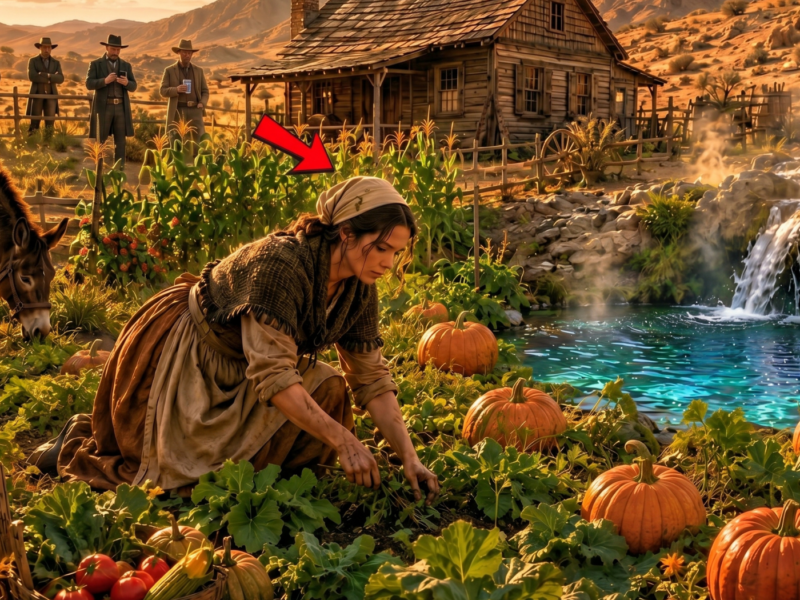
(Part 2) They Laughed When the Widow Bought a “Haunted” Farm for $15 — Then the Harvest Exploded
(Part 2) They Laughed When the Widow Bought a “Haunted” Farm for $15 — Then the Harvest Exploded
.
.
Part 2: The Truth Beneath the Surface
The change began quietly, almost imperceptibly. A customer at Merritt Cole’s store mentioned hearing that livestock became sick after drinking from the silver-blue spring. A week later, someone else claimed the unusually productive harvest was stripping nutrients from the soil and would leave the land barren within a few years. Soon after that came darker stories. The old whispers returned. The haunted farm was cursed. The spring was unnatural. The valley had ignored the warnings for too long.
Nobody could identify where the rumor started; that was part of their strength. They drifted through conversations, passed from porch to porch, growing slightly larger with every retelling. Lucinda noticed the effects before she understood the cause. Orders became smaller. Customers who once arrived early stopped showing up altogether. Several crates of produce sat longer than expected on the store porch. One afternoon, Merritt stood beside a row of unsold pumpkins and rubbed the back of his neck. “I don’t like this,” he admitted.
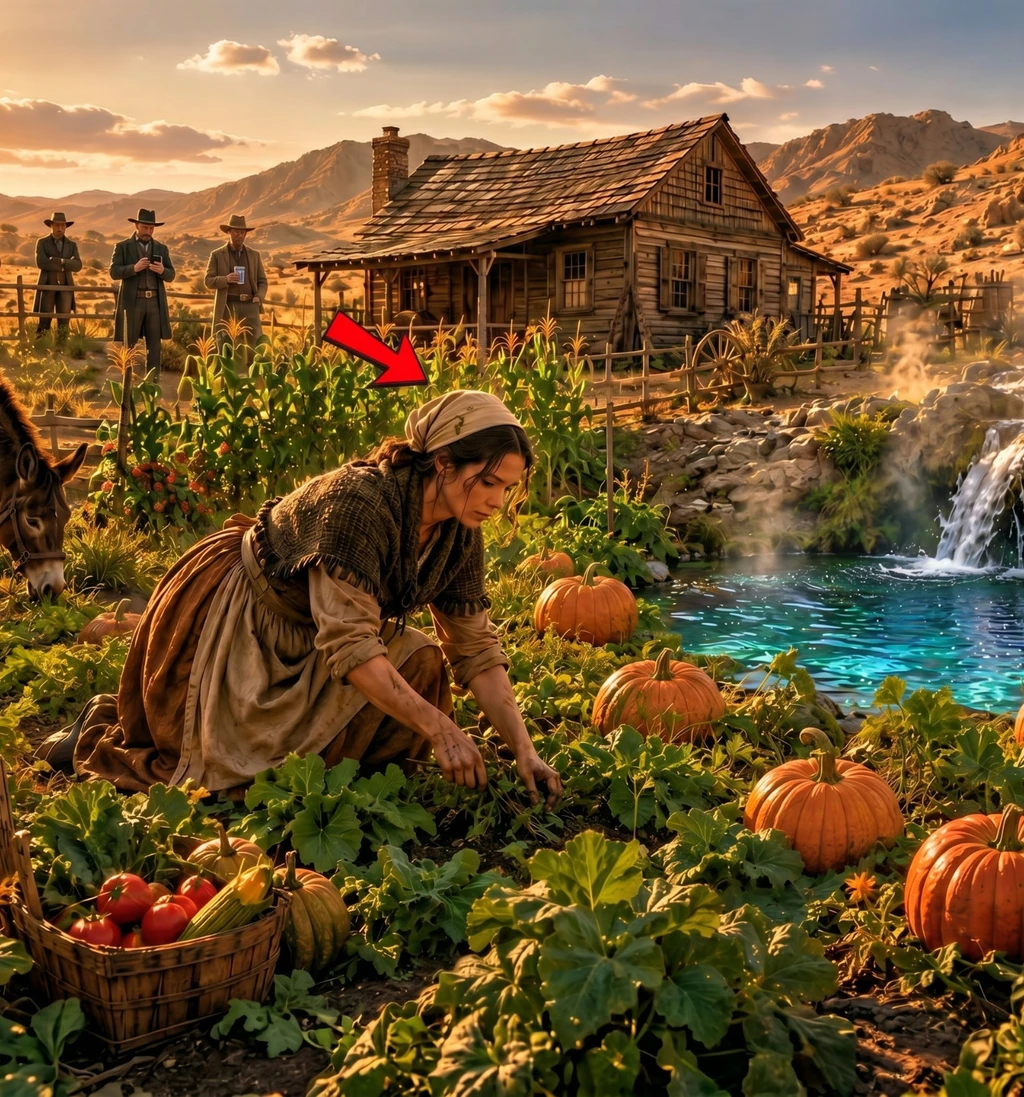
Neither did Lucinda. The harvest itself remained excellent. The crops had not changed. The spring had not changed. Only public opinion had changed. That made the problem harder to fight. Facts could be measured. Fear could not. By late autumn, even familiar faces began avoiding certain conversations when she entered town. People who had once asked questions about the farm now seemed reluctant to mention it at all. The silence bothered her more than open criticism.
On the ride home that evening, Moses pulled the wagon past fields turning gold beneath the setting sun. The farm was still thriving. Yet, for the first time since arriving there, Lucinda found herself wondering whether success alone would be enough. Months earlier, she had lost everything because of another person’s mistakes. As the wheels rolled through the dust behind Moses, an uncomfortable thought settled into her mind: perhaps it could happen again.
Determined to confront the rumors head-on, Lucinda decided that arguing with them would only make them stronger. Instead, she chose something simpler. On the first Saturday of October, Moses pulled a wagon into Morning Hollow loaded with pumpkins, beans, corn, jars of sorghum syrup, and several wooden buckets filled with water from the silver-blue spring. People noticed immediately. By mid-morning, a small crowd had gathered near the center of town.
Lucinda climbed onto the wagon and began handing out food. No speeches, no defense, no accusations—she simply invited people to eat. Some refused, others accepted cautiously. An elderly woman sampled a spoonful of sorghum syrup. A farmer broke open an ear of corn and examined the kernels before taking a bite. Children required far less convincing. Then Lucinda picked up one of the water buckets. The conversations around her grew quieter. Everyone knew where the water had come from. Without a word, she dipped a tin cup into the bucket and drank. The crowd watched.
After a moment, she filled a second cup and drank again. Nothing dramatic happened. No challenge was issued, no argument followed. The demonstration continued in the most ordinary way possible. Lucinda ate the same food she sold. She drank the same water she used. And before long, Moses wandered over from the hitching rail and lowered his head into one of the buckets. The old mule drank deeply. A few people laughed at that. The tension eased.
Then something unexpected happened. A young boy standing near the front accepted a slice of pumpkin. He ate it quickly, looked at the remaining pieces on the table, and held out his hand. “Can I have another one?” His mother started to object but then stopped. The crowd noticed. So did Lucinda. Sometimes public opinion changes through grand events. Sometimes it changes because a child asks for a second piece of pumpkin in front of everyone.
The rumors might have continued for years if the story had remained inside Morning Hollow. It didn’t. By late autumn, reports of an unusually productive farm built around a supposedly cursed spring had traveled far enough to attract the attention of Professor Asa Whitcomb, a naturalist and agricultural lecturer from Springfield, who spent much of his time studying soils, water systems, and crop production across the region. He arrived carrying notebooks, sample jars, and enough measuring instruments to fill a small wagon. Unlike most visitors, Asa showed little interest in the stories. He wanted data.
For three days, he examined nearly every part of the property. Water samples disappeared into glass vials, and soil from different fields went into labeled cloth sacks. Notes filled page after page as he compared planting records, rainfall patterns, and harvest yields. Lucinda followed whenever she could, answering questions and occasionally handing him pages from Aunt Maribel’s old ledger.
What impressed Asa most was not the harvest. It was the consistency. The same advantages appeared again and again across different crops, different sections of the farm, and different stages of growth. By the second afternoon, he moved his attention toward the spring itself. That was when he noticed something unexpected. He lowered a thermometer into the flowing water and frowned slightly. Then he repeated the measurement and repeated it again. The spring was colder than a bathhouse and warmer than nearly every natural water source nearby should have been at that time of year. Not dramatically, but enough to matter and explain part of what the valley had been witnessing.
That evening, Asa sat with Lucinda outside the cabin while the last light faded across the limestone bluff. His notebook rested open across one knee. For a moment, he watched the pale ribbon of water emerging from the rock. Then he closed the notebook. “You didn’t discover a miracle, Mrs. Bellwether,” he said. Lucinda waited, intrigued. The professor nodded toward the spring. “You discovered a system.” He explained how the mineral-rich water, the slightly elevated temperature, the limestone geology, and the surrounding soil were working together. None of the individual pieces were extraordinary by themselves. What made the farm remarkable was the way they combined. For the first time, someone had given a name to what Lucinda had been observing all along.
The haunted farm wasn’t blessed. It wasn’t cursed. It was simply understood better than it had ever been before. Professor Asa’s explanation brought Lucinda a quiet sense of peace. But theories in a notebook could not shield crops from the wrath of nature. That system needed to be proven, and the first real test arrived earlier than anyone expected.
A cold front swept into Morning Hollow during the opening weeks of autumn. The temperature dropped sharply after sunset, and by dawn, a white layer of frost covered the valley floor. Farmers stepped outside to find gardens coated in ice. Bean leaves hung limp from their vines. Pumpkin patches turned black along the edges. Tender corn stalks that had looked healthy the evening before now stood brittle and damaged beneath the morning light.
The frost had arrived nearly two weeks ahead of schedule. No one had prepared for it. Lucinda walked her fields at first light. The damage was there. Nature rarely spared anyone entirely, yet the destruction seemed uneven. The worst losses appeared farther from the bluff, while many of the rows closest to the silver-blue spring remained surprisingly healthy. A faint mist still drifted above the water. The ground surrounding the basin had not cooled as quickly during the night. Months earlier, Asa Whitcomb had measured only a small difference in temperature. Standing there now, Lucinda understood how important a small difference could become.
By midday, people from across the valley were riding out to inspect the damage. What they found deepened the unease already spreading through Morning Hollow. Fields that should have suffered equally had not done so. Near the spring, corn still stood upright. Pumpkin vines retained patches of healthy green. Several bean rows looked weeks away from the collapse occurring elsewhere. The contrast was difficult to ignore.
For generations, the valley had treated the haunted farm as a warning. Now, nature itself seemed to be offering a different judgment. The frost had touched every property in Morning Hollow, yet when the cold finally passed, Lucinda’s fields remained standing long after many others had surrendered to the season. The frost accomplished something the rumors never could. It forced people to pay attention.
Within a month, Caleb Rusk filed a legal claim against Lucinda Bellwether and the haunted farm. According to the complaint, the silver-blue spring originated beneath property he owned farther up the ridge. If that could be proven, he argued, the water belonged to him. The case immediately divided Morning Hollow. Some believed Caleb was protecting a legitimate property right. Others suspected he had simply waited until the farm became valuable before deciding to challenge its ownership.
The hearing was held in the county courthouse shortly after harvest. The room smelled faintly of lamp oil, old paper, and damp wool coats. Maps covered one table. Survey records covered another. Bottles of ink sat beside stacks of legal documents that seemed capable of burying the truth beneath paperwork alone. Lucinda arrived without a lawyer. She carried only her records, her harvest ledgers, and the confidence that comes from spending a year testing the same evidence over and over again.
Caleb arrived with surveyors, property maps, and a carefully prepared argument. For several hours, witnesses spoke about land boundaries, water flow, and ownership rights. Survey markers were examined. Old deeds were compared. Men pointed at lines on maps drawn decades earlier by people long since dead. Then Asa Whitcomb took the stand.
The professor did not speak about rumors or local legends. He spoke about geology. Using field notes, measurements, and soil samples collected throughout the year, he explained how the spring emerged from the limestone formation beneath the haunted farm. Water might travel underground for considerable distances, but ownership was determined by where the spring surfaced and became a usable resource.
Judge Alton Greer listened carefully. So did the crowded gallery. When Asa finished, the courtroom grew quiet. The decision came later that afternoon. The judge reviewed the maps one final time before setting them aside. Then he looked toward Caleb, toward Lucinda, and finally toward the survey drawing showing the point where the silver-blue spring emerged from the bluff.
“The water may travel in darkness,” he said, “but the law concerns itself with where it enters the world.” He paused briefly before delivering the sentence people would repeat across the valley for years. “The spring belongs to the land where it first sees daylight.” A murmur moved through the courtroom. The ruling was clear. The silver-blue spring belonged to the haunted farm.
For the second time that year, a long-held belief had been tested in public. And once again, the evidence had survived the examination. The lawsuit ended in winter. The drought began the following summer. At first, nobody recognized the warning signs for what they were. Spring rains arrived late. Small creeks shrank earlier than usual. By June, cracks began appearing in fields across Morning Hollow.
That was around the time Jonah Pike arrived at the haunted farm. Jonah was a well digger and stone worker whose reputation extended across several counties. He had come to see the famous spring for himself. But for a man who had spent his life coaxing water from stone, simply looking was never going to be enough. Watching Lucinda struggle to manage the flow with rudimentary hand-dug dirt channels, the craftsman in him took over. He saw a masterpiece waiting to be built.
Jonah offered to stay on for a few days to line a single ditch with stone, asking for nothing more than hot meals and a place to sleep in return. What began as a visit gradually became something else. While most people focused on the water, Jonah focused on what happened after the water left the ground. Together, he and Lucinda spent weeks improving the farm’s infrastructure. They lined irrigation channels with stone. They built holding basins to capture overflow. Shallow distribution ditches carried water across fields that previously depended entirely on rainfall. The work was slow, heavy, unremarkable to anyone passing by. But practical knowledge often looks ordinary until the day it becomes necessary.
By mid-July, the drought tightened its grip on the valley. Pastures faded from green to brown. Ponds shrank. Wells that had supplied families for decades began producing less water each week. Farmers walked their fields searching for signs of recovery and finding none. The silver-blue spring continued flowing—not faster, not slower—simply steady, as if the drought belonged to another world.
For the first time since purchasing the haunted farm, Lucinda faced a decision capable of changing her life forever. Demand for water exploded. People offered money, land, livestock. Some were willing to pay almost any price. No one would have blamed her for accepting. Instead, she opened the gates. Moses spent entire days pulling water barrels into town. Jonah helped repair broken wagons carrying empty containers back to the farm. The stone channels they had built months earlier allowed water to be distributed far beyond Lucinda’s own fields.
Families arrived from every corner of the valley. Some had supported her. Others had laughed when she bought the haunted farm. A few had repeated the very rumors that nearly destroyed her business. Lucinda served them all the same way—no ledgers, no special rates, no grudges. One afternoon, while filling buckets beneath the summer sun, she recognized a couple who had stood in the land office years earlier when the room erupted in laughter over her $15 purchase. They lowered their eyes as they approached. Lucinda filled their containers anyway.
Around them, dozens of people waited their turn beside the spring. The drought had become the harshest judge the valley had faced in years, and its verdict was impossible to misunderstand. The farm everyone feared had become the place keeping Morning Hollow alive. The drought changed Morning Hollow. Some changes happened quickly; others took years. The silver-blue spring never turned the valley into a wealthy place, but it helped many families survive long enough to rebuild.
Fields recovered, wells refilled, new barns appeared where abandoned foundations once stood, and the haunted farm slowly stopped being called the haunted farm. People began referring to it by a different name: Bellwether Farm—a name tied not to fear, but to results. In the years that followed, Jonah and Lucinda built a family together. What began with stone channels and irrigation ditches grew into a partnership built through work. New structures appeared one season at a time. A larger barn, additional storage sheds, better fencing—improvements that reflected patience rather than sudden success.
Lucinda never stopped experimenting. She continued recording rainfall, planting dates, soil conditions, and harvest yields in ledgers that gradually filled entire shelves inside the cabin. Visitors often expected to find secrets hidden somewhere on the farm. What they usually found instead were notebooks, measurements, and years of careful observation. The spring remained important, but Lucinda understood something many people missed: the water alone had never created the harvests. The harvests came from learning how to work with the land instead of fighting it.
Time passed. Children who had once been warned to avoid the property grew up hearing different stories. Some came to learn about irrigation. Others came to study soil management or crop rotation. A few arrived simply because they were curious. Among them was a boy named Samuel Rusk. By then, Caleb Rusk’s influence had faded considerably. The drought had exposed weaknesses in the system he spent years building. Ownership and control had proven less valuable than resilience.
One autumn afternoon, Caleb rode out to Bellwether Farm with Samuel beside him. Age had altered him. The confidence remained, but the certainty did not. Lucinda met them near the spring. For several moments, nobody spoke. The sound of flowing water filled the silence. Finally, Caleb rested a hand on his son’s shoulder. “He’s interested in farming,” he said. Lucinda waited. Caleb glanced toward the field stretching beyond the bluff, then toward the irrigation channels Jonah had helped build years earlier. When he spoke again, his voice carried none of the sharpness it once had. “He ought to learn from somebody who understands this place better than I do.”
It was not an apology. Men like Caleb rarely offered those, but it was something rarer—an admission. Lucinda nodded. That was enough. The following spring, Samuel began spending time on the farm. He learned how to read soil moisture from the color of freshly turned earth. He learned why water moved through certain channels and avoided others. He learned that every successful harvest began long before seeds ever entered the ground. Most importantly, he learned that ownership and stewardship were not the same thing.
Years later, visitors often found Lucinda teaching beneath the shade of a cottonwood tree while children and young farmers listened nearby. The lessons usually started the same way—with questions, observations, and the understanding that nature rarely hides answers from people willing to pay attention. Near the end of his life, Moses spent most afternoons resting beside the silver-blue spring. The old mule had crossed every stage of the journey alongside Lucinda. He had pulled the wagon carrying her final possessions. He had hauled timber, stone, crops, and water. He had stood beside her when the valley laughed and remained there when the valley changed its mind.
Now he slept beside the same spring that had changed both their lives. On warm evenings, children ran through fields that had once been abandoned. Corn rustled in the breeze. Bees drifted between flowers. Water flowed steadily from the limestone bluff just as it always had. The valley once believed a curse lived there. No curse had ever existed—only a spring, a farm, and a widow who refused to fear what others had never taken the time to understand.
And so, the story of Lucinda Bellwether and her haunted farm became a tale of resilience, transformation, and the power of understanding the land. With each passing season, the farm thrived, and Morning Hollow learned to embrace the truth that had long been hidden beneath the surface.