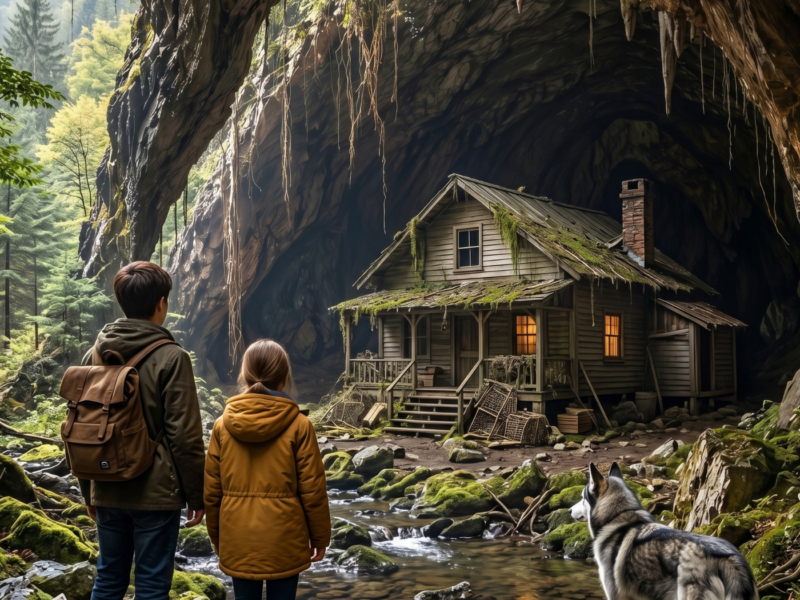
(Part 2) They Had Nowhere To Go — Until They Found a Hidden House Inside a Giant Cave
(Part 2) They Had Nowhere To Go — Until They Found a Hidden House Inside a Giant Cave
.
.
Part 2: A New Beginning
By the second week, the house no longer felt abandoned, but it still didn’t feel like ours. Every room carried signs of the people who had once lived there. Dust covered the shelves. Spider webs stretched across corners. The windows were so dirty that barely any light came through. One morning, I looked around and made a decision. If we were going to stay here, we needed to stop thinking like guests. We needed to start treating this place like home.
So, that’s exactly what we did. My sister took charge of cleaning. At least, that’s what she called it. In reality, she spent most of the morning talking to Baron while waving a broom around the room. But somehow, the house slowly began to change. We opened every window. We carried broken furniture outside. We swept away years of dust. Little by little, sunlight started reaching parts of the house that had probably been dark for years.
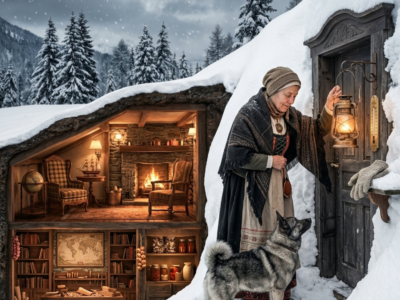
The biggest change came from the front room. At first, it looked gloomy and forgotten, but after a few days of work, it became the warmest place in the house. The fireplace glowed every evening. The chairs were repaired. The old wooden table stood proudly in the center of the room again. One afternoon, while cleaning near the back wall, my sister called my name. I hurried over. Behind an old cabinet, hidden beneath a thick layer of dust, was a small wooden door. I had never noticed it before.
Carefully, we pulled the cabinet aside. The door opened with a loud creak. Beyond it was a narrow storage room. The shelves were mostly empty, but not completely. Inside, we found old tools—a hammer, a handsaw, boxes of nails, a sharpening stone, and several bundles of rope. To most people, it would have looked like junk. To us, it looked like treasure.
Those tools changed everything. Now, we could repair things properly, fix loose boards, strengthen weak walls, build shelves, and improve the house instead of simply living inside it. For the next several days, every improvement made the place feel more alive, more personal, more ours. Even Baron seemed happier. He had claimed a permanent spot beside the fireplace and guarded it as if he owned the entire house.
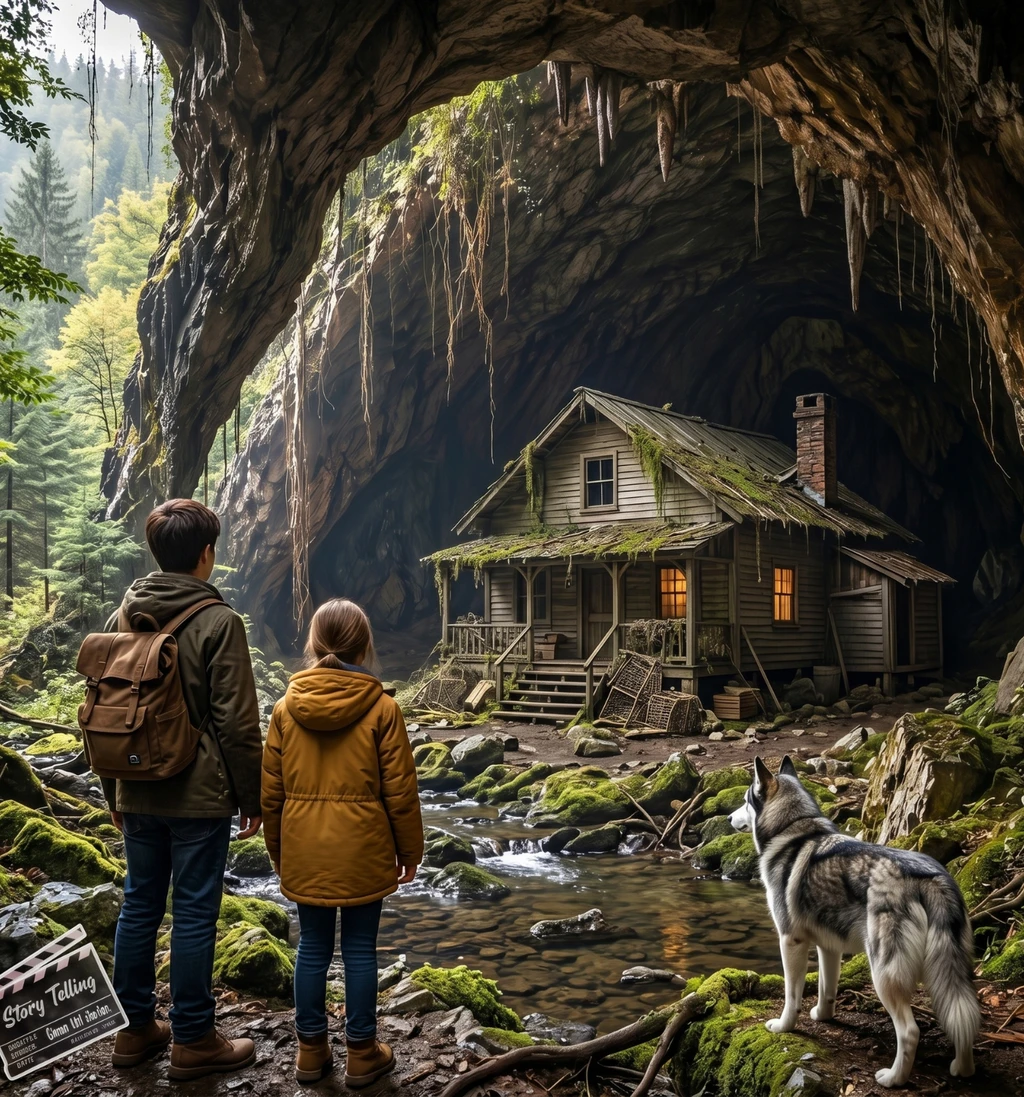
One evening, after finishing another long day of work, I stepped outside onto the porch. The cave was quiet. The forest beyond the entrance was glowing in the soft light of sunset. For a few minutes, I simply stood there looking back at the house. It wasn’t perfect. The paint was faded. The roof still needed work. And there were plenty of problems left to solve. But compared to the day we found it, it looked completely different.
That’s when I realized something. We hadn’t just been repairing the house. The house had been repairing us, too. Every board we fixed, every room we cleaned, every problem we solved gave us something we hadn’t felt in a very long time: purpose. And that feeling was worth more than anything we had lost.
Life slowly settled into a rhythm. Every morning began the same way. I collected water from the spring. My sister helped around the house, and Baron followed us everywhere, making sure none of us were ever alone. The fear that had followed us for so long began to fade. In its place came something new: routine.
We planted a small garden near the cave entrance, where sunlight reached the ground for a few hours each day. It wasn’t much—just a few simple vegetables. But watching something grow again felt important. It reminded us that not everything in life had to be about survival. Some things could be about the future.
My sister changed the most. When we first arrived, she barely spoke. Now, I heard her singing while she worked. Sometimes she laughed while playing with Baron outside the house. And every time I heard it, I felt a little lighter. One evening, we sat together beside the fireplace. The garden was growing, the firewood stacks were full, and the house was warm. For the first time since losing everything, we weren’t thinking about what we had lost. We were thinking about what we were building, and somehow, that felt even better.
One rainy afternoon, while searching through the storage room again, my sister found something hidden behind a loose wooden board. A small box, covered in dust. Carefully, we carried it to the table and opened it. Inside were a few old photographs, a worn leather journal, and something that immediately caught our attention: a small wooden figure of a husky, Baron. At least, that’s what it looked like. The resemblance was almost unbelievable—the same ears, the same posture, even the same calm expression.
My sister gently placed the figure beside Baron. For a moment, it felt as if they were looking at each other. That night, I began reading the journal. Page after page told the story of the man who had built the house. He wasn’t rich. He wasn’t famous. He was simply someone who wanted a safe place far from the noise of the world—a place where the people he loved would always have shelter.
One sentence stayed with me more than anything else. “If someone finds this house one day, I hope it protects them the way it protected us.” I read the words twice, then a third time. The room became very quiet because suddenly everything made sense. The careful design, the spring, the fireplace, the storage room full of tools—none of it was an accident. Someone had built this place with love, not just for themselves, but for whoever might need it next.
I looked around the room, at my sister, at Baron sleeping beside the fire, at the house that had saved us. And for the first time, it no longer felt like we were living in a stranger’s home. It felt like we were continuing someone else’s kindness. A few months later, the hidden house looked completely different. The dusty windows were clear. The garden near the cave entrance was thriving. Neat stacks of firewood stood beside the porch, and every room inside the house felt warm and alive.
If someone had walked in that day, they would never have believed what the place looked like when we first found it. But the biggest change wasn’t the house. It was us. My sister no longer looked frightened all the time. Her laughter filled the rooms almost every day. Baron had become the guardian of the cave, proudly patrolling the entrance as if protecting a castle. And me? For the first time in a long time, I wasn’t worried about where we would sleep tomorrow.
One morning, sunlight streamed through the roots above the cave and painted golden patterns across the floor. I stood on the porch and looked out toward the forest—the same forest that once felt cold and endless, the same forest where we thought we had lost everything. Yet somehow it had led us here. To a place no map showed. A place hidden from the world. A place built by a stranger whose kindness reached far beyond his own lifetime.
I still keep his journal on a shelf beside the fireplace. Sometimes I read that one sentence again: “If someone finds this house one day, I hope it protects them the way it protected us.” He never knew our names. He never met us. But he was right. His house protected us. And in many ways, it gave us a second chance. Because sometimes, when life takes everything away, it also leads you to something you never knew you needed: a new beginning, a safe place, a home.
As we settled into our new life