(Part 2) She Hid Wool and Firewood Inside Her Cabin — Until a Freezing Blizzard Made It Her Best Decision
(Part 2) She Hid Wool and Firewood Inside Her Cabin — Until a Freezing Blizzard Made It Her Best Decision
.
.
Part 2: The Storm and the Sanctuary
Winter did not creep in that year. It arrived like an invading army. A week of heavy gray skies was followed by a day of unnerving stillness. Then, the first flakes of snow began to fall, fat and slow and lazy. By dusk, the flakes had become a furious horizontal torrent, driven by a wind that rose from a moan to a shriek. The blizzard of 1886 had begun.
Across the territory, settlers rushed to make their final preparations, securing livestock and piling wood by their doors. Inside their drafty cabins, they stoked their stoves until they glowed cherry red, feeding the hungry flames in a desperate losing battle against the cold that seeped through every crack in their walls. The Kelleher house was filled with the roar of the fire and the howl of the wind, a constant noisy struggle for equilibrium.
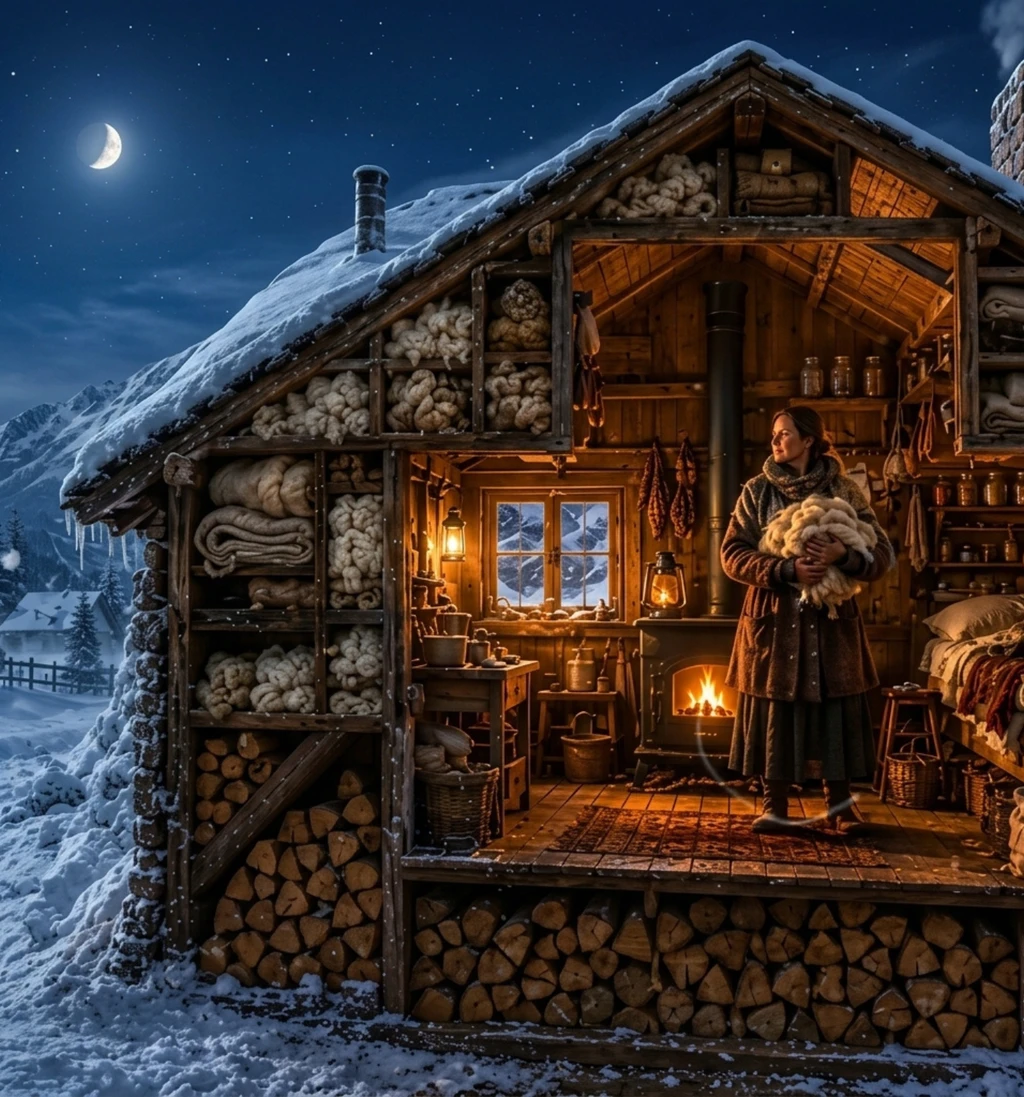
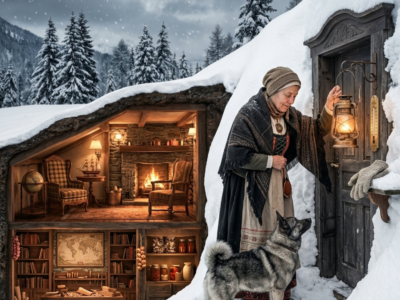
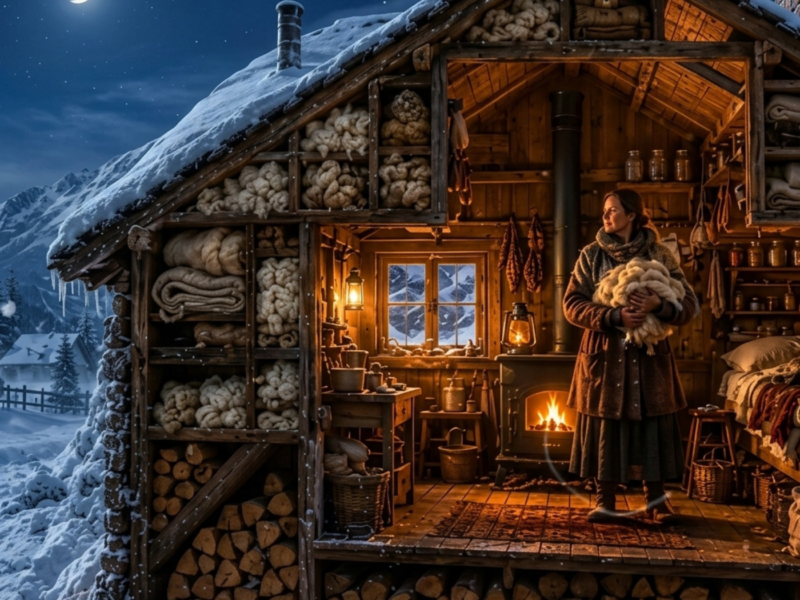
Inside Elspeth Kincaid’s cabin, however, there was a strange and profound peace. The shrieking of the wind was a dull distant roar, a beast raging against walls it could not breach. The stove was not glowing red; a small steady fire of just two logs provided gentle, sufficient heat. Elspeth sat at her small table mending a tear in Thomas’s trousers, her movements calm and unhurried. The children, instead of huddling near the fire, played on a blanket in the middle of the floor, their faces flushed with warmth.
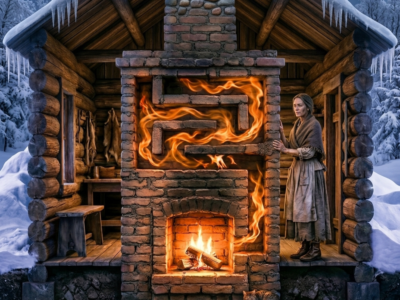
The air was not hot and dry near the stove and freezing by the walls. It was an even, consistent temperature throughout the small room. The massive wall of wood and mud, warmed by the stove, was now doing its slow, silent work, radiating a gentle, persistent heat back into the space, holding the precious warmth she made in a firm embrace. There was no draft. There was no frantic stoking of the fire. There was only the quiet hum of a system in perfect balance.
For three days, the blizzard raged. The snow piled in prodigious drifts, burying fences and outbuildings, erasing the very shape of the landscape. For three days, Elspeth and her children lived in their warm, quiet bubble. She cooked their meals, read to them from the family Bible, and listened to the storm’s muffled fury with a sense of calm detachment. She was not fighting the winter; she had simply refused to let it in.
On the morning of the fourth day, she awoke to an absolute silence. The wind had finally died. The world outside was hushed, buried under a thick blanket of white. She rose from her bed, her breath not misting in the air, and moved to the door. It took considerable effort to shove it open against the drift that had piled against it. When she finally managed to push it a foot wide, the truth of her accomplishment struck her with the force of a physical blow.
A wave of brutally cold air washed into the cabin’s entrance, so frigid it felt like a solid thing. Outside, the world was a landscape of blinding white under a sky of impossible, piercing blue. The temperature, she knew, must be well below zero. She stood on the threshold, one foot in the biting, painful cold of the outside world, and one foot in the gentle, stable warmth of her home. The contrast was staggering. It was the definitive sensory proof.
She closed the door, shutting out the harsh reality of the Wyoming winter, and leaned against it for a moment, a slow smile spreading across her face. She walked to the inward-facing wall of firewood and placed her palm flat against it. It was warm, not hot, not even close, but distinctly, tangibly warm to the touch. The wood was breathing heat. The stored energy of her small, efficient fire was held within the very walls of her home, a reservoir of comfort against the vast, indifferent cold.
It was two days later when she saw a figure struggling through the massive drifts toward her cabin. It was Amos Kelleher. He moved slowly, his body bent against the cold, his breath a ragged plume of steam. He was not checking on her out of simple concern; she knew that. He was coming, most likely, to confirm his own grim predictions, to find her and the children huddled under blankets, their fire gone on the verge of freezing.
He reached her door and pounded on it, not with the politeness of a neighbor, but with the urgency of a rescuer. Elspeth calmly unlatched the door and pulled it open. The effect on Amos was immediate and dramatic. The wave of warm, still air that washed over him made him physically recoil. He stared at her, his face a mixture of disbelief and astonishment, his beard and eyebrows caked in ice.
“My God, Elspeth,” he stammered, his eyes wide as he looked past her into the cozy, well-lit cabin. He saw Lydia and Thomas playing on the floor, wearing simple shirts, not bundled in layers of wool. He saw the small, calm fire in the stove. He saw the smooth, solid wall of wood and mud. He stepped inside, drawn by the impossible warmth, and for a long moment, he was silent, simply turning in a slow circle, taking it all in.
The evidence of his senses was in direct, violent contradiction with a lifetime of experience. He finally looked at her, his expression stripped of all its former certainty. “It’s warm in here,” he said, the words an admission of utter defeat. “Truly warm. My stove has been burning day and night since the storm began. We’ve been huddled around it, and the back of the house is still cold enough to freeze water. We’ve burned through half our winter wood already.”
Elspeth did not gloat. The quiet vindication she felt needed no outward expression. “The heat doesn’t escape,” she said simply. “The wool holds it in. And the wood wall holds the warmth from the stove and gives it back slowly.” She explained the principle again, but this time, he did not squint with incomprehension. He listened.
He walked over and laid a hand on the wall, just as she had done, and felt the gentle radiant warmth. He shook his head, a gesture no longer of pity, but of profound, grudging respect. “I called you a fool, Elspeth,” he said, his voice low. “To my wife, to Hiram Poole, to anyone who would listen. I was wrong, plain wrong.” It was the most profound apology he was capable of, and it was more than enough.
That afternoon, he sent his oldest boy over with a quarter of a butchered hog, not as charity, but as a clear and public acknowledgment of her success. The story of Elspeth Kincaid’s warm cabin spread faster than gossip ever had, for it was carried not by whispers, but by the testimony of a man who had felt the proof with his own hands. Others came, first out of curiosity, then out of a desperate need to learn. She showed them the construction, explained her father’s logic.
Constance Hartwell was among the first to visit, and she looked at Elspeth’s work not with surprise, but with a deep, knowing smile of affirmation. She saw the elegant solution for what it was, a triumph of observation and intellect over brute force and tradition. That next summer, no fewer than five families in the valley built new cabins or retrofitted their old ones with what came to be known as a Kincaid wall.
They found they burned less than half the wood they had in previous winters, and their homes were quieter, safer, and immeasurably more comfortable. Elspeth Kincaid lived in that cabin for another 40 years. Her children grew up and built their own homes nearby, both with thick insulated walls of their own design. The principle, once understood, was adapted and improved upon. Some used sawdust or even cattail fluff as insulation. Others built with a double wall of logs from the start, packing the space between them.
But the core idea remained the same: do not feed the winter. Elspeth’s innovation, born from a shipwright’s wisdom and a widow’s quiet determination, fundamentally changed the way people survived in that harsh country. The cabin itself stood for nearly a century, a testament to a woman who, when faced with the overwhelming force of a Wyoming winter and the crushing weight of community doubt, chose not to listen to either. Instead, she had listened to the memory of her father, and in doing so, had built a legacy of warmth that was passed down for generations.
And as the years passed, the story of Elspeth Kincaid became more than just a tale of survival; it became a beacon of hope, a reminder that ingenuity and resilience could triumph over adversity, even in the harshest of winters.