(Part 2) She Found Hidden Stairs Beneath Her Barn Floor — What Was Below Changed Her Entire Winter
(Part 2) She Found Hidden Stairs Beneath Her Barn Floor — What Was Below Changed Her Entire Winter
.
.
She had not looked at it in years. Rising with renewed purpose, she went to the large, battered trunk at the foot of her bed. Her fingers, numb with cold, fumbled with the latch. Lifting the heavy lid, she found the journal beneath her wedding dress and a set of Yakob’s folded shirts. Opening it, the pages smelled of dried lavender and thyme.
She turned past the recipes for fruit soup and pickled herring, past the pressed flowers and poems about the sea. Then she found it: a section titled, in Danish, Jordvarmehus, or earth heat house. It contained sketches, cross-sections of structures dug deep into the ground, notes on soil depth and insulation, and discussions of something she called thermal banking and sunken rooms.
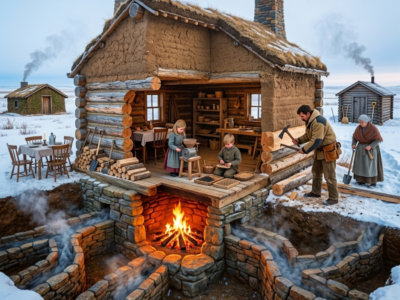
One drawing showed a long, narrow pit dug 8 ft into the earth with a sloped, glazed roof facing south. Another depicted a small subterranean room connected by a tunnel to a main house, a place for storing vegetables that would never freeze. Her grandmother had written, “The ground below the frost line is a constant friend. It holds the memory of summer’s warmth. It does not freeze. It does not steal your heat; it shares it.”
Alara stared at the drawings, her heart beginning to beat with a rhythm that was no longer just about survival but about a wild, audacious idea. She looked from the journal to the window at the vast, darkening prairie. Then her gaze fell upon the half-finished barn. Yakob had completed the frame and roof, a sturdy structure meant to shelter animals they had not yet bought.
The floor, however, was just packed earth. He had planned to lay planking before winter, but the fever had come first. A barn with a dirt floor, a place to start digging. A new kind of logic began to form in her mind, a logic borrowed from her grandmother. Blackwood’s logic was about fighting. This was about yielding. It was not about building thicker walls against the cold but about burrowing beneath it.
She traced the diagram of the sunken room with her finger. It looked like a grave or a womb. She would not sign Blackwood’s paper. She would not take his train ticket. She would not surrender her home. She would trust the earth. She would trust her grandmother.
That very night, she began her work. Her first task was to find the spot. The barn was a dark, cavernous space, smelling of raw pine and cold soil. Holding a lantern high, she walked its length. The ground was uneven, packed down by their boots in the summer rains. Near the center, a section of the floor felt different, looser. Yakob had mentioned an old root cellar from the previous homesteader, long since collapsed and filled in.
He had planned to dig it out again one day. She knelt, the lantern light pooling around her. The soil was firm, but not frozen solid, protected by the barn’s roof. She drove the tip of a shovel into the ground. It bit in with a satisfying crunch. She dug a small test hole, and a few feet down, the shovel struck something hard. Not a rock, but wood.
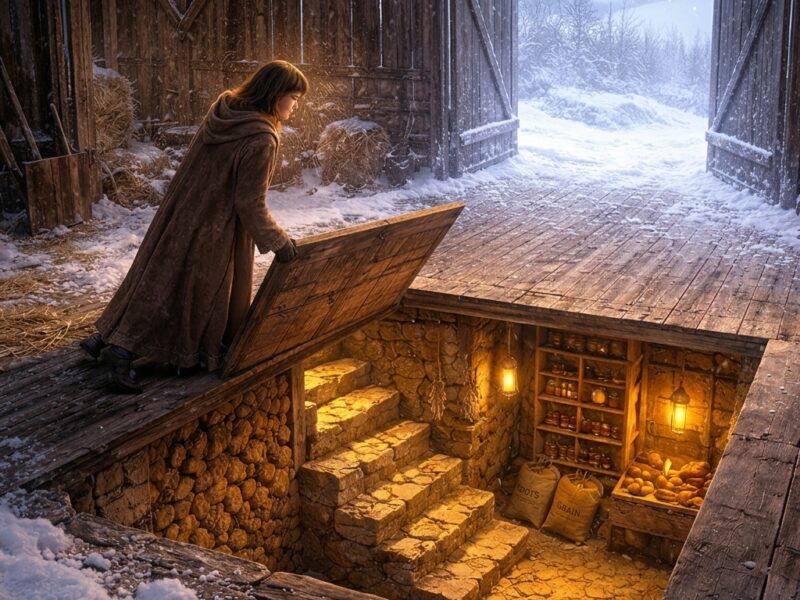
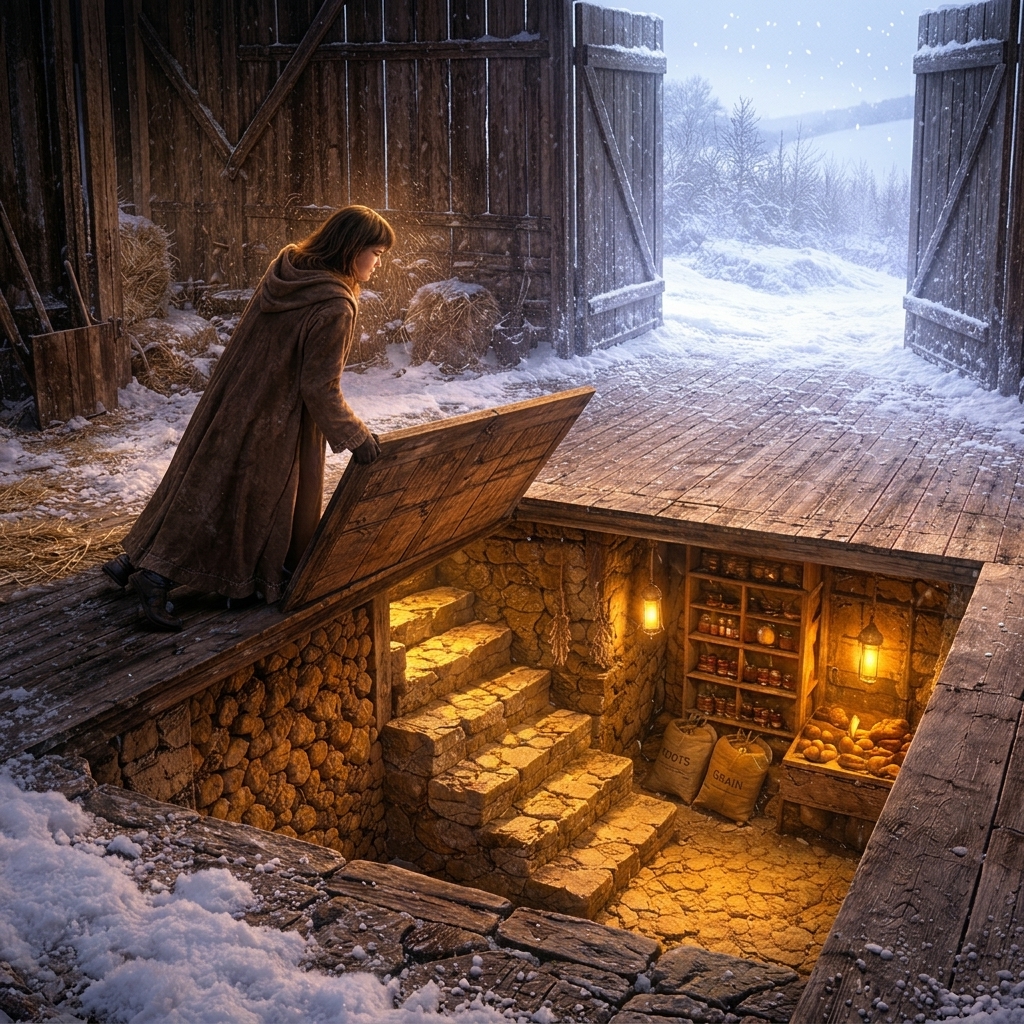
With frantic energy, she widened the hole, her breath pluming in the cold air. Soon, she uncovered the edge of a heavy plank, and then another next to it. It was a door, a heavy cellar door laid flat and covered with years of dirt and debris. She worked for an hour, scraping and digging until she had cleared the entire outline of a large rectangular trapdoor. It had no handle, only a thick iron ring, rusted and half buried.
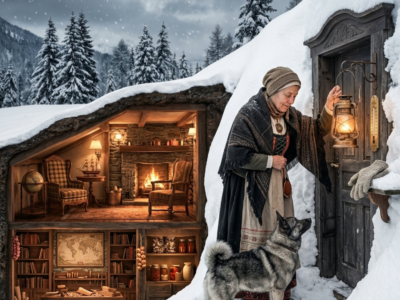
She slipped her fingers through the ring, her muscles straining. It wouldn’t budge. She pounded on it with her fist, the sound a dull thud. “Hello?” she croaked, her voice a frozen rasp. There was a scraping sound from below, and the slab slid sideways. A wave of warm, clean air washed over her face. It was not the hot, dry air of a stove, but a gentle warmth that smelled of earth, of baked bread, and of life.
A face appeared in the opening. It was Alara. Her hair was tied back, her cheeks rosy. She wore a simple dress, no coat, no shawl. She looked at him, her eyes wide with surprise, not fear. “Mr. Blackwood?” He could only stare. It was impossible. He was standing in a maelstrom that was freezing the world to death, and he was looking down into a scene of impossible, tranquil warmth.
He could see a small, neat room behind her, lit by the soft glow of a lantern. He could see a blanket on a bed, a book lying open. He could smell bread. He had not prepared for the smell of fresh bread. “How?” he whispered, the sound cracking in the frozen air. It was the only word he could manage. It contained all his confusion, his defeat, his terror, and his yawning, world-shattering awe.
“Come down,” she said, her voice calm and even. “You will freeze to death up there.” He half slid, half fell down the stone steps, landing on the warm stone floor of her sanctuary. The transition was dizzying. Above, a world of screaming chaos. Below, a world of profound peace.
The temperature was a perfect, comfortable warmth. There was no wind. The only sound was the faint, distant howl of the blizzard, a muffled roar that seemed a world away. He stood there, a giant, snow-crusted refugee, dripping melted snow onto her floor, shaking not just from cold but from the complete demolition of his reality. He looked around the small chamber. It was a miracle.
A tiny, self-sufficient world carved out of the earth. “My family,” he finally managed to say, his teeth chattering. “My house, the fire, it’s not enough. The wood is gone.” Alara looked at him, and for the first time, he saw not a defiant girl but a woman of immense, quiet strength. There was no triumph in her eyes, only a deep, sorrowful compassion.
She nodded. “Bring them here.” It was the most profound surrender of his life. He, Silas Blackwood, the master builder, the titan of timber and iron, was reduced to begging for shelter in a woman’s dirt hole. He climbed back up the stairs, back into the hell of the storm, but this time, he was not driven by desperation. He was guided by a sliver of impossible hope.
He made the journey back, a man possessed. He burst into his own frozen house and told his terrified wife to gather the children. He did not explain. There were no words for what he had seen. He wrapped them in the last of the blankets, tied them together with a rope, and led his small, freezing family out into the white death, back toward the barn.
That night, Silas Blackwood, his wife, and his two children huddled in the impossible warmth of Alara’s cellar. They ate the fresh bread she had baked. They drank water that was cool but not frozen. They listened to the storm rage above them, a beast locked out of their sanctuary. Blackwood sat on a small wooden crate, his head in his hands.
He was a man broken and remade. Everything he knew, everything he had built, everything he had preached, was wrong. His fortress of logs and iron had been a tomb. Her earthen womb was an ark. The blizzard raged for three days. On the fourth day, the wind died, and a strange, brilliant silence fell over the land.
The world was transformed, buried under a dozen feet of snow, sculpted into alien shapes. When the survivors emerged from their homes, they found a landscape of devastation. Many had not survived. Cabins were found frozen solid, their owners dead around their cold stoves, their wood piles exhausted. The story of Silas Blackwood’s survival, and that of his family, spread like wildfire.
It was a story no one could quite believe. They had survived in the folly of the widow Alara. A small party of men, led by Reverend Miller, made their way to her farm, digging a tunnel through the massive drifts. They expected to find a horror. Instead, they found the Blackwood family emerging from the barn, blinking in the bright sun, alive and well.
They found Alara, calm and composed. And when they descended into her cellar, they fell silent. They stood in the warm, dry space, touching the stone walls, feeling the gentle heat radiating from the floor. And they understood. They’d all been fighting the winter on the wrong battlefield. Silas Blackwood stood before them, his face haggard, but his eyes clear.
“She was right,” he said, his voice quiet, but carrying in the still air. “We were the fools. We built our homes in the teeth of the wind. She used the earth as her blanket. She did not fight the cold. She bargained with it.” It was a public admission, a complete recantation of a lifetime of certainty. It was the death of an old way and the birth of a new one.
In the weeks that followed, Alara was no longer an outcast. She was a sage. Her farm became a place of pilgrimage. Men who had mocked her now came to her, hats in hand. Their pride buried under the snows of the great blizzard. They did not come with pity. They came with questions. “How?” they would ask, the same word Blackwood had uttered, but now filled with respect instead of disbelief.
And Alara, with her grandmother’s journal in hand, would teach them. She showed them the principles of thermal mass, of insulation, of passive solar gain. She explained the simple, elegant physics of her earthen sanctuary. She was not boastful. She was a teacher, sharing a forgotten wisdom that had saved them all.
Silas Blackwood became her most devoted student. He tore up the deed to her land, publicly asking for her forgiveness. He abandoned his grand designs of timber and iron and dedicated himself to learning and promoting the principles of what they came to call the Alara method. Using his influence and resources, he helped other families retrofit their homes, digging new cellars, installing thermal batteries, and orienting new structures to the sun.
The folly became the standard. The landscape of the territory began to change. New homes were built lower to the ground, with deep, warm cellars and south-facing windows. Barns were prized not just for the shelter they offered animals, but for the access they provided to the stable warmth of the earth. The ravenous iron stoves were used more sparingly, as supplements rather than primary sources of heat. The vast woodpiles began to shrink. The community learned to consume less and conserve more.
They learned to work with the land, not against it. Alara never remarried. She did not need to. She had found a different kind of partnership with the earth itself. Her home became the heart of the community, a place of learning and warmth. She lived a long life, her eyes remaining as clear as a winter sky. Her hands, though calloused, never still.
She became the Oma Katrina of her adopted land, a keeper of the wise, quiet ways. Years later, when her own hair was white as snow, she would sit with the children of the children she had saved, telling them the story of the great white death of 1888. She would tell them of a time when people believed the only way to survive was to build a bigger fire, to shout louder at the storm.
“The earth is not your enemy,” she would tell them, her voice the soft echo of her grandmother’s. “It is your blanket. You only have to know how to pull it up to your chin.” And they, living in their warm, semi-subterranean homes, would listen, understanding that the greatest strength was not to be found in fighting the storm, but in finding the quiet, steadfast warmth that had been waiting for them all along, just beneath their feet.