(Part 2) Poor Widow Began Carving Shelves Into a Cave Wall — Until She Turned It Into a Perfect Home
(Part 2) Poor Widow Began Carving Shelves Into a Cave Wall — Until She Turned It Into a Perfect Home
.
.
Part 2: The Strength of the Hollow
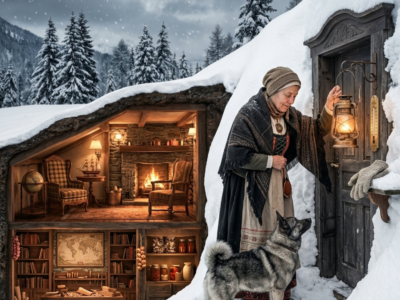
Everett Cole stood at the entrance of the hollow, his expression a mixture of surprise and admiration. The smoke curling from the opening spoke of warmth and life, a stark contrast to the doubts that had surrounded Ingred Halverson since she had taken up residence in the hillside. As he stepped inside, the air was thick with the scent of wood smoke and the earthy aroma of stone, a testament to Ingred’s hard work.
“Looks like you made it through,” he said, placing his hand against the southern wall, feeling the warmth radiate from the stone. “I didn’t expect to find you here, let alone in good spirits.”
Ingred managed a weary smile, relief flooding through her. “I couldn’t leave, not when I’ve come this far.” She gestured to the shelves she had carved into the back wall, filled with jars of preserved vegetables. “I’ve been learning from the land. It has its own way of doing things.”
Everett nodded, his eyes scanning the hollow. He had ridden by countless times, witnessing the skepticism of the valley’s residents, and now he found himself questioning his own assumptions. “You’ve done well,” he admitted, his voice softer. “I see that now.”

As the two spoke, Peter emerged from the back of the hollow, rubbing sleep from his eyes. “Is it morning, Mama?” he asked, his voice still thick with slumber.
“Yes, sweetheart,” Ingred replied, her heart swelling at the sight of her son. “We made it through the storm.”
Peter’s face lit up with a smile, and he rushed to her side, finding comfort in the warmth of the hollow. Ingred watched him with pride, knowing that every decision she made was for him. The valley had doubted her, but she was determined to raise her son in a place that felt like home, even if it was just a hollow in the rock.
As the days turned into weeks, the storm faded into memory, but the challenges of winter remained. Ingred and Peter settled into a routine, with Ingred working the stone during the day while Peter played nearby. She continued to learn from the hillside, studying the way the sun moved across the walls and how the wind shifted in the afternoons.
One afternoon, while carving another shelf, Ingred heard a knock at the entrance. She wiped the sweat from her brow and turned to find Berta Lindfist standing there, a jar of preserves in hand. “I thought I’d find you here,” Berta said, stepping inside. “I wanted to see how you were holding up.”
Ingred welcomed her in, grateful for the company. Berta had lost her husband years earlier and had rebuilt her life with resilience and determination. As they talked, Ingred felt a connection to her, a shared understanding of the struggles they faced as widows on the frontier.
“You’ve done an impressive job with this hollow,” Berta remarked, examining the shelves and the way the sunlight spilled into the space. “I’ve heard the whispers in the valley, but I’m not here to judge. I wanted to see for myself.”
Ingred felt a weight lift from her shoulders. “Thank you, Berta. It means a lot to hear that.” She shared her journey, the doubts she faced, and the lessons she had learned from the land. Berta listened intently, nodding in agreement as Ingred spoke of the warmth that radiated from the southern wall and the way the hillside seemed to guide her.
As the weeks turned into months, more neighbors began to visit. They came out of curiosity, drawn by the stories of the widow who had carved a home from stone. Each visitor brought a new perspective, sharing their own experiences of loss and resilience. Ingred found strength in their camaraderie, and as she opened her heart, she discovered a community that had once seemed distant.
But as winter wore on, the challenges grew. Food supplies dwindled, and the isolation of the hollow began to weigh heavily on Ingred. She worried about providing for Peter, and the fear of failure crept back into her mind. One evening, as she prepared a meager supper, she sat at the entrance, watching the snow fall outside. The world was silent, and the weight of uncertainty pressed down on her.
Just then, Everett rode up the hillside, his silhouette framed against the fading light. He dismounted and approached the hollow, a small bundle tucked under his arm. “I thought you might need this,” he said, handing her the bundle. Inside were provisions—flour, salt, and a few jars of preserved meat.
Ingred’s heart swelled with gratitude. “You didn’t have to do this,” she said, her voice thick with emotion.
“I know,” he replied, his gaze steady. “But I wanted to help. You’ve shown a strength that deserves support.”
As they talked, Ingred felt a shift in their relationship. The skepticism that had once clouded his judgment began to fade, replaced by a newfound respect. She shared her fears and hopes for the future, and he listened, offering encouragement and understanding. In that moment, the hollow transformed from a mere shelter into a sanctuary of connection.
As spring approached, the snow began to melt, revealing the earth beneath. The hollow, once a place of struggle, became a symbol of resilience and hope. With the help of her neighbors, Ingred expanded her garden, planting seeds that would yield fresh vegetables in the coming months. She learned to adapt, to embrace the challenges that came with each season.
One sunny afternoon, as Ingred tended to her garden, she felt a sense of peace wash over her. The warmth of the sun on her back, the laughter of Peter playing nearby, and the vibrant colors of the flowers brought her joy. She had carved out a life for herself and her son, one that was filled with love and purpose.
As the days turned into weeks, the valley began to change. The stories of Ingred’s resilience spread, and more families sought her wisdom. They came to learn about the lessons she had gleaned from the hillside, about how to build a home that embraced the land rather than fought against it. Ingred became a source of inspiration, a beacon of hope for those who had once doubted her.
And as the first blossoms of spring emerged, Ingred Halverson stood at the mouth of the hollow, her heart full of gratitude. She had faced the storm and emerged stronger, not just for herself but for her son and the community that had rallied around her. The hollow, once a symbol of loss, had become a testament to the power of resilience, love, and the unyielding spirit of a woman determined to carve out her own destiny.
As the sun dipped below the horizon, casting a warm glow over the valley, Ingred knew that her story was far from over. The hollow held the promise of new beginnings, and with each passing day, she would continue to learn, grow, and thrive in the embrace of the land she had come to call home.