(Part 2) Neighbors Laughed When She Built a Stormproof Stone Shelter — Until It Saved Her During Snowstorm
(Part 2) Neighbors Laughed When She Built a Stormproof Stone Shelter — Until It Saved Her During Snowstorm
.
.
Part 2: The Beacon
Inside the shelter, the air smelled of ozone and antiseptic. Helen stripped off her frozen layers, trembling from adrenaline and the painful rush of blood returning to her extremities. She dragged Tom closer to a geothermal heating vent. The ambient temperature was a steady 72°F, but Tom’s core temperature was dangerously low.
Helen worked with the efficiency of a combat medic. She cut away his frozen jeans, exposing the deep laceration on his calf. The cold had clamped his blood vessels shut, preventing him from bleeding out. But as he warmed up, that would change. She flushed the wound with saline, pulled the shard of glass free, and sealed the edges with medical-grade superglue before wrapping it tightly in gauze.
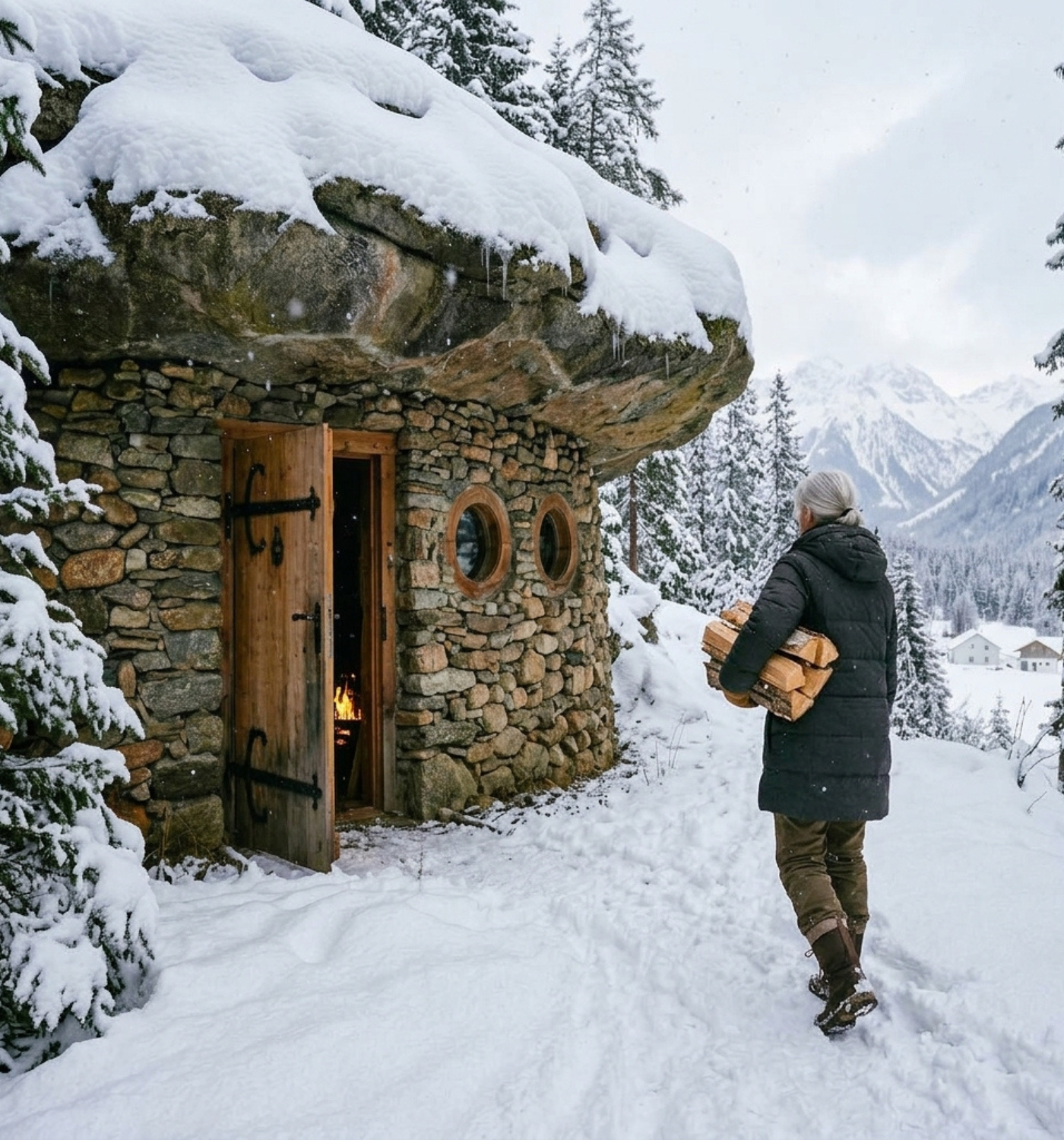
Next came the rewarming. She couldn’t put him under hot water; it would shock his heart. Instead, she packed his armpits, groin, and neck with chemical heating pads wrapped in towels and forced him into a heavy sleeping bag. For an hour, the only sound was Tom’s ragged breathing.
Finally, he coughed, a harsh rattling sound. His eyes fluttered open, glassy and unfocused. “Helen,” he rasped. “Don’t try to move. You have a lacerated calf and severe frostnip,” she instructed, monitoring his condition closely.
Tom blinked, the memories of the imploding window and the suffocating whiteout crashing down on him. “My house,” he whispered, realization hitting him like a blow. “It’s gone. The glass just vanished.”
“The thermal shock shattered the structural integrity,” Helen replied flatly. “Your fireplace couldn’t vent the heat fast enough.”
Tom squeezed his eyes shut, a tear freezing on his cheek. “Helen, I’m so sorry. I called you crazy.”
“You did,” she agreed. “But an apology won’t change the barometric pressure outside. Save your energy. You’re alive.”
Tom gasped, trying to sit up. “What about Brenda and the Harrisons?”
Helen stiffened. “What about them?”
“Brenda sent a message to the Pine View group text. Her roof is buckling. She said she was going to make a run for the Harrison’s house at the end of the cul-de-sac. Ryan and Clare have a generator.”
Helen felt a knot form in her stomach. “Did she make it?”
“I don’t know,” Tom panted. “The text didn’t go through, but Ryan’s generator is exposed. In this wind, the intake valves will be choked with ice in 20 minutes.”
“If Brenda went there and the generator died…” Helen finished. “They’re freezing to death.”
Helen walked to a heavy red switch box mounted on the wall. She flipped a protective cover and engaged two heavy toggle switches. Outside, a mechanized housing snapped open. A high-intensity strobe light erupted to life, pulsing a blinding flash that pierced the swirling snow. A maritime foghorn powered by a compressed air tank blasted a 150-decibel warning into the valley every ten seconds.
“If their house is failing, they have to move,” Helen said, staring at the switchboard. “If they step outside, they’ll see the strobe. They’ll hear the horn. It’s their only chance.”
Minutes passed, but no one came. Tom had propped himself up, drinking warm broth Helen had given him. “They aren’t coming,” he said quietly. “Brenda wouldn’t leave her house. She cares too much about her things.”
“When the cold hits your bones, you stop caring about your things,” Helen replied, never taking her eyes off the monitor.
Thirty minutes later, a shadow flickered across the airlock camera. Helen leaned closer. Four distorted shapes stumbled into view, huddled together under a heavy rug. They moved slowly, crawling toward the pulsing light of the strobe.
Helen ran to the airlock, throwing the heavy bolts. She yanked the blast door open. The wind violently shoved the group inside. They collapsed onto the concrete floor in a tangle of frozen limbs and soaked fabric.
Brenda lay gasping for air, her hair frozen into a solid block of ice. She was missing a glove, and her right hand was bloodless white. Next to her, Ryan and Clare Harrison were huddled over a small bundled shape.
“He’s not waking up,” Ryan sobbed, his face covered in frostbite blisters. “Leo stopped shivering 20 minutes ago.”
The silence that followed was heavier than the concrete above their heads. Helen dropped to her knees beside the boy, pressing two fingers against his carotid artery. The pulse was there, but it was dangerously erratic—perhaps 20 beats a minute.
“Listen to me and do exactly as I say,” Helen commanded, her voice cutting through the chaos. “He is in profound stage three hypothermia. If we warm him up too fast, the cold acidic blood from his arms and legs will rush back to his heart. We have to warm his core and only his core.”
Ryan and Clare stared at her, paralyzed by shock. “Take off your outer layers. Strip down to your base layers. Now!”
She ran to her supply cache and dragged out a double-occupancy expedition sleeping bag rated for -80°F. “Get in both of you. We are going to use skin-to-skin contact. It’s the only safe way to transfer gradual controlled heat.”
As the terrified parents scrambled into the sleeping bag, Helen carefully lifted Leo’s rigid body. She stripped off his frozen clothes, placing him between his parents and zipping the heavy down bag up to his chin, leaving his arms and legs outside to prevent rapid dilation of peripheral blood vessels.
“Wrap your arms around his chest and back,” Helen instructed.
Across the room, Brenda huddled against the wall, weeping silently. Tom, still immobilized, watched with wide, haunted eyes. Helen grabbed a basin and filled it with lukewarm water from her geothermal tap, setting it next to Brenda.
“Put your hand in there,” she said softly. “Do not rub the skin. Just let the water thaw the tissue. It’s going to hurt worse than anything you have ever felt, but if you rub it, you will destroy the cellular structure.”
Brenda looked up, mascara running down her frozen cheeks. “I’m sorry,” she choked out, lowering her trembling hand into the basin.
The next four hours were a masterclass in psychological torture. The bomb cyclone outside reached its apex, with wind speeds blinking a steady 115 mph. Inside, the shelter held firm. The only sounds were the low hum of the ventilation system, Tom’s ragged breathing, and Brenda’s muffled whimpers.
At 2:00 a.m., Leo’s chest hitched. Ryan gasped. “He moved!”
Helen leaned in with a penlight. Leo’s eyelids fluttered. A violent full-body shudder ripped through him. “The return of the shivering reflex means his hypothalamus has rebooted,” Helen said, relieved.
“Mommy, it burns,” Leo cried weakly.
“I know, baby. I know,” Clare sobbed, burying her face in his hair. “I’ve got you. You’re safe.”
Helen sat back on her stool, letting out a long breath she felt she had been holding since she first walked into the whiteout. She looked up and met Tom’s gaze across the room. He gave her a slow, trembling nod of gratitude.
They spent the next 36 hours sealed inside the bunker. Helen cooked hot meals, and they drank filtered water. Nobody mentioned property values or the homeowners association.
On Thursday morning, the barometric pressure dial on the wall began to tick upward. The roar of the wind faded into a high-pitched whistle and then to silence.
Helen walked to the monitor bank. The exterior cameras were encased in ice, rendering the screens opaque. “It’s over,” she announced, walking to the airlock. Ryan supported a limping Tom and Brenda, whose hand was heavily bandaged.
Helen disengaged the heavy steel latches. With the combined strength of Ryan and Helen, they pushed the blast door open against the massive snow drift blocking the exit.
When the sunlight poured into the airlock, it was blinding. They stepped out into a frozen wasteland. Ten-foot snow drifts buried the roads. Ancient pine trees had been snapped in half. Tom’s mansion was a skeletal ruin, the roof collapsed under the weight of ice.
Brenda’s sprawling chalet fared no better; the exterior walls had buckled, exposing the frozen interior to the sky. The Harrison’s home was invisible, swallowed by a massive snowbank