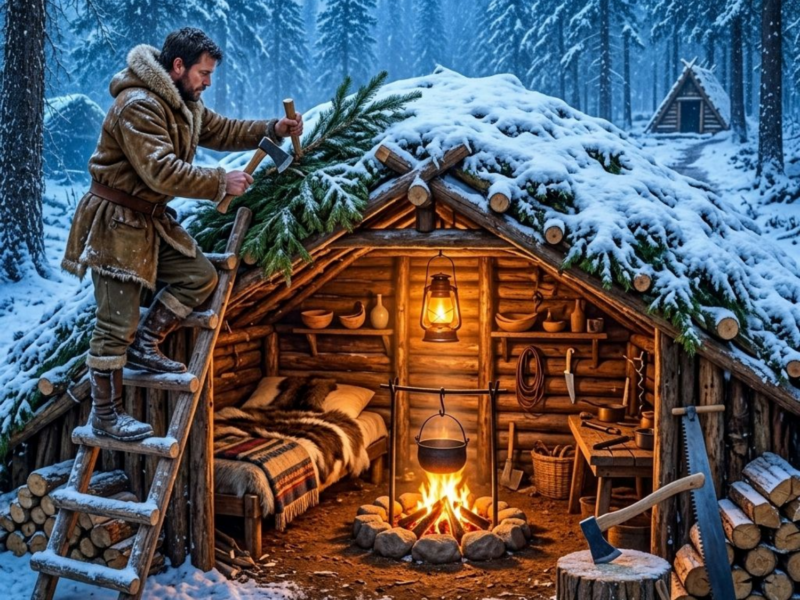
(Part 2) He Wove Branches Over His Shelter So Snow Couldn’t Fall Through — Then the Deadliest Winter Hit
(Part 2) He Wove Branches Over His Shelter So Snow Couldn’t Fall Through — Then the Deadliest Winter Hit.
.
.
Part 2: Beneath the Weight of Winter
By late November, rumors began spreading through Mercer’s Run faster than the cold itself. The barometer dropped so quickly that old men in the trading post stopped talking whenever they looked at it. Geese flew low across the valley in broken, uneven lines. Heavy wet clouds gathered beyond the northern pass and stayed there for days without moving. People started preparing in the ways they understood. Extra beams were nailed beneath barn roofs. Livestock disappeared into crowded shelters. Men chopped and stacked wood until after dark, while hammers echoed across the valley from sunrise to nightfall.
Up on Black Elk Pass, Vern prepared differently. He built woven drift fences beyond the shelter to redirect snow where he wanted it to collect. He buried extra cedar beneath a ground tarp lined with shale. Every outer seam in the roof was sealed with frozen moss, packed by hand into the smallest openings. The mountain had gone quiet in the way predators sometimes do before they move.
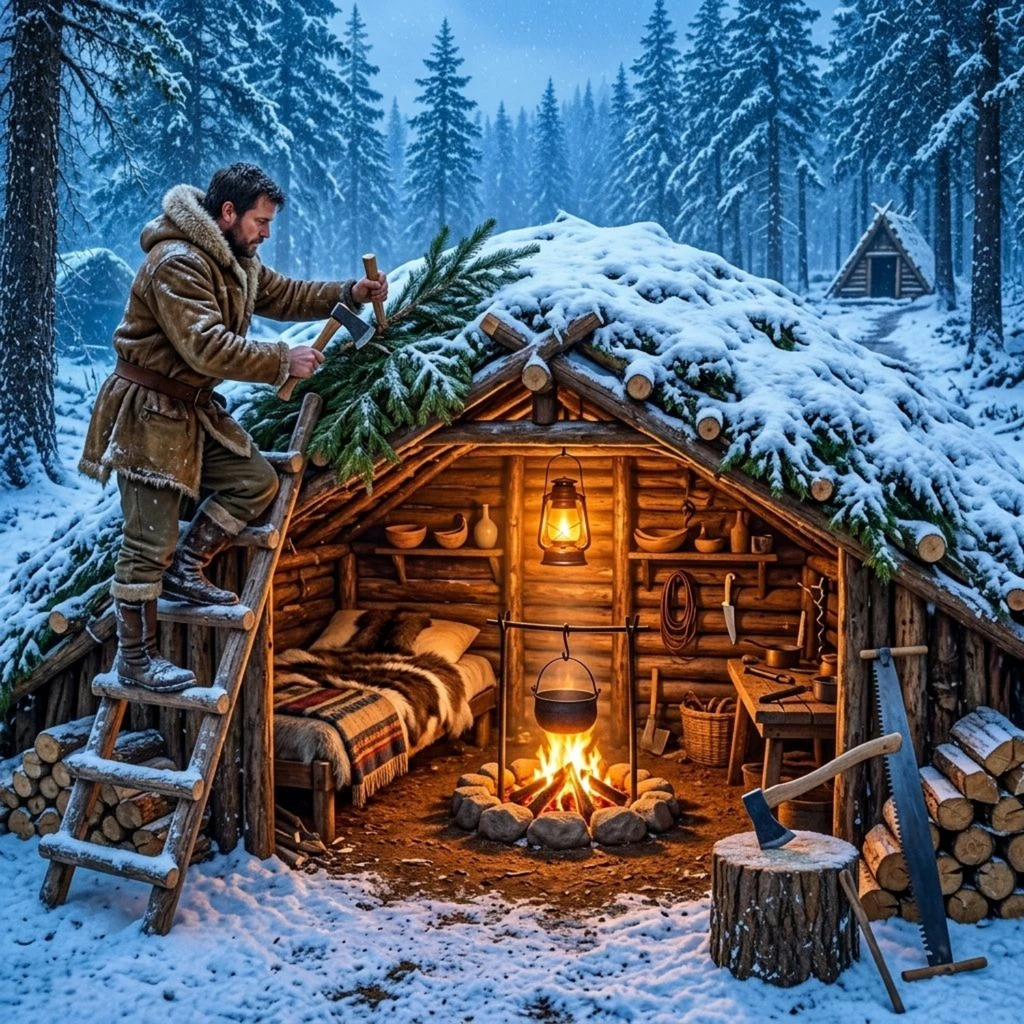
The first wet snow arrived earlier than anyone expected. It came heavy, dense, half water already. Near midnight, part of the outer weave sagged under the sudden load. One living side beam twisted downward hard enough to pull several rawhide bindings loose beneath the sod covering. Vern and Clara crawled onto the roof immediately with lantern light shaking through the storm. The snow was already knee-deep. They hacked away excess drift with short, desperate swings while freezing slush soaked through their gloves and sleeves.
Vern pulled fresh cedar lengths into the damaged section and lashed them tight beneath the strain beam using rope fibers stiff with ice. Below the ridge, Ephraim Cutter spotted their lantern moving through the storm. From a distance, the roof looked ready to collapse. He was certain the mountain had finally broken them. Then Clara slipped near the drift edge when the snow beneath her knee gave way. For one terrible second, the storm almost took her off the slope entirely. Vern caught her by the arm before the ridge could finish the decision for itself.
Then suddenly everything became still. No wind moved through the cedar. No branches creaked overhead. Even the animals vanished from the ridge as though something unseen had passed among them during the night. The silence spread across Black Elk Pass like a warning. Vern checked the split vent twice before sunset. He hung an extra blanket across the entrance tunnel to trap heat and leaned the shovel beside the doorway where he could reach it quickly if the drift buried them in. Clara sat quietly near the fire pit, watching the low orange light move across the shale walls. Outside, the mountain waited.
“Do you think it’ll hold?” she finally asked. Vern looked up toward the woven ceiling, hidden beneath sod, moss, and frozen snow. “It only has to hold longer than the storm.” Neither of them spoke after that. The silence beyond the shelter had become worse than the wind ever was.
The iron winter arrived before dawn, not as falling snow at first, but as a white wall swallowing the ridge from one end of the pass to the other. Wind slammed into Black Elk Pass hard enough to shake the cedar canopy beneath its layers of saw and frozen moss. Wet snow followed behind it in thick, relentless sheets, packing against every surface it touched before freezing solid into crusted ice. The temperature collapsed within hours. Streams locked shut beneath gray skin. Tree limbs cracked in the darkness like rifle shots. Entire drifts shifted across the mountain under the force of the gale.
And down in Mercer’s Run, the old ways began failing one after another. A barn roof folded inward beneath soaked snow before noon. Men climbed onto houses with axes to hack weight from the rafters while the wind tried to throw them into the street below. Chimneys froze closed. Smoke backed into bedrooms. Livestock died standing in crowded pens before the second night had fully passed. The storm moved faster than repairs, faster than strength, faster than pride.
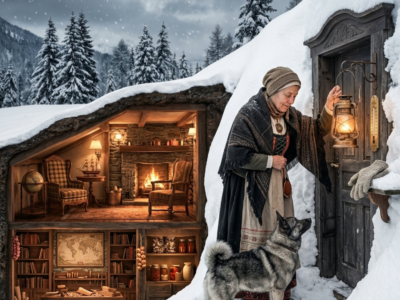
But beneath the ridge, inside the woven shelter buried deeper beneath every passing hour, a different world existed. The drift piling above the cedar canopy smothered the wind instead of feeding it. Sound changed first. The violent roar outside became distant and muffled beneath the growing snowpack overhead. Then the temperature stabilized. The fire trench glowed steadily through the darkness while trapped earth warmth held close along the shale walls and raised sleeping shelf. The deeper the drift became, the less heat escaped, exactly as Vern believed it would. Ice sealed the outer layers of snow together until the shelter sat hidden beneath a frozen shell thick enough to block most of the mountain’s fury from reaching them directly.
Several times through the night, Vern pressed his hand against the ceiling supports, expecting movement. The woven beams held, the drift held, the mountain itself seemed to settle around them instead of against them. And somewhere beyond the storm, cabins built tall and proud continued breaking apart beneath the same weight now protecting the little shelter hidden under the ridge.
The deeper the storm buried them, the warmer the mountain seemed willing to let them remain. By the fifth day, the entrance tunnel had narrowed to little more than a crawl space packed tight with drifted snow. Vern woke before sunrise and began digging upward with the shovel resting beside the doorway. The snow above them had hardened into layers, so dense they cut free in heavy blocks instead of powder. Each strike echoed dully through the buried shelter like work beneath deep water.
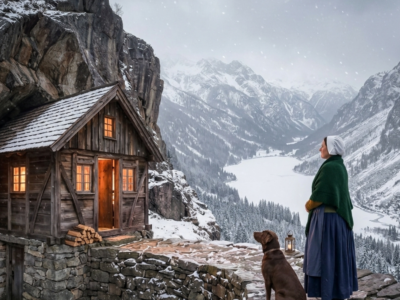
When he finally broke through to open air, cold light flooded down the tunnel. The world outside no longer looked familiar. Mercer’s Run had nearly vanished beneath the snowpack stretching across the valley floor. Barn roofs appeared as uneven white humps. Fence lines were gone entirely. Roads had disappeared under windswept drifts taller than wagons and their shelter. It no longer resembled something built by human hands. Only a smooth white mound remained against the ridge with a thin column of smoke rising from a single dark vent near the top. Alive, breathing inside, the proof surrounded them in quiet ordinary details, far stronger than words.
The butter near the fire trench remained soft enough to spread. The water bucket carried only a thin skin of ice across the surface instead of freezing solid overnight. The shale walls held faint warmth beneath the touch. Vern pressed his palms slowly against the packed earth beside the sleeping shelf while the storm wind moved harmlessly overhead beyond layers of snow and cedar. For the first time since arriving on Black Elk Pass, he understood something impossible to explain to men who only built against nature: the mountain had stopped trying to kill them.
Two days after the storm finally loosened its grip on the ridge, Vern saw movement through the pale white distance beyond the drift field. At first, it looked like nothing more than another shadow moving inside the blowing snow. Then the figure stumbled, collapsed, rose again. Ephraim Cutter was barely recognizable by the time he reached the shelter mound. His heavy wool coat hung torn open across one shoulder. Ice clung thick to his beard and eyebrows. One side of his face had turned gray-white from frostbite, and his eyes squinted against the light with the helpless look of a man half snow blind. He followed the smoke; that was all that brought him there.
Vern dragged him inside without a word. Warm air wrapped around the freezing man almost violently after the cold outside. The glow from the fire trench flickered across the shale walls while meltwater dripped quietly from Ephraim’s frozen coat onto the packed earth floor. For several long moments, he could only stare upward at the woven ceiling, at the buried cedar beams still holding beneath the weight of the mountain above them. When he finally spoke, his voice sounded thin and broken from cold. “I kept cutting against the wind.” The shelter answered with silence and steady warmth.
Ephraim sat near the fire trench for a long time before speaking again. The storm had stripped something out of him along with the feeling in his hands. “How the hell did this hold?” he finally asked. Vern looked toward the buried roof overhead, where the cedar beams curved beneath layers of snow, earth, and ice without breaking. “The mountain already showed us how,” he said quietly. His eyes moved toward the entrance tunnel where the wind groaned somewhere far above them. “Now we were the only fools trying to build against it.”
No triumph lived in the words. No satisfaction, only exhaustion and truth earned the hard way. Ephraim lowered his gaze after that. The same man who once laughed at the woven shelter now sat alive beneath it because the ridge had judged one idea stronger than the other. Outside, the storm still ruled the mountain, but down in the earth beneath the cedar roots, the argument was already over.
Three days later, Jonah Reed led a small rescue party onto Black Elk Pass wearing snowshoes cut from ash wood and rawhide. No one in Mercer’s Run believed they were going to find survivors—not after the iron winter. The men carried shovels, blankets, and a narrow sled meant for bodies frozen too stiff to bend. They moved carefully through drifts that reached chest height in some places, stopping often to catch their breath in the thin, cutting cold. Then Jonah saw the smoke, a thin gray line rising steadily into the pale winter sky. The men stopped where they stood.
Farther ahead, half-buried beneath layers of drifted snow, the shelter remained intact—not broken, not collapsed, hidden so completely within the ridge that it resembled part of the mountain itself. And outside the entrance tunnel, Vern Whitlock was splitting frozen cedar beside a chopping block carved directly into the snowpack. Alive, unhurried, unchanged. The sound of the axe echoed sharply through the white silence while the rescue party stared without speaking. Inside the shelter, Ephraim Cutter sat wrapped in blankets beside the fire trench with frostbite bandaged across both hands. His presence alone explained more than words could.
One of the townsmen slowly removed his gloves as though he no longer trusted what he was seeing. Jonah stepped toward the drift-coated roof carefully. Then, without ceremony, he climbed onto it. The buried canopy did not shift, did not groan, did not sink beneath his weight. “I’ve trapped 40 winters,” he said quietly, his eyes moving toward the snow packed thick over the woven shelter beneath his boots. “And I never saw snow used that way.”
No one laughed at the ridge anymore after that. Spring reached Black Elk Pass slowly, not in warmth at first, but in sound—water dripping beneath old snowbanks, ravens returning to the ridge, wind moving softer through the cedar instead of cutting across it like a blade. The shelter remained where winter had buried it alive. As the snowpack receded, the woven roof slowly revealed itself again beneath the thawing layers of drift grass and frozen moss. Green cedar shoots pushed through the weave exactly where Vern had left the living branches rooted in the earth months earlier.
The mountain had not crushed the structure; it had sealed it, strengthened it, hidden it inside itself. People from Mercer’s Run began climbing the ridge soon after the roads reopened. At first, they came out of curiosity. Then they returned carrying notebooks, tools, rawhide cord, and questions. Vern showed them how drift fencing redirected snow instead of fighting it. He explained why windbreaks worked better when woven low and uneven rather than tall and rigid.
Jonah Reed demonstrated how to test airflow using candle flame and smoke pull before sealing a shelter for winter. Even Ephraim Cutter returned—not to argue, but to learn. The same logging crews that once laughed at woven roofs began building lower bunkhouses with reinforced drift walls and buried wood caches along the northern camps. Farmers copied the snow fencing to protect livestock pens from crosswinds during blizzards. Trappers started using partially buried warming shelters along winter routes through the pass country.
And through all of it, the old shelter on Black Elk Pass remained standing quietly beneath the cedar trees. People eventually gave Vern Whitlock a name, the valley remembered long after the iron winter had passed: The Ridgebinder, not because he conquered the mountain, but because he listened to it. On certain cold mornings, smoke could still be seen rising from the ridge while the wind moved harmlessly over the buried canopy overhead. Travelers passing through Black Elk Pass would sometimes stop and stare at the strange mound built into the earth, half shelter and half living thing. Most never fully understood it. But the mountain did.
The frontier never rewarded the loudest man—only the one patient enough to notice what the mountain had already been trying to teach. And as Vern looked out over the ridge, he knew that they had not just survived the winter; they had learned to thrive within it, carving a life from the very heart of the mountain itself.