(Part 2) He Though His Wife Cannot Cook… Until She Started Feeding His Whole Ranch
(Part 2) He Though His Wife Cannot Cook… Until She Started Feeding His Whole Ranch
.
.
When the wagon rattled home that night, Adeline counted the cigar box twice to be sure. Even after Dietrich’s company subsidy and her costs, she had cleared more in one afternoon than the ranch kitchen spent in a week. Caleb was waiting on the porch when they returned, his face unreadable in the lamplight. She climbed down, stiff and smelling of woodsmoke, and set the cigar box on the rail beside him. “Count it,” she said.
He counted it. His hands went still. He counted it again. “This is—” He stopped. In one day, in one afternoon, and they want me back tomorrow. Dietrich says the company will pay the difference to keep the men fed and happy. Fed men work faster, and the railroad pays him by the mile. She let herself smile. “It seems your fool’s idea had a business hiding inside it.”
But as the sun set on the first week of their new venture, the laughter started up again—this time with a different edge. Pike leaned on the corral rail as she loaded the wagon. “Off to feed the railroad, are we? The bride with the frying pan turns peddler. What’s next, Mrs. Hartley? You going to sell the boss’s saddle off his horse?”
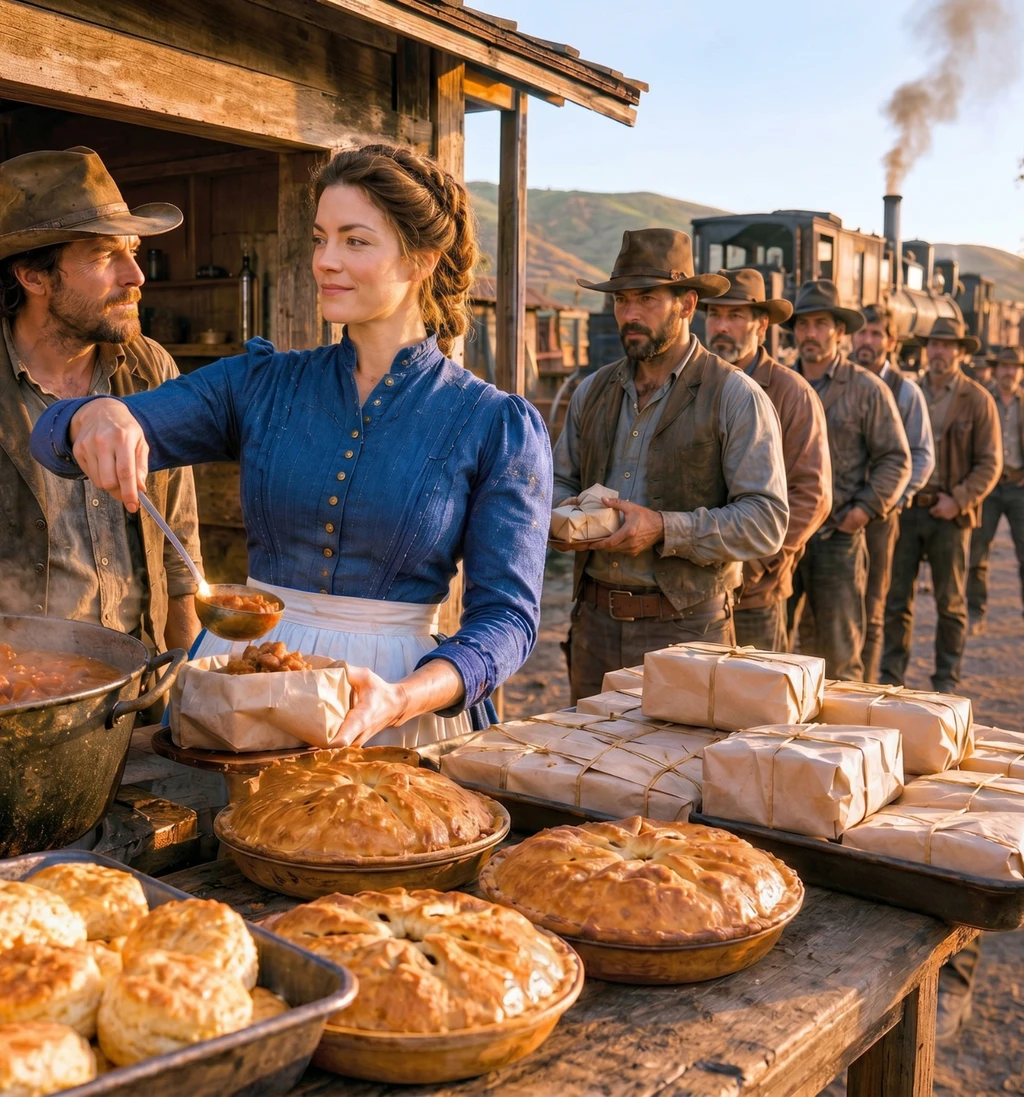
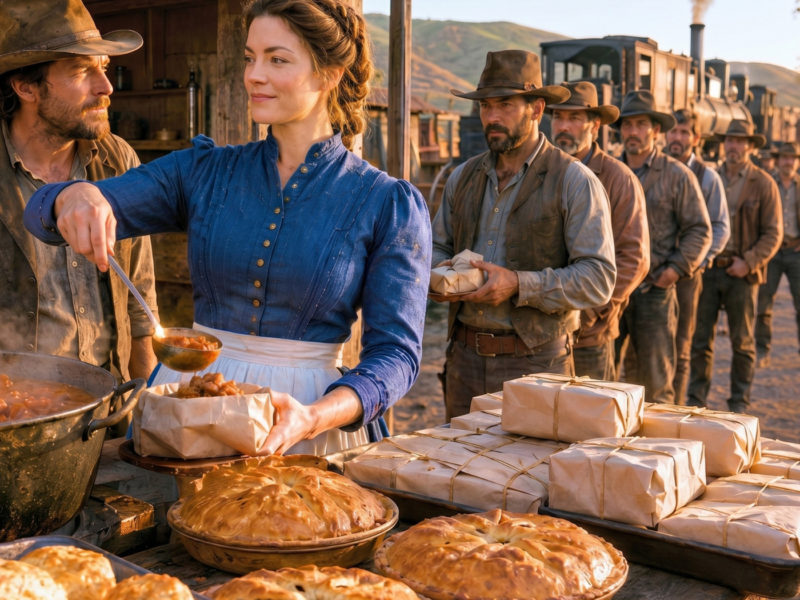
“Only if the horse can spare it,” Adeline said sweetly. Old Henry barked a laugh that surprised them both. She went back the second day and the third. She learned the rhythm of the camp when the shifts changed, which men wanted seconds, that the timekeeper had a weakness for anything with apples in it, and would pay double.
She learned that Dietrich’s crew was only one of three working the line that spring, and the other two camps had no cook either. Each evening she came home and added to the cigar box, and each evening Caleb counted it with a face that did less and less to hide his astonishment. By the end of the first week, the box held more money than the ranch had seen since the autumn cattle sale.
By the end of the second, Adeline had stopped offering free plates because her reputation arrived ahead of her wagon, and men from the neighboring camp walked the extra mile on their own legs to stand in her line. She was not a bride with a frying pan anymore. She was beginning to be something the High Plains had no name for yet. But she had a name for it. She’d had it since Omaha—a storefront on wheels, and a woman smart enough to see it.
As the weeks passed, the operation grew, and Adeline sat at the long table one night with the ledger—her ledger, now by silent agreement—and laid the problem out for Caleb like a hand of cards. Three camps, roughly one hundred twenty men between them, and I can reach maybe forty before the food cools. I’m turning away money.
Caleb leaned over the page. He had taken to doing that—leaning in rather than shutting down. The change had crept up on them both. “What do you need?”
“A second wagon, a second stove, and cooks. I can’t be in three places, and I can’t keep Tully driving while I ladle.” She tapped the column where her profits sat in a fat growing tower. “I can afford it. That’s the strange part. The money’s already here to spend.”
So, they built it. Caleb, who could mend anything with hands and bailing wire, rigged a second camp stove into the old buckboard. Adeline hired help from the unlikeliest place—the ranch itself. Old Henry’s back couldn’t take a full day in the saddle anymore. But it could take a day at a camp stove, and he turned out to have a gift for biscuits that he’d been hiding under forty years of cowboy gruffness.
A widow named Mrs. Ser from Bitterroot Junction, who’d been taking in washing to survive, signed on to bake pies in the ranch kitchen by the dozen, then the gross. The ranch began to hum in a way it hadn’t in years. The smell of baking drifted from the kitchen at all hours. Wagons came and went on a schedule. Adeline chalked onto a slate by the door. She negotiated directly with the railroad’s regional supply agent, the same sort of man who’d told her at the Omaha depot to see a storefront where others saw supper, and arranged to buy flour and beef and dried fruit by the freight load at prices that made her grin.
Caleb watched it all with the dazed expression of a man who’d planted potatoes and grown gold. One evening he found her recalculating freight costs by lamplight and simply stood in the doorway a while. “My first wife was a good woman,” he said at last. “Kind. She kept a clean house and a fine table, and she never once looked at that ledger. I loved her for the home she made,” he paused. “I never thought a wife could be a partner in the business of the thing. I didn’t know to ask for it. I’m not sure I’d have known what I was asking for.”
Adeline set down her pencil. It was, she understood, as near to a declaration as Caleb Hartley had in him, and it was a fine one. “You arranged for a cook,” she said gently. “You got a cook. You just also got everything she’d been waiting her whole life for someone to let her be.”
The men came around slowly, then all at once. The turning point was payday—the first one in two years that Caleb met in full and on time, with a small bonus besides, drawn entirely from the cigar box that had become a strongbox that had become a proper account at the Bitter Bank. Pike took his pay, counted it, and looked at it a long moment. Then he took off his hat.
Actually took it off and held it the way Caleb had held his at the depot, like a man unsure what to do with his own hands. “Mrs. Hartley,” he said. “I called you a bride with a frying pan.”
“You did. I was a fool.” He turned the hat. “My sister’s a widow over in Lodgepole. Cooks like an angel. Got three young ones and no way to feed them. If you ever need another hand at the stove, send for her,” Adeline said. “Tell her to bring her own apron and her best recipes. I’ll find the work.”
The whole bunkhouse heard it, and the whole bunkhouse understood what it meant. The bride with the frying pan was hiring now. She had crews and roots, and a name that traveled the rail line faster than the trains. Tully, promoted to head driver, had taken to introducing her to new foremen as Mrs. Hartley, who feeds the whole western line, and not one foreman had laughed.
For the first time since she’d stepped off the train, Adeline let herself believe the things she’d suspected in Omaha—not just that she could survive, but that she could build. The numbers said so, and the numbers had never lied to her yet. But numbers, she would soon learn, were not the only force on the high plains, and the man who held the largest of them had begun to take notice of the woman feeding his railroad.
He arrived in a black coach with brass fittings—a man too well-dressed for the prairie—and he introduced himself as Mr. Sloan, Regional Contracts Manager for the Railroad Company. “Mrs. Hartley,” he said, declining the chair she offered. “You’ve been feeding three of my grading camps, doing it well by all accounts. The foremen sing your praises.”
He smiled without warmth, which is precisely the problem. “You’re operating on company property, selling to company men without a company contract. We can’t have independents skimming the line.” Adeline kept her face calm, though her stomach dropped. “I’ve been told my cooking improves your crew’s productivity.”
“It does.”