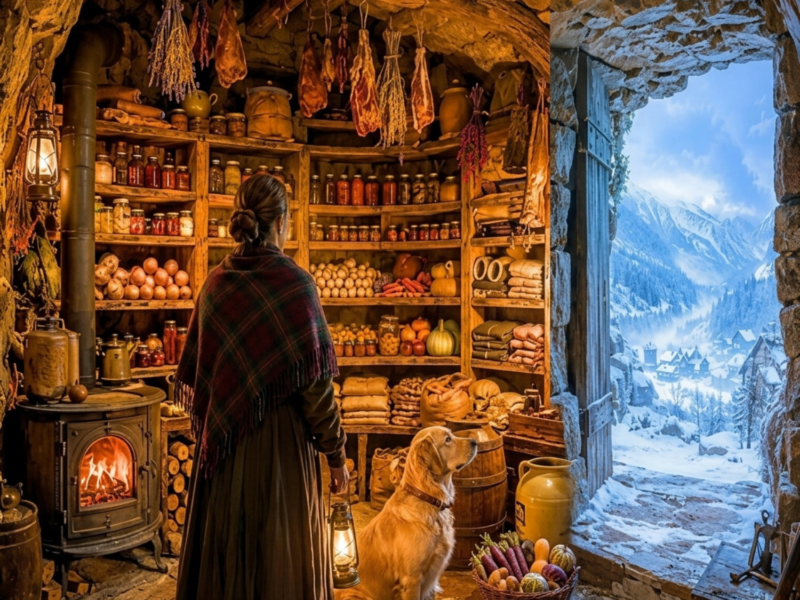
(Part 2) Cast Out With Her Dog, The Widow Found A Stone Dugout — The Shelves Were Still Full
(Part 2) Cast Out With Her Dog, The Widow Found A Stone Dugout — The Shelves Were Still Full
.
.
Part 2: The Warmth of the Limpit
The first confrontation came sooner than she expected. News of her strange activities—of her hauling stone, not to rebuild the cottage, but to drag it down into a hole in the ground—had trickled down to the valley. Silas Thorne arrived one afternoon, his fine town horse picking its way delicately through the rocky terrain. He found her covered in dust and clay, her face streaked with sweat, single-handedly wrestling a heavy stone into place at the back of the dugout where the heater was to be built. Brin growled from the entrance, a low, rumbling threat.
“Ara,” Thorne said, his voice dripping with condescending pity. “What is this madness? The whole town is talking. You’re digging your own grave.” He gestured dismissively at the dugout. “Living in a hole like a badger. Winter is coming—a real winter. You will freeze to death in this tomb.” He offered a false olive branch. “There is still time. Admit your folly. I can find a place for you. A room in the widow’s boarding house. A position as a laundress. It would be a humble life, but a life nonetheless.”
The offer was a calculated insult designed to break her spirit and reinforce his power, but his condescension fueled her fire. She looked up at him, her eyes clear and steady. “I will be fine, Silas,” she said, her voice quiet but firm. “You needn’t concern yourself.” His face hardened. “So be it,” he spat. “When the snows come, do not bother screaming for help. No one will hear you. We will find your body in the spring.” He turned and left, his contempt hanging in the cold air.
His visit had the opposite of its intended effect. It had banished any lingering doubt. It was now a war, and she would win. The labor was the hardest thing she had ever known. Following Anel’s detailed instructions, she dismantled part of the ruined chimney stack, carefully cleaning the old soot from the fire bricks within. She hauled sand from a small hidden creek bed Anel had marked on a map and mixed it with clay. She dug from a deposit behind the dugout. This became her mortar.
Day after day, she worked. Her body was a symphony of aches and pains. Her hands, once blistered, became calloused and strong. The muscles in her back and arms hardened. She learned the heft and balance of stone, the precise amount of mortar needed to set a brick, and the patient, methodical process of construction. She was not just building a stove; she was rebuilding herself stone by stone.
She worked from the first light of dawn until her muscles gave out at dusk, falling into an exhausted sleep on a bed of pine boughs. Brin curled at her side. Her supplies from the initial trip to town began to dwindle. There were things she could not find on the land—a cast iron door for the firebox, a length of metal stove pipe, and a few tools that Anel’s collection lacked. Swallowing her pride, she made the long trek back to town.
She entered Henderson’s general store, a different woman from the broken widow who had left weeks before. Her clothes were patched and stained, her face tanned by the wind, and her hands were the hands of a laborer. But her eyes held a new light, a focused, unwavering determination. She presented her list to Mr. Henderson. He looked at it, then at her. “Building a stove, are you?” he asked, his voice gruff. “Thorne says you’re living in a cave. Says you’ve lost your mind.”
Delera met his gaze without flinching. “I’m living,” she said simply. “And I need these supplies.” He stroked his beard, his eyes assessing her. He saw not madness but a formidable strength. He saw the calluses on her hands, the exhaustion, and the resolve etched onto her face. He had known Anelcane, had thought him a strange old hermit, but he had also known him to be a man of his word. “Perhaps there was more to the old man’s folly than anyone had guessed.”
“This is more than you can afford,” he said, tallying the cost. Delera’s heart sank. She had the last of her money, but it was not enough. “I can pay you back in the spring,” she said. “I can trap four pelts.” Henderson was silent for a long moment, the only sound the ticking of the large clock on the wall. Then he grunted. “Fine,” he said, turning to gather her items. “I’ll run you a line of credit. Not because I think this scheme of yours will work,” he added, fixing her with a stern look, “but because no one who works that hard deserves to freeze to death on Silas Thorne’s account.”
It was not an act of faith in her plan but an act of faith in her effort. It was the first crack in the wall of her isolation, a lifeline she hadn’t known how desperately she needed. The first sign came as a change in the quality of the light—a pearlescent gray that seemed to absorb all color from the world. The wind, her constant companion, fell silent, creating an unnerving, expectant hush. Old-timers in the valley called it the white silence—the deep breath the mountains took before the storm exhaled its fury.
A rider on a half-frozen horse came down from the high passes, his face masked in ice, babbling about a wall of white in the north—a storm the likes of which he had never seen. The harbinger had arrived. The white death was coming. In the town, a frantic, panicked energy took hold. People boarded their windows, stuffed rags into the cracks of their doors, and piled cords of wood beside their hungry, inefficient iron stoves. Silas Thorne, from the comfort of his large, modern, and notoriously drafty house, issued pronouncements about weathering the storm with fortitude and good sense—all while his servants hauled in enough firewood to heat a small village.
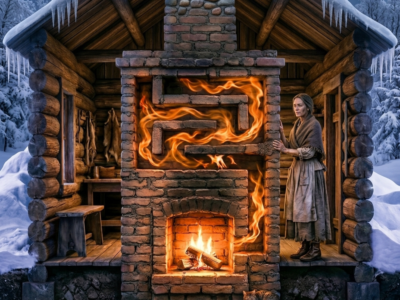
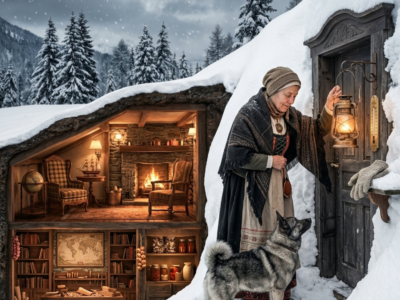
Delera felt the coming storm in her bones. She did not panic. Her work was done. The masonry heater stood at the back of the dugout, a monolithic beast of stone and clay, solid and silent. She had followed Anel’s designs to the letter. She brought Brin inside, secured the heavy insulated oak door she had built for the entrance, and lit the first fire. She used only a small bundle of seasoned pine, following her great uncle’s instructions. The fire roared to life in the firebox, a contained inferno that lasted for just under two hours. The metal stove pipe leading out through a carefully sealed hole in the roof grew hot, then cooled. The fire died down to embers, and she sealed the firebox door. Then she waited.
A profound silence filled the dugout, broken only by the sound of her own breathing and Brin’s soft snores. Slowly, almost imperceptibly at first, a deep, penetrating warmth began to radiate from the stone mass of the heater. It was not the scorching dry heat of an iron stove, but a gentle, pervasive warmth that seemed to emanate from the very walls, the very air. It was the warmth of a summer afternoon, held captive in the stone.
Then the storm hit. It came not as a gradual snowfall but as a sudden, violent explosion of white. The wind shrieked like a banshee—a physical force that hammered at the world. In the town below, the battle was joined. The wind found every crack, every seam in the houses, forcing icy tendrils of air deep inside. Families huddled closer to their stoves, feeding them constantly. The iron boxes glowed red hot, scorching the air in their immediate vicinity, while the corners of the rooms remained freezing. The consumption of wood was voracious, terrifying. People watched their carefully stacked wood piles dwindle at an alarming rate. Fear began to creep in, cold as the drafts that snaked across their floors.
In his grand house, Silas Thorne raged at his servants. Despite the massive fireplace and two iron stoves blazing away, the cold was winning. The great windows rattled in their frames, and the wind howled in the chimneys, mocking his wealth and power. The brute force of his resources was failing against the surgical precision of the cold.
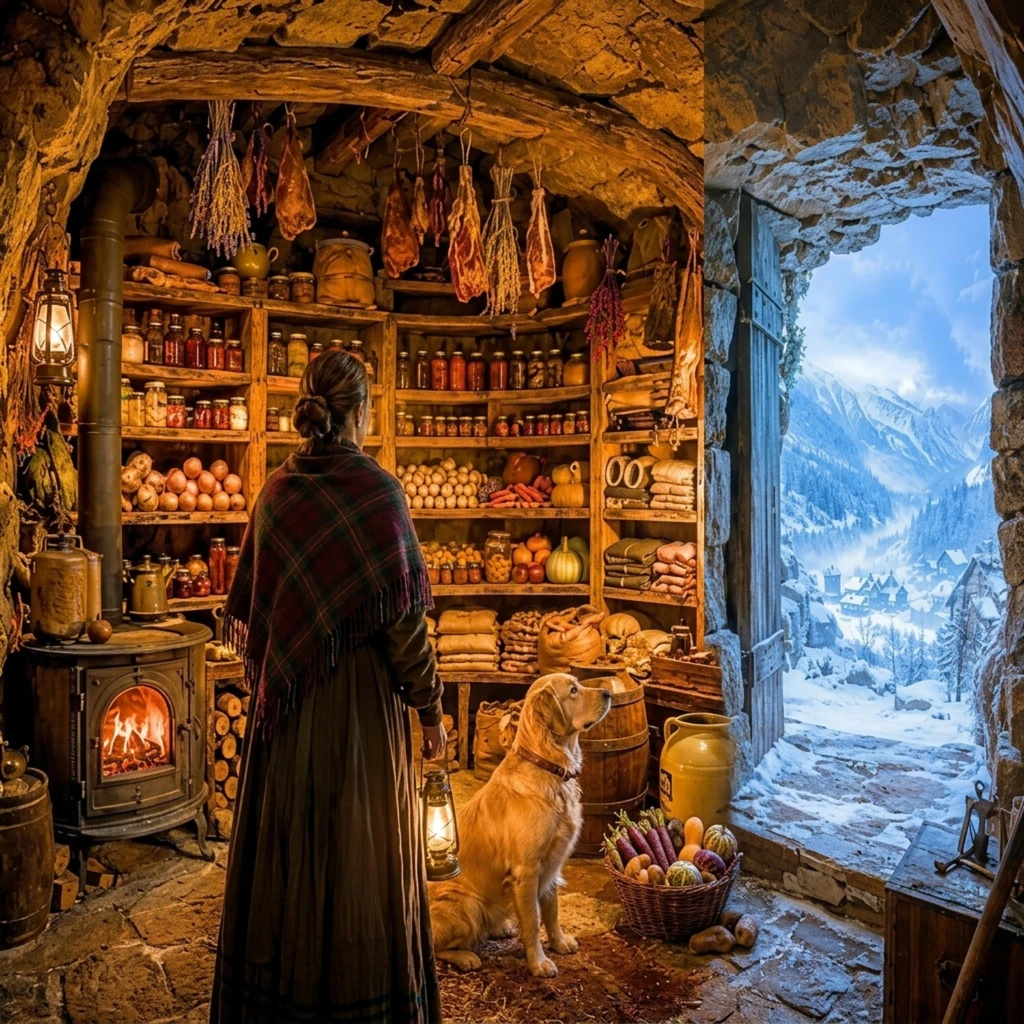
In the limpit, there was only peace. The storm was a distant abstract rumor. The wind could not touch her, buried as she was in the heart of the hill. Not a single draft penetrated the stone walls. The air was warm and still, the temperature a steady, comfortable 70°. The great stone heater radiated its gentle stored warmth—a silent, faithful guardian against the blizzard. Delera sat at her small table, reading Anel’s journals by the light of a tallow lamp. Brin slept soundly at her feet, twitching in a dream of chasing rabbits in a sun-drenched field. She had food in abundance, clean water from a small cistern Anel had built to collect seepage, and an inexhaustible supply of warmth. The contrast was absolute.
Outside, a battle for survival was being waged—a desperate losing fight against a relentless enemy. Inside, there was a sanctuary of profound and quiet safety. She was not surviving; she was thriving. The earth, as Anel had written, held the memory of summer, and the stone remembered the fire.
For four days, the world was a maelstrom of white. Then, as suddenly as it began, it stopped. The wind died, and a blinding, silent stillness descended. The landscape was utterly transformed, buried under a monolithic blanket of snow that smoothed all contours and erased all landmarks. It was a beautiful and terrifying sight.
In the valley, people emerged from their homes like shaken survivors from a shipwreck. The toll had been immense. Several outlying homesteads were lost, their inhabitants presumed frozen. Livestock had perished in their barns, and nearly everyone’s supply of winter firewood was critically low. The great blizzard had consumed in four days what should have lasted two months. A new, colder fear set in—the fear of the long, hard winter still to come.
Silas Thorne’s grand house was an icebox. His fuel supply nearly gone, but his arrogance was a heartier thing. As soon as a path could be partially cleared, he gathered a few men. “We must check on the unfortunate woman,” he announced, his tone laden with false piety. “It is our Christian duty to retrieve the body for a proper burial.” He truly believed it. In his mind, there was no possibility she could have survived. His journey was one of morbid vindication.
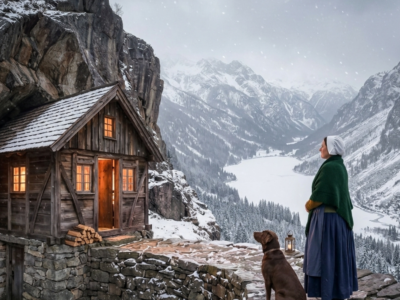
The trek to Whisper Wind Ridge was a brutal, exhausting struggle through chest-deep snow. More than once, his men suggested turning back, but Thorne, driven by a grim and obsessive need to be proven right, pushed them onward. When they finally reached the location of the ruin, they found nothing but a vast, smooth drift of snow. The crumbled walls were entirely gone, buried. It was, as Thorne had predicted, a grave.
But then one of his men pointed. Sticking up from the top of the highest drift was a thin black line. It was the stove pipe, and from its cap, a faint, almost invisible wisp of heat shimmered in the frigid air. It was impossible. A collective disbelief fell over the men. Thorne stared at it, his mind refusing to process what his eyes were seeing. He scrambled up the drift, his men following, and began to dig frantically with his hands at the snow around the pipe.
They soon uncovered the top of the heavy oak door. It was cold but not caked in ice. Thorne pounded on it with his fist. “Delera, are you in there?” he yelled, his voice a mixture of command and confusion. The door swung inward with a quiet creak. A wave of warm, clean air washed over them—a shocking, unbelievable sensation in the frozen world. And there, standing in the entryway, framed by the soft lamp light of the dugout, was Delera. She was not merely alive. She was calm, healthy, and warm, wearing a simple wool dress, her hair neatly braided. Brin stood beside her, wagging his tail. The men stared, their mouths agape.
They looked from the pristine, deadly world of white outside to the impossible warmth and safety within. It was like looking through a doorway into another season. Silas Thorne was struck dumb, his face a canvas of shattered certainty. He stumbled inside, his eyes darting around the chamber, taking in the warm stone walls, the well-stocked shelves, the massive silent heater. He touched its surface. It was not hot but deeply, radiantly warm. “How?” he whispered, the single word a confession of his own complete and utter failure of imagination. “How is this possible? Your fire. It’s not even lit.”
Delera looked at the man who had condemned her, at the man who had come to collect her body, and she felt not hatred but a distant, weary pity. His entire worldview, built on the foundations of conventional wisdom, wealth, and brute force, had just been demolished by a principle he could not comprehend. “The fire burned yesterday morning,” she explained, her voice calm and even. “For two hours the stone remembers the heat, Silas, and the earth remembers the summer.”
Her simple words, a direct quote from her great uncle’s journal, held the weight of a profound natural truth. They were an epitaph for his arrogance. In that moment, he was not a powerful patriarch; he was a small, cold man stripped bare in the face of a wisdom he had been too proud to see. The humiliation of Silas Thorne was total and absolute.
The story carried back to town by his own stunned men spread like wildfire. Mr. Henderson, upon hearing the news, loaded a sled with provisions—a celebratory gift, not a rescue mission—and made the arduous journey himself to see with his own eyes. He returned a convert, a vocal champion of the Anel method. The tale became a local legend overnight—how the powerful Silas Thorne, with all his wood and wealth, nearly froze in his mansion, while the outcast widow he had sent to her death had lived in gentle warmth through the white death. He became a laughingstock. The authority he had wielded through fear and influence evaporated.
Children would whisper “the stone remembers” as he passed in the street. Unable to bear the disgrace, his worldview shattered, Silas Thorne sold his properties at a loss and left the valley before the spring thaw—a man broken not by the storm but by a quiet, unshakable truth. The narrative of the town began to shift. The blizzard had been a brutal teacher. It had exposed the fragility of their conventional methods and the foolishness of their pride. Pity for Delera transformed into grudging respect, which then blossomed into outright awe.
They no longer saw her as the mad widow in the hole. They saw her as the woman who had listened to the mountain, the one person who had been truly prepared. She was no longer an outcast; she had become a source of vital, life-saving wisdom. Delegations of townspeople, led by a humbled and respectful Mr. Henderson, began to make the trek up to the limpit—not to rescue or mock, but to learn. At first, she was hesitant, unused to company and wary of the very people who had stood by while she was cast out. But she saw the genuine fear in their eyes—the fear of the next storm, the next long winter. She saw that they were ready to listen.
She took out Anel’s journals, the schematics, and began to teach. She explained the principles of thermal mass, of passive solar gain, of efficient combustion. She showed them how the limpit was positioned, not by accident but to receive the maximum benefit of the winter sun and be sheltered from the prevailing wind. She became a teacher, a conduit for her great uncle’s forgotten genius, sharing the knowledge not for profit or power, but for the resilience of the community.
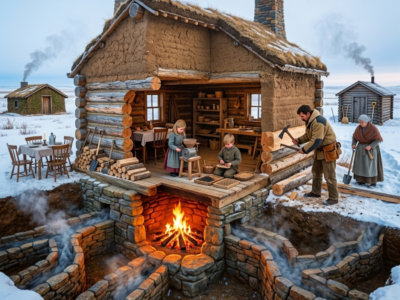
The transformation of the valley was slow but steady. That next summer, several families, with Delera’s guidance, began building. They didn’t all dig dugouts, but they applied the principles. They built thick-walled stone additions onto their homes. They constructed massive masonry heaters in the cores of their houses. They learned to see their homes not as thin shells against the cold, but as batteries for warmth, as partners with the environment rather than fortresses against it. The sound of stone being shaped and mortar being mixed became the sound of the valley’s rebirth.
Years passed. Whisper Wind Ridge was no longer a place of exile but a place of pilgrimage. Delera remained in the limpit, which had become a comfortable, thriving homestead. She never remarried, finding a deep and abiding companionship with the land itself, with the steady rhythm of the seasons, and with the succession of loyal mountain hounds who shared her hearth. The town below became known throughout the region for its uniquely warm homes, for its uncanny ability to weather the harshest winters with ease and comfort. They called them Anel houses, and Delera became the quiet, respected custodian of that legacy—a woman who had been given a worthless ruin and had turned it into the foundation of a new, more resilient world.
In the end, the story served as a permanent lesson edged into the very stones of the valley. It was a testament to the profound truth that the loudest voice is rarely the wisest. True strength is often quiet, methodical, and born of patient observation. It is a reminder that value can be found where it is least expected—in a forgotten journal, in a crumbling ruin, in a person society has thrown away. The world is full of shouting, of arrogant certainties and conventional brute force solutions. But true, enduring wisdom often comes as a whisper from the quiet genius of an ancestor, from the deep thermal memory of the earth itself. One only needs to be humble enough and desperate enough to listen.
As the seasons turned and the years rolled on, Delera’s legacy grew, not just in the homes built upon the principles she had shared, but in the hearts of those who had once cast her aside. They learned to value resilience, to respect the land, and to honor the wisdom of those who had come before them. The valley flourished, not just as a place of survival, but as a community bound together by shared knowledge, respect, and a newfound appreciation for the quiet strength that lay within each of them. And in the limpit, Delera continued to thrive, a beacon of hope and wisdom for all who sought her guidance.