(Part 2) Banished Before Winter, Widow and Her Mother Filled a Cave With Supplies — It Saved Them in Blizzard
(Part 2) Banished Before Winter, Widow and Her Mother Filled a Cave With Supplies — It Saved Them in Blizzard
.
.
Part 2: Building a New Life
As the days turned into weeks, Anne’s resourcefulness flourished within the cave. It was no longer just a refuge; it became a home. She scavenged materials from the ruins of the line shack, dismantling it piece by piece, salvaging nails, planks, and anything useful. With a flat, sharp-edged piece of shale, she fashioned tools—a knife, a scraper, and eventually a hatchet, using strips from her own petticoat to lash them together.
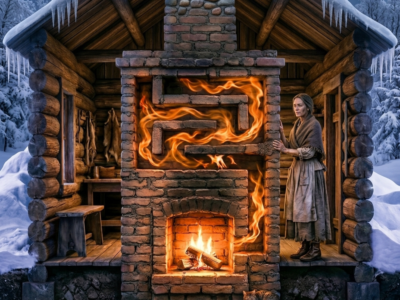
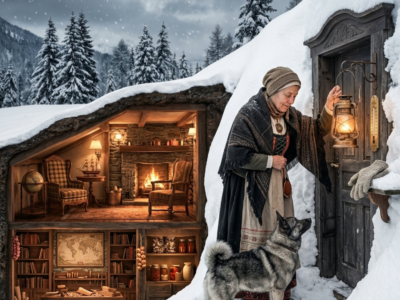
The cave demanded her attention, but it also rewarded her efforts. She spent days exploring its interior and discovered a series of chambers connected by narrow passages. In the second-largest chamber, she found a natural fissure in the ceiling, a thin crack that allowed smoke to escape, creating a chimney for her fire. After days of hard work, she built a fireplace, mixing clay with dried grass and pine needles to create a sturdy mortar. When she finally lit the first fire, the warmth flooded the chamber, and tears of joy streamed down her face.
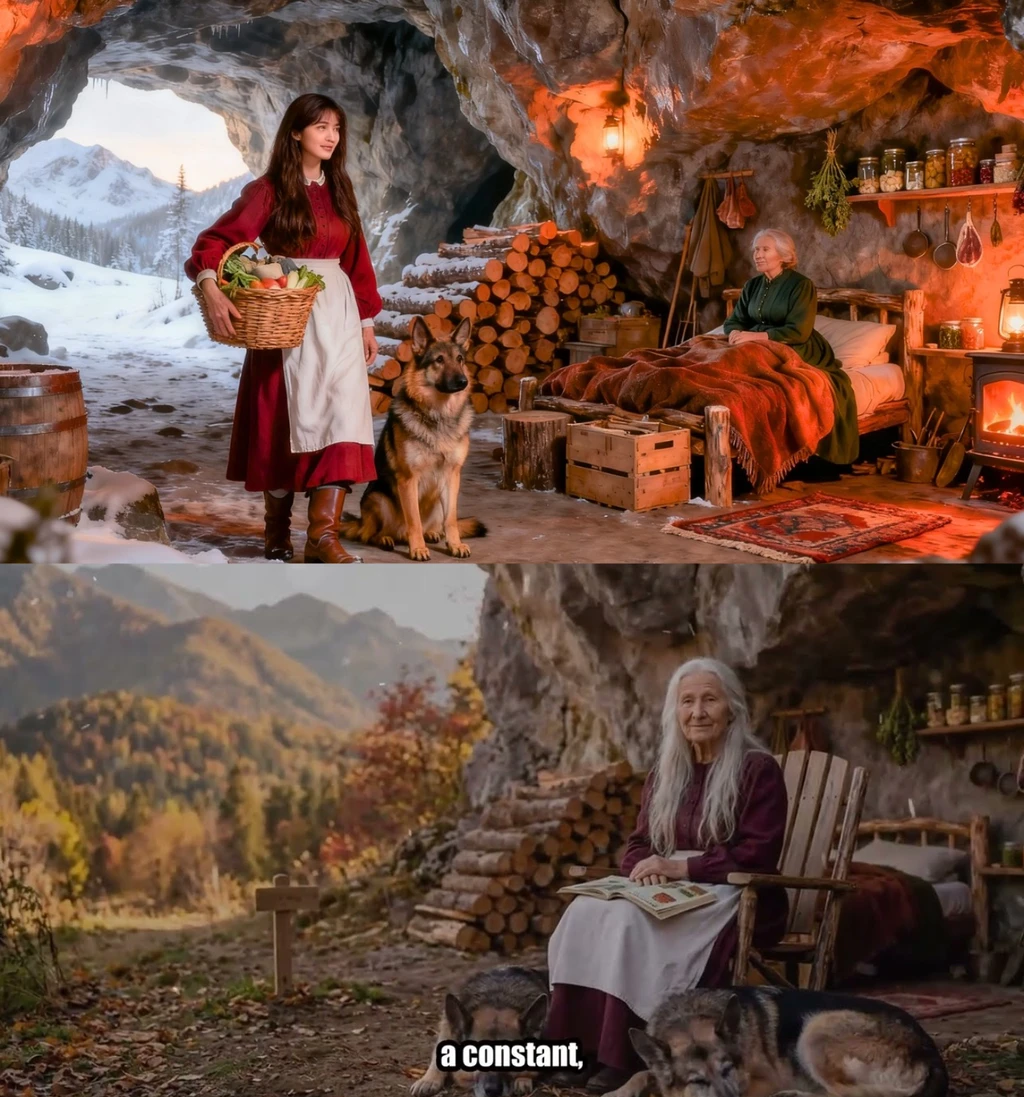
With a source of heat, everything changed. She built a raised platform for her mother’s bed, getting her off the cold stone floor. Using salvaged planks for the frame and cattail reeds for the mattress, she created a comfortable space. The first night her mother slept through without a single coughing fit was a victory greater than any harvest she could have imagined.
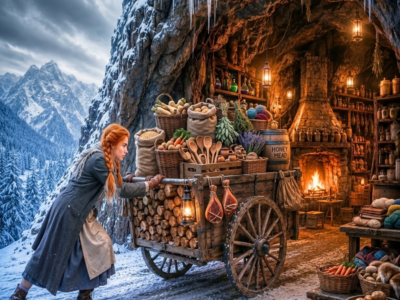
Anne fell into a rhythm of foraging, building, and hauling wood. She became an expert on firewood, learning which types burned hot and which lasted through the night. The stacks of wood lining the walls of the cave grew taller, a fortress of fuel that represented her labor and determination.
Food remained a constant concern, but Anne adapted. She set snares for rabbits and squirrels, using tricks learned from an old trapper’s guide. Kaiser became her invaluable partner, helping to corner game. She identified edible roots and found a grove of rose hips, brewing a tart, medicinal tea for her mother.
One day, while exploring deeper into the cave system, Anne discovered a chamber where the limestone walls wept with condensation. The air was humid and cool, perfect for storing food. She carefully wrapped her remaining potatoes and onions from Jon’s farm in dry moss, creating a natural root cellar that kept them from freezing.
But the most remarkable discovery was the small cloth sack containing seeds from her experimental garden. With salvaged buckets and pots of her own making, she filled them with soil and planted lettuce and radish seeds. Weeks later, in the dead of January, a pale green shoot pushed through the dark soil, a miracle that felt more significant than fire. The first head of pale, tender lettuce she harvested was proof of her resilience.
As winter raged outside, the cave became a sanctuary for Anne and her mother. They were not just surviving; they were thriving in a place that had once seemed hostile. The community’s skepticism faded into the background, a distant noise overshadowed by the life they were building.
Then came February, bringing with it a blizzard that would be remembered for generations. The sky turned a bruised slate gray, and the wind howled, a low moan that grew into a shriek. The snow fell relentlessly for four days, burying the world in white. In Providence, the carefully stacked cords of firewood dwindled, and food became scarce. The cold was no longer an adversary; it was an occupying army.
On the fifth day of the storm, a small group of men set out from the town, led by Jon. Their faces were gaunt, their eyes filled with desperation. They were not looking for Anne out of concern; they were looking for her out of sheer necessity. The trapper’s story had transformed from gossip into their only hope.
It took them six hours to cover two miles, wading through shoulder-deep drifts. When they finally found the juniper curtain, they were half-frozen, their hope nearly extinguished. Jon pulled back the branches and was met with the impossible sight of a faint warm light spilling from the mouth of the cave. The smell of wood smoke filled the air.
Inside, Anne was mending one of her mother’s socks by the fire when Kaiser let out a low growl. She looked up to see the men standing at the entrance, their forms dark against the swirling white outside. They looked like ghosts, and Jon stood at the front, his hat in his hands, snow melting in his beard.
He did not apologize; he simply said, “We need help. The town—we’re freezing. We’re running out of wood.” Anne studied the exhausted, desperate faces before her. She felt no triumph, no satisfaction. The part of her that might have wanted to see him humbled had frozen to death on his porch months ago. All that remained was a quiet, practical competence.
“Bring them in,” she said, her voice steady. “How many people are in your party?”
“Five of us,” Jon stammered. “There’s room by the fire.”
As they huddled by the fire, sipping the hot, bitter tea Anne made from rose hips, they stared at the stacks of firewood lining the walls, at the strings of dried meat, at the pale green lettuce growing in its bucket. They were looking at a miracle built of shale and clay and stubbornness.
Jon’s gaze fell on Anne’s mother, asleep on her raised bed, warm and safe. The sight seemed to break something in him, and he looked at Anne, his eyes filled with unspoken shame. He did not say he was sorry; he did not say he was wrong. Instead, he looked at the perfectly stacked cords of firewood and murmured, “You always did see things differently.”
Before he and his men left, taking as much firewood as they could carry, Jon laid his father’s prized axe on the stone hearth, a silent admission of the transfer of title. This place was hers, and it did not require an apology. As she watched them go, she said the only thing that needed to be said: “The handle on that axe is hickory. It will not crack in the cold.”
Anne never moved back to Providence, but she was no longer an outcast. The cave became a known place, a way station for travelers caught in storms and a source of knowledge for those willing to ask. She fed forty people from the town during that blizzard, sending them back with food and wood until the storm broke.
Anne taught three other families how to build cold frames, how to find dry caves, and how to read the land not as an enemy but as a difficult partner. Her mother lived for five more years, passing away peacefully in her sleep one spring morning. Anne buried her in a small clearing near the cave, marking the spot with a simple fieldstone.
Anne herself lived to be seventy-eight, dying on a mild autumn afternoon, sitting in a sturdy chair she had built near the mouth of the cave. A catalog of seeds from a company back east lay open in her lap, and Kaiser’s great-grandson slept at her feet. She looked like a person who had just finished a long and satisfying book.
Her epitaph, carved by a man whose family she had saved that winter, was a single sentence on a simple wooden marker: “She built a home here.” The world may not have had a category for people like her—those who see things differently—but she had found her place, turning what was once a burden into a foundation for a new life.
In the end, the rusted iron key that had once seemed a burden had unlocked a kingdom built of stone and silence, proving that the only difference between a burden and a foundation is what you are willing to build upon it.