“I Can’t Pay For This Meal,” The Ranch Widow Said And Turned Away… What I Did Brought Her To Tears
“I Can’t Pay For This Meal,” The Ranch Widow Said And Turned Away… What I Did Brought Her To Tears
.
.
Part 1: The Arrival at Redemption
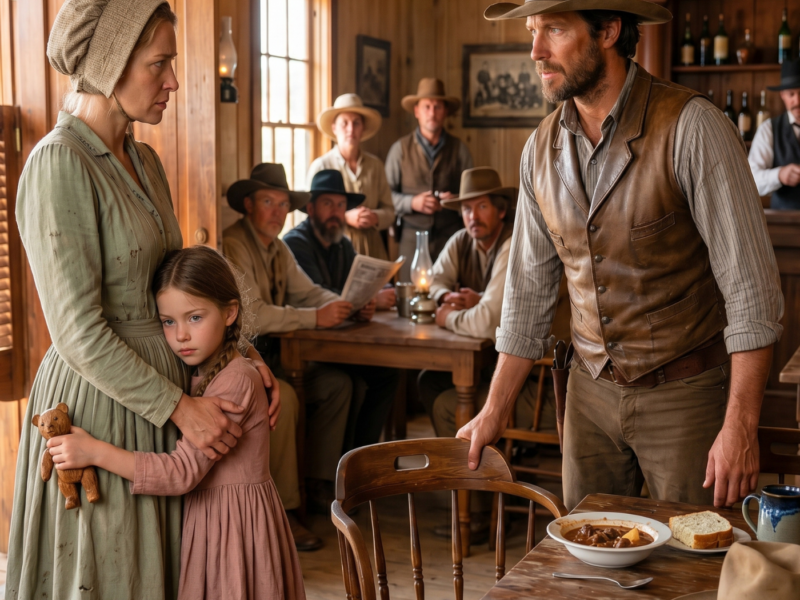
The moment Margaret Hollister walked into the Silver Dollar Saloon that autumn afternoon, the whole room shifted. I felt it in the back of my neck, like a barometric change before a storm, but I didn’t yet know that this moment would define the course of my life. I sat nursing whiskey at my corner table when she appeared—a thin woman in a worn dress, holding her daughter’s hand as if it were the only solid thing left in the world. The saloon went quiet. Everyone noticed her presence; she didn’t belong, and yet she carried herself with a subtle defiance, chin high, eyes unwavering.
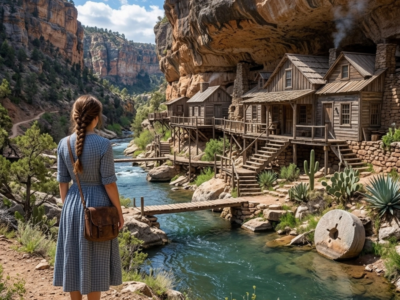
She was trouble’s latest victim. Margaret had arrived with history already pressing down on her shoulders. I had met her once before, six months prior at the general store. Her husband David had died two years before, thrown from a horse, lingered for three days with pneumonia, and then the prairie had taken him. Since then, Margaret had tried to keep the Broken Wheel Ranch alive alone, but everyone in Redemption Valley assumed her efforts were doomed. Small ranches without partners, without money, without luck—they were a relic waiting for winter’s judgment.
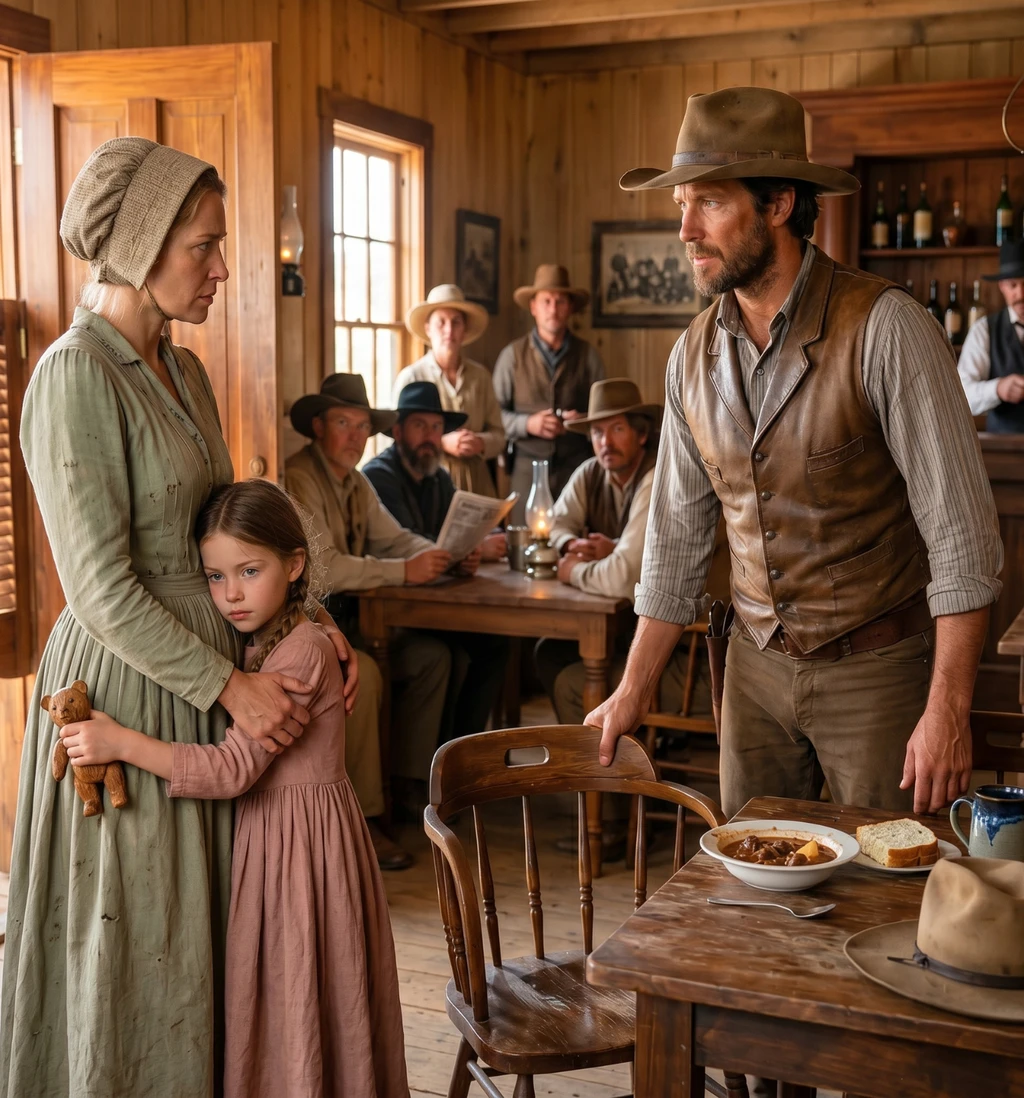
“I need work,” she said quietly to Jake Williams behind the bar. Her hands trembled ever so slightly, betraying the nerves hidden beneath her composed voice. “Any work. I can wash, cook, clean. I’ll work for food.” The room paused, and the air became heavy with curiosity. Jake shifted uneasily. A respectable woman asking for labor in a saloon was an anomaly. Social norms bristled against it.
“I’ll hire her,” I said before thinking. The room seemed to explode around me; every eye turned toward my table as if I’d just declared war on convention. My name is James Conner, fifty-three years old, face etched with lines that only hardship and loss can carve. Five years ago, I’d lost everything—my wife, my ranch, my pride—and I’d come to Redemption Valley to vanish. Until this moment, I was doing it well.
Margaret’s expression tightened, recognizing the offer for what it was: a lifeline she did not want to accept as charity. “I don’t need charity, Mr. Connor,” she said. I stepped forward, hands raised. “I need work done, real work. I’ve got a problem that’s been gnawing at me for months.” Emma, her daughter, looked up at me from behind her mother. Those eyes—they could see the truth, and they measured every lie or half-truth with precision. I kept my gaze steady.
“My hands,” I said, showing her calloused, scarred palms. “I’ve been breaking horses for the Mercer outfit, paid eighty dollars for two months of work. I’ve saved every cent.” I didn’t mention that this money had lain under my bed for a year, a hidden lifeline in a life spent hiding. “I need someone honest, someone mean enough to tell me when I’m wrong.” Margaret studied me, calculating, trying to measure the truth in my words.
“How much?” she asked. “Seventy dollars for a month,” I said. “I provide the materials. Fair?” She understood the sum’s impossibility. She also understood necessity—her daughter, her pride, hunger—all vying for dominance in her mind. I added, “I’ll pay for supper, all three of you. Whatever Martha’s got hot.” Martha, the cook, nodded and disappeared back into the kitchen. Margaret and Emma sat slowly, the weight of their uncertainty pressing against them like a winter wind.
Over dinner, Margaret shared the story of the Broken Wheel Ranch. David’s dream, 160 acres with a small but solid herd of two hundred head of cattle. She recounted the winter of 1885, the big die-up, the mass death of livestock due to barbed wire fencing—wealthy ranchers claiming everything, small operators losing everything. David borrowed to rebuild the herd, believing he had time. But then death struck, and Carl Brennan, the banker, stepped in, ready to enforce the clauses David might never have fully understood.
“I have maybe six months before Brennan decides the property is distressed enough to take,” she whispered. Emma ate quietly, counting her biscuits, a subtle ration, a glimpse into the depth of their struggle. We made a silent pact that night, no words needed: something had to change.
Three days later, I rode out to Broken Wheel Ranch. The house still stood, but the fences sagged, the barn roof leaked, and about thirty head of cattle remained, thin and desperate. Margaret was in the corral, trying to manage an old mare with a broken gate. I dismounted, carrying tools, rope, and a plan—though I wasn’t entirely sure how it would unfold. I offered a partnership, not money, showing her that together we could confront the looming threat, not just of winter, but of the predatory banker waiting in the wings.
Margaret hesitated. Emma peered around the corner, curiosity mixed with wariness. I told her, “The Broken Wheel is worth saving. You are worth saving. And Brennan is counting on fear and exhaustion. But you’re not worn down. You’re alone—but not anymore.” She studied me long and then nodded, the faintest acknowledgement of hope threading through her pride.
Autumn became our crucible. Side by side, we repaired fences, restored water troughs, and secured the barn. I taught Margaret cattle management, signs of disease, breeding cycles. She taught me the land, its rhythms, its needs. Emma carried water and gathered firewood, small hands helping wherever possible. Then came the shadow of Carl Brennan, surveying our labor from his horse as though we were pieces on his ledger. “Thirty days,” he said. “Or the ranch is mine.” Margaret went pale, but her voice remained steady: “The note is on schedule.” Brennan’s smirk revealed cruelty, not law—this was a game to him, and we were pawns.
I stepped beside Margaret, determined. We had thirty days. We had cattle to sell, loans to leverage, sweat to expend. Every day was a test, every night a negotiation with chance. The story of Broken Wheel Ranch was just beginning, and the clock of fate ticked loudly against us.
And as the sun set behind the jagged ridges, the wind whispering through the valley, a storm gathered—not in the sky, but in the world of men and contracts—a storm that would decide whether Margaret and Emma could survive, and whether James Connor’s gamble would pay off.
Part 2: The Battle for the Broken Wheel
The morning after Brennan’s threat, the valley seemed sharper, colder. The autumn air carried a metallic edge, as if warning us of the coming confrontation. We sold every possible head of cattle except a few breeding stock, raising enough to meet the immediate demand—but it wasn’t enough to feel secure. Every step, every decision, could tip the balance. Margaret’s hands ached from labor; her eyes reflected exhaustion and determination in equal measure. Emma, oblivious to the weight of the world, helped where she could, her laughter a fragile counterpoint to the tension around us.
We mapped our work with precision. Every fence repaired, every gate reinforced, every water trough cleaned and filled, became part of a rhythm designed to ensure survival. The ranch, previously on the brink of collapse, began to take form under our hands. Even the cattle responded, their health improving, their movements less erratic. There was hope, but it was tempered by awareness. Carl Brennan was watching, calculating, waiting for the inevitable misstep.
When Brennan arrived again, he didn’t announce himself. No polite knock or formal introduction. He appeared on the horizon like a storm, his expensive horse trotting with an air of arrogance that matched his finely tailored suit. His eyes scanned the ranch, not seeing the work or dedication, only numbers, only debts. “Mrs. Hollister,” he said, dismounting with the ease of a man who never encountered resistance. “I came to discuss the note.”
Margaret went pale. Her voice didn’t falter. “The note is on schedule.” Brennan smirked, waving a clause from the contract that allowed immediate repayment if the property showed distress. “This property is distressed. Thirty days.” His words fell like hammers. For him, this was a performance; for us, a life-or-death challenge.
I stepped forward. “We’re working it, improving it.” Brennan’s gaze fell on me, disdainful, measuring my worth, my claim, my audacity. “And you are?” he asked, as though encountering a stray animal in the pasture. “James Connor. Partner here.” He laughed, legal precision in his tone. “You have no standing. The note is between the Hollister family and the bank.” His confidence was total.
The next thirty days became a blur of labor. We doubled down—repairing fences, improving grazing patterns, fixing water supply lines, and tending to the cattle’s health. Margaret’s knowledge of land management and my experience with livestock complemented each other perfectly. Emma, small but persistent, carried water and firewood, learning resilience by practice. Every evening, we counted stock, assessed improvements, and mapped our remaining resources.
On the twenty-ninth day, Margaret walked into Brennan’s office, draft in hand for exactly $2,000. Outside, I watched the banker’s expression as he realized our defiance had succeeded. We had defied expectation, circumvented predatory pressure, and saved the ranch—not through wealth alone, but through partnership, strategy, and relentless effort.
Marriage followed shortly after, cementing a partnership built on struggle, mutual respect, and shared victory. Our first winter together was brutal; debts weighed heavy, cattle were scarce, and survival required constant vigilance. But through it all, Margaret, Emma, and I endured, learning the subtle art of resilience, and discovering that the true victory lay not in money, but in the ability to protect and nurture life.
And yet, even with the debt repaid and the ranch restored, whispers of challenges to come drifted across the valley, hinting that triumph was never permanent, and that the Broken Wheel would always demand vigilance.
Part 3: The Legacy of the Broken Wheel
Years passed, each season layering experience atop the last. By the third year, our herd numbered two hundred head again. By the fifth year, we were profitable, fully independent, and by the tenth, all debt was gone. Emma matured into a strong, competent woman, her hands skilled and her judgment keen. Margaret’s burdens eased, her shoulders no longer weighed by relentless responsibility.
The Broken Wheel became more than a ranch; it was a testament to human endurance, cooperation, and courage. Stories of that desperate autumn and the miraculous recovery circulated through Redemption Valley, inspiring others to work with foresight and resilience. Our neighbors, once indifferent or dismissive, now sought advice, learning from the methods we had honed under pressure.
Late nights often found us on the porch, reflecting on the journey. I remembered the ghost of my own despair before Margaret arrived, and the strange serendipity that had pulled me into action. Margaret’s dignity, perseverance, and intelligence had not only preserved the ranch and Emma’s future, but it had also restored something in me—a belief that courage, even when costly, could reclaim lives from the brink of ruin.
We worked tirelessly, every year expanding improvements, securing water, reinforcing fences, and tending to the land as stewards rather than mere owners. Each winter tested us, each spring renewed hope. Emma, having grown up amidst struggle and triumph, took the heaviest labor on herself, guiding operations with skill and compassion. The Broken Wheel became a place where knowledge, effort, and love intersected to create stability against uncertainty.
Decades later, our children and grandchildren continued the legacy, returning each winter to sustain and enhance the ranch. I watched them, proud of their competence and understanding of the land’s needs. Margaret and I grew older, but our vision endured: Broken Wheel was more than land or cattle—it was a symbol of perseverance, shared knowledge, and the transformative power of human commitment.
Even after our passing, the story persisted. Those who had witnessed the struggle, endured the challenges, and inherited the wisdom carried it forward. Redemption Valley remembered not only the restoration of a ranch, but the example of a woman who demanded dignity, a child who embodied resilience, and a man who chose risk, partnership, and love over passivity.
And so, the Broken Wheel endured—not just as a ranch, but as a testament to the enduring power of courage, wisdom, and the human spirit to prevail against adversity.