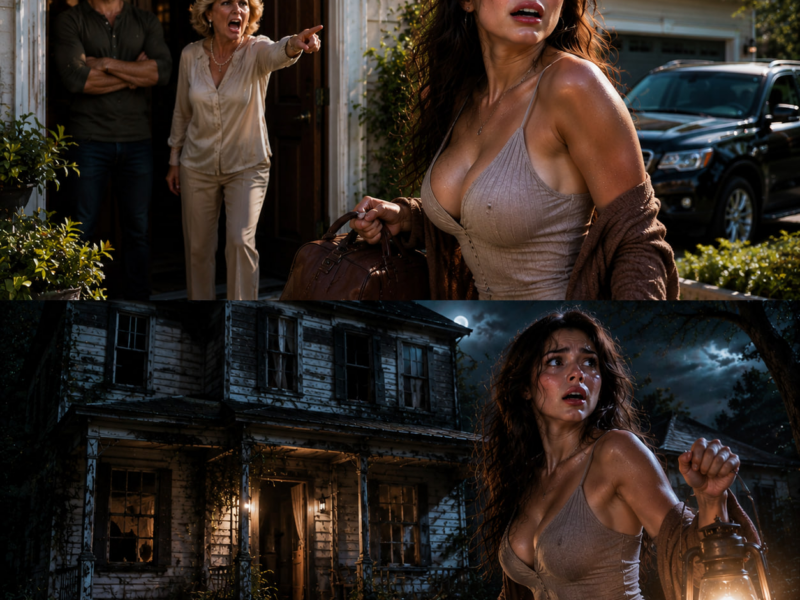
“You don’t belong here. Not now. Not ever.” Kicked out by her mother-in-law in the middle of the night, the young woman wandered aimlessly… and then something horrific happened.
The smile lingered on her face like a crack in porcelain. It stretched too wide, the corners of her mouth splitting just a fraction further than human anatomy should allow. Water dripped from her hair—ploc… ploc… ploc—onto the rotting stairs, though no rain had fallen outside.
The figure on the stairs didn’t descend. She simply… tilted her head, as if listening to something I couldn’t hear. Then she spoke, her voice a wet rasp, like lungs filled with river silt.
The words hit me harder than my mother-in-law’s. They echoed with the same cruel finality. For one insane moment I wondered if this was some fever dream, if I had actually died on that muddy road and this was purgatory’s waiting room.
The woman’s smile faded. Her eyes—black, bottomless—fixed on mine. “I am what remains when they throw you away.”
I grabbed my bag and ran deeper into the house, choosing the only direction that wasn’t back toward her. A long hallway stretched ahead, lined with faded photographs in cracked frames. I didn’t stop to look, but from the corner of my eye I caught glimpses: a family in old-fashioned clothes, a little girl with wet hair smiling at the camera, the same girl floating face-down in a pond.
Silence.
I covered my ears. Tears burned my eyes. Six months ago I had believed marrying Daniel would be my escape from a lonely life. His mother, Margaret, had smiled at the wedding. Three weeks later the mask slipped. I was too quiet, too poor, too “foreign-looking” despite being born in the next county. Daniel never defended me. He just sighed and said, “She’ll come around.”
A floorboard groaned directly above me. I looked up. Dark water was seeping through the ceiling, forming a perfect circle that dripped onto the kitchen table. The drops spelled something in the dust:
I stared. The name meant nothing to me, yet it felt familiar, like a word you forget the moment you wake from a nightmare.
It showed a young woman in a white dress—me. Except it wasn’t me. The woman had my face, my long dark hair, but she was soaking wet, standing on the edge of a pond with that same terrible smile.
Behind me, the kitchen door burst open. Elizabeth stood there, her nightgown clinging to her body as if she had just crawled out of water. Her skin was the color of drowned lilies.
“How do you know that?” I backed away until I hit the piano. The keys clanged discordantly.
My stomach twisted. “You’re dead.”
I felt the temperature drop further. My breath fogged. “I just want to leave. Please.”
She reached out. Her fingers were ice. The moment they touched my wrist, the room dissolved.
I stood in the same house, but it was alive with light and sound. Nineteen forty-seven. A radio played swing music. A young man—handsome, broad-shouldered—sat at the kitchen table reading a newspaper. Elizabeth, alive and radiant, moved around him, setting plates down. She was pregnant.
“You think he’ll stay with you after the baby comes?” Margaret hissed when her son left the room. “You’re nothing but a pretty face. He’ll find someone better. Someone from here.”
Margaret smiled the same smile I had seen on the ghost. “Love dies. Blood doesn’t.”
Margaret dragging Elizabeth by the hair through the woods while the husband slept, drugged with something slipped into his whiskey. The pond black under moonlight. Elizabeth fighting, begging, the cold water closing over her face as Margaret’s strong hands held her down.
When the vision released me, I was on my knees in the parlor, sobbing.
“Now you know,” she said. “The house keeps us. It gives us a chance to punish them. To make them feel what we felt.”
She tilted her head again. “Too late. You crossed the threshold. The house has tasted your pain. It won’t let you leave untouched.”
Elizabeth’s expression changed. For the first time, real grief broke through the ghostly mask. “My daughter never got to live. But you… you can help me.”
Hours passed, or maybe minutes. Time behaved strangely here. Elizabeth showed me more. Other women who had wandered in over the decades. A runaway bride in the 70s. A battered wife in the 90s. Each one discarded, each one absorbed.
I learned the rules. The house was a trap built on generational pain. Margaret’s own mother had been cruel to her. The cycle continued. The house fed on it, growing stronger, calling lost women like sirens.
“You must kill her,” Elizabeth whispered as we stood in an upstairs bedroom. Moonlight filtered through broken windows. “Margaret. She still lives in that house down the road. Old, bitter, waiting for her son to finally see her as right. Kill her, and the house will release you. You can have your life. Maybe even Daniel will wake up.”
Elizabeth’s eyes darkened. “Then you will stay with us forever. Another face in the wall. Another whisper in the dark.”
Against my will, I opened it.
I screamed and slammed the door.
I couldn’t kill Margaret. But I also couldn’t stay.
I turned to Elizabeth. “I forgive her. Not because she deserves it. But because I won’t let her define the rest of my life.”
“You can’t! We don’t forgive!”
The front door, which had been ajar, now stood wide open.
“If you leave, you take nothing. No power. No revenge.”
I stepped through her. It felt like walking through freezing rain. For a moment I was drowning with her, feeling every second of her death. Then I broke through into the foggy dawn.
I walked the muddy road as the sun rose, weak and exhausted but alive. When I reached the main road, an old farmer in a truck stopped and offered me a ride to town. I accepted.
“Where are you?” He sounded frantic. “Mom said you left in the middle of the night. I’ve been worried sick.”
He started to protest, the usual excuses. I hung up.
Six months later I had a small apartment in Philadelphia. I worked at a bookstore. I went to therapy. I started writing—first as a way to process the night, then because the words wouldn’t stop coming.
Elizabeth never fully left me. I think she found some rest through my forgiveness. Or maybe the house is still out there, waiting for the next discarded woman.
As for Margaret—I heard through a mutual acquaintance that she had a stroke not long after that night. She recovered, but her speech was slurred. She could no longer deliver those cutting words so precisely. Daniel finally moved out and got his own place. Last I heard he was in counseling too.
I just live.
“You belonged. You were enough.”
The night that tried to break me didn’t.
Part 3: “You don’t belong here. Not now. Not ever.” Kicked out by her mother-in-law in the middle of the night, the young woman wandered aimlessly… and then something horrific happened.
But peace did not last.
At first, they were small dreams. She saw Elizabeth standing at the end of the apartment hallway, her hair soaking wet, her pregnant belly still swollen. Elizabeth said nothing, only looked at Clara with pitch-black eyes and smiled sadly.
One night, Clara jolted awake, drenched in cold sweat. The crying was so clear it felt like it was right next to her ear. She turned on the light and searched the closet, but found nothing. Only a wet footprint on the wooden floor — the size of a small child’s foot.
“Clara Bennett?” An old woman’s voice, hoarse and weak. “This is Margaret. Daniel’s mother.”
“You need to come back. Daniel was in an accident. His car went into the river. The police say there was something strange… far too much water inside the car.”
That evening, while sitting at her desk writing, the lights in the room began flickering. On her computer screen, instead of her document, an image of the old house appeared. The front door was wide open. Elizabeth stood there, waving her hand.
Clara slammed the laptop shut. But the sound of dripping water came from the kitchen. She ran in and found the faucet turned on by itself, water flooding the floor. In the flowing water, words written in black ink appeared:
Clara panicked and cleaned everything up. She called the shelter and asked for two days off. The next morning, even though she didn’t want to, she bought a bus ticket back to the small town in Pennsylvania.
She didn’t go to Margaret’s house immediately. Instead, her feet carried her back to the haunted house.
“Did you really think forgiveness was enough?” Elizabeth asked, her voice full of pain. “We were partially freed, but the curse remains. Margaret is still alive. Daniel hasn’t paid for his silence.”
Maria stepped forward, her broken fingers still twisted. “But the house demands blood. If not theirs, then yours.”
The basement was pitch black. In the center was a small artificial pond filled with black water. Floating on the surface was Clara’s own face — but drowned, eyes wide open, mouth frozen in a silent scream.
Clara trembled. She remembered everything: the night she was thrown out, a lifetime of loneliness, Daniel’s weakness, Margaret’s contemptuous eyes. Rage surged inside her.
She knelt by the edge of the pond and reached out to touch the water. It was freezing.
A horrifying scream echoed through the house. The water in the pond began to boil, bubbles rising rapidly. Clara’s face beneath the water slowly sank. Elizabeth knelt beside her, tears mixing with the water dripping from her hair.
Clara froze. The same name.
The entire house shook violently. Cracks spread across the walls. The other spirits appeared one last time, nodding to Clara before dissolving into white mist.
“Thank you,” Elizabeth said. “Live for all of us.”
Clara sat there in the darkness for a long time. When she stood up, sunlight was streaming through the cracks in the roof.
At the town hospital, Daniel lay in bed with his leg in a cast. He looked shocked when Clara walked in.
She stood a few feet away from the bed. “Why did you have the accident?”
Clara sighed. “You never could take it. That was the problem.”
She didn’t sit down. She only said what needed to be said: “I forgive you. But we can’t go back. Please heal yourself. And don’t let your mother control you anymore.”
Clara stood there for a moment.
She placed a white flower on the table and left.
She sat down at her desk, opened her laptop. The first page of her new book appeared:
Clara smiled, her fingers moving across the keyboard.
For the first time in a very long time, she finally felt like she belonged to her own life.