“THE NIGHT SHIFT RULES — DON’T WORK ALONE AFTER 11, OR THE STORE STARTS TO NOTICE YOU”
“THE NIGHT SHIFT RULES — DON’T WORK ALONE AFTER 11, OR THE STORE STARTS TO NOTICE YOU”
PART 1 — The First Night Mark Should Have Quit
I still remember the first time I heard someone say the words “don’t work alone after 11.”
It wasn’t said like advice. It wasn’t even a warning.
It was said like a rule that had already been tested… and paid for.
The kind of rule you don’t debate. You just obey.
But Mark didn’t understand that yet.
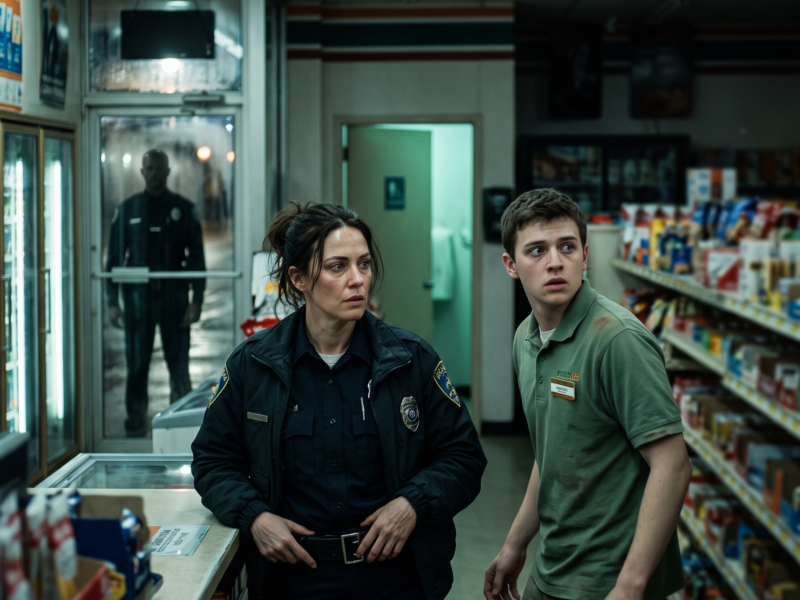
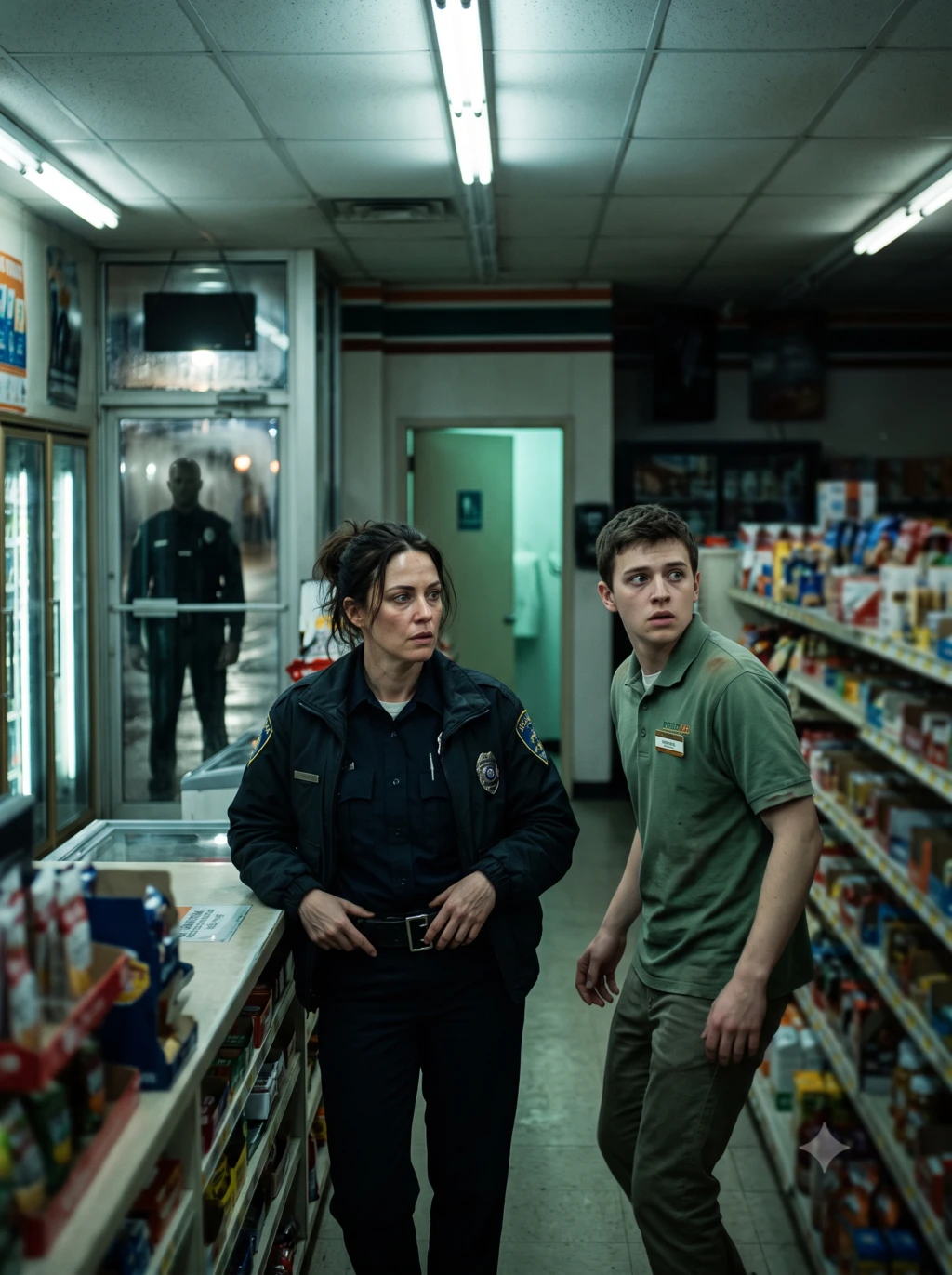
He stood behind the counter of the QuickMart on Route 9 like he was temporarily stuck there, like a guy waiting for something better to start. Early twenties, clean sneakers, fresh haircut, that “I’ll figure it out later” kind of confidence. The kind I used to have before this job taught me otherwise.
I watched him glance at the clock above the coffee machine.
10:58 PM.
Two minutes before the lock.
He smirked. “So what’s the big deal about eleven? Store turns into a pumpkin or something?”
I didn’t laugh.
Because I’d made that joke before too.
And I’d seen what happened when people didn’t take it seriously.
“My name is Samantha,” I said instead, adjusting my badge. “And I’m not your manager. I’m your last warning.”
He blinked at me like I’d spoken another language.
That was the first mistake—thinking I was just another coworker doing night shifts for extra cash. I wasn’t hired. I was assigned. There’s a difference you only understand after you’ve cleaned blood off a freezer handle that shouldn’t have been there.
The lights flickered once.
Not unusual. The grid in this part of Ohio was always unstable.
But the flicker here meant something else.
The store seemed to hold its breath.
I looked at the aisles. All of them too quiet. Too still.
Then I said it.
“The rules are simple. You follow them, you go home in the morning. You don’t, and you don’t make it to morning at all.”
Mark leaned on the counter. “Alright, Samantha. Hit me with your horror movie checklist.”
I should’ve stopped there.
But I didn’t.
Because every new employee thinks it’s a joke… until the store decides to introduce itself.
Rule one: Never work alone after 11 PM.
Rule two: No alcohol sales after 2 AM, no exceptions.
Rule three: If you hear crying in the restroom, you don’t check it.
Rule four: Lock the doors exactly at 11—never early, never late.
Rule five: Never engage customers who don’t blink.
He laughed at that one.
“Customers who don’t blink?” he repeated. “Come on.”
And right on cue, the bell above the door rang.
It was 10:59 PM.
A man walked in wearing a beige coat too clean for this weather. No umbrella. No rain outside. Just wet shoes.
He didn’t blink.
Not once.
Mark froze mid-sentence.
I saw the moment his confidence cracked. Just a little.
The man walked straight to aisle three and stood there staring at nothing. Not products. Not shelves. Just space.
“That’s… weird,” Mark muttered.
“Don’t look at him,” I said quietly.
“Why not?”
“Because he notices when you notice him.”
Mark turned anyway.
Of course he did.
And the man in the beige coat turned his head in response, slowly, like something learning how human movement works.
He smiled.
But only with half his face.
The other half didn’t move at all.
The lights flickered again.
10:59 became 11:00.
And something in the store clicked.
Not a sound.
A recognition.
Like the building itself had just woken up.
I walked to the front door and locked it.
Exactly on time.
The bolt slid into place.
Outside, the world still looked normal. Cars passed. Streetlights hummed.
Inside… the store changed temperature.
Mark whispered, “Did you feel that?”
“Yes,” I said.
“That’s normal?”
“No.”
That was the last honest answer I gave him before things got worse.
The First Breach
At 12:17 AM, Mark tried to prove me wrong.
He said it out loud too, like he needed witnesses.
“I think this is all just—stress stories. Night shift paranoia. You know?”
I was stocking cigarettes behind the counter.
“You can leave anytime,” I said.
He shook his head. “No, I’m fine. I just think—”
The restroom door slammed.
Not opened.
Slammed.
Both of us turned.
The sound echoed too long. Too deep.
Like something had hit the door from the inside.
Mark hesitated.
That hesitation mattered.
Rule three existed for a reason.
“You heard it,” he said quietly.
I nodded.
Another bang.
Then… a child’s voice.
Soft.
Wrong.
“Help me…”
Mark took a step forward.
I grabbed his arm.
“Don’t.”
He looked at me like I was crazy. “There’s a kid in there.”
“There isn’t.”
Another voice came through the door, closer now.
“Please… I can’t breathe…”
And I’ll admit something here that I don’t usually say out loud.
The first time I heard that sound, I checked the bathroom.
That was before Samantha the “experienced night clerk.”
Before Samantha the “rule enforcer.”
Before Samantha learned that curiosity is the easiest way to disappear.
Mark reached for the door handle anyway.
I pulled him back harder this time.
And that’s when the lights went out.
Blackout Protocol
Every store has emergency lights.
This one doesn’t.
This one has silence.
The hum of refrigeration stopped instantly.
Even the street outside disappeared.
No headlights.
No sound.
Just black glass and empty reflection.
Mark’s breathing got louder.
“What the hell—?”
“Don’t move,” I said.
“Why can’t I see anything?”
“Because something else is looking right now.”
That’s when the freezer aisle started knocking.
From the inside.
Not the door.
The metal.
Three slow hits.
Then scratching.
Mark backed into me.
“That’s not—there’s no way that’s—”
I cut him off.
“Rule six. If the store goes dark, you don’t make noise.”
He whispered, “What happens if you do?”
I didn’t answer.
Because I’d seen it once.
A cashier named Ron who laughed during a blackout. Said it was probably just breakers.
We found him behind aisle seven.
Folded into a shape I still don’t like remembering.
The freezer hit again.
Closer this time.
Like it was crawling.
Then a new sound came from the bathroom.
The crying again.
But now it was laughing between breaths.
Mark grabbed my sleeve. “Samantha… what is this place?”
I looked at him.
And for the first time, I didn’t try to soften it.
“This store isn’t normal,” I said. “It sits on something. A thin place. A crack. Call it what you want.”
Another knock.
This time from the ceiling.
Mark whispered, “A crack in what?”
I didn’t answer immediately.
Because I hate saying it out loud.
“Reality.”
The lights snapped back on.
Everything returned instantly.
Too instantly.
Like nothing had happened.
Except the bathroom door was now open.
Just slightly.
And something small stood just inside it.
Watching us.
William Arrives
The bell above the door rang again.
But nobody came in.
Mark turned toward the sound.
I already knew.
“Don’t look,” I said again.
Too late.
He looked.
And I watched the exact moment his face changed from confusion to something much worse.
Recognition.
Like his brain had accepted something it shouldn’t have.
“There’s… a man outside,” he whispered.
“No,” I said.
“That’s not a man.”
The figure stood just beyond the glass.
Tall.
Still.
Wearing a security uniform that didn’t match any company in the world.
No badge.
No name tag.
Just a dark silhouette where a face should’ve been.
Mark swallowed. “Who is he?”
I said the only name I knew.
“William.”
And the moment I said it, the figure raised one hand.
Not waving.
Not greeting.
Signaling.
Like he was counting something only he could see.
Mark stepped back. “Is he… here for us?”
I shook my head.
“No.”
A pause.
Then I added something I didn’t plan to say.
“He’s here because something broke.”
And that’s when the bathroom door opened fully.
End of Part 1
And just like that, Mark stopped being a skeptic.
Because whatever stepped out of that bathroom wasn’t human in any sense that mattered anymore.
And Samantha finally understood the real truth:
The rules weren’t there to keep them safe.
They were there to keep everything else out.
PART 2 — WHEN THE STORE STARTED LOOKING BACK
The bathroom door didn’t just open.
It invited something out.
I remember the exact moment Mark stopped breathing normally. Not fully stopped—people always assume fear works like in movies—but his breathing turned shallow, uneven, like his body was trying to negotiate with his instincts.
The thing in the doorway looked like a child at first glance.
That was the trick.
Small frame. Bare feet. Wet hair hanging over its face.
But the proportions were wrong in a way your brain doesn’t like to accept. Too many joints where there shouldn’t be joints. Arms slightly too long. Neck slightly too flexible, like it was deciding what shape it wanted to be.
It tilted its head.
And smiled.
Mark whispered, “That’s… not a kid.”
“No,” I said.
My voice sounded calmer than I felt. I’ve learned that part the hard way. Panic makes everything notice you faster.
The thing stepped forward.
And the store lights dimmed again—like they were reacting to it breathing.
Behind us, I heard the freezer aisle knock once.
William still stood outside the glass door.
Watching.
Always watching.
Mark backed away. “What do we do?”
That’s the question everyone asks.
Like there’s a clever answer.
There isn’t.
“There’s a rule for this,” I said quietly.
Mark looked at me. “Which one?”
I didn’t answer right away.
Because Rule Seven is the one nobody likes.
And nobody survives learning twice.
“If something comes out during a breach,” I said, “you don’t run. You don’t scream. You don’t acknowledge it directly.”
Mark frowned. “That makes no sense.”
“It does in here.”
The thing from the bathroom stepped fully into the aisle now.
And I noticed something worse.
It was learning Mark’s face.
Like it was saving it.
Mark made the mistake anyway.
He whispered, “What are you?”
The moment the words left his mouth, I closed my eyes.
Too late.
The store exhaled.
That’s the only way I can describe it.
Like a building realizing it has permission.
The lights snapped off completely.
Total darkness.
And then—
Footsteps.
Not fast.
Not slow.
Just… circling.
Mark grabbed my arm. “Samantha—where are you?”
“Don’t move,” I said again.
But he already had.
One step.
That’s all it took.
A sound like fabric tearing echoed somewhere near aisle four.
Then Mark screamed.
Short.
Cut off.
Like someone had muted him.
When the lights came back on, he was gone.
Not dragged.
Not running.
Just… absent.
A smear of wet footprints led into aisle seven and stopped halfway.
Like something had decided it was enough.
The store returned to normal brightness.
That’s the cruelest part.
Everything looked fine again.
The bell above the door rang once.
William was gone too.
And I was alone.
PART 3 — THOMAS AND THE LIE I USED TO BELIEVE
They sent Thomas at 3:12 AM.
He always arrives after something is taken.
Never before.
Never during.
He walked in like a man who had already accepted every possible outcome of the night.
Gray suit. Clean shoes. Calm eyes.
The kind of calm that doesn’t belong in places like this.
He didn’t look at the bathroom.
Didn’t look at the freezer aisle.
Didn’t even acknowledge the missing person report that I hadn’t filed yet.
He just said, “You followed procedure until the breach point.”
I leaned against the counter. My hands were shaking slightly now that the adrenaline was wearing off.
“That wasn’t a breach point,” I said. “That was a collapse.”
Thomas nodded like he agreed and didn’t care at the same time.
“There is a difference,” he said. “But not for you.”
That line always bothered me.
Not for you.
Like I stopped being a person somewhere along the way.
I’ve had jobs before this. Normal jobs.
I worked retail in college. One summer I worked at a gas station off I-75 where a man once tried to pay for cigarettes with coins soaked in gasoline. I still remember the smell of that night. Real-world weirdness. Human weirdness.
But this?
This wasn’t human.
Thomas stepped behind the counter without asking.
Like he owned the space.
“You lost your trainee,” he said.
I nodded once.
“Mark didn’t believe the rules,” I replied.
Thomas sighed. “They never do the first time.”
I looked at him sharply. “How many times has this happened?”
That’s when he finally met my eyes.
And for the first time, I saw something honest behind his professionalism.
“Twelve,” he said.
Twelve.
Something about hearing that number made the room feel heavier.
“Twelve what?” I asked.
“Twelve new hires this year alone.”
I swallowed. “And the ones before?”
He didn’t answer immediately.
That silence told me everything.
PART 4 — WHAT THE STORE REALLY IS
Thomas finally gestured toward the window.
Outside, William was back.
But now there were more of him.
Three silhouettes instead of one.
All standing at different distances in the parking lot.
None of them moving.
“They are observers,” Thomas said.
“What do they observe?” I asked.
“Failure,” he said simply.
That word hit harder than I expected.
He continued, “This location sits on a junction point. Thin boundary between layered realities. You can think of it like a tear in fabric.”
I laughed once, but it came out dry. “I’ve heard that line before.”
“Yes,” he said. “From people who survived long enough to repeat it.”
I looked around the store again.
It didn’t feel like a QuickMart anymore.
It felt like something wearing a QuickMart.
A mask.
A very convincing mask.
“So what are the rules really?” I asked.
Thomas didn’t hesitate.
“They are stabilizers,” he said. “Behavioral anchors. They prevent attention from passing through the boundary.”
I frowned. “Attention from what?”
He finally said it.
“From what lives on the other side.”
A cold feeling moved through me.
“And Mark?” I asked quietly.
Thomas looked down at the counter.
“He made contact,” he said. “Repeated contact. He became visible.”
I understood then.
Not killed.
Not taken.
Indexed.
Like a file being filed away.
I had to sit down.
For the first time in years.
Thomas leaned closer.
“You are still here because you respected Rule One,” he said.
“Don’t work alone after 11,” I whispered.
“Yes.”
I looked at him. “If I had been alone…”
“You would have been noticed sooner,” he said.
That was the moment I realized something I didn’t want to accept.
I wasn’t protecting the store.
The store was using me to protect everything else.
PART 5 — A REAL NIGHT OUTSIDE THIS PLACE
There’s something I should mention here.
Before this job, I used to think people exaggerated night shift stories.
I worked a short stint at a pharmacy in Dayton when I was twenty-six. Nothing supernatural. Just normal exhaustion, angry customers, and the occasional guy buying cough syrup at 3 AM like it was currency.
One night, a woman came in crying because her husband had left her in the parking lot during a snowstorm.
She asked me if I believed in “places that take things.”
I told her no.
She laughed and said, “You will someday.”
At the time, I thought she was unstable.
Now I wonder if she ever worked somewhere like this.
Because she described it too accurately.
A place that “takes things.”
That’s exactly what this store is.
But not randomly.
Not chaotically.
It follows rules.
And rules mean intelligence.
PART 6 — THE NEW SHIFT
They replaced Mark two days later.
I didn’t even ask his name at first.
I didn’t want to.
New guy looked younger than Mark. More nervous. Eyes constantly scanning corners like he expected the walls to move.
Thomas introduced him simply.
“Daniel.”
Daniel nodded at me like I was just another coworker.
I almost laughed.
Almost.
I didn’t tell him about Mark.
That’s part of the job too.
We don’t talk about people who get indexed.
Not because we forget.
Because the store prefers it that way.
At 10:58 PM, I walked Daniel through the rules.
His reaction was familiar.
Smirk.
Disbelief.
The classic pattern.
At 11:00 PM, I locked the doors.
And I saw William outside again.
Only one this time.
He raised his hand slightly.
Not greeting.
Not warning.
Acknowledgment.
Daniel whispered, “Who’s that?”
I looked at him.
And I made a decision I never made before.
“Don’t look at him again,” I said.
He frowned. “Why?”
I hesitated.
Then told him the truth I wish someone had told me.
“Because he remembers you when you forget yourself.”
PART 7 — ACCEPTANCE
Months passed.
The nights didn’t get easier.
They just got… familiar.
That’s the dangerous part.
Humans adapt too quickly to horror when it becomes routine.
Daniel lasted longer than Mark.
But not forever.
Nobody does.
There was a night—rainstorm, power flicker, usual pattern—when he went to check the bathroom.
I told him not to.
He said he just wanted to “make sure nothing was in there.”
That sentence.
“Make sure.”
That’s always the last mistake.
I didn’t stop him fast enough.
And I still hear the door closing sometimes when I think about it.
But I don’t scream anymore.
Because I understand now.
The store doesn’t kill carelessly.
It corrects deviations.
It enforces balance.
And me?
I’m part of the system now.
One night, Thomas asked me something unexpected.
“Do you resent it?”
I thought about that for a long time.
Honestly.
“No,” I said.
And I surprised myself by meaning it.
“I don’t think it cares whether I resent it. It just is.”
He nodded. “That’s the correct perspective.”
I looked at the aisles.
At the quiet hum of something older than the building.
“I used to think this was punishment,” I said.
“And now?” he asked.
Now I understood something simpler.
“It’s maintenance,” I said.
PART 8 — FINAL TRUTH
The deepest truth came from William.
Not Thomas.
Not the rules.
William.
One night, during a full blackout, he stepped inside for the first time.
No hesitation.
No glass barrier.
Just presence.
He stood beside me and spoke for the first time.
His voice wasn’t human.
But it wasn’t monstrous either.
It was… layered.
Like multiple conversations happening at once.
“You think you are workers,” he said.
I didn’t respond.
“You are not,” he continued. “You are anchors.”
I frowned. “Anchors for what?”
He turned slightly toward the ceiling.
“For everything that is not supposed to enter,” he said.
Then he looked at me.
And for a brief moment, I saw something like recognition.
“You are doing well,” he added.
That might have been the most unsettling compliment I’ve ever received.
ENDING — THE STORE KEEPS US ALL
I still work here.
Night shifts.
Same rules.
Same silence.
New faces every few months.
Some survive longer than others.
Some don’t make it past introduction.
But the store continues.
Because it has to.
And so do I.
Every night at 10:58 PM, I walk behind the counter and wait for the bell above the door.
Because it always rings.
And when it does, I remember something I wish I could forget:
The world outside is only safe because something inside here is still following the rules.
And if I ever stop?
If we ever stop?
Then the store won’t be the only thing that notices.
FINAL NOTE
Mark is still here, in a way.
So is Daniel.
So are the others.
Not gone.
Not alive.
Something in between that the store decided was necessary.
And sometimes, late into the night, when everything is quiet and even William is still…
I swear I hear them in the aisles.
Whispering the only thing that still matters:
“Don’t work alone after 11.”