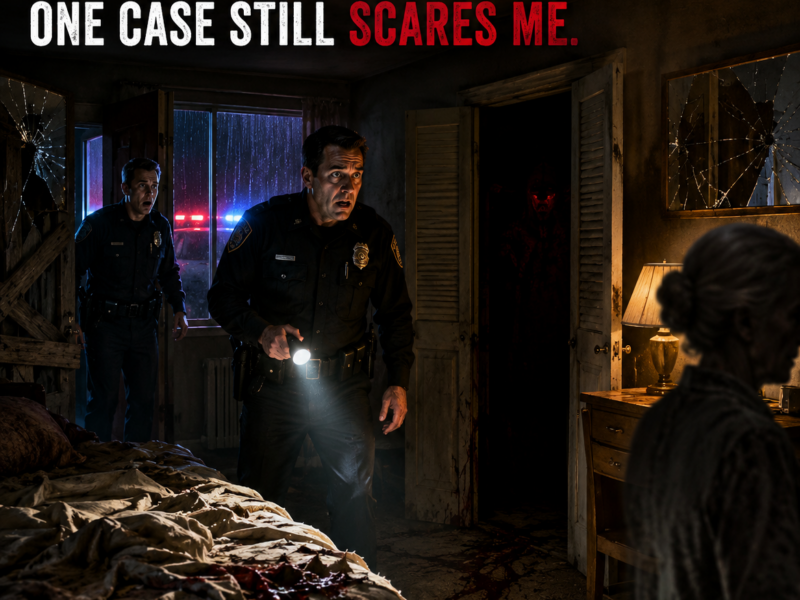
“I’ve Been A Small Town Cop For 13 Years. One Case Still Scares Me”
I’ve Been a Small-Town Cop for 13 Years. One Case Still Scares Me.
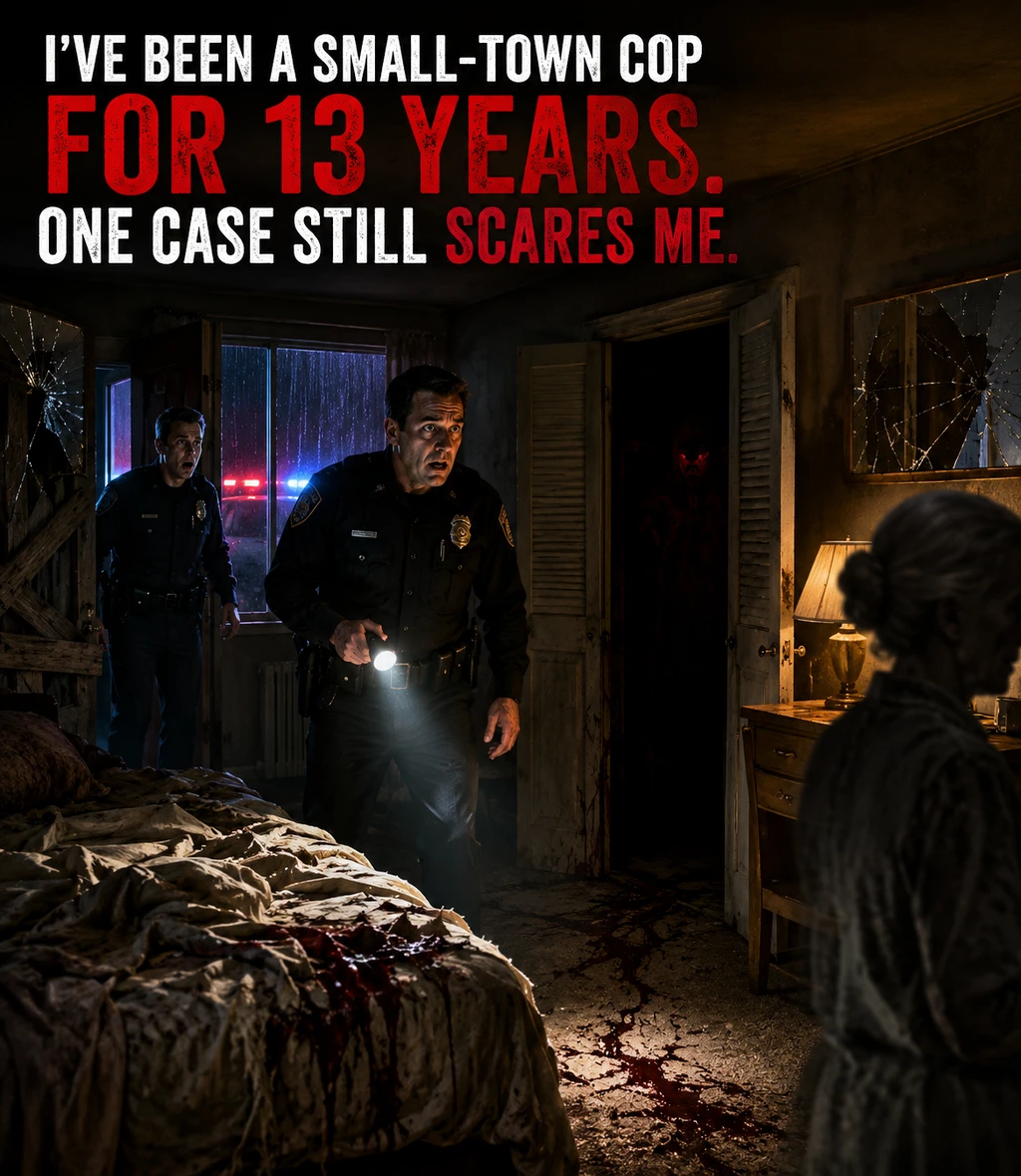
PART 1 — THE WOMAN WHO SAID SOMETHING WAS HIDING IN HER HOUSE
By the time I saw the blood trails leading into the motel closet, I already knew we had made the worst mistake of our lives.
There were ten of them.
Ten thin, shaking lines dragged through the carpet, starting at the bed and ending at the open closet door. They were not footprints. They were not marks from furniture. They were finger marks. Someone had been pulled across that room while clawing at the floor with every last bit of strength she had left.
The room was locked from the inside.
The windows were locked too.
There was blood on the mattress, blood on the wall, blood sprayed across the cheap framed painting above the bed. The curtains were still drawn. The lamp on the nightstand was still on. A paper cup of water sat untouched beside a motel Bible.
But Mrs. Garrity was gone.
Not dead on the floor. Not hiding in the bathroom. Not outside behind the ice machine, not in the parking lot, not wandering confused down the highway in her house slippers.
Gone.
And the closet was empty.
I remember standing there in that doorway with my hand near my holster, staring into a closet barely deep enough to hold a coat rack and two wire hangers, and feeling something inside me go cold in a way the Minnesota winter had never managed. It was not the ordinary chill of fear. I knew fear. Every cop does, even if some of us are too proud to admit it. This was different.
This was the feeling of realizing the rules you had trusted your whole life had just quietly stepped aside.
My partner Jerry stood beside me, breathing through his mouth like he might throw up. Chief Nolan was behind us, his face gray and stiff. Pete and Vance, the two night officers who had forced the door open after the screams, would not come back inside. I did not blame them. Sometimes there is bravery, and sometimes there is just common sense wearing a different hat.
I had seen that woman alive less than twelve hours earlier.
Her name was Eileen Garrity. She was old, lonely, widowed, and scared out of her mind. She had told us there was something in her house. Not someone. Something. She had said it hid in the closets, spoke with her dead husband’s voice, scratched at the wood from the inside, and stared at her from mirrors with red eyes.
We did not believe her.
We thought she was breaking down. We thought grief had finally eaten through whatever was left of her peace. We thought we were being kind when we took her out of that farmhouse and put her in a motel for the night.
That is the part that still hurts.
We thought we were helping.
I have replayed that day more times than I can count. I have changed my answer in my head. I have told myself I should have stayed in the room with her, should have brought her to the station, should have called an ambulance, should have dragged her children out of their comfortable homes and made them look at what loneliness had done to their mother. But regret is a useless weapon. It cuts only the person holding it.
All I know is this: Mrs. Garrity was afraid of the closets in her house.
So we brought her to a place with another closet.
And whatever had been waiting for her followed.
I am writing this now because thirteen years in law enforcement teaches you that stories do not stay buried just because you are tired of carrying them. They wait. They scratch. They call your name in a voice you recognize.
My name is Daniel Mercer. Most folks in town call me Dan. For thirteen years, I wore a badge in a small farming town in southern Minnesota, the kind of place people pass on the highway without ever knowing its name. We had grain elevators, church fish fries, three bars, one grocery store, one high school, and more cornfields than any man needs to look at in a lifetime.
Nothing big was supposed to happen there.
That is what we told ourselves, anyway.
And for the most part, it was true. Small-town policing is not like television. Nobody kicks down doors to dramatic music. Nobody solves a murder in forty-two minutes. Most days, you are dealing with drunk drivers, domestic arguments, stolen lawn equipment, teenagers spray-painting body parts on water towers, and farmers fighting over fence lines that were probably wrong before either of them was born.
People think a slow town means an easy job. It does not. It just means the danger comes wearing familiar faces.
You know the guy you arrest for fighting outside Miller’s Tap because you went to school with his older brother. You know the woman calling about her husband throwing dishes because you saw them smiling together at the county fair last summer. You know the kid stealing beer from the gas station because his mother bags your groceries every Friday.
A big city gives you strangers.
A small town gives you history.
And history makes everything messier.
Back in 2014, when the Garrity case happened, I had been on the force for five years. We had five sworn officers, including Chief Nolan, and a part-time dispatcher named Karen who used to be the town librarian. Karen knew everyone’s birthday, everyone’s maiden name, and every rumor before it became official. Our police department took up one end of the municipal building. Two offices, three holding cells, a coffee maker that tasted like burnt pennies, and a back hallway that smelled faintly of bleach no matter how often it was cleaned.
I worked day patrol with Jerry Walsh.
Jerry was seven years older than me, broad-shouldered, bald by choice, with the calm patience of a man who had raised four daughters and survived. He had a way of talking people down that I admired. He could pull over a drunk farmer, lecture him like a disappointed uncle, and somehow leave the man thanking him. I was still learning that kind of patience. I had the rulebook in my head, but Jerry had people in his bones.
Pete and Vance worked nights. Pete was all jokes and cheap tobacco. Vance was quiet, heavyset, and superstitious in a way he pretended was humor. Chief Nolan was old-school. Not cruel. Not soft either. He had been a cop for nearly forty years by then and believed paperwork should be short, coffee should be black, and officers should not lie to themselves just because the truth was inconvenient.
I did not understand that last part until Mrs. Garrity.
Eileen Garrity lived on Turner Road, about a mile past the last real neighborhood, in a farmhouse that looked like it had been leaning toward collapse since the Carter administration. Her husband Bill had died of a stroke three years earlier. After that, she withdrew from town life almost completely. Groceries delivered once a week. Church attendance stopped. Yard went wild. Curtains stayed closed.
Her two adult children lived out of state. A son in Illinois. A daughter somewhere in Arizona. They did not visit. Maybe they called on holidays. Maybe not. I try not to judge families too harshly because you never know the whole story, but I will say this: America has a quiet way of abandoning old people while pretending independence is the same thing as love.
Mrs. Garrity began calling us about a year after Bill died.
The first call was an intruder in the attic. Jerry and I found raccoons. The second was lights over the cornfield. Probably military aircraft from a base west of us. Then came noises in the walls, a man walking outside at midnight, someone whispering under the porch, a giant snake in the basement, and once, according to Pete, “a demon pretending to be a weather balloon,” though Pete liked to exaggerate when coffee was involved.
We never mocked her to her face.
Behind her back, some did.
Pete used to twirl his finger beside his temple. Vance would chuckle and say, “Old Garrity’s got ghosts again.” Jerry never laughed. Neither did I. There was something sad about her calls, something that made me uncomfortable in a way I did not have words for back then. She was not mean. She was not dramatic for attention. She was frightened, and fear is still fear even when the cause is imaginary.
At least, that is what I believed.
On the day everything changed, rain had been falling since morning. Not hard. Just steady, gray, miserable rain that turned ditches brown and made the whole town smell like wet soil. Jerry and I were in the cruiser near the grain elevator when Karen’s voice came over the radio.
“Unit Two, possible burglary in progress, Turner Road, Garrity residence.”
Jerry glanced at me.
“Guess the raccoons are back.”
I gave a tired smile and turned the cruiser around.
We did not hurry. That is one of the little details that shames me now. We drove normally, wipers dragging back and forth, heater ticking, radio low. I remember passing the Lutheran church and seeing a kid in a yellow raincoat jump over a puddle. I remember Jerry complaining that his youngest had left a wet towel on the bathroom floor again. Ordinary things. Life always surrounds horror with ordinary things. It is one of its meaner habits.
Mrs. Garrity was waiting on the porch when we arrived.
The sight of her made the joking stop.
She had always been thin, but now she looked hollowed out. Her cheeks had collapsed inward. Her gray hair hung in greasy strings around her face. The dress she wore was stained and wrinkled, and her hands trembled at her sides as if she had been standing in freezing wind, though the air was mild. Her eyes were the worst. Bloodshot. Sunken. Open too wide.
I had seen that look once before on a veteran at a domestic call who had woken from a nightmare and punched through his kitchen window. It was not madness exactly. It was exhaustion beyond the point where the face remembers how to pretend.
Jerry stepped out first.
“Afternoon, Mrs. Garrity. What seems to be the trouble?”
She stared at us.
“There’s something in my house.”
Not “someone.”
Something.
Jerry looked at me. I looked at the house.
“What kind of something?” I asked.
She swallowed. Her throat moved like it hurt.
“It hides when people come.”
That sentence bothered me. I will admit that. Not enough to believe her, but enough that I unsnapped my holster before stepping inside.
The house smelled bad.
Not the normal old-house smell of dust, wood, and stale heat. This was sour dishes, unwashed clothes, damp carpet, and fear. Fear has a smell. Any cop, nurse, soldier, or paramedic will tell you that. It is sweat and metal and something animal under the skin.
The Garrity house had always been worn down, but she used to keep it spotless. Not anymore. Dirty plates filled the kitchen sink. Trash bags leaned open near the back door. Laundry lay in the hall. A blanket and pillow were on the living room couch, along with half-eaten food, coffee cups, a Bible, a rosary, and a flashlight with nearly dead batteries.
“She’s sleeping down here,” Jerry muttered.
Upstairs, her bedroom looked abandoned. The mattress bare. The closet door nailed shut with two boards across it. Every mirror we found in the house had been shattered. Bathroom mirror. Hall mirror. Decorative mirror above a side table. Even a little hand mirror broken in the trash.
Then Jerry found the shotgun.
It was leaning in the corner of the living room, an old double-barrel that probably belonged to Bill. Jerry opened it. Two spent shells.
“Fired recently,” he said.
We followed the angle of the blast to the front hall closet. A ragged hole had been blown through the door at chest height. Splinters stuck out like broken teeth. Around the hole were smaller pellet marks. I crouched and shined my flashlight inside.
Nothing.
Just coats, a mop, dust, and darkness.
I told myself a lonely old woman had finally crossed into a place where fear became real to her body. It made sense. She had been isolated for years. Her kids ignored her. Her husband was dead. Maybe she had dementia. Maybe mold. Maybe she had heard animals in the walls and built the rest in her head.
That explanation was comfortable.
Comfortable explanations are dangerous.
When we turned around, Mrs. Garrity was standing behind us in the living room.
Neither of us heard her come in.
Jerry jumped and said something under his breath. I nearly raised my pistol.
Mrs. Garrity did not react. She just looked past us toward the closet.
“Well,” Jerry said, forcing a reassuring tone, “we didn’t find anybody inside. Whoever it was must’ve slipped out before we arrived.”
Her face changed.
It was subtle but terrible. Hope did not leave her face because there had been no hope there to begin with. Something deeper collapsed. Like she had given us one last chance to prove the world still made sense, and we had failed.
“No,” she whispered. “It’s still here.”
“Mrs. Garrity—”
“It hides when you look.” Her voice rose, thin and cracked. “That’s what it does. It waits. After you leave, it’ll come back.”
Then she began to cry.
Not normal crying. Not tears of frustration. This was full-body despair, sobs tearing out of her so hard Jerry and I both moved without thinking. We sat her on the couch. Jerry got water. I knelt in front of her and told her she was safe.
I said that.
God help me, I said that.
After a few minutes, she calmed enough to talk.
She said it started with scratching.
Soft scratching inside her bedroom closet about a month earlier. Slow. Careful. Not like a mouse. Too high on the door. Too deliberate. The first nights she ignored it. Then she opened the closet after the sound stopped and found nothing inside.
A week later, the scratching became louder. Then she saw marks on the inside of the wood. Not claw marks from an animal. Not exactly. She said they looked like fingernails.
Then came Bill’s voice.
Her dead husband called to her from inside the closet.
At first, he was gentle. He told her not to be afraid. Told her God had sent him back. Told her if she opened the door, they could be together again, young again, happy again.
I remember glancing at Jerry when she said that. His face had gone still.
Mrs. Garrity said she almost opened it. She stood barefoot in the dark with one hand on the lock, crying because it sounded so much like Bill. But something was wrong. The words were too sweet. Too smooth. Bill had never talked that way. Bill used to clear his throat before difficult sentences. Bill said “hon” when he was nervous. This voice did neither.
“It was like somebody had stolen his voice,” she said. “But they didn’t know how to wear it right.”
When she refused to open the closet, the voice changed. It grew angry. It cursed. It said things Bill would never have said. Then it pounded on the door hard enough to rattle the room.
After that, she slept downstairs.
Soon the pounding came from every closet in the house at once.
Same voice.
Same threats.
Same horrible patience.
So she nailed the closet doors shut.
Two weeks before we came, the mirrors started.
She was washing her hands in the bathroom when she looked up and saw something where her reflection should have been. A black hood. A skull-like face. Horns. Red eyes. She insisted it was not behind her. It was in the mirror itself. Then, according to her, it reached for her with claws.
She smashed the mirror with a lotion bottle.
Then every mirror in the house.
I wanted to dismiss it. I did. A practical part of my brain was already lining up possible causes: hallucinations, sleep deprivation, grief psychosis. But another part of me kept looking toward that blasted closet door.
“Why didn’t you call us sooner?” I asked.
She gave a bitter smile.
“Because everyone thinks I’m crazy.”
There was no good answer to that.
The worst had happened that morning. All the closet doors began shaking at once. She prayed. The thing laughed. She read from the Bible. It laughed harder. Finally, she got Bill’s shotgun and fired through the front hall closet.
For a moment, everything stopped.
Then she saw two red eyes in the hole.
“What did it say?” Jerry asked quietly.
Mrs. Garrity folded in on herself.
“Tonight.”
That was when we decided she could not stay in that house.
PART 2 — THE MOTEL CLOSET
We should have taken her to the hospital.
I know that now.
At the time, it was more complicated. Small towns make everything personal, and personal decisions have a way of dressing themselves up as mercy. Mrs. Garrity did not want an ambulance. She did not want to be strapped to a gurney, questioned by strangers, or placed under psychiatric observation. She was terrified, yes, but she was also embarrassed. That part mattered to her.
Jerry and I stepped outside to talk under the porch roof while rain ticked against the dead leaves in her yard.
“She can’t stay here,” Jerry said.
“No.”
“She needs evaluation.”
“Yeah.”
He rubbed his jaw. “But if we take her in like that, she’ll fight it. Maybe she shuts down. Maybe she never trusts us again.”
“She needs sleep first,” I said.
That was my contribution to tragedy.
Sleep first.
We called Chief Nolan. He agreed that we should move her somewhere safe for the night and contact her children first thing in the morning. If they refused to help, he would start the process himself. It was not perfect, but real life almost never gives you perfect. It gives you wet shoes, tired people, limited authority, and choices you hope you can live with.
We packed a small bag for her. Toothbrush. Clothes. Medication bottles from the bathroom cabinet. A framed photo of Bill she insisted on bringing. I noticed she would not step near any closet while we moved through the house. She stood in the center of each room, watching the doors like a trapped animal watches tall grass.
When we walked her to the cruiser, she looked back once.
The upstairs curtain shifted.
Just slightly.
I told myself it was air pressure from the door.
Jerry saw it too. He did not say anything.
We took her to the Prairie Star Motel, a cheap two-story place by the highway with a buzzing sign and vending machines that stole quarters. It was not fancy, but it was clean enough, warm enough, and five minutes from the station. We got her Room 12 on the ground floor because she did not want stairs.
There was a closet in the room.
Of course there was.
A little sliding-door closet near the bathroom. Barely a closet. More of a recessed space with a metal rod and two spare pillows on the shelf. Mrs. Garrity noticed it immediately. Her hand tightened around the photo frame.
“We can keep it open,” Jerry said.
He slid both closet doors wide.
She stared inside.
“Nothing there,” I said.
She did not smile, but her shoulders lowered a little.
We checked the bathroom, under the bed, behind the curtains. Jerry even knocked on the closet wall like a man inspecting a used car. I turned on the TV for background noise. Some local weather report filled the room with ordinary words: rainfall totals, county roads, overnight lows. Ordinary words help frightened people. They remind the mind it is still in the world.
Mrs. Garrity sat on the bed and touched the blanket like she had forgotten what clean fabric felt like.
“I’m sorry,” she said.
“For what?”
“For being trouble.”
I hated that. I still do. People apologize for needing help because the world has taught them need is an inconvenience. Old people especially. Lonely people. People who have already called too many times and been half-believed too often.
“You’re not trouble,” I told her.
She looked at me then, really looked.
“You don’t believe me.”
I hesitated.
A better man might have lied beautifully. Jerry would have found something gentle. I was younger and more honest than kind.
“I believe you’re scared,” I said.
She nodded slowly. “That’s not the same.”
No, it was not.
Jerry promised we would contact a priest in the morning. He said it lightly, half comfort, half strategy. Mrs. Garrity cried again, but this time from relief. She hugged him, then me. Her body felt bird-bone fragile under my hands.
As we left, she stood at the door wrapped in a motel blanket.
“Keep the closet open,” I reminded her.
She nodded.
That was the last time I saw her alive.
Back at the station, our smiles faded before we reached the parking lot. Jerry drove in silence. I looked at the rain on the windshield and felt uneasy in a way I could not explain.
“You think she’s hallucinating?” I asked.
Jerry kept his eyes on the road.
“I think she’s been alone too long.”
That answer stayed with me. It still does.
Loneliness can rot a house from the inside. It does not always look dramatic. Sometimes it looks like unopened mail, spoiled food, dirty dishes, and a woman sleeping on a couch with a Bible in one hand and a shotgun nearby. I have seen plenty of violence in my career, but neglect has its own kind of brutality. It kills slower, so people feel less guilty watching it happen.
We told Chief Nolan everything.
Not every detail. Not at first. We described her condition, the shotgun blast, the nailed closets, the shattered mirrors. The chief listened without interrupting. He had a habit of leaning back with his arms crossed when thinking, eyes narrowed at nothing.
When I mentioned the word “tonight,” his gaze shifted to me.
“She said it said that?”
“Yes.”
“Tonight.”
I nodded.
Pete, who had come in early for night shift, let out a low whistle.
“Old lady needs a padded room.”
Jerry shot him a look. Pete raised both hands.
“I’m not being cruel. I’m saying she needs help.”
He was not wrong. That was the problem. Sometimes unkind people say true things in ugly ways, and kind people avoid true things because they sound harsh.
Chief Nolan decided he and I would visit her son and daughter in the morning. Her daughter was unreachable by phone, but her son lived close enough in Illinois for a direct visit if needed. The chief had no patience for adult children who treated elderly parents like unpaid debts.
“She’s not going back to that house alone,” he said.
I respected him for that.
Then we went home.
I lived then in a small rental duplex near the water tower. I remember getting into bed around eleven-thirty, too tired to sleep. Rain tapped against the window. My wife, Laura, was visiting her sister in St. Paul that week, so the place felt too quiet. I kept thinking about the Garrity house. The nailed doors. The mirrors. The way she said something had stolen Bill’s voice.
Around two in the morning, I woke suddenly.
No noise. No dream I could remember. Just awake, heart pounding.
My phone rang at 4:07.
Chief Nolan.
“Dan,” he said, voice tight. “Get to the Prairie Star. Now.”
He would not explain over the phone.
I dressed in less than a minute.
The motel parking lot was bright with emergency lights when I arrived. Red and blue flashed across wet pavement. Pete and Vance stood outside Room 12, both pale. Jerry sat on the curb with his head down. State police were already there, along with two detectives from the county seat. That alone told me something had gone badly wrong. We did not call outside help for nothing.
Chief Nolan met me near the tape.
“She’s gone,” he said.
I thought he meant dead.
He saw my face and shook his head.
“No. Gone gone.”
The neighbors in Rooms 11 and 13 had called after hearing screams. Not a scream. Screams. Then crashing, thudding, something dragging across the floor. Pete and Vance responded first. The door was locked from inside. They forced it open.
“What did they find?” I asked.
The chief looked older than he had the day before.
“You need to see it.”
I ducked under the tape.
The room smelled like iron.
Blood was everywhere, though not enough to explain what the room suggested. The bed sheets had been torn half off the mattress, bunched toward the foot as if she had grabbed them while something pulled her away. The nightstand lay on its side. The motel Bible was open on the floor, pages ripped and stuck to the carpet. The TV still played weather reruns with the sound low.
I followed the blood marks.
Ten finger trails.
They crossed the carpet from the bed to the closet.
The closet doors stood open.
Inside: nothing.
No trapdoor. No hole. No blood pooled in the back. No vent big enough for a cat. Just a rod, two wire hangers, and one spare pillow on a shelf.
A closet cannot swallow a woman.
That is the sentence my mind kept repeating.
A closet cannot swallow a woman.
But Mrs. Garrity was gone.
The official search lasted two weeks. Volunteers combed ditches. Dogs tracked nothing useful. We checked surveillance from the gas station across the highway. No sign of her leaving. No vehicle pulled up to her room. No person entered after we left. The motel windows had been locked from the inside. The bathroom vent was too small. The ceiling intact.
Her children finally came.
The son looked irritated until he saw the room. The daughter cried in a way that sounded like guilt arriving late. I wanted to be compassionate. Some days I was. Other days, not so much.
The official report used words like “suspected abduction,” “unknown assailant,” and “possible staging.” Nobody liked those words, but reports need language, not truth. Truth is harder. Truth would have said an old woman told us something was hiding in her closets, and then she vanished into one.
Nobody wanted that in a file.
I did not sleep well for months.
Jerry started drinking more. Pete stopped joking about Mrs. Garrity. Vance requested transfer to county patrol within the year. Chief Nolan kept the case file in his office, not in storage. I knew because sometimes I would pass his door late and see him reading it under the desk lamp.
We never found Mrs. Garrity.
But her house still stood on Turner Road.
And three weeks after she disappeared, every closet door in that house was found standing open.
PART 3 — THE COLD GIRL AT THE STATION
Five years passed.
That sounds impossible after something like Mrs. Garrity, but time does what it always does. It covers the sharp edges with ordinary days. You still remember, but you learn to function around the memory. Bills come due. Cars need oil changes. People get married, divorced, arrested, sick. The world does not pause because your understanding of it cracked.
By 2019, I had been a cop for ten years.
Laura and I had a son by then, Ben, who was four and believed my badge meant I personally knew every fire truck in Minnesota. My hairline had retreated. My patience had improved. Jerry was still my partner, though quieter. Chief Nolan was talking about retirement in that fake way older men do when they want someone to beg them not to.
The Garrity case had become a ghost story.
Not publicly. Officially, it was still unsolved. But in the station, it lived in half-sentences. Somebody would mention a weird call and then stop. A closet door would stick in the back hallway, and nobody joked while forcing it open. When we stayed late, most of us avoided looking too long at the three holding cells if the doors were dark.
Fear does not disappear just because men refuse to name it.
That summer, Vance was out having his appendix removed, so I covered night patrol for a week. I hated nights. Day shift has its own headaches, but night shift lets a town show you its private face. People drink more. Cry more. Tell the truth by accident. Old streets look unfamiliar under sodium lights.
It was late June or early July. Warm evening. Bugs ticking against the station windows. I was in the office with Chief Nolan and Pete before shift, talking about nothing important. Pete had brought gas station donuts. The chief was working a jigsaw puzzle on his desk because retirement anxiety had apparently turned him into someone’s grandmother.
Then the woman appeared.
I do not mean she walked in dramatically. I mean one second the office doorway was empty, and the next she was standing there.
All three of us saw it that way.
She was young, maybe nineteen or twenty. Slender. Soaking wet from head to toe. Water dripped from her hair onto the floor. Her dress was pale blue, old-fashioned, clinging to her like she had climbed from a lake. Her skin was so white it did not look like normal cold. It looked like wax. Her eyes were wide and frantic.
“Please,” she said. “You have to help me.”
The chief stood so fast his puzzle pieces scattered.
“What happened?”
“Someone kidnapped me.” Her teeth chattered. “I got away. I think he was going to kill me.”
That woke the room up.
Pete grabbed a blanket from the back. I moved a chair toward her. The chief slipped into procedure, calm and steady.
“What’s your name, ma’am?”
“Shirley,” she said. “Shirley Anne McDougall.”
I wrote it down without thinking.
She wrapped the blanket around herself but kept shivering. Water pooled beneath the chair. Not a few drops. A puddle. I remember that because later, when people asked if maybe she had sprayed herself with water or staged the whole thing, I wanted to tell them: no prank leaves that much lake water on a police station floor.
“How old are you, Shirley?” the chief asked.
“Nineteen.”
“Where do you live?”
“With my parents. Above the hardware store on Main.”
Pete and I exchanged a look.
There was no hardware store on Main. Not anymore. Had not been one in my lifetime.
The chief did not react. That was one of his gifts. He could hear a lie, a confession, or a death threat and keep his face still.
“Name of the store?”
“McDougall’s Hardware,” she said, confused by the question.
A strange silence settled.
Pete mouthed, What?
The chief asked her to tell us everything from the beginning.
Shirley stared past us, as if looking at a street none of us could see.
She said she had gone to the movies with friends. A Martin and Lewis comedy at the Mayan Theater. Afterward, she stopped at Beckman’s Drugstore for a chocolate malt before walking home.
The Mayan Theater had been closed for decades.
Beckman’s Drugstore had become a CVS years earlier.
Chief Nolan kept writing.
Outside Beckman’s, she said, a man approached her. Older. Silver hair. Dressed like a priest. He had a crutch under one arm and asked for help retrieving his wallet from under the front seat of his car. He seemed polite. Harmless. She felt sorry for him.
That line made my stomach tighten.
Predators survive because decent people do decent things.
“What kind of car?” I asked.
“A Buick,” she said after thinking. “Dark. A couple years old. Maybe a ’53 or ’54.”
A 1953 or 1954 Buick that was only a couple years old.
The chief’s pen stopped for half a second.
Then he kept writing.
She said she knelt to reach under the seat. The man struck her from behind with the crutch. She blacked out. When she woke, he was dragging her to the trunk. She fought. He hit her. Called her names she did not want to repeat. Shoved her into the trunk and drove.
Her voice became smaller as she told it.
I have taken statements from assault victims. You learn to recognize when a person is not performing fear but reliving it. Shirley was reliving it. Every bump. Every scream. Every breath in that sealed dark space.
She did not know how long he drove. An hour maybe. Then the car swerved. Tires screamed. The vehicle crashed into water. The trunk filled. She panicked. Kicked. Pounded. Screamed.
Then nothing.
“The next thing I remember,” she whispered, “I was at the surface. I don’t know how I got out. I swam to shore. I walked back here.”
Nobody spoke.
The station clock hummed.
Pete looked unsettled in a way I had rarely seen. The chief tapped the pen once against the report.
“Shirley,” he said gently, “who is the current president?”
She blinked.
“What?”
“Just answer me.”
“Dwight Eisenhower.”
Pete looked away.
The chief’s voice softened.
“What year is it?”
She gave a nervous little laugh. “1956.”
Nobody moved.
The chief slowly turned the desk calendar toward her.
The year printed at the top was 2019.
At first, Shirley stared as if the numbers were in another language. Then she backed away. Her wet shoes squeaked on the floor.
“No,” she said. “No, that’s not right.”
The chief gestured to the computer on his desk.
“Have you seen one of these before?”
She did not answer. Her eyes moved to the wall map. Alaska. Hawaii. She whispered both names like they were impossible. Then she stumbled to the window and looked at the parking lot.
“The cars,” she said. “What’s wrong with the cars?”
That was when she began to panic.
Not screaming. Worse. Hyperventilating, clutching her stomach, trying to understand sixty-three years in one breath. The chief told Pete to take her to the women’s restroom. Pete helped her up. As they passed me, her arm brushed my hand.
She was cold.
I do not mean chilly from being wet. I mean cold like meat in a freezer. Cold so deep my skin seemed to reject the memory instantly.
Pete felt it too. His face changed.
When the door closed behind them, the chief and I stood in silence.
Finally, I forced a weak laugh.
“Hell of a night.”
The chief did not smile.
“McDougall’s Hardware burned down when I was a kid,” he said.
I stared at him.
“What?”
“Wilbur and Harriet McDougall. Owned the store. Lived upstairs. Fire killed them in ’67 or ’68. I remember my parents talking about it.”
I did not like where this was going.
“They had a daughter,” he continued. “She disappeared before that. Years before. I remember hearing her name.”
“Chief.”
He looked at me.
“This town has had strange before.”
We both thought of the same thing.
A motel room. Blood. Finger trails. An empty closet.
Then Pete shouted from down the hall.
We ran.
He stood outside the women’s restroom, pale as paper.
“She’s gone.”
The restroom had three stalls, all empty. One sink. One small window above it, unlatched. We rushed outside. Nothing. The window was high, but a small person could have squeezed through. There were no footprints in the cut grass. No wet trail. No girl running down Main. No sound but cicadas and distant traffic.
“She must’ve climbed out,” Pete said.
Nobody argued.
We needed that explanation.
We searched for Shirley Anne McDougall that night. Put out an alert. Checked hospitals, roadsides, fields, ditches, the riverbank. Nothing.
The puddle she left in the station dried by morning.
Her report stayed on the chief’s desk for three days.
Then he put it in the same drawer as the Garrity file.
PART 4 — THE NAME IN THE OLD NEWSPAPER
I told myself Shirley was a disturbed young woman who knew local history.
That explanation was not perfect, but it was usable. Maybe she had read about the McDougall disappearance online. Maybe she acted out the details during a psychotic break. Maybe she had found vintage clothing, soaked herself, and staged the whole thing for reasons only she understood. People do strange things. Cops learn that early.
But I also searched the old records.
Not because I believed her.
That is what I told myself anyway.
I went to the county archive on my day off. The woman at the desk, Ms. Harlan, had known me since I was in high school and still called me “Danny,” which should be illegal after age thirty. She helped me pull old newspapers from microfilm. There it was.
August 1956.
LOCAL GIRL MISSING AFTER MOVIE NIGHT.
Shirley Anne McDougall, 19, daughter of Wilbur and Harriet McDougall, vanished while walking home from the Mayan Theater. Last seen by friends after a late showing of a Dean Martin and Jerry Lewis film. Police searched fields, roads, waterways. No sign found.
I sat there staring at the grainy article until Ms. Harlan asked if I was okay.
There was no photo.
I searched follow-ups. Nothing useful. The case faded from the papers the way missing girls sometimes did before cable news and social media turned tragedy into national theater. Her parents lived with the wound for eleven more years before dying in the hardware store fire. No siblings mentioned. No surviving family I could find.
I copied everything and brought it to Chief Nolan.
He read without speaking.
Finally, he said, “Doesn’t prove anything.”
“No.”
But his voice said something else.
The case might have ended there for us. A strange night. A ghost story we did not tell. Life moved again. Pete insisted she had climbed out the window. Jerry, when I told him, said nothing for a long time, then asked if I wanted a drink. I did.
Laura noticed I was distant. I told her work had been strange. She asked if it was dangerous. I said no.
That was a lie.
Not because of any gun or criminal or road accident. It was dangerous because I had begun to doubt the floor beneath reality. That kind of doubt follows a person home. It sits at the dinner table. It watches your child sleep. It makes you check closets twice even when you know they are empty.
A week later, Ben woke at midnight crying.
I found him sitting in bed, blanket pulled to his chin.
“There’s a man in my closet,” he said.
My heart stopped.
I opened the closet fast, almost angrily.
Nothing.
Just toys, shoes, a laundry basket, a winter coat.
Ben sniffed. “He said Grandma wanted me.”
Laura’s mother had died before Ben was born.
I stood there with the closet light on, feeling sweat gather under my shirt.
Kids dream. Kids hear things. Kids repeat phrases from shows and half-remembered conversations. I know that. I believe that.
Still, I slept on his bedroom floor that night.
No voice came.
By morning, I had nearly convinced myself I had overreacted. Then I saw the closet door.
Three faint scratches marked the inside panel about five feet above the floor.
Could have been old. Could have been from a hanger. Could have been from anything.
I took the door off its hinges that afternoon and told Laura I wanted to repaint it.
She looked at me for a long time.
“Dan,” she said softly, “what’s going on?”
I almost told her everything.
Instead, I said, “Bad case.”
It was the coward’s answer, but not an untrue one.
For the next few years, nothing happened.
Chief Nolan retired in 2021, then came back part-time as a consultant because men like him do not know how to belong fully to their own living rooms. Jerry left the force after a heart scare and opened a small bait shop by the lake. Pete became sergeant. I moved into investigations, though “investigations” in our town still mostly meant stolen ATVs and people lying badly about insurance claims.
The Garrity house finally burned in 2022.
Electrical, they said. Old wiring. No injuries. I drove out after the fire was out and watched steam rise from blackened beams. The closets were gone. The mirrors were gone. The porch where Mrs. Garrity had stood in the rain was gone too.
I expected relief.
I felt none.
A place can burn down and still not be finished with you.
Then, in the spring of 2026, the lake gave up the Buick.
A man named Corey Voss was testing a new fish-finder sonar on Blackwater Lake, one town over. He picked up a shape twenty feet down near the old quarry drop-off. At first, he thought it was a fallen dock section. Then divers went in.
They found a car.
A 1953 Buick.
Rusted. Crushed in front. Oklahoma plates still attached.
Inside the driver’s seat was a skeleton.
In the trunk was another.
A young woman.
I was in the station break room when Pete came in holding the newspaper. He did not say a word. Just set it on the table.
LAKE YIELDS DARK SECRET AFTER 70 YEARS.
The article said the Buick was registered to a man named Raymond Colter, a drifter with a record in multiple states. In the mid-1950s, the FBI had suspected him in the disappearances of several young women across the Midwest. They never caught him. He simply vanished.
The article mentioned one survivor in Iowa who had escaped a man dressed as a priest.
A man with a crutch.
I sat down.
Pete lowered himself into the chair across from me.
“Tell me she was lying,” he said.
I could not.
DNA identification took time, but everyone already knew. The second skeleton was Shirley Anne McDougall.
The girl who appeared in our station in 2019 had been dead at the bottom of Blackwater Lake since 1956.
That fact should have been impossible.
It was also true.
Chief Nolan, retired or not, came in that afternoon. He had aged more than I wanted to admit. He looked at the newspaper, then at me.
“We have to talk about Garrity,” he said.
I knew he was right.
The two cases were different, but they touched the same nerve. Shirley came from a death trapped in water and metal. Mrs. Garrity vanished into a closet after hearing the dead. One returned to speak. One was taken where no person should be taken. Both stories involved doors that did not behave like doors.
Chief Nolan believed there were places in town where the past had not stayed put.
I wanted to reject that. Even after everything, some stubborn part of me wanted to remain practical. The problem with being practical is that reality does not ask permission before becoming strange.
We began reviewing old cases.
Not officially. There was no budget code for “possible supernatural pattern.” We worked after hours, in the chief’s old office, with coffee and boxes of records pulled from storage. Missing persons. Unexplained deaths. Fires. Drownings. Old domestic calls. Reports involving closets, mirrors, locked rooms, voices of the dead.
Most were nothing.
Some were not.
In 1978, a child disappeared from a farmhouse pantry during a blizzard. Parents heard him calling from inside the wall for three nights after. In 1989, a woman reported seeing her dead sister in every mirror before crashing her car into a ditch. In 2003, a farmer was found dead in his grain silo after telling neighbors his deceased father kept calling him from the barn.
Could all of it be coincidence? Sure. That is the word people use when patterns make them uncomfortable.
Then we found something else.
The Garrity farmhouse had not originally belonged to the Garritys.
In 1957, it had been rented by Raymond Colter.
The same man whose Buick was found in the lake.
The same suspected killer.
The same man who abducted Shirley.
For three months before he disappeared, he had lived on Turner Road in the house that would one day become Eileen Garrity’s.
I remember Chief Nolan taking off his glasses and pressing both hands over his eyes.
Pete whispered, “No.”
But the record was clear.
Colter had lived there.
And according to one old property complaint, neighbors had once reported screaming from the house.
No charges. No follow-up. No evidence.
Just a note.
Screaming heard after midnight. Tenant denies disturbance.
That was when the shape of the story changed.
Mrs. Garrity had not been haunted by grief alone. She had been living in a house that once belonged to a killer. A house that may have held screams, locked doors, and stolen voices long before she ever heard Bill calling from the closet.
Maybe evil leaves stains.
Maybe some places remember what people do inside them.
Maybe a closet is just wood and hinges until enough terror passes through it.
I do not know.
I only know what happened next.
PART 5 — THE ROOM WITHOUT A DOOR
The county wanted to close Shirley’s case once the remains were identified.
That made sense. Her killer was dead. Her body was found. Her family was gone. What else was there to do?
But closure on paper is not the same as peace.
The discovery brought reporters to town for a week. True-crime podcasts called. A YouTuber showed up filming outside the station until Pete threatened to arrest him for blocking access. People online turned Shirley into content before she had even been properly buried. That bothered me more than I expected.
Maybe because I had heard her voice.
Maybe because I had seen her confusion when she realized the world had moved on without her.
The town held a memorial service at St. Matthew’s, even though nobody knew whether Shirley had been Catholic, Lutheran, Methodist, or nothing at all. It did not matter. Sometimes ritual is for the living, and the living needed to say her name out loud.
The church was half full. Mostly older residents, officers, a few reporters in the back pretending not to be reporters. I sat with Laura. By then, I had told her most of it. Not everything in one night. A marriage can hold truth, but you still have to pour it carefully. She believed me because she knew when I was lying, and fear had made me too tired to lie well.
Chief Nolan spoke at the service.
“She was a daughter of this town,” he said. “And this town forgot her for too long.”
That line hit people hard.
It should have.
After the service, I found myself standing outside in the churchyard beside Shirley’s temporary marker. The final burial would be later, once paperwork finished. A summer wind moved through the trees. The sky looked too blue for such a sad day.
An elderly woman approached me using a cane.
“Officer Mercer?”
“Yes, ma’am.”
“My name is Ruth Bell. My mother knew Shirley.”
I straightened.
Ruth was in her eighties, small but sharp-eyed.
“She said Shirley was sweet,” Ruth continued. “Quiet. Always polite. My mother used to say the town failed that girl.”
“In what way?”
Ruth looked toward the church doors.
“People knew girls had gone missing along highways. They knew strange men passed through. But back then, folks didn’t like making trouble. A girl disappeared, people prayed, searched a little, then went back to supper.”
There was no bitterness in her voice. That made it worse. She was simply telling the truth.
Before leaving, Ruth handed me an envelope.
“My mother kept clippings. I found this years ago.”
Inside was a newspaper photo I had never seen.
Not of Shirley.
Of Raymond Colter.
Grainy. Dark suit. Silver hair. A face both ordinary and deeply wrong once you knew what it had done. Behind him in the photo was the Garrity farmhouse. The caption said he had been questioned after a complaint but released.
On the edge of the photo, barely visible in an upstairs window, stood a woman.
Or something shaped like one.
I showed Chief Nolan that evening.
He stared at it for a long time.
“Could be curtains,” he said.
“Could be.”
Neither of us believed that.
We decided to visit the site of the Garrity house one last time.
Pete insisted on coming. Jerry too, though he was retired and technically had no business there. Laura wanted me not to go. I understood. She did not forbid it. That is one reason I love her. She knew this was not about curiosity. It was about finishing a thing that had been unfinished too long.
The house was gone, but the foundation remained.
We arrived near sunset. Bad choice, maybe. Or maybe there was no good time. The burned property sat behind yellowing grass, charred beams removed, basement filled in unevenly. A few black stones marked where the chimney had stood. The air smelled of weeds and old ash.
Jerry stood with hands in his jacket pockets.
“Still hate this place,” he said.
Pete tried to laugh. Failed.
Chief Nolan held the photo Ruth had given us.
“If Colter brought victims here,” he said, “there may be more.”
We had already considered that. Ground-penetrating radar could be requested if we had probable cause. The old complaint, the photo, Colter’s history, and Shirley’s remains might be enough.
Then we heard scratching.
All four of us froze.
It came from beneath the ground.
Soft.
Slow.
Deliberate.
Pete whispered, “Nope.”
The scratching stopped.
Then a voice spoke from under the filled foundation.
“Danny?”
My stomach dropped.
It was my son’s voice.
Ben was alive at home, twelve miles away, probably playing video games and ignoring homework.
“Danny,” the voice called again, higher, frightened. “Dad, help me.”
Jerry grabbed my arm.
“Don’t answer.”
The voice changed.
Laura.
“Dan, please.”
I closed my eyes. That was a mistake. The sound became clearer. My wife crying. My son pleading. My mother, dead since 2018, telling me she was cold. Every person I loved seemed trapped under that dirt.
Chief Nolan stepped forward, shaking.
Then the voice became Mrs. Garrity.
“Please,” she whispered. “Don’t leave me again.”
That broke something in him.
The chief fell to his knees.
“I’m sorry,” he said.
The ground beneath the old foundation shifted.
Not much. Enough.
A narrow crack opened near the chimney stones, black and clean, as if the earth had split around a seam. Cold air breathed out. It smelled like wet wood, old blood, and closed rooms.
Pete drew his gun with trembling hands.
Jerry pulled the chief back.
From inside the crack, a red glow appeared.
Two points.
Eyes.
I wish I could say I acted bravely. I did not. I stood there, terrified, while the past opened its mouth in the ground.
Then Chief Nolan did the only useful thing any of us did that night.
He took the photo of Colter, held it over the crack, and said, “You don’t get to wear their voices anymore.”
The eyes vanished.
A sound came from below—not a scream exactly, more like many doors slamming at once.
The crack widened.
And we heard women.
Not one. Many.
Crying, gasping, whispering.
Names.
Shirley.
Eileen.
Others we did not know.
Then, as suddenly as it opened, the crack collapsed inward. The ground sank a few inches and settled. Silence returned. Real silence this time. Crickets. Distant traffic. Wind moving grass.
Chief Nolan was crying.
None of us spoke of that part publicly. What would we have said? That a dead killer’s house had opened under us and used our families’ voices? No. We did the practical thing. The believable thing. The next morning, we requested a forensic excavation of the property based on Raymond Colter’s confirmed residence and suspected connection to multiple disappearances.
They found bones.
Not whole bodies. Fragments. Some old, some burned, some too degraded for identification. Enough to prove the land had hidden more than one crime.
The state took over. FBI consultants arrived. Reporters returned. The Garrity property became a crime scene, then a memorial site, then eventually an empty lot fenced off by the county.
No one found Mrs. Garrity.
Not exactly.
But during excavation, in the packed dirt beneath what had once been the front hall closet, they found her wedding ring.
It was clean.
That detail never made the paper.
PART 6 — THE DOOR I KEEP OPEN
People always want horror to end with an answer.
They want the monster named, the curse explained, the bones identified, the door locked forever. I understand that. Answers comfort us. They make fear feel smaller, like we can put it in a labeled box and store it on a shelf.
Real life rarely works that way.
Raymond Colter was dead. Shirley was buried. The remains found under the Garrity property gave several families long-delayed grief and a few bitter forms of closure. The town held another memorial the following spring, this time for “the unknown victims of Turner Road.” There were flowers, speeches, a permanent stone marker, and more reporters than anyone wanted.
Chief Nolan died eight months later.
Heart failure.
At his funeral, Pete said the chief held the line between the world we understood and the one we did not. That sounded dramatic for Pete, but it was true. Some men spend their lives pretending nothing scares them. Chief Nolan was better than that. He was scared plenty. He just kept walking when it mattered.
Jerry retired fully and moved closer to his daughters. He calls me every Christmas. We never discuss Turner Road directly, but sometimes there is a pause on the line where the memory sits between us like a third person.
Pete became chief.
That still feels strange. He jokes less now. Good leaders often begin as people who finally learn when not to laugh.
As for me, I stayed on the force.
People ask why. Not about the supernatural part, of course. They ask why anyone remains a cop in a town where every family knows your grocery cart and every mistake becomes a story at the diner. The answer is simple and not simple at all. Because communities need people who show up. Because fear gets worse when no one answers the call. Because Mrs. Garrity called us, and even though we failed her in ways I will carry forever, we did answer.
That has to count for something.
I became more careful with lonely callers.
An old man reports footsteps in his attic? I check. A widow says someone is whispering outside her window? I do not smirk. A teenager says her mirror moved wrong? I listen. Most of the time, it is raccoons, loose shutters, anxiety, grief, bad wiring, or a phone reflection. Fine. I will take a hundred false alarms if it means I do not ignore the one that matters.
That is my opinion after thirteen years: people deserve to be taken seriously before they are proven right.
Especially old people.
Especially frightened women.
Especially anyone the town has already labeled “crazy.”
The world is too quick to turn fear into a punchline.
At home, we removed most of our closet doors.
Laura did not argue. Ben thought it was weird for a while, then got used to it. Kids adapt faster than adults. In our bedroom, the closet has no door. In the hallway, no door. In Ben’s room, no door. The only closet door left in the house is the small linen closet near the bathroom, and I keep it open with a rubber wedge.
Maybe that sounds extreme.
Maybe it is.
But my family sleeps.
That matters more than looking normal.
One night last winter, during a snowstorm, I woke at 2:13 a.m. The house was quiet. Furnace ticking. Wind pushing snow against the windows. Laura asleep beside me.
Then I heard scratching.
Soft.
Slow.
From the hallway.
I got out of bed and took my pistol from the lockbox, though deep down I knew a pistol had nothing to do with what frightened me. I stepped into the hall.
The linen closet door was still open.
The rubber wedge sat in place.
Inside were towels, cleaning supplies, a box of old Christmas lights.
Nothing else.
Then my phone buzzed.
A message from an unknown number.
I looked at the screen.
It said: Thank you for not leaving us there.
No sender. No callback. No record once I blinked and checked again.
Just the empty message screen.
I stood in the hallway for a long time, listening to my house breathe.
Some people would call that a haunting. Maybe it was. But it did not feel like a threat. It felt like a door closing somewhere far away. Not slammed. Not locked. Just closed because it was finally allowed to be.
I went back to bed.
Laura opened her eyes.
“Everything okay?”
I thought about Mrs. Garrity. Shirley. The unknown women under Turner Road. Chief Nolan on his knees. Jerry gripping my arm. Pete whispering no into the dark. My son’s voice coming from a place my son had never been.
“No,” I said honestly.
Laura reached for my hand.
“But we’re safe?”
I listened.
No scratching.
No voices.
No closets waiting in the dark.
“Yeah,” I said. “We’re safe.”
And for once, I believed it.
I do not know what lived in the Garrity house. I do not know if evil made a doorway there, or if the suffering of Colter’s victims stained the place so deeply that the dead and the living began reaching through the same cracks. I do not know why Shirley found us for twenty minutes in 2019, soaking wet and terrified, before disappearing back into whatever current had carried her across sixty-three years.
But I know this.
A town remembers what it refuses to face.
A house remembers what happened inside it.
And a person can spend years calling for help before anyone truly hears them.
So if you ever hear someone scratching behind a door, do not laugh first.
Listen.
Turn on the light.
Call for help.
And if the voice on the other side sounds like someone you loved and buried years ago, step back. Breathe. Remember what love actually sounded like when it was alive. Love does not lure. Love does not demand you open dark doors. Love does not threaten when you refuse.
Some voices are stolen.
Some doors are hungry.
And some stories only end when someone finally believes the person everyone else dismissed.
Mrs. Garrity used to say something was hiding in her house.
She was right.
We were just too late to save her.
But we were not too late to say her name.