I Work as a Park Ranger in Ohio. I Just Found Something TERRIFYING.
The Last Ranger of Northern Ridge
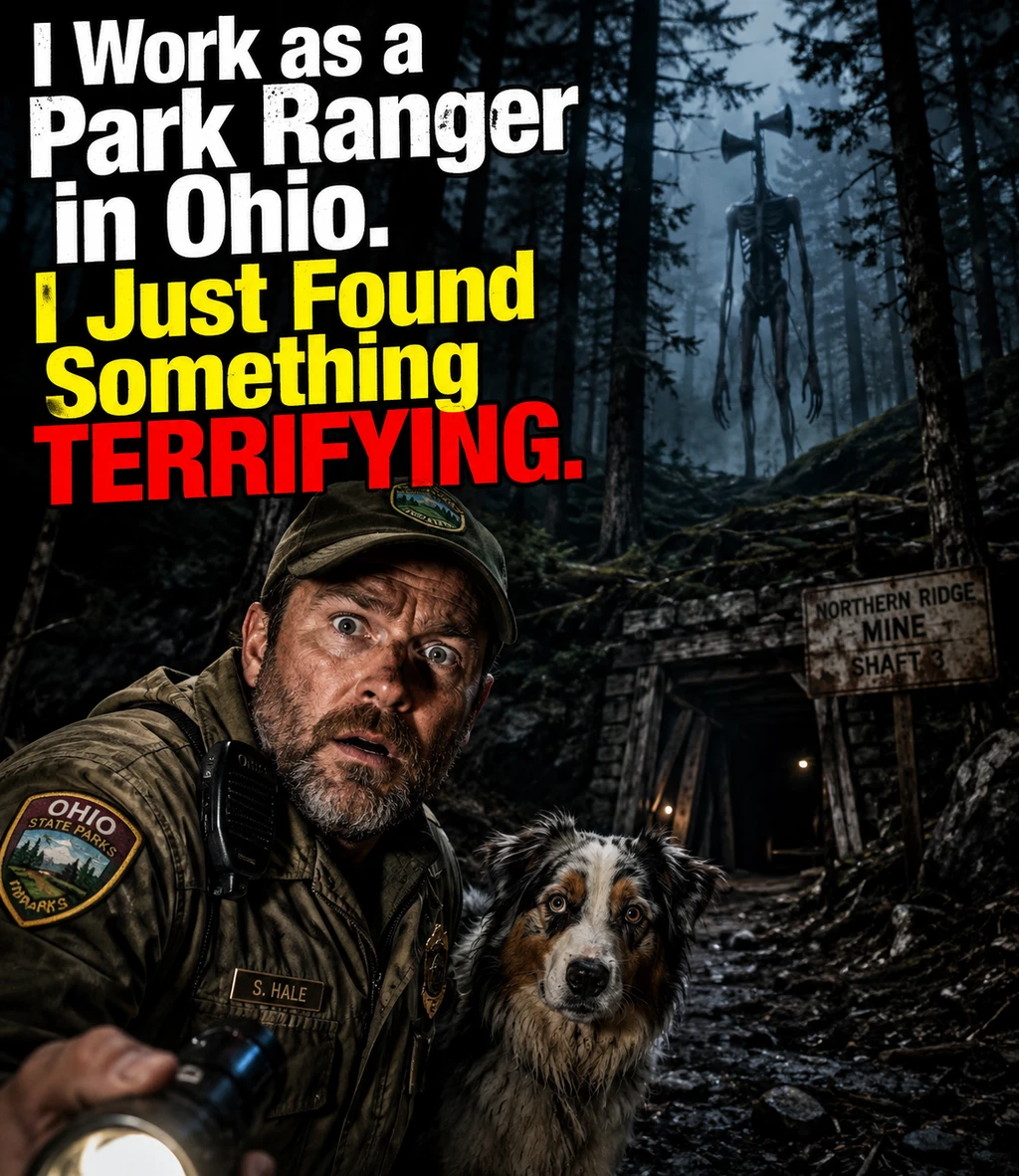
The night I stopped being a park ranger, I saw a boy sitting in the back seat of my truck with his face drained white, my dog pressed against his knees, and something taller than the trees standing beside the old mine road like it had been waiting for us to pass.
I did not scream.
That is the part people never understand when I tell them. They expect panic. They expect a man to slam the brakes, drop the flashlight, pray, cry, or do something heroic and stupid. But fear does not always come out loud. Sometimes it turns the body into a locked door. Sometimes it presses one cold hand over your mouth and says, keep driving.
So I did.
My hands stayed on the wheel. My eyes stayed forward. The gravel road ran crooked beneath the headlights, twisting through black pines and patches of dead ferns. I could smell smoke from the illegal campfire I had just put out. I could smell wet dog fur and old coffee on my own shirt. Behind me, sixteen-year-old Jimmy Whitaker sat so still he might have been carved out of wax.
Bailey, my Australian shepherd, never barked once.
That frightened me more than anything.
For twelve years, Bailey had barked at raccoons, park squirrels, drunk campers, loose trash bags, thunder, fireworks, and once at a plastic flamingo some tourist had stuck outside Cabin 8. But that night, with something impossible standing in the tree line, she only lowered her head and leaned her body against that boy like she was trying to keep his soul from leaving.
The thing was not a shadow. I wish it had been. Shadows can be blamed on moonlight, exhaustion, and fear. This was real enough that my headlights slid across its long gray limbs. Real enough that I saw rust on the metal sirens where a head should have been. Real enough that, for one horrible second, the twin horns tilted toward us, not like eyes watching, but like ears listening.
Listening for our breathing.
Listening for our thoughts.
Listening for the part of us that wanted to turn around and understand.
I kept driving.
We passed the old gate, then the ranger station, then the last warning sign I had hammered into the ground myself two weeks before. The sign said AREA CLOSED. UNSTABLE MINES. DO NOT ENTER.
Like a sign had ever stopped anything hungry.
When the main road finally appeared ahead of us, Jimmy began to shake. Not crying. Not yet. Just shaking from his shoulders down, his breath coming in short little pulls. I told him he was safe. I told Bailey she was a good girl. I told myself the same thing.
None of us believed it.
By sunrise, I had mailed in my badge, my keys, and a resignation letter so short it looked rude. By the end of that week, I had sold my truck. By the end of that month, I could no longer sleep with a window open.
But before that night, before the boy, before the voices in the woods and the missing pets and the deer left in places no deer should have been, Northern Ridge was home.
That is the part I need you to understand.
A place can love you for years and still turn on you.
Or maybe it never loved you at all. Maybe you were only useful until you finally noticed what had been standing behind the trees the whole time.
My name is Samson Hale. For sixteen years, most people knew me as Ranger Samson. I worked at Northern Ridge National Park in southern Ohio, a place most folks drove through without realizing how much land was hidden beyond the scenic loop and the picnic shelters. We had ridges sharp enough to split the sky, creeks cold enough to numb your hands in July, old mining roads swallowed by vines, and a lake that turned silver every morning before the sun broke over the eastern hills.
I loved that land with the embarrassing devotion of a man who had never figured out how to love much else.
I was not married. I had come close once, years ago, with a nurse named Ellen who thought my job sounded romantic until she realized “park ranger” meant midnight rescue calls, blood on boots, missed dinners, and a paycheck that made no sense for the amount of danger involved. She wanted a house near Columbus, kids, decent internet, and a husband who did not smell like pine smoke six days a week.
She was not wrong for wanting those things.
I was not wrong for staying.
That is something age teaches you if you let it. Sometimes nobody is the villain. Sometimes life simply puts two good people on roads that do not meet again.
After Ellen left, the park became more than a job. It became a routine, then a refuge, then a kind of marriage all its own. I knew which trail signs would loosen after heavy rain. I knew where teenagers hid beer cans under rotting logs. I knew the families who came every Memorial Day and acted like Cabin 6 was ancestral property. I knew the sound of a healthy forest, too. That mattered later.
A healthy forest is never silent.
People from the city think silence means nature. It does not. Nature whispers, clicks, hums, knocks, rustles, splashes, and breathes. Bugs scrape their legs together in the grass. Owls argue after midnight. Branches creak. Frogs call from the wet ditches. Even the dead leaves have a voice when mice move under them.
Silence in the woods is not peace.
Silence is a held breath.
I grew up poor enough that vacation meant borrowing a tent from my uncle and pretending canned beans tasted better outside. My father was a mechanic with cracked hands and a temper that softened only around campfires. My mother cleaned rooms at a motel off Route 50, and she could stretch twenty dollars farther than any banker I have ever met. We did not go to theme parks. We did not fly anywhere. We drove to state forests in a station wagon that overheated on hills, and we slept under nylon that leaked at the corners.
I loved every second of it.
When I was ten, my little sister Leah stepped on a rusted nail near a campsite. My mother panicked. My father cursed himself for not watching the ground. Then a ranger appeared from the tree line like a man sent by God. Big beard, mirrored sunglasses, clean uniform, calm voice. He washed Leah’s foot, wrapped it, told my parents where the nearest clinic was, and let me hold his flashlight while he worked.
I must have asked him fifty questions.
He answered every one.
That was it for me. Some boys see a firefighter and decide their future. Some watch a ballgame and dream of stadium lights. I watched a ranger kneel in the dirt beside my crying sister, steady as a church bell, and I thought, I want to be that kind of useful.
I did not go to a fancy college. I took community classes at night, did seasonal conservation work, learned basic emergency response, forestry management, trail maintenance, and search-and-rescue. I learned how to talk to people who were scared, drunk, lost, angry, or all four. I learned how to fix a bridge with two boards and a bad attitude. I learned that tourists lie about where they were hiking because they do not want to admit they ignored the sign.
Most of all, I learned that the woods do not care what you planned.
You adjust, or you get hurt.
Northern Ridge hired me full-time when I was thirty-two. By then, I had more patience than ambition and more comfort in trees than conference rooms. The old superintendent, Frank Delaney, told me on my first day, “This park rewards people who pay attention.”
He was right.
He did not warn me that it also punishes people who pay attention too late.
For years, the job was hard in ordinary ways. Storm damage. Flooded trails. Injured hikers. Kids throwing rocks at hornet nests. Men in expensive boots trying to prove they were outdoorsmen until they got poison ivy where no man wants poison ivy. I once spent six hours coaxing a retired dentist down from a ledge because he had climbed up to take a picture of a hawk and then remembered he hated heights.
Another time, in late October, we searched all night for a woman with early dementia who had wandered away from her family’s cabin. We found her at dawn sitting beside the lake, singing to herself with her shoes placed neatly beside her. She was cold, but alive. Her daughter hugged me so hard my radio dug into my ribs.
Those moments stay with you.
So do the bad ones.
I have carried bodies. Not many. Enough. A heart attack on Blue Heron Trail. A drowning near the lower falls. A young man who slipped during a winter hike and was found under ice two days later. People say they want honest work until honesty looks like telling a mother she needs to sit down before you give her news that will take the floor out from under her.
I am not saying this to make myself sound noble. I was not noble. I complained plenty. I hated paperwork. I drank too much gas station coffee. I got short with reckless visitors. I once threw a clipboard across the supply shed because central office denied our request for new trail radios while spending money on “visitor engagement banners.”
Still, I believed in the job.
So did the others.
We called ourselves the Green Watch because Pete Granger carved it into a crooked wooden plaque and nailed it above the ranger station coffee maker. Pete had been an Eagle Scout, a volunteer firefighter, and the kind of man who could make a broken generator run by insulting it properly. Amanda Ruiz was our best tracker and the only person I knew who could read a muddy footprint like a court document. Torres handled wildlife calls. Jake trained the seasonal kids. Ellie ran education programs and could make a room full of fifth graders listen to bear safety like it was a magic show.
We were a little family.
Like most little families, we did not realize how good it was until people began leaving.
Pete moved to Montana after his wife got sick. Torres took a job with Fish and Wildlife. Jake went west, chasing better pay and bigger mountains. Ellie got married and had twins. Amanda held out the longest. She loved Northern Ridge almost as much as I did, but the last winter before everything happened, I caught her standing behind Station Two, staring into the east woods with her arms folded tight.
“You hear that?” she asked.
I listened.
Nothing.
“No,” I said.
She nodded like that answer disappointed her.
In April, she resigned. Told me she wanted to live closer to grocery stores and streetlights. She smiled too wide when she said it. I knew enough not to press.
By the time summer came, it was mostly me, a few seasonal hires, one nervous recruit named Ralf, and Bailey.
Bailey was my dog, though calling her that feels disrespectful. She was my partner. Australian shepherd, blue merle coat, one ear that stood up and one that folded over like it had changed its mind halfway through. I found her at a shelter in Oakhill when she was maybe a year old. Skinny, quiet, watching everybody with suspicious brown eyes. While the other dogs barked and jumped, Bailey walked straight to my boots, sat down, and rested her chin on my left shoe.
The shelter worker said, “Well, I guess she picked you.”
She did.
For twelve years after that, Bailey rode beside me in trucks, slept under my desk, chased frogs by the lake, sniffed illegal fire pits like a detective, and charmed every child who came through the visitor program. She had a gift for finding granola bars in backpacks and guilt in human beings. If a camper claimed they had not left food out, Bailey would trot straight to the exact cooler behind their tent and sit there with her tail wagging.
She was not perfect. She stole a hot dog from a mayor once. But she was loyal in a way that made me ashamed of how easily people give up on each other.
That summer began like every summer at Northern Ridge. Too hot. Too bright. Too many minivans dragging too much gear. Campers poured in with coolers, folding chairs, fishing poles, portable speakers, bug spray, and confidence they had not earned. The air smelled like sunscreen, charcoal, lake mud, and cut grass.
Ralf arrived in late June.
He was twenty-three, maybe twenty-four, with careful hair, clean boots, and a pocket notebook he treated like holy scripture. He wrote down everything. Trail conditions. Visitor complaints. Radio codes. Bailey’s feeding schedule. Once, I caught him writing “clouds moving east” like the sky needed documentation.
He was a good kid.
Nervous, but good.
He asked about the east side on his third day.
“Those mining trails,” he said, pointing at an old map in the station. “Why are they blocked off so far back? The collapse zone doesn’t look that wide.”
“It’s not just one collapse zone,” I told him. “It’s a whole system. Old shafts, side tunnels, drainage cuts. Some mapped, some not. Mining company went under in the late sixties. Left a mess behind.”
“Anyone ever get in?”
“People get in everywhere they’re told not to.”
He smiled like he thought I was joking.
I was not.
The old mine lands sat beyond the eastern ridge where the healthy forest thinned into something rougher. The trees grew crooked there. The ground dipped without warning. Rusted rails poked through moss in places. A few sealed entrances remained visible, dark mouths behind fencing and warning signs. We checked those fences twice a month because teenagers treated danger like a personal invitation.
I never liked that area.
I told myself it was practical dislike. Unstable ground. Bad radio reception. Poison sumac. No easy access for rescue vehicles. All true. But there was something else too, something I did not say out loud because I was a grown man with a badge and a mortgage.
The east woods felt watched.
Not always. Not dramatically. Just enough that you sometimes turned your head expecting to catch someone stepping behind a tree. We blamed old equipment noises for a while. Wind through broken pipes can make strange sounds. So can loose metal signs, hollow logs, coyotes, and your own imagination after dark.
A person who works outdoors learns to respect imagination without obeying it.
That was my rule.
Then Jimmy Whitaker walked into Station Two with his parents and a cracked iPhone.
It was early July, around five in the evening. The station smelled like dust and lemon cleaner because Ralf had decided to “freshen the workspace,” which meant moving everything I needed to the wrong drawer. I was restocking first-aid kits when a family came in looking embarrassed in the way only parents of teenagers can look.
The father, Bill Whitaker, wore cargo shorts and a Cincinnati Reds cap. The mother, Marcy, held her purse in both hands like she wanted to apologize to it. Jimmy stood between them, skinny, pale, black band T-shirt hanging off him, hair falling into his eyes. He looked annoyed, but underneath that annoyance was fear.
Real fear.
Marcy said, “Our son thinks he saw something.”
Bill added, “Probably nothing. We told him not to bother you folks, but he won’t let it go.”
Jimmy did not look at them. He looked at me.
“Where?” I asked.
He swallowed. “East side. Past the boundary signs.”
Bill threw up a hand. “See, that’s another thing. He knows he shouldn’t have been there.”
I gave Jimmy the ranger look. Every ranger has one. It says, I am not your parent, but I have pulled enough stupid people out of ravines to be disappointed in you professionally.
Jimmy shifted his feet.
“I was taking pictures for a school project,” he said. “Erosion. The old mine area has washouts.”
“School project in July,” I said.
His face reddened. “Summer credit.”
That sounded like a lie, but not the important kind.
He unlocked his phone and showed me two photos. The first was bad. Trees, brush, a slope of loose rock, nothing unusual. The second was worse quality, zoomed too far, grainy enough to make any shape suspicious.
But there was a shape.
It stood deep between two trees, pale gray against shadow. Tall. Too tall. Thin in a way that made my stomach tighten. At first, I thought it was a dead trunk stripped of bark. Then I saw the angle of the arms. Or what looked like arms. Long, narrow, hanging down.
At the top was something that did not belong to any animal.
A double cone shape. Like old speakers. Like emergency sirens.
I stared at the picture a little too long.
Bill noticed.
“What is it?” he asked.
“Probably old mining equipment,” I said, handing the phone back. “Could be a damaged vent pipe or a piece of machinery. Phone cameras do strange things in low light.”
Jimmy’s eyes hardened.
“You don’t believe me.”
“I believe you saw something.”
“That’s not the same.”
No, it was not.
I filled out an incident note, warned him about restricted areas, and told his parents to keep him on marked trails. Marcy thanked me too many times. Bill looked relieved to have an official adult reduce his son’s terror to bad lighting.
Jimmy lingered near the door.
“It was looking at me,” he said quietly.
A smart ranger does not feed fear in a child.
A truthful man does not dismiss it either.
That day, I chose the ranger.
“Trees can look like people when you’re scared,” I told him.
He left without answering.
That picture bothered me all evening. I walked Bailey along the northern ridge after dinner, and twice I caught myself scanning between trees for pale shapes. I felt ridiculous. I was forty-eight years old, a veteran ranger, afraid of a blurry photo on a teenager’s phone.
By morning, I had mostly talked myself out of it.
The forest was loud again. Bugs. Birds. Tourists. A toddler screaming because a butterfly had landed on his sandwich. Ordinary life has a way of bullying fear into the corner.
For one week, nothing happened.
Then the college hikers came in.
Two of them, both sunburned, both trying to act cooler than they felt. They had been near the firewatch trail around dusk and saw “some tall thing” standing across a ravine. Their words, not mine. At first, they thought it was a moose, which told me they were not from Ohio and had not paid attention in biology. Then it moved wrong, they said. Not walking. Shifting. Like one long piece of shadow sliding behind another.
No photo.
No injuries.
I logged it.
Three days later, a father from Dayton reported hearing what sounded like an old tornado siren in the east woods around 2 a.m. We had no sirens in that part of the park. Closest town siren was seven miles away, and there had been no test that night.
I logged that too.
After that, reports came every few days. Always from different visitors. Always near the eastern trails or old mine boundary. Something tall. Something pale. Something standing too still. Sometimes people heard a tone, low and far away, like a public warning system buried underground. Sometimes they heard voices.
The internet found us before we found answers.
That is how trouble grows now. Not by rumor drifting from porch to porch, but by posts, clips, edits, hashtags, and strangers with too much time telling scared kids to go back and film better proof. Jimmy’s blurry picture appeared online under a username I later learned was his. Someone brightened it. Someone circled the shape in red. Someone added dramatic music. Then the comments started.
Fake.
Siren Head.
Bro found Ohio’s final boss.
Go back at 3 a.m. or it doesn’t count.
Within two weeks, Northern Ridge had a nickname online: Sirenhead Park.
Central office hated it in public and loved it in private.
Attendance jumped. Campgrounds filled. Local news sent a lifestyle reporter to do a cute segment about “spooky summer tourism.” The gift shop sold out of flashlights. A coffee stand in town started offering a “Siren Latte,” which was just vanilla with too much cinnamon. One of our seasonal hires, Tyler, posted a photo of a rusty trail sign with the caption, “We heard something in the woods,” and got more attention than any official safety announcement we had ever made.
I told him to take it down.
He said, “It’s harmless.”
That sentence has caused more damage in this world than almost any curse word.
Harmless.
People use it when they want fun without responsibility. A harmless joke. A harmless rumor. A harmless dare. Harmless until somebody steps over a fence, follows a sound, slips into a shaft, and leaves a mother standing in a parking lot screaming into her phone.
I brought my concerns to Superintendent Wallace during a video meeting. Wallace had never spent a full night in our park, but he owned three fleeces and spoke in the voice of a man who believed meetings were weather systems.
“We don’t want to validate unfounded claims,” he said.
“I’m not asking to validate a monster,” I told him. “I’m asking for more patrol staff near the east boundary.”
“We’re reviewing allocation.”
“That means no.”
“That means we’re reviewing allocation.”
A week later, we received two boxes of new visitor brochures and no extra staff.
So we did what underfunded people always do. We stretched.
I assigned Ralf to daylight patrols only. Tyler and another seasonal, Monica, handled campground education. I took evenings with Bailey. I walked the mine boundary until my knees ached, replacing signs people tore down, tightening fencing, cutting new footpaths made by trespassers.
At first, the problems were normal, just more frequent. A twisted ankle near the upper basin. A teenager dehydrated after hiking with one bottle of soda. A couple lost after leaving the marked trail to “find the haunted area.” I lectured them hard enough that the woman cried. I felt bad for that later, but only a little. Fear is kinder than a funeral.
Then came the tent.
It belonged to a woman named Denise Caldwell, camping alone at Pine Loop. Around midnight she ran into Station Three barefoot, shaking so badly she could not hold the paper cup of water Monica gave her. Her tent had been sliced open from the outside. One long cut down the back panel, high above where an animal would claw. No food taken. No prints we could identify. No sign of another camper nearby.
“Could it be a bear?” Monica asked me after Denise left with a sheriff’s deputy.
“No,” I said.
I did not elaborate.
The missing pets started after that. First, a cat in a harness outside an RV. Then a beagle named Murphy. Then two dogs from different campgrounds on the same night. One leash was found still tied to a tree, not snapped, not chewed exactly, but separated in a way I did not like. The fibers looked burned or rubbed apart.
People got angry, as people do when fear needs somewhere to go. They blamed coyotes, the park, teenagers, each other. A man from Indiana threatened to sue us because his wife’s emotional support Yorkie disappeared after he ignored three warnings not to leave animals outside.
I did not say what I was thinking.
I kept Bailey close from then on.
She hated the leash at first. Bailey was used to ranging ahead, circling back, checking brush, pretending she ran the operation. Now she stayed at my left knee, looking up at me with betrayal in her eyes. I told her she could be mad as long as she stayed alive.
Dogs understand more than we give them credit for.
By late August, the woods had changed.
Not everywhere. The lake still glittered. Kids still dropped marshmallows in fire pits. Cicadas still screamed from the maples near the visitor center. But east of the firewatch trail, sound thinned out. Birds avoided certain pockets. Bailey would stop sometimes, nose lifted, ears flat, and refuse to move forward until I turned us around.
I trusted her.
That is another thing age teaches. If a good dog says no, consider the matter seriously.
The first missing family was found alive, but not unchanged.
The Harpers had come from Pittsburgh for a long weekend. Parents, two kids, ages twelve and nine. They left their cabin after lunch for what should have been a short hike. At four, they had not returned. At five, their grandmother called the station. By six, we had search teams out.
I found them just after sunset under a white oak nearly a mile off trail.
All four were sitting in a line.
No backpacks. No shoes on the father. No visible injuries besides scratches. The mother stared at her hands. The younger boy rocked back and forth. The daughter kept asking where her brother was, though he sat right beside her. The father looked at me with empty eyes and said, “We were following the bell.”
There was no bell.
We brought them out. Paramedics checked them. The official explanation became disorientation, heat stress, and possible dehydration. That was not entirely false, which made it easier for everyone to swallow.
I did not sleep that night.
Around 3 a.m., I stood outside the ranger station with Bailey beside me and listened toward the east woods. For a long time, there was nothing.
Then, very faintly, I heard my mother call my name.
My mother had been dead six years.
I went inside, locked the door, and sat at my desk until sunrise with Bailey’s head in my lap.
I did not tell anyone. That was cowardice. I know that now. At the time, I told myself it was professionalism. No point scaring the seasonal staff. No point sounding unstable. No point putting something in a report that would make Wallace recommend leave instead of help.
But silence helps the wrong side.
I should have spoken sooner.
The incident with the boy at the ridge finally forced our hand.
It was a Saturday tour, one of the last before Labor Day. We had twenty visitors walking the overlook trail above the lower falls. I had given the safety talk. Stay on the path. No climbing barriers. Watch loose rocks. Keep children within arm’s reach.
People nodded the way people nod when rules are still theoretical.
The boy’s name was Mason. Ten years old. Red hair. Freckles. Too much energy. His older sister had stayed back at the cabin with a headache. His parents were taking pictures near the overlook when Mason went quiet.
That is what I remember.
Not a shout. Not running. Quiet.
I turned because Bailey made a sound I had never heard before, half bark, half scream. Mason had stepped over the low barrier and was walking toward the edge like he was crossing a kitchen floor. No fear. No hesitation. His eyes were fixed on something below.
I lunged.
Too late.
He went over.
His mother screamed in a way I still hear sometimes when a chair scrapes wrong.
Bailey was already moving. She tore down the slope through brush and loose stone before I could call her back. I followed, falling more than running. The creek below was high from storm rain, white water slamming over rocks. Mason surfaced once, then vanished under a ribbon of foam.
Bailey hit the water.
I cannot explain what that dog did except to say she did the impossible because she did not know it was impossible. She caught the back of Mason’s jacket in her teeth and fought the current, paws striking rock, body twisting, water rolling over her head. I reached them downstream with another visitor, a former EMT from Akron. Together we dragged boy and dog onto the bank.
Mason coughed up creek water and began crying for his sister.
His sister was two miles away.
He said he had heard her calling from below the falls.
Bailey stood trembling beside me, bleeding from one paw, and tried to lick his face.
The local paper wrote about her. HERO DOG SAVES BOY FROM DEADLY FALL. The town gave her a medal at a little ceremony outside the visitor center. Bailey tried to eat it. Everyone laughed. I smiled for the photo, but inside I felt something hard settling into place.
The park had become dangerous in a way we were not allowed to name.
After Mason, we shut down guided tours near the east side and then the overlook. Wallace finally approved temporary restrictions, though the public notice blamed storm erosion and maintenance. People complained online. They accused us of hiding evidence. They called us cowards, liars, government puppets, clout chasers, and worse. Strangers who had never walked our trails declared they had a right to explore “public land.”
I wanted to invite every one of them to help carry a soaked child from a creek and then talk to me about rights.
But anger does not fix stupid. It only raises your blood pressure.
The trespassers came anyway.
They came with GoPros, cheap flashlights, camping knives, energy drinks, and the special arrogance of people who think the worst thing that can happen is low battery. We caught groups after dark twice a week. Some ran. Some cried. Some asked for selfies. One kid from Cleveland told me, “This is history, man. You don’t understand.”
I understood better than he did.
History is mostly people ignoring warnings left by those who got hurt first.
One night in September, Ralf and I found three teenagers crouched near a sealed mine entrance. They had crawled under a fence and followed what they said sounded like a woman singing. When our flashlight hit them, they did not move. Their eyes were huge, faces slack.
Ralf whispered, “What happened to them?”
I told him to call medical.
One girl grabbed my sleeve as I helped her stand.
“It bent down,” she said.
“What did?”
She stared past me into the trees.
“It bent down to hear us better.”
That was the last night Ralf worked at Northern Ridge.
He resigned by email from his parents’ house. I did not blame him. Actually, I respected him more for leaving before pride got him killed. Young men are often taught that bravery means staying too long. It does not. Sometimes bravery is admitting the room is on fire before everyone else smells smoke.
By then, most of the wildlife had pulled away from the east woods.
Torres, who still answered my calls even after moving to Fish and Wildlife, told me animals avoid certain places for reasons humans cannot detect.
“Gas leak, underground vibration, electromagnetic weirdness, predator pressure,” he said. “Could be anything.”
“Could be,” I said.
He went quiet.
Then he asked, “Samson, what are you not saying?”
I almost told him.
Instead, I said, “Just keep your phone on.”
The deer appeared three days later.
I found the first one on Miners’ Spur, a trail we had closed with chain and signage. It lay in the center of the path as if placed there. A doe. No tracks around it. No drag marks. No signs of a predator feeding in any normal way. I will not describe it more than I need to. I have seen animal kills. This was not that. It looked arranged. Examined. Emptied.
Bailey would not go within twenty feet of it.
She backed behind my legs, hackles raised, and stared at the trees.
I reported it as suspected poaching or scavenger activity. That lie tasted bad, but I had no category for “something tall with sirens for a head is leaving warnings.”
More deer followed.
Then raccoons. Then a coyote. Then nothing at all.
That nothing scared me most. For nearly a week, I saw no deer near the east ridge, no squirrels, no rabbits, not even turkey vultures circling. The land had gone vacant.
Central office finally closed Northern Ridge in mid-October.
Officially, it was seasonal budget restructuring combined with trail safety concerns. Unofficially, Wallace called me at 7:12 p.m. on a Thursday and said, “Samson, we need to empty the place.”
He sounded older than he had the week before.
“Empty it for how long?” I asked.
“Until we know what we’re dealing with.”
That was the first honest sentence he had given me all summer.
“What are we dealing with?” I said.
He did not answer.
The closure happened fast. Campers were refunded. Cabins locked. Trailheads blocked. Seasonal staff released. Media received a statement so bland it could have been used for a broken vending machine. People online went feral for three days, then moved on to another mystery in another state.
That is the cruelty of internet attention. It can burn your life down and then get bored before the ashes cool.
Most of the staff cleared out within forty-eight hours.
I stayed.
Two weeks, I told Wallace. Final cleanup, inventory, signage, winterization. He agreed too quickly.
My sister Leah told me I was being an idiot.
Leah had grown from the little girl with the bandaged foot into a middle-school principal with three children, a practical haircut, and the ability to shame me with one eyebrow.
“You don’t owe that place your life,” she said in her kitchen while Bailey nosed around under the table for dropped cereal.
“I owe it a proper shutdown.”
“It is land, Sam.”
“No. It’s not just land.”
She softened then. Leah understood me better than most people because she remembered who I had been before the uniform. Still, she shook her head.
“Then leave Bailey with me.”
I agreed.
I meant it too.
Bailey lasted four hours at Leah’s house before pushing through a loose porch screen and trotting six miles back to the ranger station. The second time, Leah kept her inside. Bailey opened the mudroom door by jumping at the handle until it turned. The third time, Leah called me and said, “Your dog is smarter than both of us and twice as stubborn. Come get her before she files taxes.”
So Bailey stayed.
I wish I could say I regret that. Part of me does. Another part knows I would not have survived those final weeks without her.
The park after closure felt wrong in a new way.
Busy parks have a rhythm. Even annoying visitors create proof of life. Engines starting. Kids yelling. Doors slamming. Radios chirping. Without people, Northern Ridge should have returned to itself, but it did not. It felt abandoned by more than humans.
I walked empty campgrounds and found fire rings cold, picnic tables damp, lost toys under cabins. A pink water shoe. A broken fishing lure. A child’s drawing of a deer taped inside Cabin 4. Ordinary objects became sad when left behind. They reminded me that the park had been full of families only weeks before. People trusted us. They slept under these trees because we told them it was safe.
That thought stayed under my ribs like a stone.
Each morning, I made instant coffee on the old stove and shared toast crusts with Bailey. Then we worked. We locked supply sheds, drained water lines, pulled outdated notices, checked cabin windows, collected trash from trailheads, removed maps from kiosks. I kept the radio on though there was nobody left to answer except the county dispatcher.
At night, I barricaded the ranger station door with a chair.
Not because a chair would stop anything. Because sometimes the body needs a gesture, even a useless one.
The voices came twice.
The first time, I heard Ellen outside near dusk, laughing the way she used to laugh when I burned pancakes. I stood with my hand on the door for nearly a full minute. Bailey pressed against my leg and whined.
“I know,” I told her.
I did not open it.
The second time, I heard my father.
He said, “Sam, help me with the fire.”
That one almost worked.
My father had been dead eight years. He had not been a gentle man, but he had taught me how to stack kindling, how to sharpen a pocketknife, how to read rain in the smell of air. Grief does strange accounting. It subtracts the pain first and leaves you with the tender scraps.
I reached for the door.
Bailey bit my pant leg and pulled.
Not hard enough to hurt. Hard enough to remind me I was not alone.
I sat on the floor beside her until the voice stopped.
On my last scheduled day, I woke before dawn with the feeling that someone had been standing outside the station window. There were no footprints in the dirt. No marks on the glass. Just a smear of rust-colored dust along the sill.
I packed my personal things in two boxes. A framed photo of the Green Watch. Bailey’s medal. A mug Ellie had given me that said TRUST ME, I’M A RANGER. The wooden plaque Pete carved was too firmly nailed above the coffee maker, so I left it there.
That hurt more than I expected.
By afternoon, I had finished sweeping the bunkhouse. Dust clung to everything. Empty bunks. Old lockers. A deck of cards missing three queens. I stood in the doorway for a while, remembering younger rangers laughing after storms, Amanda cursing at wet socks, Pete fixing the heater by kicking it, Bailey sleeping under the table while rain hammered the roof.
You think endings arrive with music.
Most of them arrive with dust.
I returned to the station just before sunset, fed Bailey, poured the last of the coffee, and sat at the desk facing the ridge. The sky turned gold behind the trees. For a few minutes, Northern Ridge looked beautiful again, almost innocent.
Then I saw the fire.
A small orange flicker beyond the service road, low near the old quarry junction.
No one should have been there.
The gates were locked. The closure signs were up. Every cabin empty. Every permit canceled. Yet there it was, a campfire burning in dry brush near the most dangerous part of the park.
I said something ugly under my breath.
Bailey was already at the door.
We drove without the siren, headlights low, gravel crunching under the tires. I followed the service road along the ridge, past the dark visitor center, past the locked maintenance shed, past the old trailhead where the map board hung empty. The fire sharpened as we rounded the bend.
A boy stood beside it.
For one wild second, I thought it was a ghost. Then he turned, and I recognized the black band T-shirt under his jacket, the pale face, the hair in his eyes.
Jimmy Whitaker.
Six months after the first photo, he had come back.
I got out of the truck slowly. Bailey jumped down beside me but did not run ahead.
“You’re not supposed to be here,” I said.
Jimmy flinched like the words hit him.
“I know.”
“You alone?”
“Yes.”
“You armed?”
He shook his head. Then, after a pause, he pulled a pocketknife from his hoodie and held it out handle-first with embarrassed honesty.
I took it.
That small act probably saved us both from wasting time.
His camp was pathetic. One cheap tent. A backpack. Two water bottles. A camera mounted on a little tripod. Protein bars. A phone charger attached to a power bank. He had tried to ring the fire with stones, but the grass nearby was dry enough to catch.
“What were you thinking?” I asked.
He stared into the flames.
“I was thinking nobody believed me.”
That answer took some heat out of my anger.
I remembered being sixteen. Pride and pain feel almost identical at that age. Adults forget that too easily.
“Your parents know you’re here?”
“They think I’m at my cousin’s.”
“Wonderful.”
“I had to come.”
“No, Jimmy. You wanted to come. There’s a difference.”
He looked up then, eyes wet but angry.
“You told me it was equipment. Everybody told me it was fake. Then people started coming here because of my picture. That boy almost died. Those pets disappeared. The park closed. All because I posted it.”
I let that sit for a moment.
The woods behind him looked black.
“Listen to me,” I said. “You are not responsible for what people chose to do with your picture.”
“I started it.”
“You reported what you saw.”
“I posted it.”
“Yeah. That was stupid.”
He blinked, surprised.
I sighed. “But stupid is not evil. And guilt does not make you qualified to fix this.”
That is something I believe strongly. Guilt can push a person toward courage, but it can also push them toward performance. Jimmy did not need to become a hero for strangers online. He needed to go home alive and apologize to his parents for scaring ten years off their lives.
I made him pack.
He did not fight me. That told me he had already scared himself before I arrived. While he collapsed the tent, Bailey sat beside him. He scratched behind her ears with a shaking hand.
“She’s the dog from the news,” he said.
“That’s Bailey.”
“She saved that kid.”
“She did.”
He looked at her medal clipped to her harness.
“She’s braver than me.”
“Most dogs are braver than most people,” I said. “They don’t make speeches about it.”
He almost smiled.
We doused the fire with his drinking water and buried the coals under dirt. The sky had gone dark blue by then. The first stars showed between branches. I kept looking toward the mine road, feeling pressure build in my ears.
Not sound exactly.
The idea of sound.
Jimmy noticed.
“You hear it too?” he whispered.
“No talking,” I said.
We got in the truck. Jimmy sat in the back with Bailey because she refused the front passenger seat, which she had never done before. She climbed in beside him and pressed her body across his knees like a living seat belt.
I started the engine.
We rolled downhill.
At the bend by the old mine entrance, the headlights caught it.
I have already told you the simple version. The tall shape. The sirens. The impossible stillness. But memory is not simple. It returns in pieces, and every piece has teeth.
Its legs were too long, jointed in ways that suggested a human shape only if you had never seen a human move. Its torso was narrow, almost skeletal, covered in something that looked like old dried hide stretched over metal or bone. The arms hung past where knees should have been. One hand rested against a tree trunk, fingers wrapped around it like pale cables.
The head was the worst.
Two rusted siren horns fused to a central column of metal, bolted or grown into the neck. I could see dents in them. Weathering. Streaks of reddish brown. Not shiny, not new. Old. That made it worse somehow. A monster that looks new can be imagined as an accident. A monster that looks old suggests history.
It did not chase us.
It did not need to.
As we passed, the left siren rotated slightly.
Inside my skull, my mother whispered, Samson.
I nearly drove off the road.
Bailey growled then, low and steady. Not at the thing. At me. Warning me back into myself.
I hit the gas.
The truck fishtailed on gravel, corrected, and shot toward the main gate. Jimmy made a strangled sound. I did not tell him not to be afraid. That would have been insulting. Fear was the only sane response left.
We cleared the gate and reached county pavement.
Only then did Bailey bark.
Once.
Sharp as a gunshot.
I drove Jimmy straight to his parents’ house outside Chillicothe. His mother opened the door in a robe, saw him, and made a sound that no language needs to translate. His father came behind her, furious for half a second before fear swallowed it. Jimmy stumbled into their arms and broke apart.
I stood on the porch holding his pocketknife.
Bill Whitaker looked at me over his son’s shoulder.
“What happened?” he asked.
I wanted to lie. I was good at official language by then. I could have said trespassing, unsafe fire, emotional distress, restricted area. I could have built a wall of boring words and hidden behind it.
Instead, I said, “He saw it again.”
Bill’s face changed.
Marcy closed her eyes.
Jimmy sobbed harder.
I handed Bill the pocketknife and said, “Keep him close tonight. Keep the windows locked. Don’t let him answer if he hears someone calling from outside.”
Bill did not ask me what I meant.
That told me Jimmy had not been the only person in that family hearing things.
I drove home with Bailey in the front seat. We did not go back to the ranger station. My boxes stayed there. My mug. Pete’s plaque. Sixteen years of small belongings. Let them have it, I thought. Let the woods keep the props.
At home, I sat at my kitchen table until dawn.
At 8:03 a.m., I wrote my resignation.
At 8:17, I printed it at Leah’s house because my printer had been broken for two years.
At 8:42, I mailed my badge and keys to central office.
Leah read the resignation before I sealed it.
“This is one paragraph,” she said.
“It says enough.”
“It says, ‘I resign effective immediately. Samson Hale.’”
“Exactly.”
She looked at Bailey, then at me.
“What happened?”
I could have given her the soft version. Stress. Burnout. Bad season. Need a change. Families do this all the time, smoothing truth down so nobody cuts themselves on it.
But Leah had once been a little girl bleeding beside a campfire while a ranger wrapped her foot. My whole life had turned on that moment. She deserved more than a lie.
So I told her.
Not everything. Enough.
When I finished, she sat very still.
Then she got up, locked her back door, checked the windows, and made pancakes because that is what Leah does in a crisis. Some people pray. My sister makes breakfast.
For three months, I tried to become a normal man.
Normal men buy groceries at noon and do not memorize exits. Normal men sleep without a dog blocking the bedroom door. Normal men hear a tornado siren test and do not drop a glass in the sink.
I was bad at normal.
I sold the truck because Bailey jumped into it every morning expecting patrol. Watching her hope hurt worse than I can explain. I bought a used sedan from a retired teacher who had kept every oil change receipt in a folder. Bailey hated it. I did too.
Central office called twice. I did not answer. Wallace sent one email thanking me for my service and offering counseling resources. I stared at that line for a long time. Counseling resources. Maybe I needed them. Maybe I still do. But the email felt like putting a Band-Aid on a house fire.
Northern Ridge reopened in the spring.
New logo. New trail maps. Mine area removed from brochures. Better fences. More signs. Fresh paint on the visitor center. A promotional video with drone footage of the lake, happy families, and no mention of the closure that had gutted the staff. The official story became infrastructure improvements.
People love official stories because they let everyone stop thinking.
The new head ranger, Caroline Mercer, reached out in April. She had worked at parks in Kentucky and Tennessee, experienced enough not to sound cheerful about everything. Her first email was polite.
Mr. Hale, I know your departure was difficult. I’m reviewing old incident logs and would appreciate any context you are willing to share.
I ignored it for two days.
Then she sent a trail cam photo.
It showed the east fence at 2:14 a.m. A deer stood in the foreground, blurred by motion. Behind it, deep between trees, was a vertical pale line too straight to be a trunk.
I called her.
Caroline did not waste time.
“I need to know whether I’m looking at a trespasser, an animal, or something I’m going to sound crazy describing,” she said.
“Yes,” I replied.
She exhaled. “That is not comforting.”
“No.”
I told her what I could. Stay out of the east woods after dusk. Do not follow voices. Trust dogs. Keep patrols in pairs. Never let social media turn fear into entertainment. She listened without interrupting.
At the end, she said, “Do you know a man named Sam Carver?”
The name meant nothing to me then.
Carver, she explained, was a private researcher of sorts. Former acoustic engineer. Former defense contractor. Former something else nobody could verify. He studied strange events around abandoned industrial sites: mines, factories, old rail yards, decommissioned warning systems, places where metal, sound, and human disaster had soaked into the ground for decades.
“He contacted our office,” Caroline said. “Asked about Northern Ridge before I even arrived.”
“Sounds like a crank.”
“Maybe. But he knew about the Harper family before those reports were public.”
That got my attention.
A week later, I met Sam Carver in a diner outside Lancaster.
He was not what I expected. No trench coat. No conspiracy-board energy. Mid-sixties, Black, neat gray beard, wire-rim glasses, soft voice. He wore a plain brown jacket and carried a folder thick enough to qualify as furniture. He ordered black coffee and apple pie. Then he looked at Bailey under the table and said, “That dog has seen it.”
I nearly left.
Instead, I said, “Seen what?”
He did not smile.
“The receiver.”
That was his word for it.
Not monster. Not cryptid. Not Siren Head.
Receiver.
He opened the folder.
Inside were maps. Incident reports. Newspaper clippings. Printed forum posts. Missing person summaries. Photographs from places I had never visited but recognized in my bones. A quarry in Pennsylvania. A fire tower in Oregon. An abandoned factory town in Michigan. A Cold War siren field in Kansas. Different landscapes, same pattern.
First, odd sounds.
Then sightings.
Then people following voices.
Then animal deaths.
Then disappearances or shutdowns.
“Old warning systems,” Carver said. “Mine alarms. Civil defense sirens. Factory horns. Emergency broadcast towers. Anywhere sound was used to control human movement during fear.”
“That sounds poetic,” I said.
“It is not meant to.”
He explained more than I understood. Frequencies. Infrasound. Resonance. Trauma imprint. Predatory mimicry. Some of it sounded scientific. Some sounded like religion with better vocabulary. Carver believed certain places became “charged” by repeated fear and sound, especially underground. Mines were perfect. Metal structures, tunnels, pressure changes, old equipment, men dying in collapses, alarms screaming into darkness.
I wanted to dismiss him.
Then he showed me a newspaper clipping from 1968.
MINING ACCIDENT CLAIMS SEVEN AT NORTHERN RIDGE SHAFT 3.
I had known men died in those mines. Everyone knew that vaguely. Old accidents become local wallpaper. But I had never read the details.
Seven miners trapped after a partial collapse. Emergency siren malfunctioned during rescue. False signals sent crews toward the wrong shaft. By the time they reached the right tunnel, the men were dead. Families sued. Company folded. Records scattered.
Carver tapped the clipping.
“Your park did not create this thing,” he said. “It woke it.”
“With what?”
“Attention, maybe. Trespassers. Phones. Recordings. People calling into the dark and expecting something to answer.”
I thought of Jimmy’s post. The dares. The cameras. The kids whispering its name like an invitation.
“What does it want?” I asked.
Carver leaned back.
“That may be the wrong question. A tornado does not want your roof. It still takes it.”
I hated that answer.
People prefer evil to indifference. Evil can be fought in stories. Indifference is bigger. It does not hate you. It simply feeds, moves, echoes, repeats.
Carver wanted access to Northern Ridge. Caroline wanted answers. Wallace wanted the problem handled without headlines. I wanted never to see that thing again.
So of course I went back.
Not out of bravery.
I wish people understood how often important things get done for reasons less noble than courage. Guilt. Anger. Love for a dog. Shame. The need to look at one terrible chapter of your life and write the final sentence yourself.
We returned in May with a small team: Caroline, Carver, two structural engineers, a county sheriff’s deputy named Mills, and me. Bailey came because leaving her behind had already failed every test. The official purpose was mine stability assessment. We entered through the maintenance gate at 10 a.m. under a bright sky, because nobody involved wanted to be dramatic.
Northern Ridge looked almost normal.
Families picnicked by the lake. A group of schoolchildren followed a guide toward the nature center. The gift shop had magnets shaped like raccoons. For a moment, I felt foolish. Trauma can make the past look larger than it was. Maybe I had taken a bad season and built a monster around it.
Then Bailey looked toward the east ridge and tucked her tail.
The east fence was stronger now, eight feet high in places, with locked access points and cameras. Beyond it, the forest looked greener than before, too green, as if trying to cover evidence. We unlocked the service gate and stepped through.
The sound changed immediately.
On the public side, birds called and leaves moved. Past the fence, everything dulled. My ears filled with pressure. Deputy Mills noticed too. He worked his jaw like he was on a plane.
Carver carried a case of instruments. He placed sensors near the old trailhead, then along the mine road. The engineers checked ground stability with the practical irritation of men who did not like being brought into ghost stories. Caroline walked beside me, one hand near her radio.
“Still think I’m crazy?” I asked.
“I never said crazy.”
“You thought it politely.”
She gave me half a smile.
“Maybe for ten minutes.”
At Shaft 3, the air turned cold.
The entrance had been sealed with concrete decades before, but water and time had opened cracks along one edge. Rusted metal protruded from the ground nearby. Old brackets, maybe part of an alarm frame. Carver knelt beside them with an expression I did not like.
“This was a siren mount,” he said.
One engineer frowned. “So?”
Carver brushed dirt away from a corroded plate.
“So the original unit was never removed.”
The woods answered.
A tone rolled through the trees, too low to hear fully, more vibration than sound. My teeth hurt. Bailey pressed herself flat to the ground. Deputy Mills cursed. Caroline raised her radio, then lowered it when static poured out.
From inside the sealed shaft, someone screamed for help.
Not a vague voice.
A man.
Pleading.
One of the engineers stepped forward before anyone could stop him.
Carver grabbed his arm.
“No.”
“My God,” the engineer whispered. “There’s someone inside.”
“No,” Carver said again. Harder this time.
The voice changed.
Now it was a child crying.
Then a woman.
Then my father.
Sam, help me with the fire.
I closed my eyes. That was a mistake. In the dark behind my eyelids, I saw the thing turning its sirens toward me. I opened them fast.
“It uses what’s already in you,” Carver said, voice tight. “Memory gives it language.”
Caroline ordered everyone back.
That was when the trees moved.
Not wind. Not animals.
Something shifted between trunks higher up the slope, pale and narrow. Deputy Mills saw it and drew his gun. I shoved his arm down before he fired.
“Bullets won’t fix this,” I said.
“Then what will?”
Carver looked at the cracked seal, the old siren mount, the instruments blinking red.
“We collapse the chamber,” he said.
The engineers stared at him.
“Controlled fill,” he continued. “Concrete injection, expansion foam, targeted demolition if needed. Permanently seal the acoustic cavity and remove remaining metal structures.”
“That could take weeks,” Caroline said.
“Then keep people out for weeks.”
Wallace hated the plan. I heard that later. Too expensive. Too disruptive. Too hard to explain. Caroline, to her credit, made it simple for him. Either approve the closure, or she would put her concerns in writing with copies to county emergency management, the state, and every lawyer whose name appeared in old mine litigation.
Wallace approved by noon.
The public story this time was closer to truth: dangerous mine instability requiring emergency remediation. The park closed the east section indefinitely. Not the whole park, just enough. People complained again, but less loudly. Internet attention had moved on. Sirenhead Park was old content.
That may have saved lives.
Work began in June.
Crews came with concrete pumps, drilling rigs, ground radar, generators, portable lights, and men who did not believe in anything they could not invoice. Good. Skeptics work carefully when the ground can kill them. Caroline kept patrols tight. Carver monitored frequencies. I stayed as a consultant, though that title felt absurd. Mostly I walked Bailey and told people where not to stand.
The first week, nothing happened.
The second week, workers heard voices from inactive equipment. A pump radio broadcast a woman singing though it had no receiver. One man walked away from the crew during lunch and was found at the fence, crying because he thought his dead brother had called him from the trees. After that, Caroline required ear protection even when machinery was off.
On June 18, they opened a narrow inspection bore into a side cavity near Shaft 3.
The camera feed showed darkness, wet stone, rusted rails, and something hanging from the ceiling that looked like an old siren horn packed in mineral growth.
Then the feed cut.
Every radio in the east section began playing the same emergency tone.
Not loud.
That was the terrible part.
Soft.
Almost gentle.
People turned toward the mine like flowers turning toward sun.
Bailey bit my sleeve and pulled, just like she had the night I heard my father. I grabbed Caroline. Caroline grabbed Mills. Mills tackled one of the workers. For ten seconds, the entire site balanced on the edge of obedience.
Then Carver smashed the main relay with a rock.
The tone died.
Men cursed, cried, vomited, laughed. One worker quit on the spot and walked three miles to the highway without his lunchbox. I respected him.
The next day, the county wanted to pause.
Carver said pausing would be worse. Open cavities behave like open mouths. His words, not mine. Dramatic, yes. Also correct.
The final seal happened on June 23.
They pumped concrete into the old side channels from three points at once. Expansion sensors showed the void filling. Structural crews monitored pressure. Caroline kept everyone outside the inner perimeter except the pump operators. I stood with Bailey near the command truck, every muscle in my body tight.
At 4:41 p.m., the ground under Shaft 3 shuddered.
A sound came from the mine.
I cannot call it a scream. That makes it too human. It was more like every warning siren you have ever heard being dragged backward through water. Workers clamped hands over ears. Birds burst from the far trees, hundreds of them, black against the sky. Bailey howled.
On the ridge above the shaft, the thing appeared.
Not fully. Not like that night. I saw limbs between trees, the angle of the horned head, the long body leaning forward as if pulled by the sound below. It raised one arm. Or maybe a tree moved. I am done pretending certainty is always possible.
Carver shouted, “Keep pumping.”
The hoses jumped. The gauges spiked. One operator nearly ran, but Caroline stood beside him and yelled until he stayed. Concrete poured into the earth by the ton.
The thing on the ridge bent toward us.
For a second, the sirens faced me.
Every voice I had ever loved spoke at once.
My mother. My father. Ellen. Pete. Amanda. Even my younger self, ten years old, asking a ranger if he could hold the flashlight.
Come back, they said.
Bailey barked.
One clear bark.
It cut through everything.
I looked down at her, old now, gray around the muzzle, brave enough to be afraid and stay anyway.
“No,” I said.
The final pressure alarm sounded on the pump truck. The cavity was full.
The ground gave one last heavy thump.
The figure on the ridge was gone.
Sound returned slowly. Real sound. Leaves. Engines. Men breathing. A crow calling from somewhere near the service road.
Nobody cheered. Life is not a movie. People mostly stood around looking embarrassed by their own survival.
Carver removed his glasses and wiped his face with both hands.
Caroline looked at me.
“Is it over?” she asked.
I wanted to say yes. She deserved yes. We all did.
Instead, I gave the only honest answer I had.
“For this place, maybe.”
That was enough.
The east mine lands never reopened. Not as trails, not as an attraction, not as a mystery hunt. Caroline fought for a permanent conservation closure and won after the state engineers confirmed the area was unstable beyond reasonable repair. The fences stayed. The maps changed. The brochures stopped pretending that every acre of nature exists for human entertainment.
A small plaque went up near the visitor center the next year. It did not mention monsters. It honored the miners who died in 1968 and the rescue workers who tried to save them. Their names had been buried in old clippings too long. Seeing them engraved in bronze felt right.
Jimmy Whitaker came to the dedication with his parents.
He had grown taller. Still thin, still quiet, but steadier. He apologized to me again for the campfire, though he had already done it twice by letter. I told him to stop paying interest on a debt that had been settled.
He became interested in emergency management after that. Last I heard, he was studying public safety communications at Ohio State. That makes sense to me. Some people run from the thing that scared them. Others spend their lives building better warnings.
Both choices can be honorable.
Carver disappeared from my life as quickly as he entered it. Every few months, I received an envelope with no return address. Inside would be a clipped article, a map photocopy, or a short note in his careful handwriting.
Quarry closure after unexplained acoustic events.
Three hikers recovered near old factory siren tower.
Do not dismiss reports from children.
He never wrote more than he needed to. I never wrote back. Some roads are better left unpaved.
Caroline stayed at Northern Ridge. She became one of the best rangers that park ever had, though she would hate me saying that. She trained her staff differently. More respect for closed areas. Less tolerance for viral nonsense. Better radios. Clearer logs. And, because she was smarter than Wallace, she added a simple line to every safety talk:
“If you hear someone calling from beyond a closed trail, do not follow the voice. Find a ranger.”
People laughed sometimes.
That was fine.
A rule can sound silly and still save a life.
As for me, I never put the uniform back on. At first, that felt like failure. I had built my whole adult identity around being useful in one particular way. Without the badge, I felt like a retired lighthouse, still standing but no longer lit.
Then Leah asked me to speak at her school’s outdoor safety day.
I said no.
She ignored me, as sisters do, and printed my name on the schedule anyway.
So I stood in front of eighty seventh graders in a gym that smelled like floor wax and cafeteria pizza, with Bailey lying beside my chair, and I talked about trails, weather, water, panic, and listening when signs tell you not to enter. I did not mention the receiver. I did not need to. Children understand danger better when adults respect them enough to tell the truth plainly.
“Nature is beautiful,” I told them. “But beauty is not the same as safety.”
A boy in the front row raised his hand and asked if I had ever seen anything scary in the woods.
I looked at Bailey.
She thumped her tail once.
“Yes,” I said.
The gym went silent.
“What did you do?” he asked.
“I came home,” I said. “Sometimes that is the bravest ending you get.”
After that, I did more talks. Schools. Scout groups. Community centers. Search-and-rescue trainings. I taught parents how to prepare kids for hikes without frightening them uselessly. I taught teenagers that going viral is not worth becoming a missing person. I taught new rangers to trust patterns, trust animals, and document what sounds impossible because impossible things become easier to ignore when nobody writes them down.
Bailey lived three more years.
Good years. Slower years. She never stopped hating my sedan, but she accepted it eventually. She slept in sun patches, stole toast from Leah’s youngest, and barked at every tornado siren test until the day her hearing went. When she got too old for long walks, I carried her down to the small creek behind my house and let her put her paws in the water.
On her last morning, she rested her head on my boot the same way she had at the shelter.
She picked me at the beginning.
She stayed until the end.
I buried her under a maple tree on Leah’s property, where children play loudly and no woods are deep enough to hide a voice. I placed her medal in a small box beside her. Some people may think that is sentimental. They are correct. I have buried enough practical things in my life. I wanted one soft gesture.
Years have passed now.
Northern Ridge is still open, though not all of it. Families still camp there. Kids still chase butterflies. Fathers still fail at backing trailers. Mothers still organize snacks with military precision. Life returned because life is stubborn. That comforts me.
But I do not visit.
I tried once.
I drove as far as the main entrance on a bright October afternoon. The sign had been repainted. The trees were red and gold. A ranger I did not know was helping an elderly couple with directions. For a moment, I could almost see my old life waiting beyond the gate.
Then the wind shifted.
Somewhere far off, metal creaked.
I turned the car around.
I am not ashamed of that anymore.
Healing does not mean proving you can stand in the fire again. Sometimes healing means knowing which roads no longer belong to you.
I keep a notebook now. That is what you are reading, in one form or another. Habit, maybe. Guilt, maybe. Or maybe I finally understand what old rangers, old miners, old parents, and old dogs try to teach us in their different ways.
Warnings matter.
Stories matter.
Not because every shadow is a monster. Most are not. Most sounds in the woods are wind, owls, branches, water, animals, the normal breathing of a world older than us. But sometimes a warning sign stands where it stands for a reason. Sometimes a locked gate is not a challenge. Sometimes a voice calling your name from the dark is only using what you love to lead you where you should never go.
If you ever visit Northern Ridge, stay on the marked trails.
Take water. Carry a flashlight. Respect the fences. Listen to the rangers, even the tired ones with coffee breath and mud on their boots. Especially them. They know things the brochures leave out.
And if you find yourself near the eastern boundary at dusk, when the birds go quiet and the air feels heavy in your ears, do not stop to record. Do not call back. Do not convince yourself that fear is an invitation.
Turn around.
Go home.
Let the woods keep what belongs to the woods.
That is what I did in the end.
I came home.